This post is part of our series, Famous Last Words. In our main post, Famous Last Words: What Believers Said Before They Died, we gathered the dying words of Christians across 20 centuries. In this series we look closely at believers in the Bible whose final words still speak today.
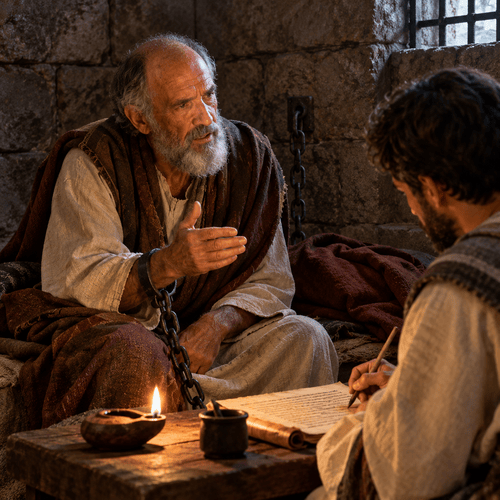
Our last post ended with a young man named Saul, holding the coats of the men who stoned Stephen. Now we meet that same man some 30 years later. He’s old, cold and chained in a Roman prison, waiting for the executioner. Saul has become Paul, the apostle to the nations. And from that cell he writes words that Christians have loved ever since: “I have fought the good fight, I have finished the race, I have kept the faith.”
One honest note before we begin. The Bible doesn’t record the words Paul spoke on the day he died. What we have is his last letter, 2 Timothy, written when he knew the end was near. These are among his last recorded words—and they’re worth every minute we spend on them.
IN SHORT
Who: Paul, the former persecutor who became the apostle to the Gentiles.
When: About AD 64–67, during his second imprisonment in Rome under the emperor Nero.
His last words: 2 Timothy 4:6–8, and the very last line of the letter: “Grace be with you” (4:22).
Why they matter: They show a man who finished well—not boasting in himself, but resting on grace and looking forward to the Lord’s appearing.
From the Coats to the Chains
Paul’s life after Stephen’s death is one of the great turnarounds in history. The dates below are approximate, but the journey is clear.
Timeline of Paul’s Life
- AD 34—Stephen’s death. Saul watches the coats and approves of the killing (Acts 7:58; 8:1).
- AD 34–35—The Damascus road. The risen Jesus meets Saul, and the persecutor becomes a preacher (Acts 9).
- AD 46–57—Three missionary journeys. Paul plants churches across modern Turkey and Greece and writes most of his letters.
- AD 57—Arrest in Jerusalem. A mob attacks him in the temple; he is held for two years in Caesarea (Acts 21–26).
- AD 60–62—First Roman imprisonment. House arrest in “his own” rented home, where he “welcomed all who came to him” (Acts 28:30).
- AD 62–64—Release and further travel. Paul’s letters to Timothy and Titus point to more journeys after Acts ends.
- AD 64–67—Final imprisonment. Arrested again during Nero’s persecution, he writes 2 Timothy from a far harsher prison, expecting death.
This second imprisonment in Rome was nothing like the first. Paul now calls himself “bound with chains as a criminal” (2 Timothy 2:9). His friend Onesiphorus had to search Rome “earnestly” just to find him (1:17). Most of his helpers had gone. Winter was coming, and he wanted his cloak. Yet he adds, “But the word of God is not bound!” (2:9).
Ready to Die Long Before the End
Paul’s calm in 2 Timothy didn’t appear suddenly in a prison cell. He’d been getting ready to die for years. Death had come close many times—beatings, shipwrecks, riots and a stoning (2 Corinthians 11:23–27). Each time, he learned to look past it.
- To the Corinthians (AD 55–56). He called the body a tent: “if the tent that is our earthly home is destroyed, we have a building from God, a house not made with hands, eternal in the heavens” (2 Corinthians 5:1). And he added, “we would rather be away from the body and at home with the Lord” (5:8).
- On the way to Jerusalem (AD 57). When friends begged him not to go, he answered, “I am ready not only to be imprisoned but even to die in Jerusalem for the name of the Lord Jesus” (Acts 21:13).
- To the Philippians (AD 60–62). From his first Roman imprisonment he wrote the famous words, “For to me to live is Christ, and to die is gain” (Philippians 1:21).
So when the end finally came, Paul wasn’t caught off guard. He’d already settled the big question long before. Christ was his life, so death could only bring him more of Christ. That’s the secret behind the clear, calm voice we hear in 2 Timothy 4. A Christian who learns to live for Christ is also learning, day by day, how to die in Him.
The Last Words: 2 Timothy 4:6–8
Here are the words at the heart of this post:
“For I am already being poured out as a drink offering, and the time of my departure has come. I have fought the good fight, I have finished the race, I have kept the faith. Henceforth there is laid up for me the crown of righteousness, which the Lord, the righteous judge, will award to me on that day, and not only to me but also to all who have loved his appearing”
2 Timothy 4:6–8
In just 3 sentences Paul uses 6 word-pictures. Each one tells us how he saw his own death.
| PICTURE | WHAT PAUL SAID | WHAT IT MEANS |
|---|---|---|
| An offering | “Poured out as a drink offering” | In Old Testament worship, wine was poured out with a sacrifice (Numbers 15:1–10). Paul saw his whole life—and now his death—as worship given to God. |
| A departure | “The time of my departure has come” | The Greek word was used for untying a ship to sail, or taking down a tent to move on. Death is not destruction; it is setting out. |
| A contest | “I have fought the good fight” | The word suggests an athlete’s hard contest or a soldier’s struggle. It was “good” because it was Christ’s fight. |
| A race | “I have finished the race” | Years earlier Paul had said he only wanted to “finish my course” (Acts 20:24). Now he had. |
| A guard | “I have kept the faith” | Like a guard protecting treasure, Paul had kept the gospel safe and handed it on unchanged (1:14; 2:2). |
| A crown | “The crown of righteousness” | Not a king’s crown but a victor’s wreath—given by the Lord on the day He appears. |
Here is a lovely link with our previous post. The Greek word for “crown” in verse 8 is stephanos—the very name of the man whose coats Saul once held. The martyr who bore the name of a crown died first. The persecutor who watched him die now looked forward to the same crown.
Was Paul Boasting?
Some readers feel uneasy here. “I have fought… I have finished… I have kept.” Is Paul praising himself? Is he earning heaven by his hard work? The rest of his writings give a clear answer: no.
- He knew he was a sinner. Paul called himself the “foremost” of sinners (1 Timothy 1:15).
- He gave the credit to grace. “By the grace of God I am what I am… though it was not I, but the grace of God that is with me” (1 Corinthians 15:10).
- His righteousness was not his own. He wanted to be found in Christ, “not having a righteousness of my own that comes from the law, but that which comes through faith in Christ” (Philippians 3:9).
- The crown is for all believers. Paul says it is “not only to me but also to all who have loved his appearing.” It is not a prize for super-Christians. It belongs to every ordinary believer who longs for Jesus to return.
So the “crown of righteousness” is not wages Paul earned. It is the gift of a gracious Lord, who first gives His people righteousness in Christ and then works in them the faithfulness He later rewards. Paul is not saying, “Look at me.” He is saying, “Look at what God’s grace has done—and will do for you too.”
Two Judges
Notice how Paul describes Jesus: “the Lord, the righteous judge.” Paul was about to stand before a very different judge. Nero was cruel, unstable and unjust. He blamed Christians for the great fire of Rome in AD 64 and had many of them put to death in horrible ways.
Paul knew that Nero’s court would condemn him. He also knew that Nero’s verdict was not the final one. A higher court would meet “on that day,” and there the righteous Judge would overturn every unjust sentence passed on His people. That is why a man facing the sword could speak of a crown.
Alone, but Not Alone
2 Timothy 4 is not only a chapter of triumph. It is also one of the most human chapters in the Bible. Paul is honest about his loneliness and his needs.
| PAUL’S WORDS | WHAT THEY SHOW |
|---|---|
| “Demas, in love with this present world, has deserted me” (4:10) | Real pain at being let down by a co-worker. |
| “Luke alone is with me” (4:11) | Gratitude for one faithful friend—“the beloved physician” (Colossians 4:14). |
| “Get Mark and bring him with you, for he is very useful to me” (4:11) | Healing of an old quarrel. Paul had once refused to take Mark along (Acts 15:37–39). |
| “Bring the cloak… also the books, and above all the parchments” (4:13) | A cold body and a hungry mind. Paul was still studying at the end. |
| “Do your best to come before winter” (4:21) | A longing to see a dear friend one last time. |
Then come some of the most moving lines in the letter: “At my first defence no one came to stand by me, but all deserted me. May it not be charged against them! But the Lord stood by me and strengthened me” (2 Timothy 4:16–17).
Do you hear the echoes? “May it not be charged against them” is almost exactly Stephen’s dying prayer: “Lord, do not hold this sin against them” (Acts 7:60). The man who once heard Stephen pray for his enemies now prays the same way for friends who failed him. And “the Lord stood by me” recalls Stephen’s vision of Jesus standing at God’s right hand. The same Lord who stood for Stephen stood beside Paul.
Paul had his own share of stones too. Writing years earlier about his sufferings, he said simply, “Once I was stoned” (2 Corinthians 11:25; see Acts 14:19). The persecutor had become one of the persecuted.
Rescued—Even Through Death
Then Paul makes a bold claim: “The Lord will rescue me from every evil deed and bring me safely into his heavenly kingdom. To him be the glory forever and ever. Amen” (2 Timothy 4:18).
At first this sounds strange. Paul knew he was about to die. How could he say the Lord would rescue him? Because Paul did not mean rescue from death. He meant rescue through death. Nero could take his head, but no one could stop the Lord from bringing him “safely into his heavenly kingdom.” Earlier he had written, “My desire is to depart and be with Christ, for that is far better” (Philippians 1:23). Now the departure had come.
This is the difference between Christian hope and wishful thinking. Paul did not hope that things would somehow turn out well in this life. He knew they would not. His hope rested on a risen Lord who had already passed through death and come out alive, and who had promised to bring His people safely home.
The Last Line: Grace
Paul’s final charge to Timothy is full of urgency: “preach the word; be ready in season and out of season” (4:2) and “endure suffering, do the work of an evangelist, fulfil your ministry” (4:5). The old soldier was handing the sword to a younger one. He had already told Timothy to entrust the gospel “to faithful men, who will be able to teach others also” (2:2). The race was a relay.
And then, the last line Paul ever wrote: “The Lord be with your spirit. Grace be with you” (2 Timothy 4:22).
Think about that. The great apostle’s final written words are a blessing of grace. He began his Christian life as a persecutor who “received mercy” (1 Timothy 1:13). He ended it wishing that same grace on others. From the Damascus road to the Roman prison, Paul’s whole story was grace from beginning to end.
What Paul’s Last Words Teach Us Today
- Aim to finish well. Many start the Christian race with energy. Paul’s goal was to finish. Faithfulness over a long life matters more than a bright start.
- Faithful, not famous. The crown is for “all who have loved his appearing,” not just for apostles.
- It is right to need people. Paul asked for friends, a coat and books. Spiritual giants are still human. Being lonely or cold is not a lack of faith.
- Mend broken relationships. Paul made peace with Mark before the end. Do not leave reconciliation too late.
- Leave justice with God. Of Alexander the coppersmith, who “did me great harm,” Paul simply said, “the Lord will repay him according to his deeds” (4:14). He took no revenge. He left it with the righteous Judge (Romans 12:19).
- Pass on the faith. Paul spent his last days training Timothy. Who are you preparing to carry the gospel after you?
- Keep looking forward. Paul’s eyes were on “that day” and on the Lord’s appearing. Hope in Christ’s return gives strength for today.
Conclusion: The Prayer That Was Answered
Stand back and look at the whole story. A young man named Saul watched Stephen die and heard him pray, “Lord, do not hold this sin against them.” God answered that prayer beyond anything Stephen could imagine. The persecutor became a preacher, the coat-holder became a church-planter, and the man who approved of a martyr’s death became a martyr himself.
Paul’s last words are not the boast of a hero. They are the testimony of a sinner saved by grace, who had run his race in the strength Christ gave him. Every believer who loves the Lord’s appearing can share his hope—and his crown.
FAMOUS LAST WORDS SERIES
Start here: Famous Last Words: What Believers Said Before They Died
Previous post: Stephen’s Last Words: “Lord Jesus, Receive My Spirit”
Coming next: David (2 Samuel 23), Jacob (Genesis 49), Joseph (Genesis 50), Simeon (Luke 2).
Tough Questions, Honest Answers
How did the apostle Paul die?
The Bible does not record Paul’s death. Early Christian writers, however, agree that he was killed in Rome under Nero. Clement of Rome (c. AD 95) says Paul bore witness before rulers and then left the world. Eusebius of Caesarea, writing in the early 300s, records that Paul was beheaded. As a Roman citizen, Paul could not legally be crucified, so beheading by the sword fits well with what we know.
Where is Paul buried?
An early tradition places Paul’s grave on the Ostian Way outside Rome. Around AD 200 a Roman Christian named Gaius mentioned the “trophies” (memorials) of the apostles there. The Basilica of St Paul Outside the Walls now stands on the site. In 2006 archaeologists uncovered an ancient stone coffin under the altar, and in 2009 bone fragments inside were dated to the first or second century. This fits the tradition, though it cannot prove the remains are Paul’s.
Did Paul really write 2 Timothy?
Some modern scholars think a later follower wrote 2 Timothy in Paul’s name. But the letter is full of small personal details—a cloak left at Troas, a friend called Carpus, Mark’s usefulness, Demas’s desertion—that a forger would have no reason to invent. Differences in style can be explained by the subject matter and by Paul’s use of a helper to write, possibly Luke. The early church accepted the letter as Paul’s without question.
What are the crowns mentioned in the Bible?
The New Testament speaks of several crowns for believers: the imperishable crown (1 Corinthians 9:25), the crown of boasting or rejoicing (1 Thessalonians 2:19), the crown of righteousness (2 Timothy 4:8), the crown of life (James 1:12; Revelation 2:10) and the unfading crown of glory (1 Peter 5:4). These are best seen as different ways of describing the one reward of eternal life with Christ. In Revelation 4:10, the elders cast their crowns before God’s throne, because all the glory belongs to Him.
Who was Timothy?
Timothy came from Lystra, in modern Turkey. His mother Eunice was a Jewish believer and his father was Greek. His faith first lived in his grandmother Lois and his mother (2 Timothy 1:5). Paul took him on his travels and called him “my true child in the faith” (1 Timothy 1:2). Later Timothy led the church in Ephesus. Paul’s two letters to him are among the most personal in the New Testament.
Why did Demas desert Paul?
Paul says Demas left him because he was “in love with this present world” (2 Timothy 4:10). Earlier Demas had been one of Paul’s trusted co-workers (Colossians 4:14; Philemon 24). We are not told whether he was afraid of sharing Paul’s fate or drawn by comfort and success. His story is a sober warning: it is possible to serve well for a time and still fail to finish the race.
Did Paul and Mark make up after their quarrel?
Yes. Mark had left Paul and Barnabas partway through their first journey (Acts 13:13). Later Paul refused to take him again, and the disagreement was so sharp that Paul and Barnabas split up (Acts 15:37–39). But years afterwards Mark is back at Paul’s side (Colossians 4:10; Philemon 24), and in his last letter Paul asks for him by name: “he is very useful to me for ministry” (2 Timothy 4:11). Early tradition says this same Mark wrote the Gospel of Mark.
Related Reads
- Famous Last Words: What Believers Said Before They Died
- Stephen’s Last Words: “Lord Jesus, Receive My Spirit”
- David’s Last Words: The King Who Looked for a Better King
- Jacob’s Last Words: “I Wait for Your Salvation, O LORD”
- Joseph’s Last Words: “God Will Surely Visit You”
- Simeon’s Last Words: “Now You Are Letting Your Servant Depart in Peace”
- The Inevitability of Death: Why Must We Prepare for It?
- What Happens to Our Souls When We Die?
- Throne Room: Who Are the 24 Elders Who Cast Their Crowns?
- Perseverance of the Saints: Why True Believers Cannot Finally Fall Away
- The Great Resurrection: What Will Glorified Bodies Be Like?
- Why Is the Bible Silent About the Intermediate State?