Of the 7 letters in Revelation 2 and 3, only 2 contain no criticism at all. One goes to Smyrna. The other to Philadelphia.
That’s surprising, because Philadelphia wasn’t an impressive church. Christ Himself says it has “but little power”. It was small, poor and ignored, and its members had been pushed out of the local synagogue—which in the Roman world also meant losing a measure of legal protection. By every measurement we use today, this was a congregation in trouble.
And yet the risen Christ hasn’t one word of correction for it.
The letter runs to just 7 verses (Revelation 3:7-13). But packed inside them is one of the most argued-over promises in the whole Bible—the promise of being kept “from the hour of trial”—and one of the loveliest pictures of heaven anywhere in Scripture: a person made into a pillar in the temple of God, who never has to leave again.
Everything in the letter turns on one question: who decides who gets in?
1. A City That Would Not Stay Still
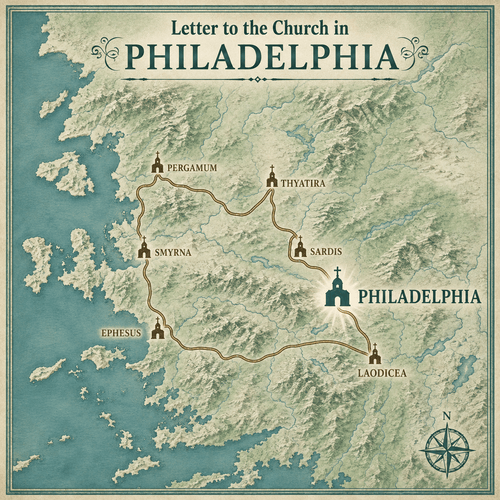
To feel the force of this letter, we need one fact about the city: the ground under it kept moving. Philadelphia stood in western Asia Minor, in modern Turkey, where the regions of Lydia, Mysia and Phrygia met—a gateway town on a main road. Its volcanic soil was excellent for vineyards but terrible for stability.
Timeline: the city behind the letter
- 2nd century BC—A city named after brotherly love. It was named for Attalus II of Pergamum, nicknamed Philadelphus, “the one who loves his brother”, after his loyalty to his brother Eumenes II.
- AD 17—The great earthquake. Roman historian Tacitus records a quake that wrecked 12 cities of Asia; Philadelphia was among the worst hit. Geographer Strabo adds the aftershocks never stopped, so many residents abandoned the town and lived outside the walls in temporary shelters.
- After AD 17—A borrowed name. Emperor Tiberius sent relief money, so the city renamed itself Neocaesarea, “the new city of Caesar”, and later took the name Flavia for another imperial family. This was a town that changed its name to keep the powerful happy.
- About AD 95—John writes. A small congregation with no standing in the city receives a letter from Christ Himself.
- About AD 110—The story continues. Ignatius of Antioch, on his way to execution in Rome, writes to the Christians of Philadelphia.
Keep the earthquakes in mind. This letter ends by promising a pillar that never has to move, to people who knew exactly what it felt like when the walls came down.
2. Who Is Speaking? The Key of David
And to the angel of the church in Philadelphia write: “The words of the holy one, the true one, who has the key of David, who opens and no one will shut, who shuts and no one opens.”
Revelation 3:7 (ESV)
Every one of the 7 letters opens with a description of Christ that fits the situation of that church. Here he gives 3 titles, and each is a claim.
Table 1. The three titles Christ uses in Revelation 3:7, and what each one claimed
| TITLE | WHAT A FIRST-CENTURY READER HEARD | WHY IT FITS PHILADELPHIA |
|---|---|---|
| The holy one | In the Old Testament, “the Holy One” is a standing name for God himself (Isaiah 40:25): set apart, pure, in a class of his own. | Christ takes for himself a name belonging to God alone. |
| The true one | The Greek word here means genuine or real—the actual thing rather than a copy or a substitute. | A group in the city claimed to be the real people of God. Christ says he is the real thing. |
| Who has the key of David | A direct quotation of Isaiah 22:22. A key meant control of a door, and control of a door meant control of access. | This church had just had a door shut in its face. Christ holds the only key that counts. |
Why Isaiah 22 matters here
Isaiah 22 tells the story of Shebna, the royal steward—the palace official who decided who was allowed in to see the king. Shebna used the post for himself, so God removed him and handed the key to Eliakim, saying he would open and no one would shut, and shut and no one would open. Christ lifts that sentence and applies it to Himself. Three things follow.
- He claims the steward’s authority—but He is no servant in the house. Hebrews 3:5–6 draws the line: Moses was faithful in God’s house as a servant, Christ over it as a Son. He doesn’t hold the key on loan. Or temporarily.
- The pattern in Isaiah breaks on purpose. 3 verses later, in Isaiah 22:25, Eliakim himself fails: the peg fixed in a secure place gives way and the load falls. Every human doorkeeper eventually collapses. The picture is built to point past itself to someone who cannot.
- Entry into God’s household is settled by Christ and nobody else. Not by a synagogue council, a Roman magistrate, a committee, a denomination or a family name.
The same hand holds another set of keys: in Revelation 1:18 Christ holds the keys of Death and Hades. One person controls the door into God’s house and the door out of the grave. GK Beale, whose commentary on Revelation is among the most detailed available, argues the key of David here is exactly this—authority over who enters the kingdom and the presence of God.
3. The Open Door That No One Can Shut
“I know your works. Behold, I have set before you an open door, which no one is able to shut.”
Revelation 3:8 (ESV)
What’s this open door? Christians have 2 main answers, and it’s worth knowing both.
TWO READINGS—AND WHY THEY BELONG TOGETHER
Reading one: a door of opportunity. The apostle Paul uses “open door” language for a chance to spread the gospel (1 Corinthians 16:9; 2 Corinthians 2:12; Colossians 4:3). Philadelphia was a gateway city on a main trade route, so this fits neatly.
Reading two: a door of entry into the kingdom. Verse 7 has just named the key that opens God’s household; verse 9 asks who genuinely belongs to God. The door between them is most naturally the door into God’s family—and this is the reading we take as primary, because it is the only one that ties all three verses together.
The two aren’t rivals. Nobody walks through that door and stays still. A congregation that has been let in is, by that very fact, a congregation sent out.
Notice the guarantee: no one is able to shut it. Not the synagogue that expelled them, not the officials who ignored them, not Rome. Vern Poythress, who has written a helpful short guide to Revelation, presses the point that the book lets us see our situation from the throne room rather than from the street. From the street, this church looked shut out of everything. From the throne room, a door stood open that no power on earth could close.
4. “But Little Power”—Weakness That Isn’t Failure
“I know that you have but little power, and yet you have kept my word and have not denied my name.”
Revelation 3:8 (ESV)
Read that slowly, because the placement changes everything. “You have but little power” doesn’t stand alone as a complaint. It sits between two compliments: you have kept my word, and you haven’t denied my name. It describes their circumstances, not their character. And that matters, because the letter immediately before this one went to a church with the opposite problem.
Table 2. Sardis and Philadelphia compared: reputation is not the same as reality
| SARDIS (REVELATION 3:1–6) | PHILADELPHIA (REVELATION 3:7–13) | |
|---|---|---|
| How the church looked to others | A strong, living church with a fine name | Small, weak, with little influence |
| What Christ actually saw | Dead, with only a few faithful members left | Faithful under pressure |
| What Christ said | Wake up; strengthen what remains | No rebuke at all |
| The lesson | A reputation can outlive the reality behind it | Weakness is not the same thing as unfaithfulness |
Michael Horton has written at length against the modern assumption that ordinary church life is 2nd-rate and that only the dramatic counts. Philadelphia answers that assumption in 7 verses. This congregation did nothing that would draw a crowd. It held on to what it had been taught and refused to disown the name of Jesus when that was costly. Christ calls it success.
If your church is small, ageing, short of money and easy to overlook, this is your letter. The strength of the congregation was never the point. The one who holds the key is the point.
5. The Synagogue of Satan: A Verse That Is Often Misused
“Behold, I will make those of the synagogue of Satan who say that they are Jews and are not, but lie—behold, I will make them come and bow down before your feet, and they will learn that I have loved you.”
Revelation 3:9 (ESV)
The word “synagogue” simply means an assembly. The same phrase appears in the letter to Smyrna (Revelation 2:9), and the situation in both cities was similar: a local Jewish community was denying that these Christians had any claim on the promises God made to Abraham, and that denial had practical consequences, including exposure to official hostility.
READ THIS VERSE CAREFULLY BEFORE YOU QUOTE IT
This verse has been abused for centuries to justify hatred of Jewish people. That use turns it upside down, for 3 straightforward reasons.
The writer is Jewish. So is Jesus. So were the apostles. This is an argument inside the family about who inherits the family promises—not a verdict passed on a race by an outsider.
The complaint concerns a specific group in one city, not Jewish people as such, and certainly not Jewish people in later centuries.
The New Testament’s image is a grafted tree, not a replacement tree. In Romans 11 Paul calls Gentile believers wild branches grafted into Israel’s olive tree. Christians do not get a different tree; they’re joined to the same one, and Paul warns them plainly against arrogance towards the natural branches.
So what’s the actual claim? That the mark of belonging to God’s people is faith in Israel’s Messiah. Paul says the same in Romans 2:28–29, where the real Jew is the one whose heart has been changed, and in Philippians 3:3, where believers in Jesus are the true circumcision.
The great reversal
Now look at the promise. In Isaiah 45:14, Isaiah 49:23 and Isaiah 60:14, God says the nations will one day bow down before Israel. Here that picture is turned around: those claiming to be Israel will bow before this small, despised congregation. Threat, or promise? 2 readings are possible.
- A forced admission at the judgement. Grammatically possible, but it doesn’t sit well with the rest of the verse.
- Conversion. The following clause decides it: “they will learn that I have loved you”. That’s the language of discovery and welcome, not condemnation.
This verse is nearly always preached as a warning. It reads far better as a promise: some of the very people persecuting this church will one day kneel among them as brothers. Christ humbles opponents by saving them.
6. “Kept From the Hour of Trial”—The Verse Everyone Argues About
“Because you have kept my word about patient endurance, I will keep you from the hour of trial that is coming on the whole world, to try those who dwell on the earth.”
Revelation 3:10 (ESV)
This is the most disputed sentence in the letter, and it’s regularly used to argue that the church will be removed from the earth before a future period of great suffering. We think it says something different, and something better. Four pieces of evidence point the same way.
- The reward is shaped to match the deed. One Greek verb is used twice: you have kept my word, so I will keep you. It would be strange for the reward of patient endurance to be removal from the place where endurance happens.
- The grammar points to protection, not evacuation. The phrase is “keep from”—in Greek, tereo ek. The only other place that exact combination appears in the New Testament is John 17:15, by the same author, where Jesus prays: “I do not ask that you take them out of the world, but that you keep them from the evil one.” Removal is ruled out in the very same sentence. The picture is a guard posted inside the danger, not a helicopter lifting people out of it.
- The people being tested are not the church. “Those who dwell on the earth” is not a neutral term for everybody alive. In Revelation it’s a fixed expression for unbelieving humanity under judgement.
- The promise was made to real people in AD 95, and given as comfort. Any reading that applies it only to a generation 2000 years later must explain why Philadelphia was given it at all.
Table 3. “Those who dwell on the earth” in Revelation: a fixed phrase for unbelieving humanity
| REFERENCE | WHO THE PHRASE DESCRIBES |
|---|---|
| Revelation 6:10 | Those whose blood-guilt the martyrs ask God to judge |
| Revelation 8:13 | Those on whom the coming woes will fall |
| Revelation 11:10 | Those who celebrate the death of God’s two witnesses |
| Revelation 13:8 | Those who worship the beast |
| Revelation 13:14 | Those deceived into making an image of the beast |
| Revelation 17:8 | Those whose names are not written in the book of life |
The point is hard to miss: the hour of trial tests the earth-dwellers. Believers are not spared suffering—Revelation says the opposite again and again—but they are sealed, as chapter 7 shows, precisely so that they come through it. Protection here is not the absence of hardship; it is the guarantee that hardship cannot destroy them.
Table 4. Four main ways Christians read Revelation 3:10
| POSITION | WHAT THE HOUR OF TRIAL IS | WHAT “KEEP YOU FROM” MEANS | ASSOCIATED WRITERS |
|---|---|---|---|
| Amillennial | Trouble running through the whole present age, sharpening at the end | Preserved through it | William Hendriksen, G. K. Beale, Vern Poythress, Kim Riddlebarger |
| Preterist | The judgment that fell on Judaea and Rome in the first century | Protected through that crisis | Kenneth Gentry |
| Historic premillennial | A future period of trouble before Christ returns | The church passes through it, guarded | George Eldon Ladd |
| Pre-tribulational | A future seven-year tribulation | The church is removed beforehand | Popularised by the Scofield Reference Bible |
Notice that George Eldon Ladd, who did expect a future tribulation, argued firmly against the church being taken away before it. The disagreement is not really about whether hard times are coming. It is about what Christ promises to do with his people when they arrive. Our reading is the one the words themselves suggest: he keeps them, he does not evacuate them.
7. Hold Fast Your Crown
“I am coming soon. Hold fast what you have, so that no one may seize your crown.”
Revelation 3:11 (ESV)
- The crown is a wreath, not a royal headpiece. The Greek word is stephanos, the leafy wreath given to the winner at the games; a king’s crown is a different word (diadema). This is the reward of someone who finished the race, and every reader in a Greek city caught the image at once.
- The danger is pressure from outside, not slow drift. “So that no one may seize” points to someone else trying to take it—the pressure to renounce Christ and buy back a quiet life.
- A warning and a guarantee are not enemies. Some find it confusing that Christ promises to keep his people and then tells them to hold on. But the warning is one of the tools by which he keeps them. God does not preserve his people around such commands; he preserves them through such commands. When a warning like this makes you tighten your grip, it has done exactly what it was sent to do.
8. A Pillar Who Never Has to Leave
“The one who conquers, I will make him a pillar in the temple of my God. Never shall he go out of it, and I will write on him the name of my God, and the name of the city of my God, the new Jerusalem, which comes down from my God out of heaven, and my own new name.”
Revelation 3:12 (ESV)
Now the earthquakes pay off. Four gifts are promised, and each answers something this congregation had lost.
- A pillar. In a city where buildings came down and people slept outside the walls, Christ promises to make a person into load-bearing stone. Solomon’s temple had two great named pillars at its entrance (1 Kings 7:21), and in Galatians 2:9 Paul calls certain leaders “pillars” of the church. A pillar is not decoration. It is structure.
- Permanence: “never shall he go out of it”. These believers had been put out of the synagogue—a penalty John’s Gospel mentions more than once (John 9:22; 16:2), meaning exclusion from the community you had belonged to all your life. They had also, quite literally, fled the city when the ground shook. Christ promises an assembly nobody can expel them from and a building that will never send them running.
- Three names written on them. The name of God—you belong to him. The name of his city—you are a citizen. Christ’s own new name—you are united to him. This is the exact opposite of the mark the beast puts on his followers (Revelation 13:16–17), and it matches how the redeemed are described in Revelation 14:1 and 22:4. The nearest Old Testament parallel is the engraved plate on the high priest’s forehead (Exodus 28:36–38).
- A name given, not bought. This city had twice taken an emperor’s name to win favour and funding. Christ tells a congregation with no influence that the only name which lasts is one they will receive as a gift.
“BUT DOESN’T REVELATION 21:22 SAY THERE IS NO TEMPLE?”
It does: John sees no temple in the new Jerusalem, “for its temple is the Lord God the Almighty and the Lamb”.
The two pictures agree. A temple was the place where God’s presence met his people. In the world to come there is no separate building for that, because God and the Lamb are the meeting place. So to be “a pillar in the temple of my God” is not a promise about architecture. It is a promise of permanent, unbroken nearness to God himself—exactly what Revelation 21 describes.
9. Three Ways to Read This Letter Wrongly
- As a map of church history. A popular scheme, spread through the Scofield Reference Bible, treats the seven churches as seven ages, with Philadelphia standing for a missionary era of roughly 1750 to 1900. Nothing in the text suggests it, no early Christian read it that way, and it quietly assumes European history sets the clock for the whole church. These were seven real congregations that needed these letters at once.
- As a promise about your career. “God has opened a door” has become shorthand for a job offer. God certainly governs such things, but the door in this verse is the door into his kingdom, and shrinking it to a promotion loses almost everything.
- As a date on a calendar. “I am coming soon” has fuelled predictions for nearly two thousand years. The Greek word carries suddenness and certainty rather than a countdown. Every generation lives within reach of that moment, and every generation should live accordingly.
Holding On When You Have Little to Hold With
Picture that room in Philadelphia as the letter was read out. A handful of believers. No money, no status, no protection. Recently expelled from the synagogue. Living in a city that had been shaken flat once and might be again. Nothing they had, including the ground, could be relied on.
And the letter tells them that the one who holds the key of David has opened a door before them that no power on earth can shut. That the people who threw them out may one day kneel among them and learn how loved they were. That when the great testing comes, they will be kept. And that at the end, Christ will take these fragile, unimpressive people and set them into the house of God as pillars, three names carved into them, never to be moved out again.
That is what Christ says to a church with little power. It is worth asking what he would find to commend in ours.
Tough Questions, Honest Answers
Does the city of Philadelphia still exist today?
Yes. It survives as Alasehir, a town in Manisa Province in western Turkey, and it is one of the few of the seven cities that has been continuously inhabited ever since. Visitors can still see a handful of tall brick piers from a Byzantine church traditionally associated with the apostle John, along with sections of the old city wall. It is a moving sight, though it is worth remembering that the promise of the letter was never attached to the place. The pillar Christ speaks of is a person, not a ruin, and the city he promises comes down out of heaven rather than standing in Turkey.
Is Philadelphia in the United States named after this city?
Indirectly, yes. William Penn named his new settlement in 1682 using the Greek word philadelphia, meaning brotherly love, to express the peaceful and tolerant society he hoped to build there. He was drawing on the same Greek word that gave the ancient city its name, and as a well-read man of his time he would certainly have known the church of Revelation 3. But the American city was not founded as a tribute to the congregation John wrote to. The shared name reflects a shared ideal rather than a direct line of descent.
Who is “the angel of the church” that each letter is addressed to?
Three explanations are commonly offered. The Greek word angelos simply means messenger, so some take it to be a human leader or the person who carried and read the letter aloud. Others take it literally as a heavenly being associated with the congregation, since every other use of the word in Revelation refers to an actual angel. A third view treats the angel as a way of speaking about the congregation’s corporate character—its collective self, so to speak. The safest observation is that the content of every letter is addressed to the whole church, and each one closes by telling anyone with ears to listen. Whatever the angel is, the letter is for the people in the pews.
Why 7 churches, and why these 7 in particular?
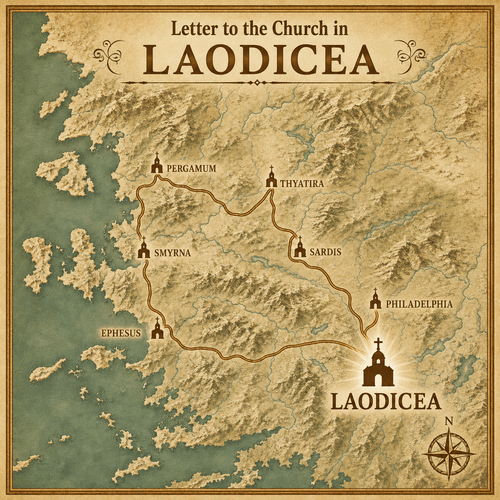
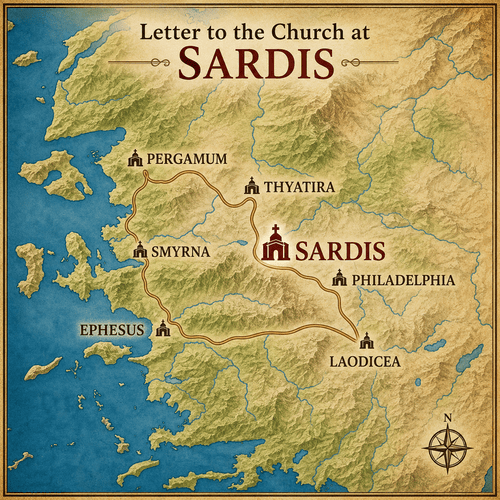
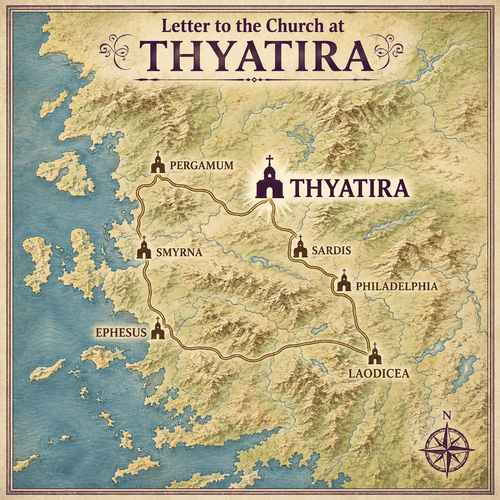
The 7 cities sit on a natural circular route through the Roman province of Asia, so a messenger carrying the scroll could travel from one to the next in order, which is exactly the order Revelation follows. But there were more than 7 churches in the province—Colossae and Hierapolis are both mentioned in the New Testament and neither appears here. The number 7 runs all through Revelation as a figure for completeness, so the selection is deliberate. These 7 real congregations, with their real problems, together stand for the whole church in every age, which is why the letters keep speaking long after the seven cities faded.
What happened to the church at Philadelphia after the 1st century?
It kept going, and we hear from it again fairly soon. Around AD 110, Ignatius of Antioch wrote to the Philadelphian Christians while travelling to his execution, urging them to stay united and warning them against those pressing believers back under the old covenant law—which sounds like a later chapter of the same conflict Revelation 3:9 describes. Historian Eusebius later mentions a prophetess called Ammia of Philadelphia. Remarkably, the city held out as one of the last free Christian towns in Asia Minor, falling only in 1390. Historian Edward Gibbon made much of that survival, and older preachers loved the detail, but it’s wiser to enjoy it as history than to treat it as prophecy fulfilled.
What does it mean the new Jerusalem “comes down out of heaven”?
It means the final state of God’s people is something He gives rather than something we build or climb towards. In Revelation 21:2 and 21:10 the city descends, fully prepared, from God. That direction of travel is the whole point: salvation arrives from above. It also tells us the destination isn’t an escape from the created world into a purely spiritual realm. The city comes down to a renewed earth, and God comes to dwell with people here. The bride imagery attached to the city makes plain the city is finally not masonry at all, but the redeemed community itself.
Is “the one who conquers” a special class of stronger Christian?
No, and this matters pastorally. Every one of the seven letters ends with a promise to the one who conquers, and the promises attached are basic salvation blessings: the tree of life, escape from the second death, a name in the book of life. If conquering marked out an elite, then ordinary believers would be left without eternal life, which no one wants to say. The apostle John settles the question elsewhere: in 1 John 5:4–5 everyone born of God overcomes the world, and the one who overcomes is simply the one who believes that Jesus is the Son of God. Conquering here means holding on to Christ to the end—and even that grip is a gift, held in place by the one who has the key.