Picture a church doing better this year than last. The people love one another more. They serve more. They put up with more hardship without complaining. Most of us would call that a healthy church and leave it well alone.
Jesus called it a church in danger.
The letter to Thyatira is the 4th of 7 short letters the risen Christ dictates to Apostle John in Revelation 2 and 3. It’s the longest of the 7, which is odd, because Thyatira was the smallest and least important of the seven cities. Jesus doesn’t measure a church by its postcode.
It also carries the sharpest warning of the 7. Not because the church has gone cold, but because its warmth bordered on carelessness. Thyatira is the church that loved much and looked away.
A Small Town With a Big Trade
The background isn’t decoration. Almost every line Jesus writes lands on something people in Thyatira saw every day.
THE CITY AT A GLANCE
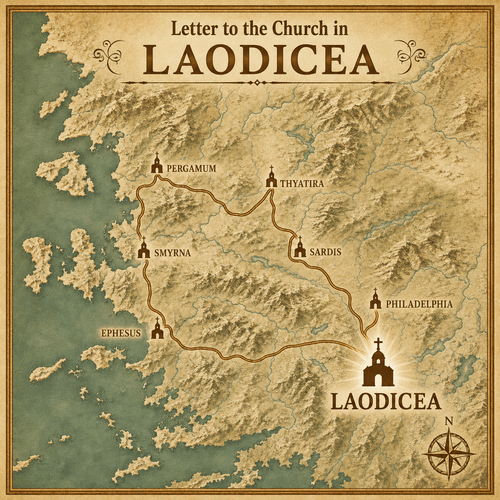
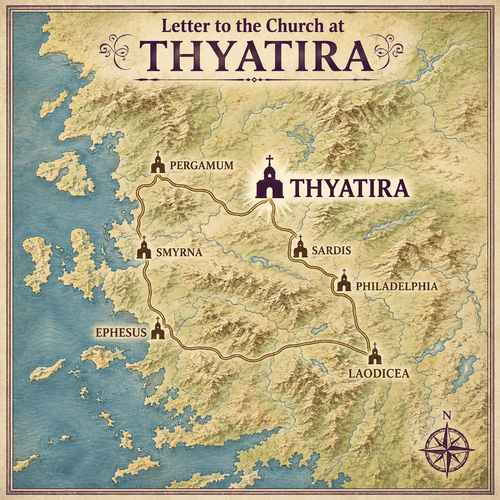
Its location: an inland town about 65 kilometres south-east of Pergamum, on the road to Sardis. Today it’s the Turkish town of Akhisar.
Known for: trade. Wool, linen, dyeing, leather, tanning, pottery, baking and, above all, bronze and metalwork.
Its religion: the local god Apollo Tyrimnaeus, a sun-god worshipped as the son of Zeus, honoured alongside the Roman emperor.
Its Bible link: Lydia, converted at Philippi, was “from the city of Thyatira, a seller of purple goods” (Acts 16:14). Purple dye was a signature local product.
Its weakness: it had no natural defences, and was overrun many times. Thyatira survived by making itself useful, not by making itself strong.
That last point matters. This was a town whose whole identity rested on getting along and keeping the trade moving. In that soil, compromise feels less like sin and more like common sense.
Colin J Hemer, who studied the local background of all 7 cities, noted more trade guild inscriptions were recovered from Thyatira than from any other city in the region. Those guilds are key to the whole letter.
How Jesus Introduces Himself
Each of the 7 letters opens with Jesus describing Himself, and He never repeats a description. Dennis E Johnson has observed in each case the picture is chosen to fit what the church most needs to see. Thyatira gets this:
“The words of the Son of God, who has eyes like a flame of fire, and whose feet are like burnished bronze.” (Revelation 2:18)
| THE DESCRIPTION | WHAT THE PICTURE MEANS | WHY THYATIRA NEEDED TO HEAR IT |
|---|---|---|
| “The Son of God” | A claim to share the very nature of God the Father. | The only place in Revelation where Jesus uses this exact title of Himself. The city already had a “son of god” in Apollo. Jesus says there’s only one, and it is Him. |
| “Eyes like a flame of fire” | Sight that burns through every cover story. | This church couldn’t tell a true teacher from a false one. He can. The image comes from Daniel 10:6. |
| “Feet like burnished bronze” | Metal glowing white-hot in the furnace. Feet are for walking, and in the Bible for treading down. | A metalworking town knew that image from the inside. It pictures a judge already on his way, who can’t be resisted when he arrives. |
A WORD FOUND NOWHERE ELSE
The Greek behind “burnished bronze” is chalkolibanon, a word found nowhere else in surviving Greek literature. Colin J Hemer suggested it may have been a local trade term for an alloy made in Thyatira. If so, Jesus describes Himself in a word from their own workshops, spoken back to the very tradesmen under pressure to compromise in order to keep working.
What Jesus Praises
“I know your works, your love and faith and service and patient endurance, and that your latter works exceed the first.” (Revelation 2:19)
Read that slowly, because it’s generous. Four qualities are named: love, faith, service and patient endurance. Then comes a compliment better than all of them: their recent works are greater than their earlier ones. This church wasn’t merely coasting. It was growing.
Now set that beside the first letter of the series. To Ephesus, Jesus said, “But I have this against you, that you have abandoned the love you had at first” (Revelation 2:4). Yet Ephesus had one thing Thyatira lacked. It tested men who claimed to be apostles and exposed them as liars (Revelation 2:2). Thyatira tested nobody.
| EPHESUS (REVELATION 2:1-7) | THYATIRA (REVELATION 2:18-29) | |
|---|---|---|
| Its strength | Sharp discernment. It examined teachers and rejected the false. | Warm love. It cared, served, endured, and was growing in all of it. |
| Its failure | Lost love. The doctrine stayed correct; the heart cooled. | No discernment. The heart stayed warm; nobody checked the teaching. |
| The verdict | “You have abandoned the love you had at first.” | “You tolerate that woman Jezebel.” |
| The lesson | Truth without love hardens into suspicion. | Love without truth softens into permission. |
Neither church is safe. We assume the careless church is at least the kind one, and the careful church is at least the sound one. Jesus refuses both assumptions and tells both to repent.
The One Thing Against Them
“But I have this against you, that you tolerate that woman Jezebel, who calls herself a prophetess and is teaching and seducing my servants to practise sexual immorality and to eat food sacrificed to idols.” (Revelation 2:20)
The word to underline is tolerate. It means to allow, to leave alone, to let something carry on when you have the power to stop it. It describes people who aren’t doing the wrong thing themselves, but who’ve decided it isn’t their business to interfere. Note too she “calls herself a prophetess”. Nobody appointed her, and nobody asked to see her credentials.
Why the name Jezebel?
This was almost certainly not her real name. Jewish families in Asia Minor wouldn’t call their daughters Jezebel any more than we’d today call our sons Judas. It’s a label, and every reader of the Old Testament understood it instantly.
The first Jezebel was a foreign princess who married King Ahab of Israel (1 Kings 16:31). She funded hundreds of false prophets from the royal treasury, hunted down the prophets of the Lord and rebuilt the nation’s religion around her own gods. Generations later, she was still the measure of corruption: “the whorings and the sorceries of your mother Jezebel are so many” (2 Kings 9:22).
Here’s the detail that stings. Ahab is remembered as Israel’s worst king, yet he didn’t invent Baal worship. His sin was that he married the problem and then let it run amok. That’s exactly the charge against Thyatira. Robert Mounce takes the view that a real and influential woman stood behind the label, someone with enough standing that people were reluctant to confront her.
A NOTE ON THE TEXT
A few ancient manuscripts read “your wife Jezebel”, which would make her the leader’s wife and explain the silence. Most manuscripts support the reading in our English Bibles. Either way the dynamic is the same: she wasn’t an outsider who could be turned away, and confronting her would cost somebody something.
Why the Compromise Made Perfect Sense
Modern readers usually ask why anyone would bother eating meat from a pagan temple. Nobody in Thyatira would have asked that, because everyone knew what was at stake. Their livelihoods were.
A guild was a trade association, a professional body and a social club rolled into one. If you were a dyer, you belonged to the dyers’ guild. Membership was how you found work, won contracts, obtained credit and were buried decently. Outside it you were nobody.
Guilds met for regular banquets, normally in a temple dining room or opened with an offering to the patron god, with meat dedicated to him. As the wine went round, prostitutes were commonly part of the arrangement. This wasn’t an occasional scandal. It was the ordinary shape of business life.
So a believer faced a genuinely painful choice.
- Stay out: keep your conscience clean, lose your customers, and watch your children go without.
- Go in: eat the meat, look away from the rest, and tell yourself the idol is nothing anyway.
Jezebel offered a third option, and that’s what made her dangerous. She didn’t ask anyone to renounce Christ. She offered a teaching, a reasoned position, that let a believer keep Christ and keep the income. Gregory Beale argues her message amounted to a theology of the marketplace, giving religious permission for economic survival.
WHY HER TEACHING WAS SO PERSUASIVE
It was practical. It solved a real problem for real families.
It sounded mature. It framed refusal as the response of weak believers who hadn’t yet grasped their freedom.
It felt kind. It relieved genuine pressure on poor people. Opposing it would look harsh.
It moved slowly. It asked for one dinner, not for apostasy. Nobody leaves the faith in a single step.
It came from inside. Not from an enemy at the gate, but from a respected member with a spiritual reputation.
The Sin Wasn’t Teaching It. The Sin Was Allowing It.
Read the charge again and notice what Jesus doesn’t say. Not “you teach this”. Not “you believe this”. He says, “you tolerate this”. Thyatira wasn’t a heretical church. It was a hospitable one that had extended hospitality to something quietly poisoning it, and the whole congregation is held responsible for what a part of it was permitted to do.
The churches of the Reformation identified three marks of a true church: the gospel faithfully preached, the sacraments rightly administered, and discipline actually exercised. Thyatira had the first, and love in abundance. It didn’t have the third, and that alone was enough for Jesus to say, “I have this against you.”
Sinclair Ferguson has argued that legalism and the belief that grace makes obedience optional aren’t opposites but twins, growing from one root: a suspicion that God isn’t truly good and that His commands are a burden rather than a gift. Jezebel’s followers weren’t setting the law aside because they’d understood grace, but because they’d decided God’s way didn’t work in the real world.
Tolerance then and now
In our culture tolerance is close to the highest virtue we have. In Thyatira it was the fatal flaw. That’s not a difference of vocabulary but of definition.
The New Testament is full of patience with weak believers. Romans 14 tells the strong to carry the scruples of the weak without contempt, and over food offered to idols at that. What it never permits is patience with false teaching. One is bearing with a brother. The other is handing him the poison.
Love that has lost the ability to say no hasn’t become more loving. It has only become less useful.
Patience With a Deadline, and Three Circles of Judgement
“I gave her time to repent, but she refuses to repent of her sexual immorality.” (Revelation 2:21)
Before any judgement is announced, Jesus notes He had already been waiting. The delay was mercy, deliberately extended: God’s kindness is meant to lead us to repentance (Romans 2:4). But patience isn’t permanence. A door held open is still a door that can close.
“Behold, I will throw her onto a sickbed, and those who commit adultery with her I will throw into great tribulation, unless they repent of her works, and I will strike her children dead.” (Revelation 2:22-23)
Three groups are named, and they’re not treated alike. Jesus distinguishes carefully between the teacher, those who dabbled, and those who committed themselves fully.
| WHO IS JUDGED | WHAT THE GROUP HAD DONE | THE SENTENCE | ANY WAY OUT? |
|---|---|---|---|
| Jezebel herself | Invented and promoted the teaching, and had already refused a season of grace. | Thrown onto a sickbed. | No further condition offered. Her time had been given and spent. |
| Those who commit adultery with her | Went along with it. Attended the dinners, accepted the reasoning, kept their heads down. | Great tribulation. | Yes. “Unless they repent of her works.” The door is explicitly still open. |
| Her children | Her committed disciples, who had taken the teaching into their bones and were spreading it themselves. | Struck dead. | No condition is stated. |
There’s grim wordplay in that first sentence: she had used a bed for her sin, and will be given a bed for her sickness. The instrument of the rebellion becomes the instrument of the sentence.
The middle row deserves the most attention, because it’s where most compromising Christians actually live. These aren’t ringleaders. They’re ordinary believers who found a teaching convenient and chose not to examine it. To them, and only to them, Jesus attaches the word unless. Even inside a paragraph of judgement, mercy is offered by name.
“I Am He Who Searches Mind and Heart”
“And all the churches will know that I am he who searches mind and heart, and I will give to each of you according to your works.” (Revelation 2:23)
The Greek behind “mind and heart” is literally “kidneys and hearts”. In Hebrew thought the kidneys stood for a person’s deepest feelings and hidden motives, the heart for the will and the thinking. Together the phrase means the entire inner person, including the parts you have never shown anyone.
In the Old Testament, searching that inner person is something only God does. “I the Lord search the heart and test the mind” (Jeremiah 17:10). Jesus takes that divine job description and applies it to Himself without argument. In one clause He claims to do what God alone can do, and that answers Thyatira’s whole problem: a church that couldn’t tell a true prophet from a false one is told the One writing to them sees straight through both.
Note the reach of it too: “all the churches will know”. What Christ does in one congregation, He intends every other to learn from. These letters were never private post.
“According to your works”: what it does and doesn’t mean
That last line deserves a straight answer, because it’s easily misused. Scripture is emphatic no one is saved by works: “For by grace you have been saved through faith. And this is not your own doing; it is the gift of God, not a result of works, so that no one may boast” (Ephesians 2:8-9).
Yet the Bible is equally emphatic judgement is according to works (Romans 2:6; 2 Corinthians 5:10). There’s no contradiction once we see what works are for. Works are the evidence of living faith, not the payment for it. A tree isn’t made alive by its fruit, but the fruit is how you know it is alive.
Applied to Thyatira, that’s uncomfortably practical. The believers at the guild banquet would have recited the right doctrines on Sunday. Jesus says He will look at what they did with their Tuesday evenings.
“The Deep Things of Satan”
“To the rest of you in Thyatira, who do not hold this teaching, who have not learned what some call the deep things of Satan, to you I say, I do not lay on you any other burden.” (Revelation 2:24)
The phrase “what some call” tells us this was a slogan, and they were proud of it. Jezebel’s circle spoke of knowing the deep things, perhaps echoing Paul’s statement that the Spirit searches “the depths of God” (1 Corinthians 2:10).
The argument probably ran like this: a truly mature believer knows an idol is nothing at all, and can therefore walk into a temple, eat the meat, stay for the evening and come out untouched. Only immature Christians need rules. Real depth means you’ve grown past them.
Jesus changes exactly one word in their slogan. Deep things, yes. Deep things of Satan.
THE OLDEST LIE, IN ITS NEWEST CLOTHES
The first temptation wasn’t an invitation to hate God. It was an invitation to know more: “you will be like God, knowing good and evil” (Genesis 3:5). Ever since, one of the most reliable marks of a false teaching is that it promises a level of insight placing you above ordinary obedience.
The test is simple and has never changed. Does this teaching make me more obedient to Christ, or does it explain why obedience no longer applies to someone at my level? Depth that leads away from the commands of Jesus isn’t depth. It’s distance.
“I do not lay on you any other burden”
Those words almost certainly echo the Jerusalem Council, which wrote to the Gentile churches: “it has seemed good to the Holy Spirit and to us to lay on you no greater burden than these requirements: that you abstain from what has been sacrificed to idols, and from blood, and from what has been strangled, and from sexual immorality” (Acts 15:28-29).
The two items Jesus names at Thyatira are two the apostles had named decades earlier. He isn’t adding new rules for a struggling church. He’s refusing to remove the old ones, and the apostolic minimum now stands with His personal authority behind it.
“Only hold fast what you have until I come.” (Revelation 2:25)
The Promise: A Rod and a Star
“The one who conquers and who keeps my works until the end, to him I will give authority over the nations, and he will rule them with a rod of iron, as when earthen pots are broken in pieces, even as I myself have received authority from my Father. And I will give him the morning star.” (Revelation 2:26-28)
Two gifts are promised, and both are aimed straight at the pressure these believers were under.
First gift: a share in Christ’s own authority
The words about the rod of iron quote Psalm 2, a psalm about God’s appointed King: “You shall break them with a rod of iron and dash them in pieces like a potter’s vessel” (Psalm 2:9). That authority belongs to the Messiah. Jesus quotes it, says He received it from His Father, and hands a share of it to ordinary believers in a small provincial town.
A rod of iron was a shepherd’s heavy club, metal-tipped, used against predators. It pictures not cruelty but settled, final authority over everything that harms the flock. Paul asks something similar: “Do you not know that the saints will judge the world?” (1 Corinthians 6:2). Feel the irony. People squeezed because they had no economic power, no guild membership and no standing are promised authority over the nations.
Second gift: the morning star
What’s the morning star? Revelation answers at the end of the book, when Jesus says, “I am the root and the descendant of David, the bright morning star” (Revelation 22:16). So the reward isn’t a thing but a person. Everything the guild dinner offered was payment; what Christ offers is presence.
There’s a second layer. The morning star is the last light before dawn, the sign the night is nearly over. And in Roman propaganda the morning star, the planet Venus, stood for empire and destiny. To a believer who had just lost a contract for refusing a banquet, Jesus says: the star Rome stamps on its coins, I will simply give to you.
| WHAT FAITHFULNESS COST THEM | WHAT CHRIST PROMISED IN EXCHANGE |
|---|---|
| A seat at the guild banquet | A share in Christ’s own authority over the nations |
| A steady income and secure trade | A reign no economic downturn can touch |
| The respect of their industry | Christ himself, given as the morning star |
A Letter to Them, or a Letter to Us?
These were 7 real congregations in 7 real cities. That’s where interpretation begins, but every letter closes the same way: “He who has an ear, let him hear what the Spirit says to the churches.” Plural. William Hendriksen argued the 7 together give a complete picture of the church in every age, and Vern Poythress makes a similar point about Revelation’s symbols generally: they’re given not as a coded timetable of future events but as a way of seeing the present accurately. Thyatira isn’t a prophecy about one century. It’s a mirror held up to any church with a warm heart, an open door and nobody watching the door.
Where the Guild Hall Stands Today
We may have no trade guilds with patron deities. But we do have something of the same shape.
- A professional world with beliefs attached. Many industries now expect not merely competent work but visible agreement with a set of convictions. Dissent isn’t argued with; it’s quietly priced in.
- A cost that lands on your family. The Thyatiran wasn’t choosing between comfort and martyrdom, but between his conscience and his children’s dinner. That’s what made compromise feel responsible rather than cowardly.
- A teacher who says it’s fine. There’s always someone ready to explain why the line we’re about to cross was never really a line.
- A church that would rather not have the conversation. Confrontation is expensive. Silence is free, right up until the moment it isn’t.
Michael Horton has warned that the greatest danger to the church in comfortable societies is rarely open persecution but slow accommodation in which the faith isn’t attacked so much as gently emptied of anything that costs. Jesus doesn’t ask this church to become suspicious or cold. He doesn’t tell them to love less. He tells them to be discerning.
Eyes That Don’t Blink
The letter opens with eyes like a flame of fire, and everything follows from that. Thyatira’s problem wasn’t a shortage of love but a shortage of sight. They’d learned to look at a growing, generous, hard-working congregation and see nothing wrong, because so much was right.
Christ saw all of it. He saw the love, and said so first and at length. He saw the woman nobody would confront, and the men who kept quiet because their trade depended on it. He saw the ones who never bent, and told them plainly that no extra weight would be added to their load.
That’s the mercy hidden inside a frightening letter. Eyes that see everything are the only eyes that can be trusted to judge fairly, and they belong to the one who died for the church He is correcting. To those who held on He gave the promise that outlasts every contract they lost: authority alongside their King, and the morning star, which is to say, Himself.
“He who has an ear, let him hear what the Spirit says to the churches.” (Revelation 2:29)
Tough Questions, Honest Answers
Is the “morning star” of Revelation 2:28 the same as “Lucifer” in Isaiah 14:12?
No, and the confusion comes from a translation rather than from the Bible. “Lucifer” isn’t a name. It’s a Latin word meaning light-bearer, which the Latin Vulgate used to render a Hebrew term for the morning star, and later English readers mistook the description for a proper noun. The ESV renders it accurately as “Day Star, son of Dawn”. Isaiah 14 is a taunt song against the king of Babylon, mocking a proud ruler whose brilliance was brief. Revelation tells us plainly who its morning star is: “I am the root and the descendant of David, the bright morning star” (Revelation 22:16). The same image is used of a false glory that fades and of the true glory that never will.
Do the 7 letters describe 7 successive periods of church history?
Some readers map the 7 churches onto 7 eras, with Ephesus as the apostolic age and Laodicea as the church just before Christ returns. It’s an old idea, but the text gives no encouragement for it. 3 problems stand out. The letters never hint at a sequence in time; they follow the actual postal route a messenger would travel through the province of Asia. Every letter ends by addressing “the churches”, plural and present. And the scheme must be adjusted every century or two as history refuses to cooperate, which usually means a system is being imposed on Scripture rather than drawn out of it. The simpler reading is also the more useful. 7 is the number of completeness in Revelation, and these conditions appear together in every generation. Somewhere near you there’s an Ephesus, a Smyrna and a Thyatira, all at once.
Does the “sickbed” judgement mean sickness is always God’s punishment for sin?
It doesn’t, and Scripture blocks that conclusion firmly. When the disciples assumed a man’s blindness must be traceable to somebody’s sin, Jesus rejected the question outright (John 9:1-3), and the book of Job exists in part to demolish the theory that suffering can be read backwards as a verdict on the sufferer. Revelation 2:22 describes a specific, announced judgement on a named, unrepentant false teacher after an explicit period of grace. It’s not a general rule about illness. Sin can carry physical consequences, as Paul says of the misuse of the Lord’s Supper at Corinth (1 Corinthians 11:30), but we are never invited to diagnose one another that way. When a Christian falls ill, the right response is care, prayer and medicine, not an investigation. God has told us how to treat the sick. He hasn’t appointed us to interpret them.
Does “I will strike her children dead” mean God punishes children for their parents’ sins?
The children here aren’t sons and daughters. In biblical language, “children of” regularly means those who share someone’s character, as when Jesus speaks of the children of the devil (John 8:44) or Paul calls believers the children of Abraham (Galatians 3:7). Jezebel’s children are her thoroughgoing disciples. That reading fits the structure of the paragraph, which moves outward from the teacher, to those who dabbled, to those fully committed. Each group is judged by its own involvement, not by its family tree. On the wider question, Scripture is clear God judges each person for their own guilt: “The soul who sins shall die. The son shall not suffer for the iniquity of the father” (Ezekiel 18:20). Sin leaves consequences that spill into families, but guilt itself is never inherited.
Paul says an idol is nothing (1 Corinthians 8:4). So why was eating idol food so serious here?
Paul and Jesus address two different situations, and Paul himself draws the line. In 1 Corinthians 8 and 10 he deals with meat that had passed through a temple and ended up in the market or on a friend’s table. There the meat carries no contamination, and a believer may eat with a clear conscience unless it would wound someone else. But Paul is immovable about the temple meal itself: “You cannot partake of the table of the Lord and the table of demons” (1 Corinthians 10:21). Sitting down at a religious meal is not neutral eating; it is joining an act of worship. Thyatira was the 2nd situation: guild banquets held under a god’s patronage, opened with an offering and often ending in immorality. The issue was never the chemistry of the meat. It was the identity of the table.
What happened to the church at Thyatira after this letter?
The historical record is thin, which is itself worth noticing. The city continued for centuries and Christians remained there, but Thyatira never became a significant centre of the faith as Ephesus and Smyrna did. Early Christian writers link the region with the Montanist movement, an enthusiastic prophetic sect of the second century, and at least one ancient source claims that for a time the town had no orthodox congregation at all. The evidence is fragmentary and shouldn’t be pressed hard. What can be said is that the warning wasn’t theatre. A church can be genuinely loving, busy and growing, and still lose its place if it won’t deal with what’s eating it from the inside.
Should a Christian leave a church that tolerates false teaching?
Not as a first step, and usually not quickly. Jesus does not tell the faithful believers at Thyatira to leave. He tells them to hold fast (Revelation 2:25). The letter is an act of correction aimed at healing the congregation, not emptying it. So the first duty is to speak, not to walk, and Scripture gives an order for it: go privately, then with others, then to the church (Matthew 18:15-17). Many problems are drift rather than rebellion, and drift often responds to a clear, patient word from someone willing to stay. There does come a point where leaving is right: when the gospel itself is denied, when sin is defended rather than merely tolerated, or when leadership has made plain that correction will never be received. Even then, leave quietly rather than loudly. And test your own heart on the way out, because Ephesus shows how easily a person can win the argument about truth and lose their love in the process.