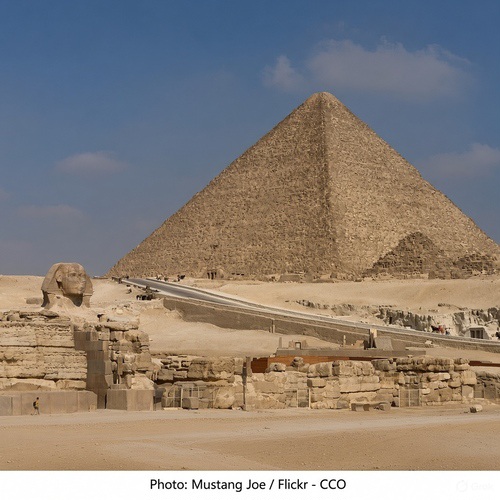
Put your hand on a block of the Great Pyramid of Giza and look closely. You’ll see small round shapes, like tiny coins, pressed into the stone. They’re fossils: remains of sea creatures that were buried in mud and turned to stone. Only much later did workers cut that rock into blocks and stack them almost 147 metres into the sky.
That picture answers one of the boldest challenges to the Bible.
Here’s the challenge. Many history books say the Great Pyramid was built around 2560 BC. Many Bible timelines place Noah’s Flood around 2350 BC. If both dates are right, the pyramids were already standing when the Flood came. Somehow they survived a disaster that, the Bible says, destroyed every living thing on dry land.
Sceptics say this proves the Bible wrong. But the stones tell a different story.
THE SHORT ANSWER
No. The Bible teaches a worldwide Flood, and Egypt itself was founded by Noah’s family after it.
The pyramids stand on, and are built from, rock full of sea fossils. That rock had to exist first.
So the real question isn’t whether the pyramids came after the Flood, but how to line up the dates.
The Clash Everyone Talks About
A chronology is simply a timeline: events listed in order, with dates. Here are two that seem to disagree.
Two Timelines Compared: Textbooks and the Bible
| EVENT | TEXTBOOK DATE | BIBLE-BASED DATE (HEBREW TEXT) |
|---|---|---|
| Creation of the world | Billions of years ago | About 4000 BC |
| Noah’s Flood | No worldwide flood | About 2350 BC |
| First pyramid (King Djoser’s step pyramid) | About 2650 BC | Must come after the Flood |
| Great Pyramid (King Khufu) | About 2560 BC | Must come after the Flood |
Textbook dates are those most Egyptologists (experts in ancient Egypt) use today. Bible-based dates follow Archbishop James Ussher (1581–1656), who added up the ages in the Hebrew Old Testament.
On paper, the pyramids seem to have been built about 2 centuries before the Flood. So who’s wrong? Here’s our answer. In 5 steps, or ‘pillars’.
Pillar 1: The Bible Puts Egypt After the Flood
We start with God’s Word, the most trustworthy record we have. The Flood in Genesis wasn’t a local river flood. Moses writes:
‘And the waters prevailed so mightily on the earth that all the high mountains under the whole heaven were covered. The waters prevailed above the mountains, covering them fifteen cubits deep.’
Genesis 7:19–20
Jesus spoke of the Flood as real history (Matthew 24:38–39), and Peter said ‘the world that then existed was deluged with water and perished’ (2 Peter 3:6).
Now look at where Egypt comes from. Genesis 10 is often called the Table of Nations. It is a family tree showing how all nations grew from Noah’s three sons after the Flood. Verse 6 says, ‘The sons of Ham: Cush, Egypt, Put, and Canaan.’ The Hebrew word translated ‘Egypt’ is Mizraim. It was first the name of a man, Noah’s grandson, and then of his nation. The psalmist calls Egypt ‘the land of Ham’ (Psalm 105:23).
Put these facts together:
- Egypt had a founder. Mizraim was Ham’s son and Noah’s grandson (Genesis 10:6).
- Nations came after the Flood. ‘From these the nations spread abroad on the earth after the flood’ (Genesis 10:32).
- Nations came after Babel. God scattered people across the earth from the tower of Babel (Genesis 11:8–9).
So Egypt, and everything Egyptians built, belongs to the world after the Flood and Babel.
Pillar 2: What the Rock Reveals
Geologists, the scientists who study rocks, say the Giza pyramids stand on a rock layer called the Mokattam Formation. It is made mostly of limestone, a rock that forms when shells and lime mud settle under water and harden. Most of the Great Pyramid’s 2.3 million blocks were cut from this same rock, in a quarry just south of the pyramid.
The limestone is packed with fossils called nummulites (NUM-yoo-lites). The name comes from the Latin word for ‘coin’, because that is what they look like. Each was a tiny, single-celled sea creature inside a shell.
WHY THE FOSSILS SETTLE THE QUESTION
- Step 1: The fossils are sea creatures, buried in limestone.
- Step 2: That limestone had to form, harden and dry out before anyone could cut it.
- Step 3: The builders quarried that rock, shaped it into blocks and stood their pyramids on top of it.
- Result: The rock is older than the pyramids. If the Flood laid down that rock, or the layers it rests on, the pyramids must be younger than the Flood.
Every geologist agrees the rock came first. The disagreement is only about when it formed. Most textbooks say about 50 million years ago. Bible-believing geologists see thick layers full of buried sea life as exactly what a worldwide Flood would leave behind, either during the Flood itself or in the unsettled years soon after it. Either way, the order is fixed: rock first, pyramids second. Even the Great Sphinx was carved straight out of this same fossil-filled bedrock.
Pillar 3: Where Is the Flood Damage?
Genesis says ‘the waters prevailed on the earth 150 days’ (Genesis 7:24). Such a Flood would tear up rock and lay down thick layers of mud and sand across whole continents.
Yet the Great Pyramid’s base is almost perfectly level, and its sides face almost exactly north, south, east and west. It is not buried under Flood mud, and it is not smashed to pieces. It sits on top of the rock layers, not inside them.
A building that came through such a disaster untouched would be a wonder the Bible never mentions. The simple explanation is the right one: it was built afterwards.
Pillar 4: How Egypt’s Dates Are Built, and Where They Are Weak
If the Bible and the rock agree, why do textbooks put the pyramids so early? Ancient Egyptians did not write ‘BC’ on their monuments. They counted years by each king’s rule, for example ‘Year 5 of King So-and-so’. Historians must join these pieces together, and they use three main tools.
Three Tools Used to Date Ancient Egypt, and Their Weak Points
| Tool | How it works | Weak point |
|---|---|---|
| Manetho’s king lists | An Egyptian priest named Manetho wrote a history in the third century BC. He grouped the kings into 30 dynasties (ruling families). | His book is lost. We only have pieces copied by later writers, and the copies disagree. Some dynasties ruled at the same time, not one after another. |
| Star records | A few ancient texts mention when the star Sirius rose. Scholars use these to fix some Egyptian dates to our calendar. | There are only a handful of these records, and experts still argue about how to read them. |
| Radiocarbon dating | Living things take in a type of carbon called carbon-14. After death it slowly breaks down. Measuring how much is left gives an estimated age. | It assumes the amount of carbon-14 in the air stayed fairly steady. Old or reused wood can also make things look older. |
Even mainstream experts admit this. A major 2010 study in the journal Science, led by Christopher Bronk Ramsey of Oxford University, called the standard Egyptian timelines ‘floating’. They are built from reign lengths and tied to our calendar by only a few ancient star sightings that are still debated.
The Radiocarbon Surprise
In 1984, followers of the psychic Edgar Cayce, who claimed the Great Pyramid was built in 10,500 BC, paid for radiocarbon tests on it. The results came nowhere near that, but they still ran several centuries older than the textbooks. A larger test in 1995 gave dates 100 to 200 years older than the history books. Samples from Khufu’s pyramid were scattered across about 400 years. The researchers themselves suggested that the builders may have burned old wood.
Bible-believing scientists add another reason. The Flood buried vast amounts of plant and animal life and upset the balance of carbon on earth. For a time afterwards, the air may have held less carbon-14, so anything that lived then would look older than it really is.
This does not make scientists dishonest. Dates are interpretations of evidence, shaped by starting beliefs. John Calvin (1509–1564) put it memorably:
‘For as the aged, or those whose sight is defective… when aided by glasses, begin to read distinctly, so Scripture… dissipates the darkness, and shows us the true God clearly.’
Institutes 1.6.1
In simple words, the Bible works like reading glasses: we see the evidence clearly only through God’s Word.
Pillar 5: Every Bible Timeline Leads to the Same Place
Christians do not all date the Flood the same way. There are two main ancient forms of the Old Testament. The Masoretic Text is the standard Hebrew text, copied with great care by Jewish scribes. Most English Bibles, including the ESV, translate it. The Septuagint is an ancient Greek translation made before the time of Jesus. In Genesis 5 and 11 it gives larger ages for some fathers, so its timeline is longer.
3 Ways Christians Date the Flood
| VIEW | APPROXIMATE FLOOD DATE | DO THE PYRAMIDS STILL COME AFTER THE FLOOD? |
|---|---|---|
| Hebrew text, as added up by James Ussher | About 2350 BC | Yes, but Egypt’s textbook dates must be shortened by a few centuries. |
| Greek Septuagint | About 3300–3100 BC | Yes, comfortably, even using textbook dates. |
| ‘Open’ family trees (William Henry Green) | Earlier; no fixed date | Yes, comfortably, even using textbook dates. |
For comparison, the textbook date for the Great Pyramid is about 2560 BC.
The third view comes from William Henry Green, an Old Testament professor at Princeton Theological Seminary. In 1890 he noted that Bible family trees sometimes skip generations; Matthew 1:8 leaves out three kings. Green concluded:
‘The Scriptures furnish no data for a chronological computation prior to the life of Abraham; and… the Mosaic records do not fix and were not intended to fix the precise date either of the Flood or of the creation of the world.’
Primeval Chronology
His Princeton colleague Benjamin Breckinridge Warfield went further: ‘The question of the antiquity of man has of itself no theological significance.’ In other words, our faith does not stand or fall on an exact date.
Not every faithful scholar agrees. In 2015, Jeremy Sexton argued in the Westminster Theological Journal that Genesis 5 and 11, unlike any other family tree in Scripture, give each father’s age at his son’s birth, which looks like a real timeline.
Here is the key point: on none of these views were the pyramids built before the Flood. Faithful Christians debate the date of the Flood. Nobody who trusts Genesis debates the order of events.
Timeline: From the Ark to Abraham
Using the Hebrew text, counted in years after the Flood:
- Year 0 (about 2350 BC): Noah and his family leave the ark (Genesis 8:18).
- Year 2: Arpachshad, Shem’s son, is born (Genesis 11:10).
- Year 101: Peleg is born; ‘in his days the earth was divided’ (Genesis 10:25). Many link this to Babel.
- After Babel: Mizraim’s family settles the Nile Valley, and Egypt is born.
- Year 350: Noah dies (Genesis 9:28).
- Year 352 (about 1996 BC): Abram is born, by Ussher’s count.
- About year 427 (about 1920 BC): Abram goes down to Egypt and meets a Pharaoh with a royal court (Genesis 12:10–15).
Shem, Noah’s son, lived on until around year 502 (Genesis 11:11), and Calvin reckoned Babel was built while Noah himself was alive. Egypt’s first great age may well have risen while men who walked off the ark were still living.
Could People Build Pyramids So Soon?
Sceptics ask how so few people could build such huge things so soon. Scripture gives three answers.
- People multiplied fast. God told Noah’s family to ‘be fruitful and multiply and fill the earth’ (Genesis 9:1). Later, Israel grew from 70 people to about 600,000 men, plus women and children, within a few centuries (Exodus 1:7; 12:37).
- People lived long. Early post-Flood fathers lived for centuries, so skills were not lost between generations.
- People were clever from the start. Before the Flood, people built cities and worked bronze and iron (Genesis 4:17, 22). That know-how came through the Flood on the ark.
Archaeologists think the Great Pyramid needed thousands of workers, not millions. A young, growing nation could supply that.
The Hardest Objections
- ‘Radiocarbon now proves the textbook dates.’ The 2010 Science study used 211 samples from short-lived plants and dated the start of King Djoser’s rule to between 2691 and 2625 BC. That is careful work. But the study built in reign lengths historians already assumed, and it read the results with a ‘calibration curve’ that assumes carbon-14 behaved normally all the way back, which a worldwide Flood would disturb. And on the Septuagint or Green’s view, the clash disappears altogether.
- ‘Egyptian culture shows no break.’ Egypt’s story, from early villages to pharaohs, does look unbroken. But that whole story sits on top of the Flood layers; it began after Babel, and its early part is simply shorter than textbooks think.
- ‘The Flood was only local.’ Some Christians say the Flood covered only Noah’s region, so Egypt was untouched. But Genesis says the waters covered ‘all the high mountains under the whole heaven’ (Genesis 7:19). God also promised, ‘never again shall there be a flood to destroy the earth’ (Genesis 9:11). Local floods happen every year. If Noah’s Flood was local, God has broken that promise thousands of times.
Tombs of Stone, an Empty Tomb
The pyramids were tombs, each a king’s attempt to beat death and make his name last forever. That desire is older than Egypt. At Babel people said, ‘let us make a name for ourselves’ (Genesis 11:4). Calvin saw the heart behind it:
‘They wish to have an immortal name on earth; and thus they build, as if in opposition to the will of God.’
Commentary on Genesis 11:4
The pyramids still stand, but robbers emptied most of the tombs long ago. Stone could not save the kings.
Moses grew up among Egypt’s treasures, yet ‘he considered the reproach of Christ greater wealth than the treasures of Egypt’ (Hebrews 11:26). He knew a better hope than a mountain of stone.
That hope is Jesus Christ. His tomb was not a pyramid but a borrowed grave cut in rock, and it is empty. The angel said, ‘He is not here, for he has risen, as he said’ (Matthew 28:6). The pyramids show that people cannot build their way out of the grave. The empty tomb shows that God has done it for us.
So were the pyramids built before Noah’s Flood? No. The Bible says so, the rock says so, and the standing stones confirm it. And the God who carried Noah safely through the waters of judgement still rescues everyone who trusts in his Son (1 Peter 3:20–21).
Tough Questions, Honest Answers
Did Joseph build the pyramids to store grain?
No. This idea became famous in 2015, when an old speech by the American politician Ben Carson resurfaced in the news. But Genesis says Joseph stored grain in the cities, close to the fields that grew it (Genesis 41:48). The great pyramids are almost solid stone, with only a few narrow passages and small rooms inside, so there is no space for grain. They were also already old in Joseph’s day, since Abram had met a Pharaoh generations earlier. Joseph’s real legacy was not a monument but a rescue that kept God’s promised family alive (Genesis 50:20).
Did Hebrew slaves build the pyramids?
Very unlikely, even though many films suggest it. The Bible says the Israelites built ‘store cities, Pithom and Raamses’ for Pharaoh, working ‘in mortar and brick’ (Exodus 1:11, 14), not stone pyramids. The great pyramids of Giza were built centuries before Jacob’s family went down to Egypt. Since the 1990s, archaeologists have dug up the town and graves of the pyramid workers near Giza, which point to organised teams of Egyptian labourers. Israel’s slavery was real, but it belongs to a later chapter of Egypt’s story.
Does Isaiah 19:19 point to the Great Pyramid?
Some 19th-century writers, such as the astronomer Charles Piazzi Smyth, believed it did. Isaiah says, ‘In that day there will be an altar to the LORD in the midst of the land of Egypt, and a pillar to the LORD at its border’ (Isaiah 19:19). But the Great Pyramid is not an altar or a monument to the LORD; it is a pharaoh’s tomb. Read in context, Isaiah looks forward to Egyptians worshipping the true God, ending with the words ‘Blessed be Egypt my people’ (Isaiah 19:25). That promise is being fulfilled as the gospel reaches Egyptians. As the Westminster Confession of Faith puts it, ‘The infallible rule of interpretation of Scripture is the Scripture itself’, not the measuring of stones.
Were the pyramids built by the Nephilim, or by aliens?
No. The Nephilim were ‘the mighty men who were of old’ in the world before the Flood (Genesis 6:4), and that world was swept away. Ideas about giants or aliens usually begin with the belief that ancient people were too simple to build such things. The Bible teaches the opposite: people are made in God’s image (Genesis 1:27) and were skilled from the very beginning. Archaeologists have found the quarries, tools, ramps and workers’ graves, and they all point to human hands. Giving the credit to aliens robs the ancient Egyptians of gifts that God gave them.
Is the Sphinx older than the Flood?
Some writers say so. In the early 1990s the geologist Robert Schoch argued that the Sphinx was worn away by heavy rain, which he believed pointed to a much earlier date. Most geologists and Egyptologists disagree with him. But even if heavy rain did wear the Sphinx, that fits the Bible well, because North Africa was once much wetter, with lakes and grasslands where the Sahara Desert lies today. In the Bible’s timeline, that wet age followed the Flood. And the Sphinx is carved from the same fossil-filled rock as the pyramids, so it came after that rock was laid down.
Was the Tower of Babel a pyramid?
Not an Egyptian one. Babel was built in ‘the land of Shinar’, in Mesopotamia (modern Iraq), and its builders ‘had brick for stone, and bitumen for mortar’ (Genesis 11:2–3). Bitumen is a kind of natural tar. Many scholars think Babel was a ziggurat, a tall temple tower built in stepped levels. Egypt’s first pyramid, built for King Djoser, also rose in steps, so the two look like cousins. Whether or not one copied the other, both show the same human urge to reach upward and make a name.
Where did the idea of pre-Flood pyramids come from?
It is an old idea, but it does not come from the Bible. The Jewish historian Josephus, writing in the first century AD, told of Seth’s descendants building two pillars, one of brick and one of stone, to survive a future disaster by fire or water. Medieval Arab writers told tales of a pre-Flood king named Surid who built the pyramids, and the ninth-century Persian astrologer Abu Ma‘shar helped spread such legends. In modern times, Edgar Cayce claimed the pyramids dated to 10,500 BC. Legends can be colourful, but Christians test every claim by God’s Word (Acts 17:11), and Scripture gives no hint that any pyramid survived the Flood.
Related Reads
- Why Noah’s Flood Was Global: Scientific Evidences Often Overlooked
- Rocks Don’t Lie: 10 Global Evidences Supporting Noah’s Flood
- Does Carbon Dating Disprove the Bible’s Timeline?
- Geologic Dating: Is It a Showstopper for Young Earth Science?
- Tower of Babel: Historical Evidence Supports Bible Account
- Worldwide Ziggurats and Babel: What’s the Connection?
- The Masoretic and Septuagint: How Ancient Texts Shaped the Bible
- Who Were the Nephilim in the Bible? Genesis 6 Explained
- Ancient Flood Stories Compared: What Makes Noah’s Account Different?