“God knew you’d say yes, so He chose you.” It’s a tidy explanation, and it’s the one most believers reach for first when they try to hold together God’s sovereignty and human freedom. There’s just one problem: it isn’t what the Bible actually means when it uses the word “foreknew.” Get this one word wrong, and a whole doctrine—predestination, election, the very logic of how salvation unfolds—gets quietly rebuilt on the wrong foundation.
This post makes the case that God’s foreknowledge is far more than advance information. It’s relational, covenantal, active—and seeing that changes everything about how the doctrine of election actually works.
The short answer
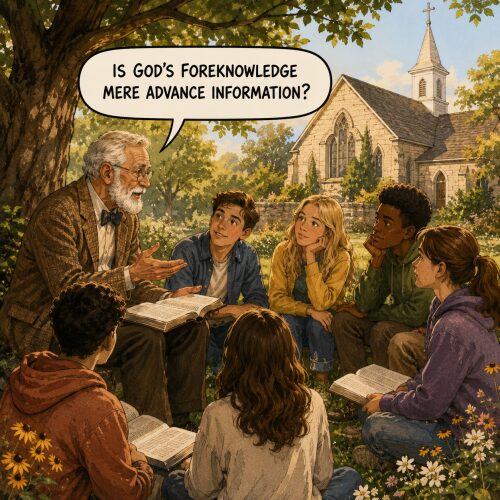
God’s foreknowledge isn’t merely His advance knowledge of future events or choices. In key texts like Romans 8:29, “foreknew” carries the Hebrew sense of relational, covenantal love—God setting His affection on a people beforehand—not simply His prior awareness of who would choose Him.
Two Very Different Views of “Foreknew”
Everything hinges on how you read one Greek word, proginōskō, in one pivotal verse: “For those whom he foreknew he also predestined to be conformed to the image of his Son” (Romans 8:29).
The Arminian view: simple foreknowledge
On this reading, God looks down the corridor of time, sees who will freely choose to believe, and predestines those He foresaw would say yes. Foreknowledge here means cognitive awareness of future free choices—God knows in advance, and elects on the basis of what He knows.
The Reformed view: foreknowledge as covenantal love
The Reformed reading points out that “know” in Hebrew thought regularly means far more than intellectual awareness—it means to set one’s affection on, to enter covenant relationship with. Amos 3:2 is the clearest example: “You only have I known of all the families of the earth”—God obviously had cognitive knowledge of every nation on earth; what He means is that He chose and loved Israel uniquely. Jesus uses the same sense in reverse at the final judgement: “I never knew you” (Matthew 7:23)—not a claim of ignorance, but of relational rejection. Read this way, Romans 8:29 says God set His covenantal love on a people beforehand—”fore-loved” them, in effect—and predestined those He had already set His heart upon.
| SIMPLE FOREKNOWLEDGE (ARMINIAN) | COVENANTAL FOREKNOWLEDGE (REFORMED) | |
|---|---|---|
| What God foreknows | Who will freely choose to believe | A people He has set His covenantal love upon |
| Basis of election | Foreseen human faith | God’s own gracious purpose |
| Whose action initiates | The human will, ultimately | God’s will, entirely |
| Key support | General sense of “foreknow” as advance knowledge | Hebrew usage of “know” (Amos 3:2); Matthew 7:23 |
The difference isn’t academic hair-splitting. It determines whether election ultimately depends on something God finds in us, or rests entirely on God’s own initiative—which is precisely the fault line running through the whole TULIP debate.
Tracing the Ordo: Foreknowledge, Predestination, and What Follows
Romans 8:29–30 doesn’t leave foreknowledge floating on its own—it links it into a chain: “For those whom he foreknew he also predestined… and those whom he predestined he also called, and those whom he called he also justified, and those whom he justified he also glorified.” Each link is grounded in the one before it, and not one person is lost along the way—everyone foreknown is glorified. Read as covenantal love, foreknowledge is the first, gracious link in an unbreakable chain, not a passive report on choices God simply happened to observe in advance.
Foreknowledge and the Nature of Omniscience
None of this denies that God also possesses complete cognitive knowledge of the future—Scripture is clear that nothing catches God by surprise, and His knowledge of all things, past, present, and future, is total and certain. The point isn’t that God lacks foresight. It’s that the specific word “foreknew” in Romans 8:29, in context, is doing relational work, not merely descriptive work. God’s foreknowledge, properly understood, is an act of His covenantal will reaching into eternity past, not simply His vantage point for observing a future He otherwise stands outside of and reacts to.
The Molinist Third Way—and Why Reformed Theology Resists It
A significant alternative worth naming is Molinism, which proposes “middle knowledge”: God knows, with certainty, what every possible free creature would freely choose in every possible circumstance, and He then actualises the world containing the choices He desires—without, Molinists argue, overriding anyone’s freedom. It’s an ingenious attempt to preserve libertarian free will while keeping God fully sovereign over outcomes.
The Reformed critique is that middle knowledge doesn’t actually solve the problem it sets out to solve—it just relocates it. If there is a true fact about what a person would freely choose in any given circumstance, that fact must have a source, and Scripture’s own account of election (unconditional, resting on God’s will rather than foreseen choices) leaves little room for human choices to be the deciding, uncaused variable Molinism needs them to be. For the fuller treatment of this debate, see our companion piece, Calvinism vs Molinism: A Deep Dive into the Debate.
Why This Distinction Actually Matters
- It determines who gets the credit. If election rests on foreseen faith, the deciding factor in salvation is ultimately something the believer supplied. If election rests on God’s covenantal love alone, the credit belongs entirely to God—which is exactly Paul’s point throughout Romans 9, where he insists election rests “not because of works but because of him who calls” (Romans 9:11).
- It grounds assurance differently. A choice foreseen is still, in the end, a human choice that could in principle have gone the other way. A love set beforehand by God’s own will is unshakeable, because it never depended on human performance to begin with.
- It shapes how the whole ordo salutis holds together. Predestination, calling, justification, and glorification in Romans 8:30 all flow from foreknowledge as their source. If foreknowledge is just information, the whole chain becomes reactive rather than purposeful—God responding to data rather than executing a plan.
Two Common Objections, Answered
“This just sounds like relabelling—’foreknew’ still means ‘knew in advance’ either way”
Not quite. Nobody disputes that God’s knowledge is prior to the events it concerns—that much is true on both readings. The dispute is over what kind of knowledge the word is describing. English “know” is a fairly thin word covering everything from “I know the capital of France” to “I know my wife.” Hebrew and its New Testament Greek equivalents regularly reach for the second, relational sense when describing God’s knowledge of His people—which is precisely why Amos 3:2 can say God “knew” only Israel among all the nations, despite obviously being cognitively aware of every nation on earth. The relational reading isn’t a stretch; it’s simply taking biblical usage on its own terms rather than importing a modern English default.
“If election doesn’t rest on foreseen faith, doesn’t that make God arbitrary?”
Arbitrary would mean without reason. Scripture never says God’s choice is reasonless—it says the reason lies entirely within God’s own gracious purpose rather than in anything foreseen in the objects of His choice: “not because of works but because of him who calls” (Romans 9:11), and again, God chose His people “according to the purpose of his will, to the praise of his glorious grace” (Ephesians 1:5–6). A choice grounded in God’s own settled, gracious will is the opposite of arbitrary—it’s the most stable possible foundation, precisely because it doesn’t depend on the unpredictable, ever-changing will of the creature.
A Doctrine That Ends in Comfort, Not Anxiety
It’s easy to hear “predestination” and feel unsettled, as though your standing before God were decided by an impersonal decree rather than love. The Reformed reading of foreknowledge corrects that impression rather than reinforcing it. If God’s foreknowledge means He set His covenantal love on His people before they existed, before they had done anything, good or bad, to earn or forfeit it—then the doctrine isn’t cold machinery. It’s the oldest love story there is, and it began before the world did.
Tough Questions, Honest Answers
What does “foreknew” mean in Romans 8:29?
In context, it carries the Hebrew relational sense of “know”—to set one’s covenantal love and affection upon, as in Amos 3:2 (“you only have I known”) and Matthew 7:23 (“I never knew you”). It describes God’s gracious choice to love a people beforehand, not merely His advance awareness of their future choices.
Isn’t foreknowledge just God knowing the future in advance?
God certainly does know the future completely—Scripture never denies that. But the specific word “foreknew” in Romans 8:29 is doing more targeted, relational work in context, describing whom God set His love upon, not simply cataloguing facts He happened to observe about the future.
Does God’s foreknowledge remove human free will?
Reformed theology affirms humans make real, voluntary choices; it denies that those choices are the deciding factor behind God’s electing purpose. God’s foreknowledge and predestination operate at the level of His eternal decree, while human responsibility remains real at the level of everyday choosing—Scripture holds both without fully resolving the tension between them.
What’s the difference between foreknowledge and predestination?
In Romans 8:29–30, foreknowledge is the first link in the chain—God’s gracious setting of His love on a people—and predestination is what follows from it: God’s determination to conform that foreknown people to the image of His Son. Foreknowledge is the “whom,” predestination is the “to what.”
What is Molinism, and why do Reformed theologians reject it?
Molinism proposes God has “middle knowledge” of what every possible person would freely choose in any circumstance, and builds the world around those foreseen choices. Reformed theologians argue this still makes human choice the deciding, uncaused factor behind election, which conflicts with Scripture’s picture of election as resting on God’s will, not foreseen human decisions.
If God foreknew who would be saved, why evangelise at all?
Because God ordains the means as well as the ends. Scripture consistently ties the calling of the foreknown to the preaching of the gospel (Romans 10:14–17)—evangelism is the God-appointed instrument through which His foreknown people are actually called, not a redundant extra step.
Does this doctrine make God’s love conditional on anything I do?
No—that’s precisely what the covenantal reading rules out. If foreknowledge means God set His love on His people before they existed, before any faith or works on their part, then that love was never conditioned on anything they would supply. It’s the basis for unconditional assurance, not a hurdle still to be cleared.
Related Reads
- Calvinism vs Molinism: A Deep Dive into the Debate
- Unconditional Election: Why God’s Choice Is Entirely His Own
- What Is TULIP Calvinism? The Five Points Explained
- Does God Know the Future? All of It, Perfectly?
- Does God Change His Mind? The Truth About Genesis 6:6
- Did God Step Into Time During Creation—Or Remain Outside It?
- Why Does God Choose Some for Salvation and Not Others?
- The Ordo Salutis: What Are the Seven Steps in Our Salvation?