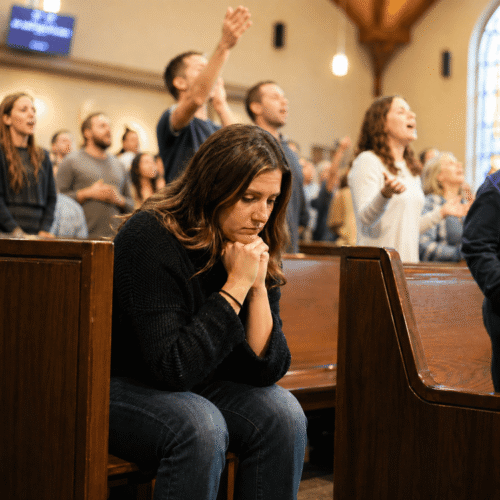
Ever stared at the ceiling in church during worship, wondering if you’re the only one thinking, “What if I’m not truly saved?” You aren’t alone. For many Christians, the question of salvation feels less like a solid rock and more like a sliding scale. One day, we’re overwhelmed by the joy of the Gospel; the next, a sharp word to our spouse or a lingering struggle with a besetting sin leaves us wondering if God has closed His books on us. We know the verses, we’ve heard the sermons, but the peace everyone talks about feels like a radio signal fading in and out.
Why is assurance so elusive? The truth is, our doubts don’t necessarily mean we lack faith; often, it just means we’re looking in the wrong direction. Scripture offers a remarkably honest and satisfying answer to this struggle. It doesn’t ask us to ignore our sins or conjure up a fake emotional high. Instead, it invites us to move our gaze from the “shaking bog” of our own hearts to the “solid rock” of a Saviour who finished the work before we even began.
WHY CAN’T I BE SURE I’M SAVED?
Before we can find the remedy, we need to name the problem accurately—because the causes of weak assurance vary, and so do the cures.
Sometimes the problem is theological confusion—a nagging sense that claiming to be sure of our salvation is somehow arrogant or presumptuous. But this confuses humility with unbelief. God wants us to be assured.
Sometimes it’s temperament. The 17th-century Puritan pastor Richard Sibbes, in his tender classic The Bruised Reed, recognised some believers are by nature more melancholic, more prone to self-doubt. God does not despise this—but He does address it.
Sometimes assurance is dimmed by unconfessed sin. David knew this well: “Restore to me the joy of your salvation” (Psalm 51:12). Sin clouds the conscience. It doesn’t undo salvation, but it can hide the sight of it.
Other times the cause is simply spiritual immaturity—assurance often deepens with time, as we accumulate experience of God’s faithfulness across the seasons of life.
And sometimes the enemy is involved. Scripture calls Satan “the accuser of our brothers” (Revelation 12:10). Casting doubt on God’s promises is his specific, targeted work.
Finally, sometimes God Himself withdraws the felt sense of His presence, not in anger, but in sovereign wisdom, to deepen and purify faith. Isaiah records God saying: “For a brief moment I deserted you” (Isaiah 54:7). The great Puritan pastors called this experience “desertion”—and they were careful to distinguish it from divine judgement. This isn’t God abandoning His child; it’s a Father disciplining and weaning the soul away from dependence on feelings toward a deeper trust in His Word. Richard Sibbes, John Owen, and more recently Sinclair Ferguson (whose short book Deserted by God? is a pastoral gift to suffering believers) have all written about this with tenderness and care. The Westminster Confession of Faith (18.4) even lists “God’s withdrawing the light of His countenance” as a recognised and distinct cause of weakened assurance—separate from sin or immaturity. This is real. But it isn’t the final word.
WHAT IS ASSURANCE, EXACTLY?
Assurance isn’t a feeling of permanent happiness, nor a certainty that we shall never sin again, nor spiritual arrogance. It’s a well-grounded confidence that we’re in a state of grace—that we truly belong to God. The Westminster Confession of Faith (the great 17-century summary of Protestant doctrine) identifies three interlocking foundations of assurance:
- The objective promises of God in Scripture
- The inward evidence of grace in our lives
- And the direct witness of the Holy Spirit.
The Apostle John wrote an entire letter (1 John) for this express purpose: “I write these things to you who believe in the name of the Son of God, that you may know that you have eternal life” (1 John 5:13). Assurance isn’t a bonus—it’s God’s stated will for every believer.
LOOK OUTWARD FIRST: CLING TO THE PROMISES
The most important direction to look is outward—to Christ and His promises. Not inward to our feelings or performance. Calvin put it memorably: “Faith is not a distant view but a warm embrace of Christ.” The antidote to doubt isn’t more self-examination but more gospel.
The promises of God are unconditional in their foundation. They rest on God’s character, not our consistency. Jesus said: “All that the Father gives me will come to me, and whoever comes to me I will never cast out” (John 6:37). Paul declares nothing in all creation “will be able to separate us from the love of God in Christ Jesus our Lord” (Romans 8:38–39). Let’s feed on these promises daily. And return to them repeatedly.
LOOK INWARD NEXT: THE MARKS OF GRACE
Once we’re anchored in the promises, it’s right and helpful to look inward—not to earn assurance, but to confirm what the gospel already declares. Puritan writer Thomas Brooks observed: “Assurance is a pearl that most want, but few take the pains to find.”
What are we to look for?
- A genuine love for God and His Word (1 John 2:5).
- A hatred of sin and a longing for holiness.
- A real love for other believers (1 John 3:14).
- And—crucially— a consistent pattern of returning to Christ after failure (1 John 2:1).
These aren’t the achievements of a perfect person. They’re the instincts of a regenerate one.
WHAT ABOUT MY SIN AND TEMPTATION?
This is where many believers stumble most painfully. They reason: “A truly saved person wouldn’t struggle like this.” But the Reformed tradition stands this logic on its head: the ongoing struggle with sin is itself evidence of new life. The unregenerate do not grieve over sin as sin—only the indwelling Spirit produces that anguish.
Romans 7 is Paul’s own agonised cry: “Wretched man that I am!”—and it flows directly into Romans 8:1: “There is therefore now no condemnation for those who are in Christ Jesus.” The anguish and the comfort belong together.
John Owen, the greatest of the Puritan theologians, wrote with striking directness: “The greatest unkindness you can do to the Father is not to believe that he loves you.” Persistent guilt that refuses to receive Christ’s forgiveness does not honour God—it dishonours the cross.
And Sinclair Ferguson offers this pastoral lifeline: “The very fact that you are troubled by your sin is a mark of the Spirit’s work in your heart.”
Confess specifically. Receive forgiveness specifically (1 John 1:9). And rise. Prolonged self-condemnation isn’t humility—it’s unbelief dressed in religious clothing.
USE THE MEANS GOD HAS GIVEN
Assurance doesn’t grow in a vacuum. It grows through faithful, habitual use of what theologians call the means of grace—the ordinary channels through which God strengthens faith.
Read and hear Scripture repeatedly—faith comes by hearing (Romans 10:17), and the promises must be heard many times before they’re believed deeply. Pray—especially the simple, childlike cry of “Abba, Father” (Romans 8:15)—for the Spirit’s witness comes most often in the place of prayer. Receive the Lord’s Supper—that visible, tangible seal of God’s promise, given precisely because God knows we’re weak and forgetful. And stay in Christian fellowship—you need brothers and sisters who will speak grace and truth to you when you cannot speak it to yourself (Hebrews 10:24–25).
JI Packer captured it well: “The way to grow in assurance is to grow in grace—and the means of grace are the instruments God uses to strengthen faith.”
THE FINAL WORD: THE SPIRIT’S OWN VOICE
Beneath all of this lies something that cannot be manufactured: the direct witness of the Holy Spirit. “The Spirit himself bears witness with our spirit that we are children of God” (Romans 8:16). This isn’t argument or inference—it’s the Spirit of God speaking into the depths of the human heart. He is described in Ephesians 1:13–14 as God’s own seal upon the believer—a guarantee of the inheritance to come.
We cannot produce this witness by trying harder. But we can position ourselves to receive this witness—through faith, obedience, and the means of grace.
Three cords together make assurance strong: the promise of God (outside us, unshakeable), the evidence of grace (inside us, Spirit-produced), and the witness of the Holy Spirit (beyond us, sovereign and free).
And if you’re reading this with a longing heart, asking in all sincerity, “Am I truly His?”—hear this carefully: that very question, rising from genuine desire and godly sorrow, is itself almost certainly a mark of the Spirit’s work in you. The self-satisfied do not ask it.
Do not chase certainty. Pursue Christ. You’ll find the certainty follows.
TOUGH QUESTIONS, HONEST ANSWERS
I prayed the sinner’s prayer years ago, but I feel nothing now. Does that mean I was never really saved?
The moment of conversion matters far less than the direction of our lives. RC Sproul was fond of pointing out assurance doesn’t rest on the memory of a past prayer but on a present trust in a living Christ. Those who’re genuinely concerned their faith may not be real are already demonstrating something the spiritually dead never do—they’re seeking God. The better question is not “Do I remember the moment?” but “Do I, right now, trust Christ and desire Him above all else?”
I have doubted God’s existence itself. Surely that means I cannot be a true believer?
Doubt and unbelief aren’t the same thing. Sinclair Ferguson draws a sharp and liberating distinction: doubt is faith under pressure, wrestling toward trust—unbelief is faith refused. Many of the greatest figures in Scripture—Job, the Psalmists, even John the Baptist in prison—passed through crushing seasons of doubt without forfeiting their standing before God. The presence of doubt doesn’t disqualify us; the direction we take our doubt is what matters. When we bring it to Christ, as Thomas did, we hear the same words: “Do not disbelieve, but believe” (John 20:27).
I have committed the same sin repeatedly, even after confessing it. Can I really be forgiven—again?
The gospel does not have a repetition limit. Michael Reeves helpfully reminds us the Father’s love for His children isn’t a reward for improved behaviour but the stable, unshakeable foundation beneath all our failures. First John 2:1 is written precisely for this situation: “If anyone sins, we have an advocate with the Father—Jesus Christ the righteous.”
What if I only believe because I was raised in a Christian home? How do I know my faith is genuinely my own?
The origin of faith doesn’t determine its authenticity. Tim Keller pointed that no one chooses the influences that first bring them to Christ—what matters is whether we have personally embraced Him as our own Lord and Saviour, whatever the path that led us there. A person born into a medical family who becomes a doctor is no less a doctor. The real question isn’t how we came to faith, but whether the faith we now hold is genuinely ours—marked by personal repentance, personal trust, and personal love for Christ.
I don’t seem to have the spiritual gifts or joy that other Christians have. Does that mean my faith is deficient or fake?
Christians differ enormously in temperament, gifting, and emotional experience—and Scripture never presents uniform emotional intensity as the benchmark of genuine faith. Joel Beeke, who has written more extensively on assurance than almost any living scholar, stresses the marks of grace in 1 John are relational and moral—love for God, love for others, hatred of sin—not emotional or charismatic. Comparing our inner experience to another believer’s outward expression is a recipe for unnecessary despair. God does not mass-produce His children; He deals with each one individually.
I went through a period of walking away from God entirely. How can I be sure I have truly come back—and that it will last?
The doctrine of God’s preserving grace—that He holds His own and does not ultimately let them go—is one of the most stabilising truths in all of Scripture. Sinclair Ferguson points to John 10:28–29 as the bedrock: the security of the believer rests not on the strength of our grip on Christ but on the strength of His grip on us. A return to God marked by genuine repentance, renewed hunger for His Word, and honest confession is itself strong evidence that the Spirit never fully departed. The very fact that you came back—and that you came back grieving—speaks louder than the season of wandering.
I am afraid I may have committed the unforgivable sin. What if it’s too late for me?
This fear is one of the most agonising a believer can face—and it carries within it its own answer. RC Sproul and Sinclair Ferguson both make the same pastoral observation with great consistency: people who have genuinely committed the unforgivable sin—the final, hardened rejection of the Holy Spirit—do not fear that they have done so. That sin is characterised in Scripture by a seared conscience and a settled, untroubled contempt for Christ (Matthew 12:31–32). The very anguish you feel, the very fear that it may be too late, is itself powerful evidence the Spirit of God is still at work in you. Come to Christ—the door is not closed.
OUR RELATED POSTS
- Assurance of Salvation: Can I Really Know I’m Saved?
- Fool’s Paradise: Is My Assurance of Salvation Real or False?
- The Unpardonable Sin: What is the Blasphemy Against the Spirit?
- Is Eternal Security a License to Sin?
- Battling Recurring Sin: What Sanctification Looks Like in Real Life
- Why Can’t I Stop Sinning? The Christian’s Ongoing Struggle with Sin
- Can Repentance be Real If We Struggle With Habitual Sin?
- Salvation: By Faith Alone or by Works? The Biblical Answer