
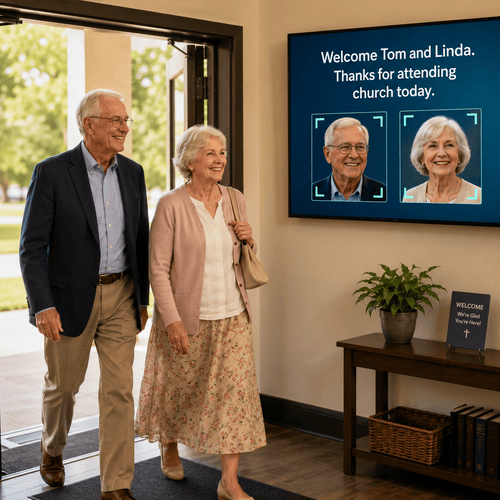
In late 2023, a small church in Texas made headlines when it emerged they’d installed facial recognition cameras to track attendance and engagement during services. Church leadership cited noble intentions—better pastoral care and faster follow-up with absent members. But the announcement sparked a sharp debate that’s only grown louder since: is it ever right for a church to recognise your face before it recognises your name?
QUICK ANSWER
Facial recognition technology isn’t inherently sinful—Scripture treats tools as morally neutral until we ask how they’re used and what they cost. But churches weighing it face a real trade-off: the efficiency gained in attendance tracking and security comes at the price of the trust-based, unmonitored fellowship that has always marked authentic Christian community. Before installing cameras, elders should ask whether the problem they’re solving actually requires surveillance—and whether they’d still be comfortable with the system if every member could see exactly how their data is used.
What Facial Recognition Actually Does in Churches Today
Facial recognition technology (FRT) uses artificial intelligence to analyse and match human faces across images and video feeds. Its applications have expanded well beyond photo-tagging on social media: the same underlying technology now powers phone unlocking, law enforcement investigations, retail analytics—and, increasingly, church management systems.
The Clearview AI controversy showed how easily this can go wrong. The company scraped billions of photos from social media without consent, building a surveillance database it then sold to law enforcement and private entities. In China, facial recognition has become a tool for monitoring religious gatherings and tracking minority populations, including Christians in some regions. Churches adopting the same underlying technology, even for benign reasons, are stepping into that same class of tool.
| HOW CHURCHES ARE USING IT | WHAT IT SOLVES | WHAT IT RISKS |
|---|---|---|
| Children’s ministry check-in | Prevents unauthorised pickup of a child | Builds a biometric database of minors who cannot consent |
| Attendance and engagement tracking | Flags members who’ve quietly stopped attending, prompting pastoral follow-up | Congregants are monitored without knowing it—worship becomes a data event |
| Campus security screening | Flags banned or dangerous individuals at entry points | Scope creep from “known threats” to general monitoring of everyone |
| Event and parking automation | Speeds logistics for large multi-service congregations | Normalises biometric collection for pure convenience, not safety |
Notice the pattern: every legitimate use case sits right next to its own distortion. That’s not a reason to reject the technology outright—it’s a reason to think carefully before adopting it.
Biblical Foundations for Assessing the Technology
Scripture teaches we’re created in God’s image (Genesis 1:27): it gives us both the capacity for technological innovation and the responsibility to use it wisely. The cultural mandate (Genesis 1:28) suggests technological development is itself part of our calling, not something to be treated with automatic suspicion. But the Fall means every human innovation—facial recognition included—can be twisted for purposes far removed from its original good use.
GOD’S OMNISCIENCE ISN’T SURVEILLANCE
God’s all-seeing knowledge of us (Psalm 139) is paired with perfect love and perfect justice. Human attempts to replicate that oversight are marred by sin and limited understanding—which is exactly why they need constraints that God’s own knowledge doesn’t. A camera that logs your face every Sunday isn’t shepherding you; it’s cataloguing you. The comfort of Psalm 139 comes from who is watching, not merely from the fact of being watched.
The Case For: Legitimate Benefits
Facial recognition offers real benefits that can align with Christian values when the technology is bounded and accountable.
| BENEFIT | HOW IT SERVES THE CHURCH |
|---|---|
| Protecting vulnerable populations | Ensures only authorised individuals collect children from Sunday school, or access elderly members’ care facilities—fulfilling the biblical mandate to protect the vulnerable |
| Supporting justice and safety | Can help identify missing persons or trafficking victims when used by law enforcement within proper legal limits—aligned with the pursuit of justice for the oppressed |
| Improving accessibility | Helps people with visual impairments or face blindness (prosopagnosia) recognise those approaching them, fostering fuller participation in fellowship |
| Freeing staff for ministry | Automating check-in or entry logistics can redirect volunteer and staff time toward pastoral care rather than administration |
The Case Against: Serious Concerns
Set against those benefits are concerns that go to the heart of what a church is.
| CONCERN | WHY IT MATTERS |
|---|---|
| Privacy and human dignity | As image-bearers, we have inherent dignity that constant surveillance can erode by reducing people to data points rather than souls known by name |
| Potential for abuse of power | Technology is neutral, but human sinfulness means data collected to serve can just as easily be used to control—church leaders are not exempt from this temptation |
| Data security and stewardship | A breach of biometric attendance data could expose sensitive information about who attends, when, and how often—especially dangerous for members facing persecution elsewhere |
| Chilling effect on attendance | Facial recognition can deter visitors from persecuted backgrounds, or anyone quietly exploring faith who isn’t ready to be identified and logged |
| Erosion of authentic community | When people know they’re being watched, they become less likely to seek help or share honestly—undermining the vulnerability that real fellowship requires |
A Framework for Elders and Church Leadership
The question “should our church use facial recognition?” rarely has a single right answer—it depends on the specific use case, the safeguards in place, and the congregation’s own comfort with being observed. What every leadership team can do is run the decision through the same set of tests before installing anything.
- The necessity test: Does this problem actually require facial recognition, or would a simpler, less invasive method—a sign-in sheet, a name tag, a greeter who knows the regulars—do the job just as well?
- The transparency test: Will every member know the system exists and understand exactly what it’s used for, or is it running quietly in the background?
- The stewardship test: Who has access to the biometric data, where is it stored, how long is it kept, and what happens to it if the church changes management software or closes?
- The consent test: Can a member opt out of the system entirely without being treated as suspicious or made to feel unwelcome?
- The relationship test: Does this technology change how pastors relate to the flock—from shepherds who notice an absence personally, to a dashboard that flags one?
THE HONEST TRADE-OFF
No church has to choose between caring for absent members and respecting their privacy—but facial recognition tempts leadership to solve a relational problem with a technical shortcut. A phone call from a deacon who noticed you were missing communicates something a database flag never can: that a person, not a system, noticed. If a church can’t staff that kind of follow-up without cameras, the honest question isn’t “should we install facial recognition” but “why don’t we have enough shepherds.”
Personal Use
On a personal level, Christians should approach facial recognition with thoughtful discernment rather than passive acceptance—understanding what we agree to when we tap “accept” on apps and devices, and reviewing privacy settings regularly. Our individual choices about this technology can affect family members, fellow congregants, and vulnerable people within our sphere of influence, so the question is never purely private.
Civic Engagement
Beyond church walls, Christians have both an opportunity and a responsibility to shape how facial recognition develops in wider society: staying informed about proposed biometric-data legislation, engaging in public debate about ethical limits, and advocating for protections that safeguard religious freedom and human dignity for everyone, not only ourselves.
Conclusion
Facial recognition technology, like most modern innovations, brings real opportunities alongside real risks. We can embrace its legitimate uses—protecting children, aiding accessibility, freeing staff for ministry—while staying alert to how easily the same tool can undermine dignity, privacy, and the trust that fellowship depends on. The key question a church must answer honestly isn’t whether the technology works, but whether the shortcut it offers is worth what it costs in relationship.
As we navigate these decisions, it’s worth remembering that our ultimate security was never meant to come from surveillance systems but from God’s sovereign care. Technology should serve people, not replace the shepherding that only people—watching, noticing, and following up in love—can do.
Tough Questions, Honest Answers
Isn’t tracking attendance just good pastoral care—why does the method matter?
The goal is good; the method changes what it communicates. A pastor who calls a member who’s been absent is expressing personal care. A system that silently flags an absence and prompts an automated message expresses something closer to monitoring. The method isn’t neutral—it shapes whether members experience the church as a family that notices them or an organisation that tracks them. Churches can absolutely use simple attendance records for pastoral follow-up; the concern is specifically the biometric, often-unannounced nature of facial recognition.
What are some of the most high-profile misuses of facial recognition technology in recent times?
Beyond Clearview AI, concerning cases include China’s use of facial recognition to monitor religious minorities and track church attendance, contributing to persecution. Several US cities have banned law enforcement use of the technology after studies revealed racial bias and wrongful arrests. The IRS’s 2022 attempt to require facial recognition for tax-filing access was reversed after public outcry—a reminder that even well-intentioned implementations can threaten privacy and equal access to essential services.
Is it ethical to use facial recognition for evangelism or outreach tracking?
This raises serious concerns. Using facial recognition to track potential converts or measure outreach “success” treats evangelism as a data problem rather than a relational one. The Great Commission is carried out through genuine relationships and the work of the Holy Spirit—not technological monitoring of who walked through the door and how often.
Should Christians accept facial recognition payment systems becoming common in some countries?
This requires discernment between convenience and complicity. Using biometric payments isn’t inherently wrong, but Christians should weigh whether participating in such systems normalises unjust social control or discrimination elsewhere. The key question is whether participation compromises our ability to live faithfully or quietly harms our neighbours.
Does using facial recognition for church security show a lack of trust in God’s protection?
Not necessarily—using technology for security doesn’t indicate a lack of faith any more than locking the church doors does. But we should guard against placing ultimate trust in technological solutions rather than God’s providence. The test is whether the technology is one tool among many, wisely stewarded, or has quietly become the thing the congregation actually trusts to keep it safe.
What should missionaries in restricted countries consider regarding facial recognition?
Exceptional caution. Christians serving in restricted areas must consider whether facial recognition systems—even ones installed by others, such as host governments or venues—could compromise their ministry or endanger local believers. In some contexts, deliberately avoiding environments with facial recognition may be necessary to protect the local church. Mission organisations should have clear protocols prioritising the safety of workers and national believers over convenience.
How should Christians think about facial recognition in home security systems?
Home systems with facial recognition can be a legitimate tool for protecting family and stewarding resources well. But households should consider the privacy implications for visitors and neighbours who never agreed to be recorded and identified, and should use the technology in a way that preserves hospitality rather than creating an atmosphere of suspicion.
Related Reads
- Screen Time for Children: A Christian Parent’s Guide
- Mindful Social Media Engagement for Christians: A Biblical Guide
- Can I Use AI for Bible Study and Prayer? A Biblical Perspective
- Genetic Engineering and Faith: Christian Ethics in the Age of CRISPR
- Blockchain Technology: Christian Perspectives on Cryptocurrency
- What Does the Bible Say About Climate Change? A Reformed Perspective