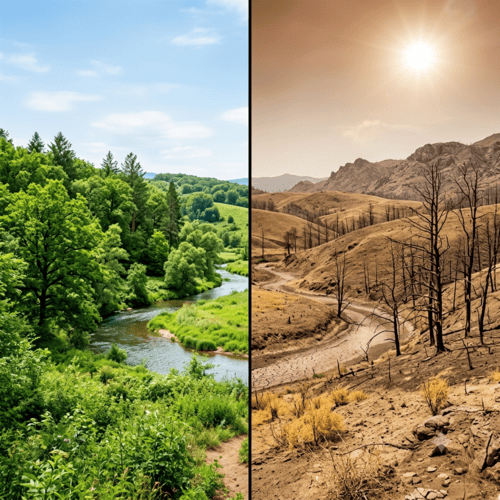
Climate change has become one of the most politically charged topics of our time—which is precisely the problem. Ask most Christians what the Bible says about it, and you’ll get silence, because most of what’s written on the subject, on every side, treats it as a purely scientific or political question. It rarely is. Scripture speaks directly to the climate: to how the earth was made, how it’s sustained, what dominion actually means, and what we should do when experts disagree.
QUICK ANSWER
The Bible doesn’t settle the scientific dispute over how much of current warming is human-caused versus natural variation—that’s a question for careful observation, not exegesis. But Scripture does give Christians a framework the secular debate lacks: Genesis 8:22 promises God will sustain the seasons “while the earth remains,” Genesis 1:28 calls us to responsible stewardship rather than either exploitation or paralysis, and Romans 8 places the whole conversation inside a bigger story—creation groaning, awaiting renewal, under a Sovereign who is not surprised by any of it. That framework should make Christians the calmest people in the room, not the most anxious or the most dismissive.
Why This Debate Needs a Christian Framework, Not Just a Christian Opinion
Most writing on climate change from Christian sources falls into one of two traps. Either it borrows wholesale from secular alarmism and adds a verse at the end, or it borrows wholesale from secular scepticism and does the same. Both approaches treat the Bible as decoration rather than the actual foundation for how we should think. This post tries something different: starting with what Scripture actually claims about creation, and only then asking what that means for how we weigh the competing scientific claims.
What Genesis Actually Promises About the Seasons
After the flood, God makes a covenant promise that’s easy to skim past: “While the earth remains, seedtime and harvest, cold and heat, summer and winter, day and night, shall not cease” (Genesis 8:22). This isn’t a scientific claim about the mechanics of climate—it’s a covenant commitment. God is promising that the basic rhythms sustaining life on earth will continue as long as the earth itself does.
That promise doesn’t mean the climate is static—Scripture never claims that, and neither does honest science. It means the underlying order isn’t at the mercy of chaos, human error, or accident. Whatever natural or human factors are shifting global temperatures, they’re operating within a creation that its Maker actively sustains, not one spinning out of His control.
WHAT GENESIS 8:22 DOES AND DOESN’T SETTLE
It doesn’t tell us whether current warming is mostly natural or mostly human-caused—that’s an empirical question Genesis was never written to answer. It does tell us the seasons won’t fail entirely while the earth remains, which is a direct challenge to any framing—on either side—that treats the climate as either doomed or as a purely mechanical system with no Sustainer behind it.
The Dominion Mandate: Stewardship, Not Exploitation or Paralysis
Genesis 1:28 gives humanity dominion over the earth—a calling to cultivate and develop creation’s potential, not merely to leave it untouched. Genesis 2:15 adds the balancing word: Adam was placed in the garden “to work it and keep it.” Dominion was never a licence to exploit; it was a stewardship, exercised by someone who would answer to the owner.
That single word—stewardship—cuts against both extremes in the modern debate. It rules out treating creation as raw material to be used without consequence, since a steward who wrecks what he’s entrusted with hasn’t exercised dominion, he’s abused it. But it equally rules out treating every human use of creation’s resources as a moral crisis, since the mandate to “work” the earth assumes real human activity, real development, and real change to the created order as part of our calling, not a departure from it.
| POSTURE | WHAT IT GETS RIGHT | WHAT IT MISSES |
|---|---|---|
| Alarmism (“the earth is being destroyed”) | Takes stewardship seriously; recognises human activity has real environmental consequences | Often treats creation as fragile beyond what Genesis 8:22 promises, and can slide into treating nature itself as sacred |
| Dismissal (“it’s not our problem”) | Resists treating every environmental claim as settled fact; values economic flourishing and the poor’s access to affordable energy | Can drift into treating dominion as licence rather than stewardship, and dismisses real questions worth taking seriously |
| Biblical stewardship | Holds both truths together: the earth is sustained by covenant promise, and we are still accountable for how we use it | Requires the harder work of genuine humility about what we don’t yet know scientifically |
What the Earth’s Climate History Actually Shows
Whatever role human activity plays today, the earth’s climate has never been static. Long before industrialisation, the planet experienced significant warming and cooling. The Medieval Warm Period (roughly 950–1250 AD) saw temperatures in some regions comparable to today’s, enabling Norse settlements in Greenland and vineyards as far north as England. It was followed by the Little Ice Age (roughly 1300–1850), when Europe endured harsh winters and repeated crop failures.
| PERIOD | APPROXIMATE DATES | WHAT HAPPENED |
|---|---|---|
| Medieval Warm Period | 950–1250 AD | Regional warming enabled Norse settlement of Greenland and vineyards in northern England |
| Little Ice Age | 1300–1850 AD | Prolonged cooling brought harsh winters, shortened growing seasons, and repeated crop failures across Europe |
| Modern warming period | ~1850–present | Gradual warming began near the end of the Little Ice Age, then accelerated through the 20th century alongside industrialisation |
This history is genuinely relevant. It shows the climate system is capable of significant natural swings, which is one reason a body of credentialed scientists—atmospheric physicists such as Richard Lindzen, climatologists such as Judith Curry, and satellite temperature specialists such as Roy Spencer and John Christy—have pushed back on aspects of the mainstream consensus, particularly around how much warming is attributable to natural variability versus human emissions, and how sensitive the climate actually is to rising CO2. None of them deny that the climate is warming or that humans have some effect; the disagreement is about magnitude, mechanism, and how confidently we can model the future.
Where Genuine Scientific Uncertainty Lies
Christians don’t need to pretend more certainty exists than does. A few areas where honest disagreement remains active within climate science itself:
- Climate sensitivity. How much warming results from a doubling of atmospheric CO2 is still debated, with published estimates ranging from under 2°C to over 4°C—a wide enough spread to change the urgency of the conclusion considerably.
- Cloud feedback. Water vapour and cloud formation are acknowledged even within mainstream climate science as one of the least well-understood parts of the system, since clouds can either warm or cool the planet depending on type and altitude.
- Model-observation gaps. Some climate models have run warmer than subsequent observations, including failing to anticipate the early-2000s warming slowdown—a reminder that projections are tools for reasoning under uncertainty, not settled prophecy.
- Natural cycle interactions. Oceanic cycles like the Pacific Decadal Oscillation and El Niño–Southern Oscillation redistribute enormous amounts of heat on decade-long timescales, and how they interact with any human-driven warming is still an active research question.
WHAT WE AREN’T CLAIMING
We aren’t claiming human CO2 emissions have no warming effect—the basic greenhouse mechanism is well established physics. We aren’t claiming the scientists who emphasise natural variability have “won” some hidden debate the media suppresses. What we are claiming is narrower: genuine, credentialed disagreement exists about magnitude and mechanism, that disagreement is often flattened into false certainty on both sides for political convenience, and Christians should be honest about the difference between “the climate is changing” (essentially settled) and “we know exactly how much, why, and what will happen next” (genuinely contested).
Why the Debate Gets Treated Like a Religion
Watch how the climate conversation is actually conducted, on both sides, and you’ll notice something theological happening. For some, climate catastrophe has become an eschatology without a Christ—a looming judgment with no atonement, generating real anxiety, especially in the young, that the Bible’s actual eschatology was designed to answer. For others, dismissing the entire subject has become a tribal marker of identity rather than a conclusion reached by weighing evidence.
Romans 8:19-22 offers something neither camp does: creation itself is described as groaning, subjected to futility, “waiting with eager longing” for the freedom that comes with the resurrection of God’s children. That’s a remarkable claim. It takes creation’s brokenness seriously—more seriously than casual dismissal allows—while placing the ultimate solution outside human policy entirely, in the same redemption that saves us. Christians can care about creation without needing it to be saved by carbon accounting, because we already know how the story ends.
How Then Should Christians Engage?
- Hold science and Scripture in their right places. The Bible tells us the earth is sustained, purposeful, and will be renewed. It doesn’t hand us a temperature dataset. Read the science as science, weighing evidence and uncertainty like any other empirical question.
- Resist both idolatries. Don’t make nature sacred in a way Scripture never does—creation serves humanity, not the reverse (Genesis 1:28-29). And don’t make comfort or economic convenience sacred either, treating every call to stewardship as an attack on liberty.
- Care about the poor in the debate, not just the debate itself. Whatever position Christians land on, the practical stakes of climate policy—energy costs, development, access to electricity in poorer nations—fall hardest on people Scripture calls us to love, not on the people arguing about it online.
- Let hope, not anxiety, drive engagement. A Christian who believes Romans 8 can care about creation care without either despairing over it or being defined by defiance toward those who do.
Conclusion
Genesis 8:22 doesn’t resolve the argument over what’s driving today’s temperature trends—and Christians who claim it does are asking the verse to do work it was never given. But it does something the purely secular debate can’t: it tells us the earth’s rhythms are held in place by promise, not chance, and that whatever the data eventually shows, the One who made the seasons hasn’t lost His grip on them.
That should change the tone of how Christians engage this topic, even where it doesn’t change the science. Less anxiety. Less tribal certainty. More honest stewardship, more compassion for those who bear the real-world costs of whatever policies get chosen, and more confidence that the created order answers to a Sustainer, not merely to us.
Tough Questions, Honest Answers
Doesn’t the Bible’s dominion mandate mean Christians should prioritise economic growth over environmental concerns?
Not quite—dominion in Genesis 1:28 is paired with the instruction to “keep” the garden in Genesis 2:15, a word that implies guarding and preserving, not merely using. The mandate authorises real human development of creation’s potential; it doesn’t authorise careless disregard for the consequences. A steward who ruins what he’s entrusted with has failed the mandate, not fulfilled it.
If God promised the seasons won’t cease, does that mean climate change isn’t something Christians need to take seriously?
No—Genesis 8:22 promises the basic rhythms will continue “while the earth remains,” not that specific regions, ecosystems, or vulnerable communities won’t suffer real disruption from a changing climate, whatever its cause. The promise is about the earth’s overall sustaining order, not a guarantee that every local consequence of environmental change is automatically painless.
Why do so many scientists claim there’s a consensus on human-caused climate change?
Most climate scientists agree that human activity has some warming effect—that part of the consensus is broad and genuine. Where more disagreement exists, even among credentialed scientists, is over magnitude, the reliability of long-range projections, and how much of the observed warming is attributable to human causes versus natural variability. Treating the entire topic as a single monolithic “consensus” tends to flatten these real, ongoing distinctions.
Isn’t focusing on scientific uncertainty just a way to avoid taking responsibility?
It doesn’t have to be. Acknowledging genuine uncertainty about magnitude and mechanism is compatible with still practising real stewardship—using resources wisely, avoiding waste, caring for the specific, local environmental effects we can observe directly. Christians can act responsibly without first requiring perfect certainty about global projections decades out, in the same way we buy insurance and lock our doors without claiming certainty about what will happen.
What about the precautionary principle—shouldn’t Christians act just in case worst-case predictions are right?
The precautionary principle cuts both ways. Costly policy responses create real harm too—particularly to the poor, through higher energy costs and slowed development in nations still working toward the electricity access the West has long taken for granted. Genuine precaution weighs all the risks on both sides, not only the risks of inaction, and asks which choices best love our neighbour given real uncertainty on both fronts.
How should Christians respond to climate anxiety, especially in young people?
Take it seriously as a pastoral issue, not just a scientific or political one. Much youth climate anxiety functions like an eschatology without a gospel—real fear of judgment with no offer of rescue. Romans 8’s picture of creation groaning yet destined for renewal, under a sovereign God who is not surprised by any of it, speaks directly into that fear in a way secular catastrophism, by design, cannot.
Related Reads
- All of Creation is Groaning: What Does Scripture Mean?
- God’s Role in Natural Disasters: A Biblical Deep Dive
- The Doctrine of Providence: Does God Really Govern All Things?
- What’s Wrong With Dominion Theology? A Biblical Critique
- Bible Verses About Science: 15 Claims That Stood the Test of Time
- Should Churches Use Facial Recognition to Track Attendance? A Christian Ethics Guide