For hundreds of years, people have argued about one question. Did Sodom and Gomorrah really exist, or are they just a story? Recent digs beside the Dead Sea have given us the best answers we’ve ever had. This post walks you through what was actually found, what it can prove and cannot, and why our confidence in Genesis was never resting on a spade in the first place.
The headline that fell apart
In September 2021, a scientific paper travelled around the world. It said a large city near the Dead Sea had been flattened about 3,600 years ago by a cosmic airburst—that is, a rock or comet from space that explodes in the air before it hits the ground, releasing enormous heat and pressure. The paper suggested this event might lie behind the Bible’s account of Sodom. Christian websites shared it in their thousands. Here at last, many said, was proof.
Then, in April 2025, the journal took the paper back. The editors said the claim of an airburst wasn’t supported well enough by the data, and that they no longer had confidence in the conclusions. In plain terms: the claim was withdrawn.
If our confidence in Genesis 19 was built on that 2021 headline, April 2025 was a painful month. If it wasn’t, April 2025 was simply an ordinary month in the slow, careful business of archaeology.
And here’s the part almost nobody reported. While the famous paper was falling apart, quieter and far more careful work was going on a little further south. In January 2025, a new excavation began on the south-eastern shore of the Dead Sea, with one modest aim: to pin down the one city in the story that was never destroyed. That small, unglamorous dig may end up doing more for the historical credibility of Genesis 19 than the headline ever did.
First, what does the Bible actually claim?
Before we look at the ground, we must be clear what we’re looking for. It’s easy to get excited about a burnt ruin and forget to ask whether it matches the text. Genesis gives us a short and surprisingly specific list.
- A green, well-watered plain. Abraham and Lot separate, and Lot chooses the better land: “that the Jordan Valley was well watered everywhere like the garden of the LORD, like the land of Egypt, in the direction of Zoar” (Genesis 13:10).
- Five cities, not two. Sodom, Gomorrah, Admah, Zeboiim and Bela—“that is, Zoar” (Genesis 14:2). Four are destroyed. One is spared.
- A real walled city with a gate. “Lot was sitting in the gate of Sodom” (Genesis 19:1). In the ancient world, the gate was the place where the city elders sat, judged disputes and did business. A gate means a wall, and a wall means a town of real importance, not a village.
- Destruction from above, by fire and sulfur. “Then the LORD rained on Sodom and Gomorrah sulfur and fire from the LORD out of heaven” (Genesis 19:24).
- Zoar close enough to reach on foot before sunrise. Lot is dragged out of the city at dawn and arrives at Zoar as the sun rises (Genesis 19:15–23). Whatever else we say, Sodom and Zoar were within a short walk of each other.
- Never rebuilt. This is repeated as a settled fact of geography, not a poetic flourish: “the whole land burned out with brimstone and salt, nothing sown and nothing growing” (Deuteronomy 29:23); “Moab shall become like Sodom, and the Ammonites like Gomorrah… a waste forever” (Zephaniah 2:9).
That last point is the one most people miss, and it’s the most useful of all. The Bible doesn’t merely claim a destruction. It claims a permanent abandonment. A site that burned and was then rebuilt fails the test. A site that burned and stayed empty passes it.
How the search unfolded: a timeline
- 1924—William Foxwell Albright, often called the father of biblical archaeology, searches the southern Dead Sea region. He finds no city and wonders whether the ruins lie under the water.
- 1965–1981—Paul Lapp, and after his death Walter Rast and Thomas Schaub, excavate a walled town called Bab edh-Dhra on the south-eastern shore. It is huge, it burned, and it was never reoccupied.
- 1973— survey of the region finds four more ancient sites nearby: Numeira, Feifa, Khanazir and es-Safi. Five sites in a line, all occupied in the same period. The pattern is striking.
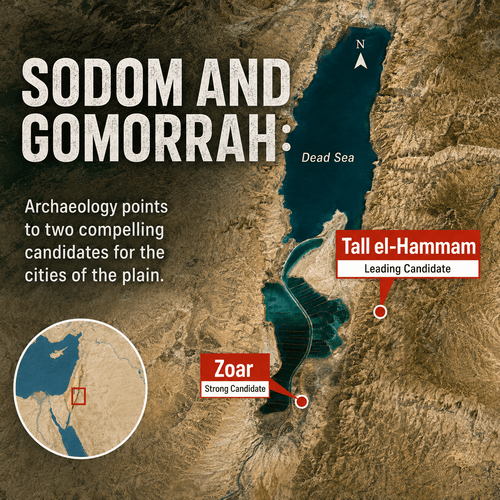
- 2005 onwards—Steven Collins begins digging Tall el-Hammam, a very large site north of the Dead Sea, and argues it is Sodom. This becomes known as the northern view.
- September 2021—The airburst paper is published and becomes a global story.
- 2022–2023—Geologists Steven Jaret and R. Scott Harris publish a detailed challenge to the mineral and chemical evidence. Mark Boslough and Vincenzo Bruno show that the comparisons with the 1908 Tunguska explosion in Siberia rested on figures that overstated the temperatures and wind speeds involved.
- January 2025—The Zoar Excavations Project begins its first season at Ghor es-Safi, in a partnership involving Titus Kennedy, Joel Kramer and the Greek archaeologist Konstantinos Politis.
- April 2025—The airburst paper is formally retracted. 11 of its authors publicly disagree with the decision and republish an expanded version through a specialist journal, where the debate continues.
The northern candidate: Tall el-Hammam
Tall el-Hammam sits in the Jordan Valley, north-east of the Dead Sea. Nobody disputes it’s impressive. Including the settlements outside its walls, the site covers roughly 300 acres, with a walled lower city of about 65 acres and a raised upper city towering above the plain. It was, without question, the giant of its region.
Nor does anyone dispute that something terrible happened there. Excavators have found a thick layer of ash and burnt debris, pottery melted to the point of turning glassy, and human remains that were violently broken apart. In archaeology this is called a destruction layer—a band of burnt material in the ground that marks the moment a settlement was destroyed. After it, the region appears to have been largely empty for several centuries.
The case for Tall el-Hammam being Sodom rests on three things: its size, scale of destruction, and a reading of Genesis 13 that places the “Jordan Valley” north of the Dead Sea rather than south of it.
The difficulty: the strongest scientific plank of that case has just been withdrawn. The destruction layer is real. The claim that it was caused by an exploding object from space is now formally off the record, defended by its authors in a journal run largely by the same research community. Mainstream archaeologists reject the identification with Sodom altogether.
THE ELEVATION PROBLEM
There’s also a geographical wrinkle that’s rarely mentioned. Zoar and the other ruins beside the Dead Sea sit roughly 1,100 feet below sea level. Tall el-Hammam sits about 1,200 feet higher than that, and well to the north.
Genesis has Lot fleeing Sodom on foot and reaching Zoar by sunrise. If Sodom were at Tall el-Hammam, that walk becomes a long overnight journey down a steep valley—possible to argue, but a strain on the text.
The southern candidates: and the city that was never lost
The southern case works differently, and this is why it deserves our attention. It doesn’t begin with a spectacular ruin. It begins with a fixed point.
Zoar: the anchor
Of the five cities in Genesis, four were destroyed and one wasn’t. Zoar survived. And because it survived, it never dropped out of history. It kept its name and its location for thousands of years, and we can trace it in the records:
- The Madaba Map—a mosaic map of the Holy Land laid into a church floor in Jordan around AD 542—shows Zoar on the south-eastern side of the Dead Sea.
- Written sources from Jewish historian Josephus in the 1st century, through to Byzantine pilgrims centuries later, place it consistently in the same area.
- Spanish pilgrim Egeria wrote of the bishopric of Zoar—a church district with its own bishop—around AD 380. A gravestone in Greek for a bishop named Opsis dates to about AD 369.
This is worth pausing on. If we know where Zoar is, and if Lot walked there from Sodom in a single night, Sodom must lie within walking distance. We’re no longer hunting the whole Near East. We’re searching a small circle on the map.
That’s exactly what the Zoar Excavations Project set out to nail down. Its first season ran in January 2025, and its stated aim wasn’t to find Sodom at all. It was to fix Zoar with certainty. Establish the anchor, and everything else falls into place.
What lies within that circle
Inside a day’s walk of Zoar sit four ancient sites: Bab edh-Dhra, Numeira, Feifa and Khanazir. Bab edh-Dhra is the largest of the group. It was fortified, it was destroyed by fire, and—critically—was never reoccupied.
Three findings from these sites deserve close attention, because each of them matches a specific detail of the biblical account rather than a general impression of it.
Fires that started on the roofs
At Bab edh-Dhra the dead were not buried in caves but placed in charnel houses—rectangular buildings above ground, used to hold the bones of the dead. Excavation showed these buildings burned, and that the burning began at the roof and worked downwards into the burial chambers below.
Think about what that means. A fire set by an enemy, or a fire spreading from a burning house, starts at ground level and climbs. A fire that begins on the roof of a sealed stone building came from above. Titus Kennedy draws the obvious inference: the destruction fell on the city from above. It wasn’t lit from within.
Set that beside Genesis 19:24—“the LORD rained on Sodom and Gomorrah sulfur and fire from the LORD out of heaven”—and the fit is uncomfortably precise.
Bodies left where they fell
At Numeira, about 20 kilometres south of Bab edh-Dhra, excavators found human skeletons beneath a collapsed tower. That sounds unremarkable until we understand the burial customs of the period. People of this culture buried their dead carefully, in sealed tombs. Complete skeletons simply lying in the ruins are rare.
Unburied bodies mean that nobody survived to bury them, or that the disaster was so sudden there was no time. The nearest parallel most readers will know is Pompeii, where the eruption of Vesuvius caught people where they stood.
A garden that became a desert
Genesis says the plain was “well watered everywhere like the garden of the LORD” (13:10). The soil at Bab edh-Dhra has given up the remains of what people there were actually growing: wheat and barley, dates and plums, almonds and olives. Five streams once ran through the area. Today they don’t, and the land is dry. And largely empty.
So we have a place that was once remarkably fertile, that was burnt, and that was then abandoned and never rebuilt. That is not merely consistent with the biblical account. It is the specific and unusual sequence the Bible predicts.
Why “never rebuilt” matters so much
Ancient cities were built where they were for good reasons—water, farmland, trade routes. When a city was destroyed, people almost always rebuilt on the same spot. Jericho was destroyed and rebuilt many times over. So was Jerusalem.
A city that is destroyed and then simply left, with the site never reoccupied, is genuinely odd. Four such sites, side by side, are odder still.
And that permanent emptiness is precisely what the prophets said would mark this place out (Deuteronomy 29:23; Jeremiah 49:18; Zephaniah 2:9). The ruin itself is the sign.
Weighing the two candidates side by side
Here’s how each proposed location performs against the details Genesis actually gives us. “Partly” means the evidence points that way but is disputed or incomplete.
| WHAT GENESIS REQUIRES | TALL EL-HAMMAM (NORTH) | BAB EDH-DHRA AND NEIGHBOURS (SOUTH) |
|---|---|---|
| A large, walled city with a gate | Yes—roughly 300 acres, heavily fortified | Yes, but far smaller—about 10 acres |
| Fertile, well-watered plain | Yes | Yes—crop remains recovered from the soil |
| Within a night’s walk of Zoar | Difficult—far north and around 1,200 feet higher | Yes—all four sites sit within a day’s walk |
| Destroyed by fire from above | Destruction certain; the airburst explanation is retracted | Partly—charnel-house fires burned downwards from the roofs |
| Four cities destroyed, one spared | Not matched—no five-site pattern | Yes—four abandoned, Zoar continuously occupied |
| Never rebuilt afterwards | Region emptied for centuries, then resettled | Yes—the four sites were never reoccupied |
| Right period for Abraham and Lot | Middle Bronze Age, around 1650 BC | Early Bronze Age—disputed, and possibly too early |
Read the table with an open mind and a pattern appears. The northern site wins on scale. The southern sites win on pattern—and pattern is harder to produce by coincidence. One burnt city proves that a city burned. Four burnt and abandoned cities beside one surviving city, all within a morning’s walk, is a shape that matches the text in a way a single ruin never can.
What this evidence cannot do
A trustworthy case names its own weaknesses. Here are the real problems with the southern view, stated plainly.
- Two of the four “cities” may not be cities at all. At Feifa, what looked like a fortified enclosure turned out on excavation to be an Iron Age fortress from the 8th century BC, built on top of a much older cemetery. At Khanazir, the walls seen in the 1973 survey proved to be rectangular structures marking shaft tombs. Both sites may be burial grounds rather than towns. That damages the tidy five-city map.
- The dates are contested. On some readings, Bab edh-Dhra fell around 2350 BC and Numeira several centuries earlier, which would rule out a single simultaneous catastrophe and place both events well before Abraham. Other scholars dispute those dates and the chronology they rest on. This argument is not settled, and anyone who tells you it is settled is selling something.
- Size is a genuine difficulty. Bab edh-Dhra is small. Genesis describes Sodom as a city of real weight, with a king and a gate court.
Three popular claims that should be quietly dropped
“The Ebla tablets name Sodom and Gomorrah.” This claim appeared in the 1970s and is repeated on Christian websites to this day. It’s no longer accepted by scholars who work on those tablets.
“The cities are under the Dead Sea.” The Dead Sea has dropped roughly 150 feet in the last century and lost around 40% of its surface area. If ruins were sitting in the shallows, they’d be dry land by now.
“Sulfur balls prove the fire.” Round, flammable sulfur nodules are indeed found in the region, and some archaeologists think they’re relevant. But this argument entered popular Christian use through a poorly documented source and is contested. We may treat it as interesting, not as evidence.
There’s one more criticism worth hearing, because it comes from a place of legitimate concern. Archaeologists Morag Kersel, Meredith Chesson and Austin Hill argue sensational claims about these sites generate hype that damages the credibility of archaeology and, worse, encourages illegal digging by treasure hunters who read the headlines. Whatever we make of their view of the Bible, that warning deserves a hearing. Careless excitement on our side has real costs on the ground.
“Fire from heaven”: how God normally works
Now to the question underneath all of this, and the one that actually troubles believers. Suppose the airburst theory had held up. Suppose tomorrow a geologist demonstrates the fire came from a rupture along the Dead Sea fault line, igniting the natural deposits of bitumen and sulfur that the region is famous for. Genesis 14:10 itself that the Valley of Siddim was “full of bitumen pits”. Would a natural mechanism explain the miracle away?
It wouldn’t, and it pays to understand why.
First causes and second causes
Scripture teaches that God governs everything that happens. But it also teaches that He usually governs through ordinary means. These means are called second causes. God is the first cause; the wind, the fire, the illness, the army are second causes He employs.
God is free to work through means, above means, and against means, as He pleases. All three are equally His work.
So when God sends a wind to part the sea (Exodus 14:21), naming the wind does not remove God from the event. The wind is how He did it. When God sends a fish for Jonah, or a worm for Jonah’s plant, biology isn’t a rival explanation.
This means the discovery of a mechanism is never a threat. Finding out how something happened tells us nothing about who brought it about, or why.
Read Genesis 19:24 again and notice how careful the wording is: “Then the LORD rained on Sodom and Gomorrah sulfur and fire from the LORD out of heaven.” The verse names the agent twice. It doesn’t name a mechanism at all. The text isn’t committed to a comet, or a fault line, or a lightning strike on a bitumen seam. It’s committed to the claim that this was the deliberate act of God in judgement.
That claim isn’t the sort of thing a trench can confirm or refute. Two people can stand at the same ash layer. One sees an unlucky city. The other sees the hand of God. The ash doesn’t settle it. What settles it is what each person already believes about whether God speaks and acts in history. There is no such thing as a bare fact that interprets itself—every fact is read through a set of prior convictions, and that’s as true for the sceptic as it is for the believer.
This is why the 2025 retraction, painful as it was for some, changes nothing theologically. A mechanism was proposed and didn’t survive review. The claim of Genesis was never that a comet did it.
Why our confidence doesn’t wait on the spade
Here’s the honest question. What if the digs had turned up nothing at all? What if every candidate site had failed?
The answer must be that our confidence in Genesis 19 would be exactly where it is now. Scripture doesn’t derive its authority from external confirmation. It carries its authority in itself, as the word of God, and it is received as such by those whom God’s Spirit persuades. Archaeology can support, illustrate and enrich our reading. It can’t establish it, and therefore can’t overturn it.
If that sounds like special pleading, consider how the New Testament treats this particular story. It doesn’t treat Sodom as a legend or a moral fable. It treats it as an event that happened, in a place, to people, and then uses it as the pattern for the judgement still to come.
- Jesus speaks of Lot, of the day Lot left Sodom, and of Lot’s wife, all as plain history—and then applies it directly to His own return: “Remember Lot’s wife” (Luke 17:28–32). He also declares that Sodom will fare better on the day of judgement than the towns that rejected Him (Matthew 10:15; 11:23–24).
- Peter writes that God “turned the cities of Sodom and Gomorrah to ashes… making them an example of what is going to happen to the ungodly” (2 Peter 2:6).
- Jude describes the cities as “an example by undergoing a punishment of eternal fire” (Jude 7).
- The prophets use Sodom as the fixed measure of ruin—Isaiah 1:9, Jeremiah 49:18, Lamentations 4:6, Amos 4:11, Zephaniah 2:9—and Ezekiel gives the fullest account of the sin: “pride, excess of food, and prosperous ease… they did not aid the poor and needy. They were haughty and did an abomination before me” (Ezekiel 16:49–50).
Notice Ezekiel’s list is broader than most people expect, and also narrower than some would like. It names pride, comfort, gluttony and hard-heartedness towards the poor and it names abomination. It won’t let us reduce Sodom to a single sin, in either direction. Genesis 19:4–9 is part of the record, and so is Ezekiel 16:49. A city rots from the top down, and by the end everything in it was corrupt.
For the Christian, then, the decisive testimony about Sodom isn’t a potsherd. It’s the Lord Jesus Christ, who spoke of that city as a real place under real judgement, and who told us to remember what happened there. If archaeology agrees, we’re glad. If archaeology is still arguing, we’re patient. Our footing doesn’t move either way.
Zoar: the little city that was spared
There’s one last thing worth noticing.
Before the fire fell, Abraham stood before God and pleaded for the city (Genesis 18:22–33). 50 righteous, then 45, 40, 30, 20, 10. The bargaining sounds almost audacious, and God grants every request. There weren’t 10. But there was one household, and when the moment came the angels didn’t wait for Lot to be persuaded: “the men seized him and his wife and his two daughters by the hand, the LORD being merciful to him” (Genesis 19:16).
And then Lot begged for the small town. He was frightened of the hills; he asked to run to Zoar instead. “Behold, this city is near enough to flee to, and it’s a little one” (Genesis 19:20). And God spared a whole city because one rescued man asked Him to.
Now stand back and look at what the archaeology shows. Four sites burnt and left empty for 4000 years. One site beside them, continuously lived in, its name kept alive on a mosaic church floor, in the writings of pilgrims, on the gravestone of a bishop—still there today. The record of judgement is silence and ash. The record of mercy is a town that never stopped being inhabited.
That’s the sermon the ground is preaching, if we have ears for it. Judgement is real, it is deserved, and it is final. And in the middle of it God reaches out, takes hold of a hand, and pulls someone clear who’d done nothing to deserve it. The cities of the plain warn us about what we’ve earned. Zoar shows us what God delights to give.
“Remember Lot’s wife,” said Jesus. It’s still the best possible advice.
Tough Questions, Honest Answers
Where are Sodom and Gomorrah today, and can I visit the sites?
The leading southern candidates—Bab edh-Dhra and Numeira—lie in modern Jordan, on the south-eastern side of the Dead Sea, close to the main road. Tall el-Hammam, the northern candidate, is in the Jordan Valley north-east of the Dead Sea. All three can be visited, and organised tours of Jordan sometimes include them, though there is little to see beyond low walls, foundations and the outline of a tell. Be prepared for a quiet field rather than a monument. And do go with the right expectation: the value of standing there is not that it proves anything, but that it makes a page of Scripture feel like a place with dust on it.
Was the sin of Sodom really sexual, or was it pride and neglect of the poor?
It was both, and the Bible refuses to let us choose. Ezekiel 16:49–50 lists pride, excess of food, prosperous ease and a hard heart towards the poor and needy, and then adds that they “were haughty and did an abomination before me”. Genesis 19:4–9 records the attempted assault on Lot’s guests by “all the people to the last man”, and Jude 7 speaks of sexual immorality and unnatural desire. The two accounts aren’t rivals; they describe a society that had rotted through. Comfortable, wealthy, indifferent to the suffering at its gate, and finally lawless in every direction—that’s the full charge sheet. Anyone using this passage to attack one sin while ignoring others is using it selectively, and that includes people on every side of the modern argument.
Is Lot’s wife still standing somewhere as a pillar of salt?
There’s a well-known salt formation on Mount Sodom, at the south-western end of the Dead Sea, which local tradition calls Lot’s wife, and Josephus reported seeing a pillar in the first century. But Mount Sodom is a salt mountain that is constantly eroding and reshaping itself, and formations like it appear and collapse over time. There’s no reason to think the present pillar is the one Genesis describes. Nothing in the Christian faith depends on identifying it. What Genesis records is that she looked back and was judged, and what Jesus does with that fact—“Remember Lot’s wife” (Luke 17:32)—is to make it a warning about the divided heart that has been rescued but still longs for what it left behind.
Do the Ebla tablets mention Sodom and Gomorrah?
No, and this claim should be retired. In the 1970s, after the discovery of a large archive of clay tablets at Ebla in Syria, it was announced that the tablets listed the cities of the plain by name. The claim spread rapidly through Christian books and websites and is still repeated today. The scholars who actually work on the Ebla texts no longer accept it; the supposed readings did not survive closer study. This is worth saying plainly, because our credibility is worth more than a talking point. A case for the truth of Scripture that leans on outdated evidence is not a strong case, and it will be dismantled in public by the first person who checks.
How many people died when the cities were destroyed?
Nobody knows, and any figure you see quoted is an estimate built on assumptions about population density and the size of the settlements. Some estimates for the wider region run into the tens of thousands; the excavated towns themselves would have held far fewer. The Bible gives no number at all, which is itself instructive. Scripture is not interested in the statistics of the disaster but in its meaning: that God judges, that He judged justly, and that He rescued a man who did not deserve rescuing. Where Scripture is silent, curiosity is fine, but confidence is not.
Was it just for God to destroy a whole city, including children?
This is the hardest question in the passage, and it should not be answered quickly. Two things must be held together. First, Abraham himself pressed exactly this objection—“Shall not the Judge of all the earth do what is just?” (Genesis 18:25)—and God did not rebuke him for asking; He answered him, and granted every reduction Abraham requested. The text invites the question rather than forbidding it. Second, the standard by which we judge God is itself borrowed from God; if there is no God, there is no injustice in a city burning, only physics. What Genesis actually shows is a Judge who is more willing to spare than Abraham dared hope, who searched for ten righteous people and found none, and who nonetheless pulled a reluctant family out by the hand. We are not told what became of the children of Sodom, and we should not pretend to know. We are told to trust the character of the One who decided.
Do any sources outside the Bible mention the destruction?
Several ancient writers refer to it, though all of them are later than the event and most are drawing on Jewish tradition. The historian Josephus, writing in the first century, describes the region and its ruined condition. The Greek geographer Strabo records local traditions of cities destroyed by fire near the Dead Sea. The Roman historian Tacitus mentions the burnt and barren land. The Qur’an also recounts the story of Lot. None of these is independent confirmation in the way a contemporary Egyptian record would be, and none should be presented as such. Their real value is different: they show that the memory of a catastrophe in that specific place was widespread in the ancient world, which is harder to explain if nothing ever happened there.
Related Reads
- Why Did God Destroy Sodom and Gomorrah? The Full Story
- Is the Bible Historically Reliable? Here’s What the Evidence Shows
- Hezekiah and Assyria: 7 Archaeological Discoveries Confirm Scripture
- Babylon Archaeology: How the Ruins Confirm Bible Accounts
- The Ketef Hinnom Scrolls: The Oldest Biblical Text Ever Found
- Nineveh Archaeology and the Bible: What the 2026 Digs Found