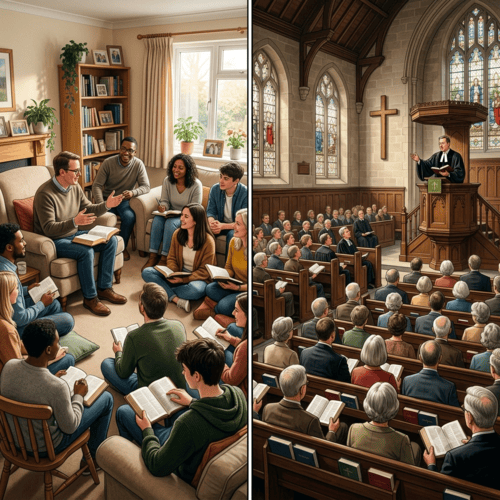

Every Sunday, in churches across the world, a simple scene unfolds. Bread is broken. A cup is poured. Words are spoken that have echoed through 20 centuries: “This is my body, given for you.”
But what actually happens at that Table?
Does the congregation meet the living Christ—or simply remember a dead one? Is this a moment of genuine grace, or an elaborate act of collective memory? This question has divided Christians for 500 years, split reformers from Rome, and even fractured the Protestant Reformation itself. It’s no trivial question. How we answer it shapes our entire experience of worship, grace, and the Christian life.
The Reformed tradition—the theological stream flowing from John Calvin through the Westminster Confession, the Heidelberg Catechism—offers what this article argues is the most biblically faithful, Christologically coherent, and pastorally satisfying answer. But to appreciate it, we must first understand what it isn’t.
THREE VIEWS THAT FALL SHORT
Rome says: the bread becomes Christ’s body. At the moment of consecration by a priest, the substance of the bread and wine is entirely transformed into the actual body and blood of Christ—though it still looks, smells, and tastes like bread and wine. This is called transubstantiation. The Mass, for Rome, is a sacrifice—a re-presentation of Calvary itself.
The problem? Hebrews 9:28 is unambiguous: Christ was offered once for all. A sacrifice that must be repeated is a sacrifice that was not enough. Calvin rightly called this a doctrine that “buries and suffocates” the finished work of Christ (Institutes IV.18.1). Rome also imports Aristotelian philosophy—a Greek framework of “substance” and “accidents”—into what Scripture never requires. The text does not demand it; tradition invented it.
Luther says: Christ’s body is present alongside the bread. Luther rejected Rome’s transformation of the elements but refused any weakening of Christ’s bodily presence. His position—bread remains bread, wine remains wine, but Christ’s body is truly present in, with, and under them—required an extraordinary claim: that Christ’s glorified human body is omnipresent (everywhere at once), a doctrine called ubiquity.
But this collides with Chalcedon, the great ecumenical council of 451 AD, which established Christ’s two natures—divine and human—remain distinct and unconfused. Omnipresence is a divine attribute. A genuinely human body is finite, localised, embodied. To make Christ’s humanity omnipresent is, quietly, to stop taking His humanity seriously.
Zwingli says: the Supper is a memorial, nothing more. Ulrich Zwingli, the Swiss Reformer, argued the bread and cup are pure symbols—signs pointing to a past event. “This is my body” means “this represents my body.” The Supper is a public pledge, a communal act of remembrance. Christ isn’t specially present; we’re simply remembering Him.
This sounds humble. It’s actually impoverishing. Calvin’s devastating response: Zwingli reduces the sacrament to a “bare, naked sign”—a signpost with no road behind it (Short Treatise on the Holy Supper, 1541). If the Supper is only what we do in memory, it has ceased to be a means of grace—something God gives—and become merely a means of performance—something we achieve.
THE REFORMED ANSWER: SPIRITUAL REAL PRESENCE
The Reformed position isn’t a timid compromise between Luther and Zwingli. It’s a genuinely distinct and, as this article argues, superior answer.
The core claim is this: Jesus Christ is truly, really, and substantially present at His Table—but His presence is spiritual (not physical), mediated by the Holy Spirit, and received through faith.
Christ’s glorified body is in heaven. This isn’t a problem to solve—it’s a theological fact to embrace. Acts 3:21 tells us heaven must receive him “until the time comes for God to restore everything.” Hebrews 8:1 places Him at the right hand of the Father. The Ascension is real. The body that walked out of the tomb, that Thomas touched, that ascended in a cloud—that body is in heaven, not here.
And yet—through the Holy Spirit, the distance is abolished. The Spirit does not bring Christ down into the bread. The Spirit lifts us up to Christ. This is the ancient cry of the liturgy, the Sursum Corda: “Lift up your hearts.” “We lift them up to the Lord.” Reformed worship has always understood the Supper as a moment of Spirit-enabled ascent—the congregation drawn by grace into the presence of the glorified Lord.
The Westminster Confession of Faith (XXIX.7) states it with precision: worthy receivers “do then also, inwardly by faith, really and indeed, yet not carnally and corporally, but spiritually, receive and feed upon Christ crucified, and all benefits of His death.” Notice the careful adverbs: really and indeed—this is no bare symbol. Not carnally or corporally—this is no physical chewing. But spiritually—through the Spirit, by faith.
FIVE PILLARS OF THE REFORMED POSITION
- The Ascended Christ gives Himself through the Spirit. John 16:7—Jesus told His disciples it was better that He go away, so the Spirit could come. The Spirit’s presence is not Christ’s absence in disguise; it’s the mode by which the ascended Christ is more intimately present to His whole people than His physical presence in first-century Palestine ever allowed.
- The sign and the reality are truly, not merely, connected. 1 Corinthians 10:16 calls the cup “a participation (koinonia) in the blood of Christ.” Koinonia means real sharing, genuine fellowship—not symbolic gesture. The Belgic Confession (Article 35) insists the elements are not “empty and hollow.” When the bread is placed in our hand, Christ is simultaneously placed, by the Spirit, into our soul.
- The Supper is a means of grace, not merely a means of memory. Just as bread genuinely nourishes a hungry body, the broken body of Christ genuinely nourishes a hungry soul. Calvin writes the Supper “feeds, refreshes, and quickens” the spiritual life (Short Treatise). This is why he fought—unsuccessfully, to his grief—for weekly communion in Geneva. The soul needs feeding as regularly as the body.
- Union with Christ is the foundation. 1 Corinthians 10:17—“Because there is one bread, we who are many are one body.” The Supper does not create our union with Christ; it deepens and confirms it. Michael Horton writes the Supper “ratifies and intensifies” the covenantal union already given in regeneration (The Christian Faith, p. 797). Every Table is a renewal of the covenant bond between Christ and His people.
- Christ is received through faith, not through the mouth. John 6:35—“Whoever comes to me will never go hungry; whoever believes in me will never be thirsty.” Believing is the eating. The Spirit, not the stomach, is the organ of reception. This is why the Reformed insist unbelievers receive only bread and wine at the Table—not because the grace is absent, but because only faith has the capacity to receive it.
PASTORAL IMPLICATIONS: WHY THIS MATTERS
Come hungry, not worthy. The most common reason Christians shrink back from the Table is a sense of unworthiness. But self-examination (1 Corinthians 11:28) is preparation for receiving, not a bar to entry. Thomas Watson put it simply: “Come with appetite” (The Lord’s Supper). The Table is for the famished, not the full.
The Supper is the gospel made visible. 1 Corinthians 11:26—“you proclaim the Lord’s death until he comes.” Every time the bread is broken, the gospel is enacted. Law cannot be administered through bread and wine—only grace can. Sit at this Table long enough, and you will find your assurance deepening not through argument, but through bread placed in an open hand.
Every Table is a foretaste of the last one. Revelation 19:9—“Blessed are those who are invited to the wedding supper of the Lamb.” Sinclair Ferguson observes the Supper trains us to live as people “between the times”—between the cross already accomplished and the glory not yet revealed (The Holy Spirit, p. 203). We eat in hope.
CONCLUSION
Bread is broken. A cup is poured. And by the secret, sovereign work of the Holy Spirit, the glorified Christ—body at the Father’s right hand, Spirit filling all things—genuinely meets and feeds His people.
Not a transformation of elements. Not an omnipresent body hidden in bread. Not a bare act of memory.
A real meal. A living host. A grace that is given, not performed.
Calvin said it best: “Though it seems unbelievable that Christ’s flesh, separated from us by so great a distance, penetrates to us so that it becomes our food—let us remember how far the secret power of the Holy Spirit towers above all our senses.” (Institutes IV.17.10)
Come to the Table. Come hungry. Come in faith.
Christ is there.
TOUGH QUESTIONS, HONEST ANSWERS
Doesn’t Jesus say ‘This IS my body’? Isn’t the plain, literal reading the honest one?
The word “is” in Scripture regularly carries a representational meaning—Jesus says “I am the vine” (John 15:1), “I am the door” (John 10:9), and Paul writes “the rock was Christ” (1 Corinthians 10:4) without anyone insisting the Mediterranean landscape contained a literal Saviour. Context, not the word “is” alone, determines meaning. More decisively, Jesus spoke these words in Aramaic at a Passover meal where every element on the table was already a symbol carrying the weight of redemptive history—His disciples were trained to hear symbolic-yet-real covenantal language, not chemistry. As Sinclair Ferguson observes (In Christ Alone, p. 179), the question is never simply what the words say but what the words mean within their redemptive-historical context—and that context points unmistakably toward a covenant sign, not a physical transformation.
“If Christ’s body is in heaven, isn’t the Reformed view just a polite way of saying He’s absent from the Supper?”
This objection mistakes physical proximity for real presence—a confusion the New Testament itself corrects. Jesus told His disciples in John 16:7 that His departure was not abandonment but advantage. The Spirit’s coming would make Him more intimately present to His whole people than His bodily presence in one location ever could. The Reformed position insists on a richer presence, not a lesser one—the omnipresent Spirit mediates the whole Christ, not merely a localised body. Michael Horton puts it well (Covenant and Salvation, p. 163): the Supper is not a funeral where we mourn an absent friend but a royal banquet where the ascended King hosts His people through His living Spirit.
Isn’t this just Zwingli with better vocabulary? How is ‘spiritual presence’ meaningfully different from ‘no presence’?
This is exactly the question Calvin spent his career answering, and the distinction is not verbal but theological. A Zwinglian memorial is something we perform—an act of human remembrance directed toward an absent Christ. The Reformed doctrine of spiritual real presence describes something God gives—an act of divine condescension in which the Spirit genuinely mediates Christ and all His saving benefits to the believing communicant. The difference is the difference between looking at a photograph of someone you love and actually being in their presence—except the Reformed view insists the Supper is the latter, not the former. As Herman Bavinck writes (Reformed Dogmatics, Vol. 4, p. 474), the sacrament is an “effectual sign”—a sign that does not merely point to grace but actually conveys it through the Spirit’s sovereign work.
John 6:51-58 sounds unmistakably physical— ‘My flesh is real food, my blood is real drink.’ Doesn’t this demand a bodily presence in the Supper?
John 6 is one of the richest and most contested passages in this debate, and a careful reading actually supports the Reformed position rather than undermining it. Jesus Himself provides the interpretive key in verse 63: “The flesh counts for nothing; the Spirit gives life”—if physical eating were the point, this statement would be self-defeating. The eating and drinking language throughout John 6 is consistently parallel to believing (compare v.35 with v.48-51), indicating that “eating” Christ’s flesh is the vivid, embodied metaphor Jesus chose for faith-union with himself. DA Carson concludes (The Gospel According to John, p. 297) that while John 6 has legitimate Eucharistic resonance, its primary meaning is the necessity of genuine faith in the incarnate, crucified Christ—and the Supper is the ordained sign that enacts and seals exactly that union.
If the Supper requires faith to be effective, doesn’t that make the grace dependent on us rather than on God—and isn’t that just works-religion through the back door?
This objection reveals a misunderstanding of what faith is in Reformed theology. Faith isn’t a human achievement or a contribution we bring to God—it is itself the gift of the Spirit, the empty hand that receives rather than the strong hand that earns. Saying that Christ is received through faith no more makes grace human-dependent than saying a drowning man must open his hand to grab the lifeline. The initiative, the lifeline, and even the open hand are all the rescuer’s provision. John Murray (Redemption Accomplished and Applied, p. 113) writes faith is precisely “the instrument of reception, not the ground of merit”—and the Spirit who creates faith is the same Spirit who, through that faith, mediates the living Christ at the Table.
Does any of this actually matter practically? Isn’t it just theological hair-splitting that divides Christians unnecessarily?
It matters enormously, because what you believe about the Supper shapes what you believe about grace, the Spirit, and the Christian life itself. If the Table is merely a memorial, you’ll approach it as a performer—someone who must generate sufficient emotion and recollection to make the exercise meaningful. If you believe Christ genuinely meets and feeds you there by His Spirit, you approach it as a recipient—hungry, expectant, and dependent on grace rather than on your own spiritual effort. Kevin DeYoung observes (The Hole in Our Holiness, p. 141) that recovering a robust theology of the Supper is one of the most practical things a congregation can do, because it trains people week by week in the posture that defines the entire Christian life: receiving everything from Christ and contributing nothing but need.
OUR RELATED POSTS