Most cases for the resurrection are built like a patchwork quilt. You take a witness list from Paul, a burial account from Matthew, an appearance from John, a sermon from Acts, and you stitch them together into one argument. That’s a perfectly good way to do it. But it can leave a reader with the impression the evidence is scattered—that you’ve to go hunting across the whole New Testament to assemble anything convincing.
Luke 24 quietly undoes that impression. In a single chapter—one continuous narrative, from the women walking to the tomb at dawn to the disciples worshipping in Jerusalem—Luke lays down ten distinct lines of evidence for the resurrection. Not ten retellings of the same point. Ten different kinds of evidence: physical facts, named witnesses, hostile scepticism, fulfilled prophecy, a meal eaten in company, lives turned inside out.
When we say “evidence” here, we mean roughly what a historian or a courtroom would mean: things that need explaining, and that are best explained by Jesus having actually risen. None of these ten is a knock-down proof on its own. That’s not how evidence usually works. The force is cumulative—each strand adds its weight, and together they become very hard to dismiss. Let’s walk through all ten, in the order Luke gives them.
Evidence 1: The First Witnesses Were Women (Luke 24:1–10)
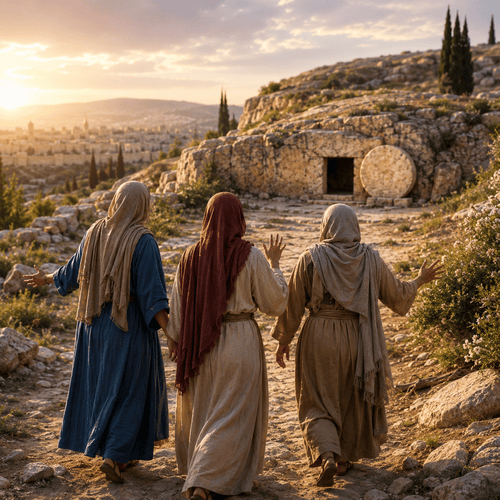
The evidence. Luke opens with the women. At early dawn they come to the tomb carrying the spices they’d prepared, and they’re the ones who find it open. And empty. They hear the angelic announcement, and carry the news back. Luke even names them: Mary Magdalene, Joanna, and Mary the mother of James.
Why it matters. In the first-century world this is the last way you’d invent a story you wanted believed. A woman’s testimony was widely treated as second-class; in some Jewish legal settings it wasn’t admitted at all. If the early Christians had been free to design their account for maximum credibility, they’d have put respected men at the empty tomb. They did the opposite. Historians call this the criterion of embarrassment—the principle that a detail an author would have been embarrassed to include, and had every motive to change, is very likely there because it actually happened. Richard Bauckham, in his study Jesus and the Eyewitnesses, argues naming these women marks them out as known sources—people the early church could have gone to and questioned.
The sceptic’s objection. “Perhaps the women are there for theological reasons, or as a literary touch—not because it’s historical.”
A brief answer. The trouble is the detail buys the writers nothing rhetorically and costs them a great deal. It cuts straight against the grain of the culture. The simplest explanation for a detail that awkward is that the women were there because they were there. William Lane Craig has long pressed this point, and it remains one of the strongest single arguments for the historicity of the empty-tomb tradition.
Evidence 2: The Stone Was Already Rolled Away (Luke 24:2)
The evidence. They found the stone rolled away from the tomb.
Why it matters. Tombs of this kind were sealed with a large, heavy, disc-shaped stone set in a channel. It took several strong people to move one. In Mark’s parallel account the women’s anxious question on the way is precisely who will roll away the stone for them. By the time they arrive, the problem has solved itself—and not by their hand. This is a public, physical fact, not a private experience.
The sceptic’s objection. “Someone moved it—the disciples, grave robbers—and took the body.”
A brief answer. The theft theory has to explain why grave robbers would unwrap a corpse and leave the costly linen behind (Peter notices the cloths a few verses later), and why a band of frightened followers would later cheerfully suffer and die for what they’d themselves faked. People don’t generally die for what they know to be a hoax. The moved stone isn’t proof of resurrection on its own—but it sets the scene that every rival theory then has to account for.
Evidence 3: The Tomb Was Empty (Luke 24:3)
The evidence. They went in and did not find the body of the Lord Jesus.
Why it matters. The empty tomb is the hinge of the whole chapter. What makes it so telling is that even the earliest opponents of the Christians conceded it. The counter-story circulating in Matthew’s day was that the disciples stole the body while the guards slept—and that story only works if the tomb was, in fact, empty. Nobody needs to explain away a body that’s still lying there. The opposition’s own propaganda admits the central fact.
The Roman soldiers and the Jewish authorities had no motive to steal the body, as they were interested in maintaining the status quo and preventing any claims of resurrection. The disciples themselves were in a state of disbelief and were unlikely to have stolen the body, as they’d have risked severe punishment by the Roman authorities. Even if the disciples had stolen the body, it’s highly implausible they would have willingly suffered persecution and martyrdom for a lie they’d perpetrated themselves.
The sceptic’s objection. “An empty tomb proves only that the body is gone. It doesn’t prove a resurrection.”
A brief answer. True—and that’s exactly why it’s one of ten and not the whole case. An empty tomb on its own could in principle have several explanations. What rules the alternatives out is the company it keeps: the appearances, the meal, the worship. NT Wright, in his major study The Resurrection of the Son of God, argues the empty tomb and the appearances together—neither alone—are what make the resurrection the best explanation. Luke gives us both, in the same chapter.
Evidence 4: The Angelic Testimony (Luke 24:4–7)
The evidence. As the women stand puzzled, two men in dazzling clothes appear and ask, Why do you seek the living among the dead? He is not here, but has risen. Then they do something striking: they remind the women of what Jesus Himself had said would happen.
Why it matters. It’s fitting that heaven announces the raising of the Son of God, rather than letting bewildered witnesses simply infer it. And notice what the angels emphasise—not spectacle, but interpretation. They tie the event straight back to Jesus’s own predictions. The fact and its meaning arrive together.
An event as epoch-making as the resurrection of the Son of God demands more than circumstantial evidence. Throughout Jesus’s earthly ministry, God provided such supernatural validation at pivotal moments. At His birth, angels announced the news to the shepherds. At His baptism, the voice of God affirmed His divine sonship. During the transfiguration, Jesus’ glory was revealed, and the voice of God once again testified to His identity. Even at His death, supernatural signs like the darkness and the tearing of the temple veil pointed to the significance of the event.
The sceptic’s objection. “Angels are exactly the sort of thing a legend grows. This is embellishment.”
A brief answer. Compare Luke’s restraint with the frankly legendary resurrection accounts that appeared in later centuries, full of talking crosses and sky-high figures. Luke’s angels say very little, and what they say points away from themselves and back to Jesus’s words. That isn’t how legends tend to behave. For the believing reader this is in fact the theological heart of the chapter: God interprets His own act, so we’re not left to invent its meaning for ourselves.
Evidence 5: Third-Party Attestation (Luke 24:8–10)
The evidence. The women remember Jesus’s words, return from the tomb, and report everything to the Eleven and to all the rest. Luke names the reporters once more.
Why it matters. This is how a reliable report is established: it moves from primary witnesses to a wider circle who can weigh it, question it, and check it. The witnesses are named—not anonymous voices but identifiable people. Simon Greenleaf, a professor at Harvard Law School and an authority on the law of evidence, argued in the 19th century that when the Gospel witnesses are examined by the ordinary rules a court applies to testimony, they come out as credible. Named, multiple, mutually consistent witnesses are precisely what a careful enquirer wants.
The sceptic’s objection. “It is all in-house—believers reporting to believers. Hardly impartial.”
A brief answer. But at this exact moment they are not yet believers in the resurrection. The report is met with flat disbelief, which is our very next piece of evidence—and that disbelief is the opposite of a credulous in-group eager to swallow a rumour.
Evidence 6: The Disciples Didn’t Believe at First (Luke 24:11–12)
The evidence. These words seemed to them an idle tale, and they didn’t believe the women. Only Peter gets up and runs to the tomb, stoops in, sees the linen cloths lying there, and goes home wondering at what had happened.
Why it matters. The disciples aren’t a band of mystics primed to see visions. They’re sceptics. Their first response to the resurrection report is to dismiss it as nonsense—the word Luke uses was applied to the ravings of the delirious. Whatever else they were, they weren’t expecting this and weren’t easily talked into it. That makes their eventual conviction far weightier.
The sceptic’s objection. “Grief does strange things. They wanted him back so badly they imagined he was alive—wish-fulfilment.”
A brief answer. Wish-fulfilment predicts the wrong thing. If grief were manufacturing belief, we’d expect immediate, eager acceptance. Instead we get stubborn refusal, and a sceptic running to inspect the physical evidence for himself. Peter doesn’t see a vision; he sees grave-clothes lying empty. The text shows us doubt overcome by evidence, not desire papering over loss.
Evidence 7: Fulfilled Prophecy (Luke 24:25–27)
The evidence. On the road to Emmaus, Jesus falls in with two downcast travellers and gently rebukes them: O foolish ones, and slow of heart to believe all that the prophets have spoken! Then, beginning with Moses and all the Prophets, he interpreted to them in all the Scriptures the things concerning himself.
Why it matters. The resurrection isn’t presented as a bolt from the blue. It’s the climax the Hebrew Scriptures had been pointing towards for centuries. This matters enormously, because predictive prophecy is evidence no impostor can manufacture after the fact—you cannot arrange to have texts written hundreds of years before your birth. And the pattern runs across many passages, not one: the suffering and vindication of Psalm 22, the pierced and exalted servant of Isaiah 53, the holy one not abandoned to the grave of Psalm 16. Behind that unity stands a conviction worth naming: that the whole of Scripture, written by many human hands over many centuries, has a single divine Author telling a single story. As John Calvin stressed, the same Spirit who inspired those Scriptures must open the reader’s eyes to recognise their fulfilment.
The sceptic’s objection. “The early church simply read these texts back onto Jesus after the event.”
A brief answer. A couple of cherry-picked verses might be explained that way. A converging pattern across the Law, the Psalms, and the Prophets is much harder to dismiss—and the texts themselves aren’t in doubt. Copies of Isaiah recovered among the Dead Sea Scrolls are demonstrably older than Jesus, so there’s no question of Christians having tampered with the predictions to fit. The fit was there to be found.
Evidence 8: The See, Touch, and Eat Test (Luke 24:30–43)
The evidence. This is the most physical evidence in the chapter, and Luke piles it on. At Emmaus, Jesus is recognised in the breaking of the bread. Then, appearing to the gathered disciples, He meets their terror head-on: See my hands and my feet, that it is I myself. Touch me, and see. For a spirit does not have flesh and bones as you see that I have. And then, to settle the matter beyond any doubt, He asks for something to eat and consumes a piece of broiled fish in front of them.
Why it matters. Luke is deliberately closing off the two easiest escape routes. You cannot shake hands with a hallucination, and a ghost doesn’t get hungry. This is bodily, multi-sense verification—seeing, hearing, touching, and sharing a meal—and it happens in front of a group, not a lone grieving individual. Jesus practically runs the experiment for them.
The sceptic’s objection. “It was a mass hallucination, or a collective vision of a ghostly figure.”
A brief answer. Hallucinations, as far as we can tell, are private mental events—two people don’t share the identical detailed one, and certainly not one they can touch and watch eat. A group experience of a solid, conversing, fish-eating figure is not a documented psychological phenomenon; it is simply a label pasted over the problem. Michael Licona and others have pressed this point at length. (We treat it more fully in our piece on the mass-hallucination theory, linked below.)
Evidence 9: The Changed Lives of the Disciples
The evidence. Step back and look at the arc Luke 24 sets in motion. The same men who dismissed the resurrection as an idle tale, and who in the surrounding chapters deserted and denied Jesus, become within weeks the public, fearless proclaimers of His resurrection—and most of them eventually suffered and died rather than take it back.
Why it matters. This is one of the most stubborn facts in the whole discussion. People will, of course, die for beliefs that happen to be false. But people don’t generally die for something they know to be a lie. The disciples were in a unique position: if the resurrection were invented, they were the inventors, and they knew it. Their willingness to be imprisoned, beaten, and killed for the claim is very hard to square with their having made it up.
The sceptic’s objection. “Plenty of people have died for false religions. Martyrdom proves sincerity, not truth.”
A brief answer. True—and that’s precisely the distinction that matters. Those other martyrs die for beliefs they received from someone else; their sincerity isn’t in question, but their information might be second-hand. The apostles died for an event they claimed to have witnessed with their own eyes and hands. The relevant comparison isn’t sincere believers dying for inherited doctrine, but eyewitnesses dying for a story they knew to be fabricated—and that’s vanishingly rare, if it happens at all.
Evidence 10: The Worship Test (Luke 24:50–53)
The evidence. Luke ends where you might least expect a Jewish story to end. Jesus leads them out to Bethany, lifts His hands, and blesses them; and as He is parted from them, they worshipped Him and returned to Jerusalem with great joy, and were continually in the temple blessing God.
Why it matters. To feel the force of this, you have to remember who these people were. First-century Jews were fierce, uncompromising monotheists—believers in one God alone. The daily confession of their faith was the Shema: Hear, O Israel: the LORD our God, the LORD is one. Worship belonged to God alone, and offering it to any creature was the gravest of sins. For devout Jews to fall down and worship a man, and then go up to the temple rejoicing rather than tearing their clothes in horror, is a seismic shift that demands an explanation. Only one thing accounts for it: they’d become convinced this man was no mere man, and that God Himself had vindicated Him by raising Him.
The sceptic’s objection. “This is later, developed belief about Jesus’s divinity, read back into the scene.”
A brief answer. The worship is presented as the immediate response of the first followers, not a doctrine bolted on generations later. And the monotheistic backdrop is the very thing that makes the move so costly and so unlikely to be invented. The simplest explanation for monotheistic Jews worshipping Jesus is that something had happened which left them no honest alternative.
Why One Chapter Is Enough
It’s worth being honest about each of these ten lines on its own. Press hard on any single one and a determined sceptic can usually imagine some alternative. The empty tomb alone might have another explanation. The appearances alone might be reinterpreted. That’s normal for historical evidence, and it’s exactly why the case does not rest on any one plank.
Here’s the better way to picture it. A chain is only as strong as its weakest link—break one link and the whole thing fails. But Luke 24 isn’t a chain; it’s a rope. A rope holds because many independent strands bear the load together, and no single strand has to carry it all. To overturn Luke’s chapter, a sceptic cannot simply find a weak spot in one argument. They have to defeat all ten at once—and, crucially, do it with one coherent counter-story that explains the moved stone and the empty tomb and the embarrassing witnesses and the hostile disbelief turned to conviction and the shared meal and the fulfilled prophecies and the worshipping monotheists. No naturalistic theory on offer manages that. Each one rescues a strand or two and snaps somewhere else.
This is what writers like Gary Habermas mean when they speak of a cumulative case: the strength lies in the convergence. Luke saw it first. He told a friend named Theophilus he had investigated everything carefully so that he might know the certainty of the things he’d been taught—and then he handed him a chapter in which ten lines of evidence all point the same way.
One last word, and it’s the most important. Evidence can persuade the mind, and it should. But notice how the chapter itself describes the moment of recognition at Emmaus: their eyes were opened; and earlier, did not our hearts burn within us? The disciples didn’t reason their way to the risen Christ unaided—their eyes had to be opened. Evidence and that inward opening aren’t rivals. God gives the evidence, and God opens the eyes to see what it means. If you find these ten strands weighing on you, that may be more than an argument doing its work. It may be the same hand that rolled the stone away beginning to open your eyes too.
Tough Questions, Honest Answers
Doesn’t Luke contradict the other Gospels on the number of women and angels?
The Gospels differ in detail—how many women, one angel or two—because each writer selects from a larger event, as independent witnesses always do. One Gospel mentioning a single angel does not deny a second; it simply focuses on the one who spoke. Investigators treat this kind of variation as a mark of genuine, uncollaborated testimony rather than a problem. Wooden, word-for-word agreement across four accounts would be the real red flag, pointing to collusion.
Could the disciples have stolen the body?
This was the very first counter-theory (Matthew 28), and it struggles badly. It cannot explain why men who had just fled and denied Jesus would suddenly risk everything to steal a corpse, then knowingly die for a fraud they had staged. It also leaves the linen grave-clothes, the appearances, and the transformed lives entirely unexplained. A stolen body produces no risen Lord to touch and eat with.
Isn’t the empty tomb just an argument from silence?
No. An argument from silence infers something from the absence of a record. Here we have the opposite: positive testimony that named witnesses went in and found the tomb empty, plus the awkward fact that Jesus’s own opponents conceded it by accusing the disciples of theft. The emptiness is attested, not merely assumed.
Why didn’t the risen Jesus appear to Pilate or the Sanhedrin to silence everyone?
Scripture indicates the appearances were given to witnesses God had chosen to establish and spread the testimony (Acts 10:41). There is also a sobering principle at work: Luke 16 ends with the line that if people will not listen to Moses and the Prophets, neither will they be convinced if someone rises from the dead. The root of unbelief is rarely a shortage of evidence.
Couldn’t the appearances simply be grief hallucinations?
Grief hallucinations are private, fleeting, and shaped by longing—and crucially, the grieving person still knows the loved one is dead. They do not produce a figure that a roomful of people can examine, touch, and watch eat fish, nor do they turn sceptics who dismissed the news into men who die for it. Luke’s account is built precisely to rule this reading out.
How early is this material—wasn’t it written down too late to trust?
The resurrection claim is not a late legend. Paul, writing within roughly twenty-five years of the events, hands on a list of eyewitnesses he calls received tradition (1 Corinthians 15)—material most scholars date to within a few years of the crucifixion. Luke, a careful researcher with access to those eyewitnesses, is working from very early testimony, not centuries-old rumour.
If the evidence is this strong, why doesn’t everyone believe?
Because belief is not produced by evidence alone. The disciples in this very chapter had the evidence in front of them and still struggled until their eyes were opened. Evidence removes excuses and gives the mind solid ground; the final step—seeing the risen Christ for who he truly is—is something God graciously works in a person. The right response to strong evidence is not only to weigh it, but to ask for eyes to see.
Related Reads
- Did Jesus Rise from the Dead? The Historical Case for the Resurrection
- Did the Disciples Die for a Lie?
- How Did Jesus Die? What Doctors Say About the Cross
- The Resurrection of Jesus: Historical Evidence That Even Sceptics Accept
- The Empty Tomb: Did the Disciples Steal Jesus’ Body?
- Mass Hallucination: Does This Explain Resurrection Appearances?
- Hidden in Plain Sight: Jesus’ Resurrection in OT Prophecy
- If 500 People Saw Jesus Alive, Where Is Their Testimony?