People have always been willing to die for things they believe to be true. A soldier dies for his country; a campaigner dies for a cause; in our own day, a suicide bomber dies convinced he’s serving the will of God. So sincerity, on its own, proves nothing about whether a belief is actually correct—it only proves the person holding it is sincere. Sceptics know this well, and it’s usually the first thing they say when a Christian points to the deaths of the apostles. And they’re right to say it. Conviction is not the same as truth.
But there’s a sharper question hiding underneath, one the sceptic rarely thinks to ask. Would you die for something you yourself had made up? Not a mistaken belief you picked up from somebody else and trusted in good faith—but a deliberate lie you personally invented and knew, beyond any doubt, to be false?
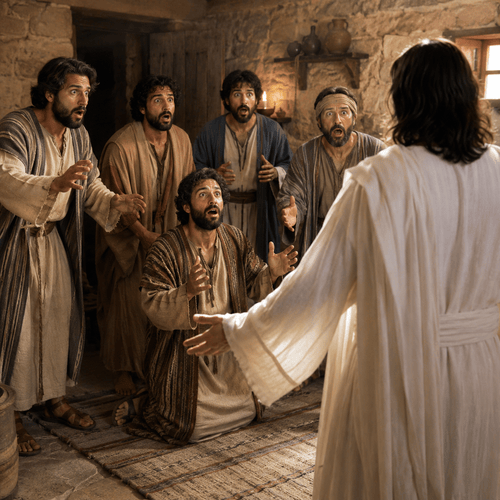
That’s the question the first followers of Jesus put to us, and it will not go away. They weren’t repeating a rumour that had reached them third-hand. They were the primary sources—the men who claimed to have watched Jesus die and then to have eaten breakfast with Him three days later; or, in Paul’s case, to have met Him alive on a dusty road and been knocked flat by the encounter. If anyone on earth was in a position to know whether the resurrection truly happened, it was these men. And almost to a man, they chose flogging, prison, exile and execution rather than take a single word of their testimony back.
That’s what we might call the martyrdom argument. It’s one of the quietest, yet most stubborn pieces of evidence for the resurrection—and it’s worth examining slowly.
Why This Argument Is Different from “Dying for Your Beliefs”
Let’s be honest about the weak version of the argument first, because Christians sometimes overstate it. “The disciples died for their faith, therefore the resurrection is true” simply doesn’t follow. History is full of people who died bravely for things that were false, and their courage only tells us they meant it.
The martyrdom argument is narrower and far sharper than that. The point isn’t that the apostles believed something strongly enough to die for it. The point is they were in a position to know whether the thing was true—and they still died for it.
Think about the difference. A believer today who dies for the resurrection is dying for a report he has received and trusted. The apostles were dying for a report they themselves had given. If it was a lie, they weren’t deceived victims; they were the deceivers. And deceivers, as a rule, don’t let themselves be tortured to death to protect a story they know they fabricated. The moment the lie is likely to cost us our lives, we’d tell the truth to save it. The apostles never did.
Sean McDowell, who wrote his doctoral thesis on exactly this question—later published as The Fate of the Apostles (2016)—makes a careful and important distinction. We don’t need to prove every apostle was definitely martyred for the argument to work. We need only show that each of them faced real danger and the live threat of death, and that none of them ever recanted to escape it. That much rests on very firm historical ground. With that frame in place, let’s meet the witnesses one at a time.
Peter—From Three Denials to an Upside-Down Cross
The case of Peter is so striking precisely because of how badly he began. This is the man who, on the night Jesus was arrested, was asked by a servant girl if he knew Him—and swore blind that he’d never heard the name. He did it three times, then went out and wept bitterly (Luke 22:54–62). Under the mildest pressure imaginable—a question from a girl by a fire—Peter folded completely.
Now hold that picture next to what came later. Within a matter of weeks the same man was standing up in the very city where Jesus had been executed, preaching openly that God had raised Him from the dead (Acts 2). The change isn’t gradual; it’s a reversal. Something happened in between that turned a frightened man who lied to save his skin into a fearless one who wouldn’t lie to save his life.
What happened, the New Testament tells us, is that Peter saw the risen Jesus (Luke 24:34; 1 Corinthians 15:5; John 21). Tradition preserved by the early writer Origen, and echoed by others, records Peter was eventually crucified in Rome under the emperor Nero, and that he asked to be hung upside down because he didn’t count himself worthy to die in the same manner as his Lord.
Whatever we make of the detail about the upside-down crucifixion, the historical core is hard to shift: the coward of the courtyard became the boldest preacher in Jerusalem, and he kept preaching until it killed him. A man doesn’t undergo such transformation over a story he secretly knows to be false.
James—The Brother Who Didn’t Believe
If Peter is the most dramatic case, James—the brother of Jesus—may be the most logically powerful. Here’s what makes James so important. During Jesus’ lifetime his own family didn’t believe in him. The Gospel of Mark tells us his relatives once tried to seize him, thinking he’d lost his mind (Mark 3:21), and John states it flatly: even his own brothers did not believe in him (John 7:5). Put yourself in James’s sandals. You’ve grown up in the same house as this man. You’ve watched him eat, sleep, argue and work. The last thing you’d want to do is worship your older brother as the risen Lord. Familiarity is the great enemy of awe.
And yet. Paul, writing within roughly 25 years of the events and quoting a creed older still, records the risen Jesus appeared to James in particular (1 Corinthians 15:7). Whatever happened in that meeting, the effect was total. Within a few years James isn’t merely a believer but the recognised leader of the church in Jerusalem. He’s even named by Paul among the pillars of the movement (Galatians 1:19; 2:9).
And he died for it. Jewish historian Josephus—not a Christian, writing for a Roman audience—records James was put to death by stoning around AD 62 (Antiquities 20.9.1). That’s one of the best-attested martyrdoms we have, and it comes from a hostile source. If the resurrection were a fabrication cooked up by Jesus’ inner circle, James is the last man on earth who’d want to sign up for it, let alone die for it. The sceptic of the family became a martyr for the family’s claim.
Thomas—The Doubter Who Carried the Gospel to India
Everyone knows Thomas as “doubting Thomas”, and the nickname is fair enough. When the other disciples told him they’d seen the risen Jesus, Thomas refused to take their word for it. He demanded physical proof: unless he could put his finger where the nails had been, he said, he would not believe it (John 20:25).
But notice what that scepticism does for us. Thomas is, of all people, the one disciple who explicitly wouldn’t be talked into a resurrection he hadn’t verified. He was no gullible enthusiast ready to believe anything; he was the original hard-nosed empiricist—someone who insists on seeing the evidence before accepting a claim. And John records he did get his evidence. Jesus appeared, offered him the very proof he’d asked for, and Thomas answered with the highest confession in the Gospel: My Lord and my God! (John 20:28).
What Thomas did next is telling. Strong and ancient tradition—recorded by the early historian Eusebius, by Origen, and in the Acts of Thomas—holds Thomas travelled all the way to southern India to preach, where he was finally killed with a spear near Mylapore, on the coast of what’s now Chennai. The Mar Thoma Christians of Kerala trace their church to his work to this day, and the San Thome Basilica marks the traditional site of his death.
Sit with the shape of that life. The one man who refused to believe without proof became the man who carried the message some 5000 kilometres from home. And died for it on a foreign shore. Doubt that’s satisfied by evidence and then sealed in blood isn’t the behaviour of a fraud.
Paul—The Persecutor Who Became the Persecuted
Paul is unique among the witnesses, because he didn’t start as a follower of Jesus at all. He started as the movement’s most feared enemy. Under his given name Saul, he hunted Christians down, approved of their executions, and travelled from city to city to drag them off to prison (Acts 8:1–3; 9:1–2). He had every worldly reason to stay exactly where he was: he was a rising star in Pharisaic Judaism—learned, respected, zealous. Conversion would cost him all of it.
Then, on the road to Damascus, by his own insistent testimony, he met the risen Jesus and was never the same again (Acts 9; 1 Corinthians 15:8). The enemy became the apostle. And the cost he had every reason to avoid, he paid in full. In one remarkable passage Paul lists what his new loyalty earned him: five floggings of 39 lashes, three beatings with rods, a stoning that left him for dead, three shipwrecks, and danger of every kind (2 Corinthians 11:23–27). By early and reliable testimony—including that of Clement of Rome, writing around AD 96—he was finally executed in Rome under Nero.
The conversion is the thing that demands an explanation. A contented disciple dying for his faith is one matter; a hostile persecutor abruptly switching sides at enormous personal cost, and then dying for the very claim he’d been trying to stamp out, is quite another. When Paul wrote I have been crucified with Christ (Galatians 2:20), he wasn’t striking a pose. He was describing a man whose entire life had been overturned by something he was certain he’d seen.
Stephen—The First to Die for the Risen Christ
Stephen is, strictly speaking, a slightly different case, and it’s worth being honest about that. He was not one of the Twelve, and he isn’t mentioned in Scripture as an eyewitness of the empty tomb; he was a deacon, one of the men appointed to serve the early church (Acts 6). So why include him among the witnesses at all?
Because Stephen shows us what the resurrection did to the people it touched. Hauled before a hostile council and facing death by stoning, he didn’t flinch. Luke records he looked up and said he could see the heavens opened and the Son of Man standing at the right hand of God (Acts 7:55–56). That small word standing is loaded with meaning. Everywhere else in the New Testament the risen Christ is described as seated at God’s right hand—the posture of a finished work and settled authority (Psalm 110:1; Hebrews 1:3). Some suggest Stephen sees him rising to his feet to welcome home the first man to die in his name.
And then, as the stones fell, Stephen prayed for the men killing him, asking that the sin not be held against them (Acts 7:60)—an almost exact echo of Jesus’s own words from the cross. That isn’t natural human behaviour under a hail of stones. It’s the behaviour of a man so gripped by the reality of a living, risen Lord that even his dying looks like his Master’s. Stephen didn’t need to have seen the empty tomb. He had seen enough.
John—The Survivor Who Still Would Not Walk It Back
John is the odd one out. Of all the inner circle, John appears not to have died a martyr’s death. He lived to a great age and, by the consistent testimony of the early church, died of natural causes in Ephesus. At first glance this looks like a weakness in the argument. It’s actually a hidden strength.
Tradition recorded by Tertullian holds Rome did try to kill John—that he was thrown into boiling oil and astonishingly survived, after which he was exiled to the bleak prison-island of Patmos. So here’s a man given, in effect, every chance to recant. He’d already suffered for the message; he was old; a quiet retirement was surely tempting. One word of denial might have ended his exile. He never spoke it.
From that barren rock John instead wrote the book of Revelation, still proclaiming the risen and returning Christ as loudly as ever (Revelation 1:9). The question his long life puts to us is simple and sharp: what did this elderly man know that made exile on a stony island more bearable than the smallest lie? Whatever it was, he carried it to his grave without ever taking it back—the witness who outlived his persecutors and still refused to recant.
Where the Martyrdom Argument Leaves Us
Lay the cases side by side and a pattern emerges that’s very hard to explain on the assumption that the disciples lied. Peter, the man who once denied even knowing Jesus, died rather than deny him again. James, who grew up thinking his brother had lost his mind, died at the hands of the establishment he’d once belonged to. Thomas, who refused to believe without proof, carried his belief to the far side of the world. Paul, who’d been killing Christians, joined them and was killed in turn. Stephen forgave his executioners as the stones fell, and John wouldn’t recant even when survival offered him the chance.
None of this proves the resurrection the way a mathematical theorem is proved. But it sets the sceptic a genuine problem. People do die for beliefs they hold sincerely but wrongly. People do not, as a rule, die for claims they’ve personally invented and know to be false—least of all in a slow, scattered series of deaths across decades, with every opportunity to recant and save themselves.
The behaviour of these men is exactly what we’d expect if they’d really seen what they said they saw, and very difficult to account for on any other view. That, in the end, is the weight of the martyrdom argument: not merely that the witnesses were willing to die, but that the people best placed to know the truth chose death over denial—and were visibly changed men because of it.
Tough Questions, Honest Answers
How do we actually know how the apostles died? Aren’t the accounts just legends?
It’s a fair challenge, and the honest answer is that the evidence varies from case to case. Some martyrdoms are very well attested—James’s death is recorded by the non-Christian historian Josephus, and Peter’s and Paul’s executions in Rome are reported by several early sources. Others, such as Thomas’s death in India, rest on strong and ancient tradition but less direct documentation. Sean McDowell, who examined every case in detail, argues we don’t need certainty about the manner of each death. We need only the well-supported fact that these men faced persecution and the threat of death and never recanted. And that is solidly established.
Doesn’t everyone die for what they sincerely believe? Plenty of people die for false religions.
Yes, and that’s exactly why the argument is framed so carefully. The point isn’t that the disciples were sincere—lots of sincere people are mistaken. The point is that they were the original sources of the claim, not later believers who’d received it second-hand. A modern martyr dies for a report he trusts. The apostles died for a report they themselves gave. If it was false, they alone would have known it was false, and that changes everything.
Wasn’t Stephen only a deacon, not an eyewitness of the resurrection?
Technically, yes—Stephen wasn’t among the Twelve and isn’t said to have seen the empty tomb. He’s included here not as a witness to the event itself but as evidence of its effect. His fearlessness under stoning, and his prayer of forgiveness for his killers, show what the resurrection produced in those it touched. He’s a witness to the transforming power of the claim rather than to the tomb.
Could the disciples have simply lost their nerve and died without ever formally recanting?
The records suggest otherwise. These weren’t men who quietly kept their heads down and were swept up by events. Peter preached publicly in Jerusalem within weeks of the crucifixion; Paul travelled the empire announcing the resurrection; John wrote Revelation from exile. They were active, vocal proclaimers right up to the end. Silence might be explained by fear, but decades of open proclamation in the face of danger cannot.
What about the women, like Mary Magdalene? Weren’t they the first witnesses?
They were, and that’s a point in the argument’s favour, not against it. All four Gospels report women were the first to find the empty tomb and meet the risen Jesus (e.g. John 20:11–18). In the first-century world a woman’s testimony carried little legal weight, so anyone inventing a story to persuade that culture would never have chosen women as their lead witnesses. The fact that the accounts feature them anyway is a strong sign the writers were reporting what actually happened rather than crafting convenient propaganda.
Couldn’t the disciples have been sincerely mistaken—hallucinating, perhaps—rather than lying?
That’s a more serious objection than the “dying for beliefs” one, and it deserves its own discussion (we treat it separately in our post on the hallucination theory). In brief: hallucinations are private, individual experiences, like dreams, whereas the New Testament describes Jesus appearing to groups, on multiple occasions, over a period of weeks, even sharing meals. Hallucination cannot easily explain group experiences, and it cannot explain the empty tomb or the conversion of a hostile enemy like Paul. The martyrdom argument and the hallucination question work together: the disciples were neither lying nor, on the evidence, mistaken.
Even if all this is true, does it prove the resurrection?
Not by itself, and we shouldn’t claim more than we can deliver. What the martyrdom argument does is close off the easiest sceptical exit—the idea that the whole thing was a deliberate hoax. If the people best placed to know the truth went to their deaths rather than deny it, fraud becomes very hard to sustain. Combined with the empty tomb, the early eyewitness testimony, and the explosive growth of the church, it forms part of a strong cumulative case. The deaths of the witnesses don’t stand alone—but they’re one of the hardest threads for the sceptic to cut.
Related Reads
- Did Jesus Rise from the Dead? The Historical Case for the Resurrection
- Ten Evidences for the Resurrection in Luke 24: What One Chapter Proves
- How Did Jesus Die? What Doctors Say About the Cross
- The Resurrection of Jesus: Historical Evidence That Even Sceptics Accept
- Mass Hallucination: Does This Explain Resurrection Appearances?
- The Empty Tomb: Did the Disciples Steal Jesus’ Body?
- Why Must We Affirm the Virgin Birth?