
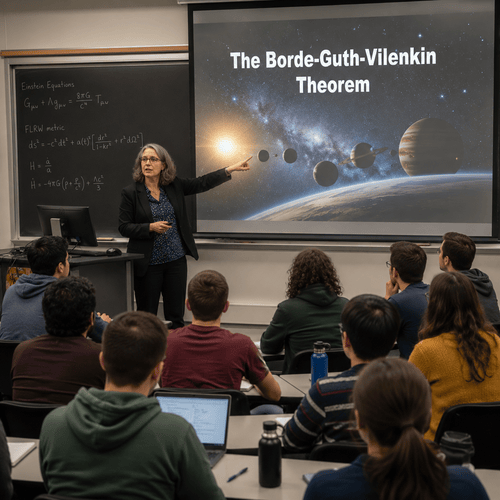
“All the evidence we have says that the universe had a beginning.” Those aren’t the words of a preacher or theologian. They belong to Alexander Vilenkin—one of the three physicists whose names are stamped on a piece of cosmological mathematics that has unsettled the conversation about cosmic origins for more than two decades. Before we unpack a single equation, sit with that sentence for a moment.
In 2003, three cosmologists—Arvind Borde, Alan Guth, and Alexander Vilenkin—published a short, dense paper (called the BGV Theorem) that has since become one of the most quoted results in the science-and-faith conversation. Stripped of its math, the theorem says something deceptively simple: any universe that has, on average, been expanding throughout its history must have had a beginning. It cannot stretch back forever.
This isn’t a proof for God—let’s be clear about that from the outset. It’s a piece of evidence, and a stubborn one, because the cosmologists who discovered it cannot easily escape it. What this post will do is three things: explain what the theorem actually says in plain English, trace where its implications lead, and engage honestly with the strongest objections scientists raise against it. No strawmen, no overclaiming.
What Is the BGV Theorem? A Plain-English Explanation
Picture a film of the universe playing in reverse. Galaxies that are currently flying apart come rushing back together. Run the film far enough and everything converges. The question the BGV theorem answers is whether that reverse film can keep running forever, or whether it will eventually hit a wall—a beginning.
The theorem answers it will hit a wall. More precisely: any universe that has been expanding on average cannot be infinite in the past. It must have a past space-time boundary—a genuine beginning to the very fabric of space and time.
What makes the theorem so striking is one word: kinematic. Earlier singularity theorems, such as those of Stephen Hawking and Roger Penrose, leaned on assumptions about the energy and matter filling the universe. The BGV does not. It makes no assumptions about energy conditions and no commitments about what the universe is made of. It depends only on the expansion itself. That’s why it holds whether the universe is open, flat, or closed—and, crucially, why it applies even to the inflationary multiverse models that many cosmologists favour.
Think of tracing a single particle’s path backwards through an expanding cosmos. In a universe that’s expanding on average, that path simply cannot be extended infinitely into the past. It runs out. The history is finite. That, in essence, is the BGV theorem.
Why This Is Stronger Than Earlier Singularity Themes
For decades, the natural reply to “the universe had a beginning” was to tinker with the physics. The Hawking-Penrose theorems required something called the strong energy condition—and quantum effects can violate that condition. So a determined sceptic could always say: perhaps in the quantum regime, the beginning quietly dissolves.
Borde, Guth, and Vilenkin designed their theorem precisely to close that escape hatch. Because it makes no appeal to energy conditions, the usual quantum get-out-of-jail card does not apply in the same way. Guth himself is reported to have called the result “air-tight.” That’s why cosmologists take it seriously even when they plainly dislike where it points. The physics is robust; what to make of it is where the real argument begins.
From Physics to Philosophy: What Must Lie Beyond the Boundary?
Here the theorem hands the question over to philosophy. If space, time, and matter all had a beginning, then whatever caused that beginning cannot itself be made of space, time, or matter. Walk through what that implies about the cause:
- Spaceless: it cannot occupy a space that did not yet exist.
- Timeless: it cannot be located in a moment of time before time itself began.
- Immaterial: matter had not yet come into being.
- Enormously powerful: it brought an entire universe into existence.
- Personal (agent causation): An impersonal, mechanical set of laws cannot exist in a timeless state and suddenly decide to trigger an effect. If the cause were a timeless machine, its effect would be timeless too. Only a personal agent with a free will can exist changelessly and choose to initiate a brand-new effect.
None of this is dictated by the equations. But each step follows reasonably from the bare fact of a beginning. The theorem builds the bridge; philosophy walks across it.
What Scientists Object: The Strongest Challenges
Intellectual honesty demands we put the best objections on the table, not the weakest. These are the serious ones, each followed by an honest reply.
- Quantum gravity may dissolve the boundary. Sean Carroll’s central objection is that the BGV applies to classical space-time. A complete theory of quantum gravity—which we do not yet possess—might permit a past-eternal quantum state with no boundary. Carroll even suggests that asking “what came before the Big Bang?” may be as meaningless as asking what lies south of the South Pole. Reply: this is a genuine live question, but “physics we have not discovered yet might change the answer” is a promissory note, not a refutation. No such theory currently exists that demonstrably escapes the theorem.
- Eternal inflation might allow a past-eternal substrate. Alan Guth—the theorem’s co-author—acknowledges the mathematics of past-incompleteness but speculates the arrow of time might flip at the boundary, or that a deeper quantum state avoids the definition of a traditional “beginning.” Reply: Vilenkin maintains that regardless of arrow-of-time gymnastics, the past histories still hit a hard stop. The two authors are openly divided—which is itself instructive. The disagreement isn’t about the mathematics, but about the philosophical lengths one will go to avoid a cosmic absolute beginning.
- A “Big Bounce” could sidestep the expansion condition. Loop Quantum Cosmology proposes a contracting universe that bounces into expansion. If the average expansion rate along past histories is non-positive, the BGV condition may not bite. Reply: Audrey Mithani and Alexander Vilenkin have argued bouncing models face quantum instability problems that prevent a genuinely eternal past. The debate continues, but the bounce isn’t the clean escape it first appears to be.
- Cyclic cosmologies might be past-eternal. Roger Penrose’s Conformal Cyclic Cosmology imagines successive “aeons” joined at conformal boundaries, which some read as eternal. Reply: such models are highly speculative, lack observational support, and remain disputed even within mainstream cosmology. They are interesting proposals, not established physics.
- A beginning is not the same as a creation. Even granting a boundary, critics argue that a space-time boundary is just a limit of our coordinate description, not a creation event that demands an agent. Reply: this conflates a mathematical boundary with a physical one. The geodesic incompleteness the BGV identifies is physical—the histories genuinely run out—not a mere quirk of how we draw our diagrams.
- Calling the cause “God” is a God-of-the-gaps move. Pointing at an unknown cause and labelling it “God,” the charge runs, is filling ignorance with theology. Reply: the inference here isn’t from ignorance but from the known attributes of the cause—spaceless, timeless, immaterial, powerful, personal. That’s a positive description that happens to match classical theism, not a placeholder dropped into a gap.
What Vilenkin Himself Concludes
It’s worth dwelling on Vilenkin, because he is no apologist. He is an agnostic physicist who doesn’t believe the theorem leads to the God of any religion. He suspects the universe arose from a quantum fluctuation governed by laws that somehow pre-existed it. And yet—in his book Many Worlds in One, and in correspondence with the philosopher William Lane Craig that Vilenkin has confirmed as accurate—he states plainly the universe had an absolute beginning.
That tension is the whole point. Guth co-authored the very same theorem and reads its implications differently. Two of the three authors disagree about what it ultimately means. The physics is settled; the philosophy is where the genuine disagreement lives. And notice where Vilenkin’s own alternative leaves us: if the universe came from laws that pre-existed it, then where did those laws come from? The regress simply moves back a step. It continues until we reach something that’s itself uncaused—which is exactly what classical theism has always claimed about God.
Why the BGV Theorem Matters
Let’s bring it home without overclaiming. The BGV theorem doesn’t prove the God of the Bible. It will not, on its own, settle the question of God’s existence. What it does is quieter and, in its way, more powerful: it removes the “eternal universe” escape route that naturalism leaned on for generations. The idea the cosmos simply always was—no beginning, no cause, no explanation required—is the option the theorem closes off.
Set beside the Kalam Cosmological Argument and the Fine-Tuning Argument, the BGV theorem becomes one strand in a cumulative case. The Kalam supplies the logic—whatever begins to exist has a cause. Fine-tuning shows a universe improbably suited to life. The BGV supplies the scientific backbone for the claim that the universe began. Three independent lines, all pointing in the same direction.
Conclusion
The BGV theorem doesn’t settle the God question by itself—but it does something remarkable: it forces the question to be asked. A universe with a beginning demands an explanation that lies outside itself. And the characteristics of that explanation—spaceless, timeless, immaterial, powerful, personal—fit the description of God with uncanny precision.
The critics remain, and their objections are serious; we’ve sought to engage them honestly rather than wave them away. But once the eternal-universe door is shut, the question of a beginning will not stay quiet. And the direction the evidence points is hard to mistake.
Tough Questions, Honest Answers
How does the BGV theorem point to a spaceless, timeless creator?
The BGV theorem points to a spaceless, timeless creator by proving that physical space, time, and matter had a definitive beginning. Because a cause must exist independently of its effect, the cause of space and time must logically be spaceless, timeless, and immaterial.
Didn’t Alan Guth—one of the authors—say the universe had no beginning?
In a sense, yes. Guth thinks eternal inflation may permit a past-eternal multiverse even if our own bubble universe began. Vilenkin disagrees, arguing that the theorem applies to the inflating space-time as a whole. The co-authors are genuinely divided on interpretation—which is precisely why the philosophical reasoning matters as much as the physics.
Can quantum gravity get around the theorem?
Possibly—this is the most serious scientific objection, raised by Sean Carroll among others. The BGV applies to classical space-time, and a complete theory of quantum gravity might behave differently. But no such theory currently exists that demonstrably avoids the boundary. “Future physics might change things” is a reasonable hope, not a present-day refutation.
Can a “Big Bounce” model escape it?
Loop Quantum Cosmology proposes a contracting universe that bounces into expansion, which could sidestep the average-expansion condition. However, Audrey Mithani and Alexander Vilenkin have argued that bouncing models face quantum instabilities that stop them being truly past-eternal. The question is live, but the bounce is not a clean exit.
What’s the difference between the BGV theorem and the Kalam Cosmological Argument?
The Kalam is a philosophical argument: whatever begins to exist has a cause; the universe began to exist; therefore the universe has a cause. The BGV theorem is scientific evidence for that second premise. It supports the Kalam without being the same thing—one is cosmological physics, the other a syllogism.
What does it mean for the Creator to be “timeless”?
It means existing without being subject to temporal succession—no before or after, no change, no decay. Classical theology calls this “eternal” rather than merely “everlasting.” William Lane Craig and others argue this is coherent: a timeless, immaterial mind that freely chose to bring time itself into being at the moment of creation.
If the universe had a beginning, couldn’t it have come from nothing without a Creator?
Lawrence Krauss’s popular “universe from nothing” argument quietly redefines “nothing” as a quantum vacuum—which is in fact something: a sea of quantum fields governed by laws. A true metaphysical nothing has no properties, no potential, and no laws. Out of nothing, nothing comes. A quantum vacuum is not the nothing the question imagines.
Related Reads:
- The Teleological Argument: Does Nature Point to a Designer?
- The Fine-Tuning Argument: Why the Universe Looks Designed for Life
- Order in Chaos: What the Hadron Collider Shows Us About the Universe
- The Kalam Cosmological Argument: Does the Universe Need a Creator?
- The Moral Argument for God’s Existence: The Case, Objections, and Answers
- RNA World Hypothesis: Can Chemistry Explain Life’s Origin?
- Big Problems for the Big Bang: What Recent Finds Show
- The God Particle: What Does the Higgs Boson Really Say About God?