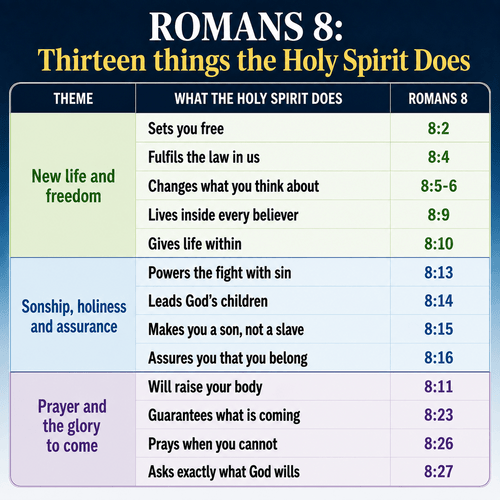

Many today—including sincere seekers, members of groups such as the Jehovah’s Witnesses, and even Christians who’ve perhaps never quite thought it through—picture the Holy Spirit as a kind of divine electricity. A force. An influence radiating from God, like heat from a fire. Something powerful, yes—but not someone you could actually know.
But the Bible, read carefully and honestly, says otherwise. From the grammar of the Greek New Testament to the deepest structures of Christian prayer, Scripture insists—not merely suggests—the Holy Spirit is a fully personal divine Being. Here’s the evidence.
THE GRAMMAR PROBLEM—AND WHY IT IS NOT A PROBLEM
Critics sometimes point to the Greek word for Spirit—pneuma—which is grammatically neuter. Doesn’t that settle things? Doesn’t “it” win by default?
No. And here’s why.
Grammatical gender in ancient languages has nothing to do with whether something is personal. More importantly, the Bible overrides its own grammar at key moments. In John 16:13–14, Jesus refers to the Spirit using the masculine pronoun ekeinos—meaning “He” or “that One”—even though the rules of Greek grammar did not require it. This is a deliberate, intentional move. John Calvin, the great 16th-century theologian, noticed this carefully, pointing out that Jesus used this pronoun specifically to signal the Spirit isn’t a mere quality or divine energy, but a distinct personal Being.
When the Bible bends its own grammar to make a theological point, we should pay attention.
THE SPIRIT DOES WHAT ONLY PERSONS DO
Impersonal forces—electricity, wind, gravity—do not think, choose, speak, or pray. The Holy Spirit does all of these:
- He thinks and searches: “The Spirit searches all things, even the deep things of God” (1 Corinthians 2:10). Only a mind can search. Only a person can know.
- He wills: He distributes spiritual gifts to believers “just as He determines” (1 Corinthians 12:11). This is sovereign, personal decision-making—not random divine energy.
- He speaks and commands: “The Holy Spirit said, ‘Set apart for me Barnabas and Saul'” (Acts 13:2). Forces do not issue instructions.
- He intercedes: He “intercedes for us through wordless groans” (Rom. 8:26). Prayer—real prayer, on our behalf— is irreducibly personal. A power cannot plead for you.
- He teaches and guides: Jesus promises the Spirit will “teach you all things” (John 14:26) and “guide you into all truth” (John 16:13). Notice the full triad: He hears, He speaks, He declares—the language of a communicating Person, not a flowing force.
As theologian Anthony Thiselton observes: “The Spirit is portrayed throughout the New Testament not as an influence radiating from God, but as one who acts, speaks, and relates—the marks of genuine personal agency.”
THE SPIRIT EXPERIENCES WHAT ONLY PERSONS FEEL
Here the Bible becomes particularly striking. Impersonal forces cannot be emotionally affected. The Holy Spirit can—and is:
- He is grieved: “Do not grieve the Holy Spirit of God” (Ephesians 4:30). Grieving someone requires that they have an inner personal life — a capacity to be hurt by our choices. Electricity cannot be grieved. A Person can.
- He can be resisted: Stephen tells his persecutors, “You always resist the Holy Spirit” (Acts 7:51). Resistance only makes moral sense when directed at a Person with a will and a purpose.
- He loves: Paul appeals to believers through “the love of the Spirit” (Romans 15:30). Love is not an attribute of a force. It is the defining quality of a Person in relationship.
These aren’t loose poetic images. They’re windows into the Spirit’s genuine personal life.
THE SPIRIT’S DISTINCT IDENTITY WITHIN THE GODHEAD
The clearest and most comprehensive evidence comes from how the Bible positions the Spirit alongside the Father and the Son:
- The Great Commission (Matthew 28:19) commands baptism into the one Name—singular—of the Father, Son, and Holy Spirit. Three Persons, one divine Name, equal standing.
- The Upper Room Discourse (John 14–16): Jesus promises “another Helper”—the Greek word allos meaning another of the same kind. The Spirit isn’t Jesus in a different mode. He is a distinct Person who continues what Jesus began—being personally present with believers after Jesus returns to the Father.
- Acts 5:3–4: Peter confronts Ananias—”You have lied to the Holy Spirit… You have not lied to men but to God.” In two consecutive sentences, the Spirit is called both a Person (who can be lied to) and God. Personhood and deity, in a single passage.
- Acts 13:4; 16:6–7; 20:28: The Spirit sends missionaries, forbids travel, and appoints church leaders. These are acts of personal divine authority—not impersonal spiritual weather.
Michael Horton, a leading contemporary theologian, captures this precisely: “The Spirit is not the impersonal energy of the Godhead but the personal executor of the Father’s purposes and the Son’s redemption—present with us as a distinct, divine ‘I.'”
WHY THIS CHANGES EVERYTHING
If the Holy Spirit is merely a force, the Christian life becomes a matter of using spiritual power correctly—a kind of holy technique. But if the Spirit is a Person, everything shifts.
The Bible’s closing benediction—”the fellowship of the Holy Spirit be with you all” (2 Corinthians 13:14)—uses the Greek word koinōnia, which means deep, mutual, personal communion. We cannot have koinōnia with electricity.
We can grieve the Spirit—which means our choices today have relational weight, not merely moral consequences. We can be led by the Spirit (Romans 8:14)—not mechanically driven, but personally guided, the way a trusted friend guides you through unfamiliar territory.
Prayer, worship, and the pursuit of holiness aren’t programmes to master. They’re a relationship to live.
The New Testament doesn’t merely permit personal language about the Holy Spirit. It insists on it—through deliberate grammar, through personal actions, through genuine emotion, and through the very structure of the Christian God.
The Holy Spirit is not an it. He is the Third Person of the Trinity—fully divine, genuinely personal, and personally present with every believer.
HARD QUESTIONS, HONEST ANSWERS
If the Holy Spirit is a Person, why does the Bible sometimes compare Him to wind, fire, and water—impersonal things?
These are symbols of the Spirit’s activity, not definitions of His nature. The Bible also compares God the Father to a rock and a shield—nobody concludes the Father is therefore impersonal. Symbols describe what something does, not what something is. As Sinclair Ferguson notes in The Holy Spirit (1996), the Spirit’s personal nature is established by what He does—teaching, grieving, interceding—while the symbols simply capture the power and character of His work. The imagery is vivid and evocative; it was never meant to be a metaphysical statement.
Isn’t the language of the Spirit being “poured out” (Acts 2:17–18) more consistent with an impersonal force than a Person?
“Poured out” is relational and covenantal language drawn from the Old Testament prophets, particularly Joel 2:28. It describes the generous gift of the Spirit’s presence, not His essential nature. We speak of “pouring out love” or “pouring out our hearts” without meaning either love or the heart is impersonal. Michael Horton (in Rediscovering the Holy Spirit, 2017) points out Pentecost is best understood as the Spirit coming in personal, indwelling presence—not as a substance distributed in measured quantities. The pouring-out language tells us about the abundance of the gift, not the impersonality of the Giver.
The Old Testament rarely speaks of the Spirit in personal terms. Doesn’t that suggest personhood is a later theological development?
The Old Testament does present the Spirit’s personhood in a less developed way, but the seeds are unmistakably there. Isaiah 63:10 says Israel “grieved His Holy Spirit”—grief is a personal response, not a property of impersonal force. Sinclair Ferguson argues the Old Testament operates with genuine pneumatological continuity—the same Spirit, the same Person—but progressive revelation means His full personal identity is disclosed more completely in the New Testament, particularly through Jesus’ own teaching in John 14–16. The development is one of clarity, not contradiction.
Jehovah’s Witnesses argue the Holy Spirit is God’s “active force,” like electricity. How do we answer that fairly and convincingly?
The “active force” view cannot account for the full range of personal actions the Bible ascribes to the Spirit He is lied to (Acts 5:3), He grieves (Ephesians 4:30), He intercedes with groans (Romans 8:26), He speaks and commands (Acts 13:2). You cannot lie to electricity; you cannot grieve a force; a force does not intercede. Anthony Thiselton observes the New Testament’s personal language about the Spirit is too consistent, too varied, and too grammatically deliberate to be dismissed as mere metaphor. The “active force” reading requires ignoring or flattening a substantial body of explicit biblical testimony.
If the Holy Spirit is truly a Person, why does He seem so self-effacing—always pointing to Jesus rather than drawing attention to Himself?
This self-effacement is not evidence of impersonality— it’s evidence of perfect personal character. Jesus Himself said the Spirit “will not speak on His own” but “will glorify Me” (John 16:13–14)—this is a description of the Spirit’s relational role within the Trinity, not His ontological status. Herman Bavinck (Reformed Dogmatics, Vol. 3) beautifully describes the Spirit as the one who “remains hidden behind His own work,” bringing believers into union with Christ rather than making Himself the object of attention. A person who consistently deflects glory to another isn’t less personal—they’re displaying one of the highest forms of personal virtue.
Could the personal language about the Spirit simply be a literary device—personification—like when the Bible personifies Wisdom in Proverbs 8?
Personification is a recognised literary device, but several features distinguish the Spirit’s portrayal from it decisively. Wisdom in Proverbs 8 is a literary figure who doesn’t interact with specific individuals in real time—the Spirit does: He speaks to Philip (Acts 8:29), forbids Paul from entering Bithynia (Acts 16:6–7), and appoints specific elders in Ephesus (Acts 20:28). John Frame (Systematic Theology, 2013) notes the Spirit appears throughout Acts as a narrative agent making concrete decisions in real historical situations—precisely the kind of particularity that distinguishes a Person from a personified concept. Personification decorates a point; the Spirit drives the plot.
Does belief in the Holy Spirit’s personhood require full Trinitarian theology—and isn’t the Trinity itself a post-biblical invention?
The word Trinity is post-biblical, but the reality it names is woven into the New Testament’s texture from beginning to end. The Great Commission (Matthew 28:19) coordinates Father, Son, and Spirit under one Name with striking equality; Paul’s benediction in 2 Corinthians 13:14 places all three in parallel personal relationship with believers. Michael Horton argues Trinitarian theology is not an imposition onto Scripture but the best account of Scripture—the Church’s attempt to say carefully what the Bible says less systematically but no less clearly. Rejecting the Trinity does not simplify the Bible; it creates far more problems than it solves.
OUR RELATED POSTS