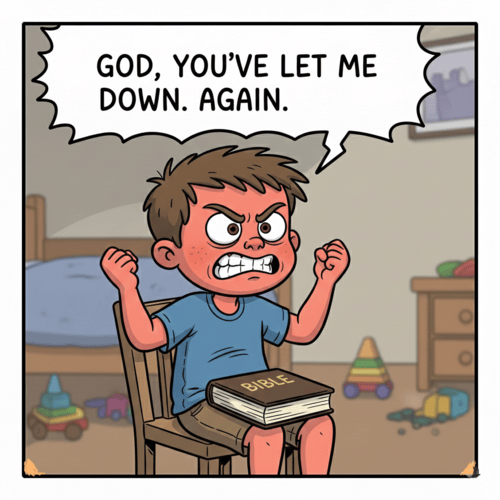
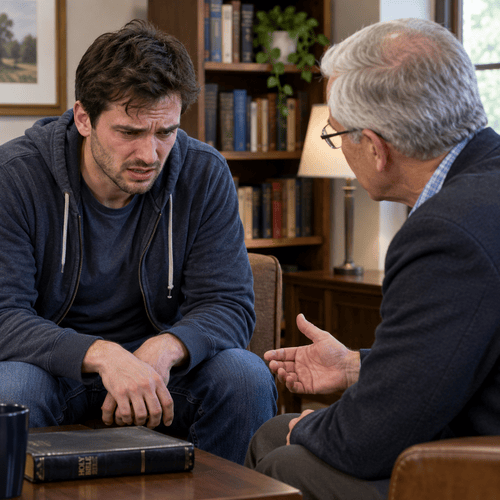
Here’s a strange fact. Some of the most tormented people in our churches aren’t the worst sinners. They’re the people who cannot stop worrying that they might be.
They pray the same prayer 10 times because the first 9 “didn’t count”. They confess a sin, feel clean for 5 minutes, then confess it again. A terrible thought flashes through their mind during worship, and they spend the rest of the service begging God not to reject them. Friends call them devoted. Inside, they’re drowning.
If that sounds like you, you’re not alone, and you’re not as far from God as you feel. You may be dealing with something called religious OCD, also known as scrupulosity. Let’s see what it is, why it isn’t weak faith, what the Bible says, and how a treatment called ERP, used in a Christian way, can bring real freedom.
KEY TERMS IN PLAIN ENGLISH
- OCD (obsessive-compulsive disorder): a medical condition in which unwanted thoughts and fears keep coming back, and the person feels driven to do things to make the fear go away.
- Obsession: an unwanted thought, picture or doubt that pushes into the mind again and again.
- Compulsion (or ritual): something a person does, or thinks, to get rid of the fear for a little while.
- Scrupulosity: OCD that attaches itself to faith or right and wrong. The word comes from the Latin scrupulus, a small sharp stone in a shoe.
What Is Religious OCD (Scrupulosity)?
Picture a small stone in your shoe. It isn’t big, but you can’t stop noticing it. Scrupulosity is like that: a small doubt about sin or salvation gets stuck and simply refuses to leave.
Everyone has strange or ugly thoughts sometimes. Most people move on. A person with OCD cannot. The thought feels dangerous, so they try to “fix” it. The fix brings short relief, then the doubt returns, only stronger.
Here are some common fears and the rituals they lead to.
| THE FEAR (OBSESSION) | WHAT IT SOUNDS LIKE | WHAT THE PERSON DOES (COMPULSION) |
|---|---|---|
| Fear of an unforgivable sin | “What if I have blasphemed the Holy Spirit?” | Searches the internet for answers, asks pastors again and again |
| Fear that prayers do not count | “I didn’t mean it enough. Do it again.” | Repeats prayers until they feel “right” |
| Fear of not being saved | “I don’t feel saved, so maybe I’m not.” | Checks their feelings all day, re-prays the sinner’s prayer |
| Unwanted blasphemous thoughts | Ugly words about God pop into the mind | Tries to cancel the thought, avoids church or the Bible |
Is Scrupulosity a Sign of Weak Faith—or Strong Faith?
Neither. This is the first thing we need to get right, because both answers hurt people.
Some Christians praise the sufferer: “I wish I took sin as seriously as you!” That feeds the illness. Others blame them: “If you trusted God, you wouldn’t worry like this.” That adds another stone to the shoe.
In the US, between 5 and 33 out of every 100 people with OCD have religious fears; in Egypt and Saudi Arabia, half or more. Yet there’s very little evidence that faith causes OCD. OCD attacks whatever matters most to a person. For a new mother, it may be fear of harming her baby. For a believer, it’s fear of offending God.
So religious OCD isn’t proof your faith is fake. A careless sinner doesn’t lose sleep over whether he has grieved the Holy Spirit.
Body and Soul: Why the Bible Allows Both Faith and Medicine
God made us body and soul, and OCD affects both. It twists what we believe about God, and it involves how the brain handles fear.
The Bible isn’t against using medical help. Luke, who wrote 2 books of the New Testament, was “the beloved physician” (Colossians 4:14). Paul told Timothy, “No longer drink only water, but use a little wine for the sake of your stomach and your frequent ailments” (1 Timothy 5:23). Paul gave him a remedy, not a rebuke.
Theologians call this common grace—God’s kindness to all people, including the skill He gives doctors and scientists, believers or not. We thank God for antibiotics; we can thank Him for good OCD treatment too.
A VOICE FROM THE PAST: RICHARD BAXTER
Puritan pastor Richard Baxter cared for many guilt-ridden believers in the 1600s. He wrote a treatise with a telling title: The Cure of Melancholy and Overmuch Sorrow by Faith and Physick. “Physick” was the old word for medicine. Baxter built his advice on 2 Corinthians 2:7, where Paul warns a believer can be “overwhelmed by excessive sorrow”. His point: some sorrow for sin is too much, and the cure needs both gospel and doctor.
The Lies OCD Tells About God
OCD is a liar, and its lies are usually about God’s character. The best way to see this is to place what OCD says next to what God has actually said.
On the left are common OCD thoughts. On the right is God’s answer.
| WHAT OCD SAYS | WHAT GOD’S WORD SAYS |
|---|---|
| “God is waiting to catch you out.” | “As a father shows compassion to his children, so the LORD shows compassion to those who fear him. For he knows our frame; he remembers that we are dust” (Psalm 103:13–14). |
| “Your heart condemns you, so God must condemn you too.” | “Whenever our heart condemns us, God is greater than our heart, and he knows everything” (1 John 3:20). |
| “One more confession will finally make you clean.” | “For by a single offering he has perfected for all time those who are being sanctified” (Hebrews 10:14). |
| “You must be 100% certain right now.” | “The secret things belong to the LORD our God” (Deuteronomy 29:29). |
| “Your faith is too weak to count.” | “A bruised reed he will not break, and a faintly burning wick he will not quench” (Isaiah 42:3). |
| “You are still under judgement.” | “There is therefore now no condemnation for those who are in Christ Jesus” (Romans 8:1). |
Notice Deuteronomy 29:29. Some things belong to God alone. OCD demands total certainty. Faith says, “I don’t know everything, but I know Him.”
This is why John Calvin didn’t define faith as a feeling. He called it “a firm and certain knowledge of God’s benevolence toward us, founded upon the truth of the freely given promise in Christ”. Faith rests on God’s promise, not on today’s feelings. Yet Calvin admitted no believer’s certainty is free from being “tinged with doubt”.
The Westminster Confession of Faith (1646) agrees: true believers may have their assurance “shaken, diminished, and intermitted” (18.4). Feeling unsure does not mean you are lost. It also teaches that “God alone is Lord of the conscience” (20.2). OCD is not Lord of your conscience. Christ is.
RICHARD SIBBES, THE BRUISED REED (1630)
“There is more mercy in Christ than sin in us.”
Why Just Telling Yourself the Truth Isn’t Enough
You might think, “I just need the right Bible verses.” God’s Word is vital. But OCD sets a trap.
A sufferer asks a pastor, “Am I really saved?” The pastor gives a good, biblical answer. Relief lasts an hour, or a day. Then the doubt returns. This is called reassurance-seeking, and it’s a common OCD ritual. A Catholic ministry for scrupulous believers puts it bluntly: you cannot think or study your way out of OCD.
Think of a mosquito bite. Scratching feels good for a moment but makes the itch worse. Each time we “scratch” a doubt, we teach the brain it was an emergency.
THE OCD CYCLE IN 4 STEPS
- Trigger: a thought, a sermon or a Bible verse sets off the fear.
- Fear: “What if this means I am lost?”
- Ritual: praying again, confessing again, checking, asking for reassurance.
- Short relief: the fear drops for a while, then comes back stronger. The cycle starts again.
Martyn Lloyd-Jones, a medical doctor turned preacher, famously asked whether most of our unhappiness comes from “listening to yourself instead of talking to yourself”. Wise advice. But with OCD, arguing with the thought over and over can itself become a ritual. Speak the truth once, then stop arguing.
What Is Exposure and Response Prevention (ERP)?
Exposure and response prevention (ERP) is a type of cognitive behavioural therapy (a talking therapy that looks at how our thoughts and actions affect each other). It is the first and best-tested treatment for every kind of OCD, including scrupulosity. It has two parts:
- Exposure: slowly and carefully facing the things that trigger your fear, instead of running from them.
- Response prevention: choosing not to do the ritual that usually follows.
At first, anxiety rises. But without the ritual, it slowly falls on its own, and the brain learns the doubt was a false alarm.
Here is what ERP might look like for a Christian:
| The fear | Exposure (facing it) | Response prevention (not doing the ritual) |
|---|---|---|
| “I’ve committed the unforgivable sin.” | Read Matthew 12:31–32 slowly. | Do not search online or ask anyone whether you’re safe. |
| “My prayer didn’t count.” | Pray once, simply and honestly. | Do not repeat it to get it “right”. |
| “A bad thought came during worship.” | Keep singing and listening. | Do not stop to confess it in your head. |
ERP works. Research shows that 75 to 80 out of every 100 adults with OCD improve with it. In one study of over 3,500 adults treated online, symptoms dropped by more than 40% on average. Some people also benefit from medicines called SSRIs, prescribed by a doctor.
ERP the Christian Way: 5 Guardrails
Some Christians fear ERP will push them against their faith. A good therapist will not. Researchers have written about shaping ERP around religious patients’ beliefs. Here are five guardrails:
FIVE GUARDRAILS FOR CHRISTIANS IN ERP
- Never sin as an exercise. Exposure means facing a fear, not breaking God’s law. You should never be asked to blaspheme on purpose.
- Use words of trust, not despair. Instead of “Maybe I’m going to hell,” say, “I can’t feel sure right now, and I am leaving this with God.”
- Find a therapist who respects your faith. Ask directly. Experts agree good treatment doesn’t make anyone less faithful.
- Make your pastor a partner, not a reassurance machine.
- Keep the means of grace. Keep reading the Bible, praying and going to church. Just stop using them as rituals to calm the fear.
ERP fits the gospel well. The gospel says, “You cannot make yourself clean, so trust Christ.” ERP says, “Stop trying to feel clean through rituals.” Both call us to stop saving ourselves. Michael Emlet, a medical doctor and biblical counsellor, puts it memorably: those who struggle need to learn to “doubt their doubts”.
Is It Conviction or Is It OCD?
How do I know if guilt is from the Holy Spirit or from OCD? The Spirit does convict us of sin (John 16:8), but His voice sounds very different.
Compare the 2 voices:
| FEATURE | THE HOLY SPIRIT’S CONVICTION | OCD GUILT |
|---|---|---|
| What it points to | A real, specific sin | A vague “what if?” |
| Where it leads | To Christ and repentance | To rituals and checking |
| After confession | Peace and a fresh start | New doubt within minutes |
| How it sounds | Firm but kind, like a loving father | Harsh, urgent and accusing |
| The end result | Growth and freedom (2 Corinthians 7:10) | Exhaustion and fear |
Answering Common Objections
- “ERP is just secular psychology.” ERP is not a religion. It describes how fear works. We use insulin made by unbelieving scientists without worry; common grace lets us use what is true wherever it is found.
- “It feels wrong to stop repeating my prayers.” Jesus said, “When you pray, do not heap up empty phrases as the Gentiles do, for they think that they will be heard for their many words” (Matthew 6:7). One trusting prayer honours God more than fifty fearful ones. With OCD, “praying harder” is often the ritual itself.
- “Won’t therapy weaken my faith?” Usually the opposite happens. When rituals lose their grip, worship becomes free again.
How Churches Can Help—or Hurt
Churches can feed scrupulosity without meaning to. Sermons that keep asking, “Are you really saved?” without pointing clearly to Christ can torment sensitive believers. Experts say scrupulosity often goes unrecognised because churches mistake it for exceptional faith.
Pastors, family and friends can help in these ways:
- Listen first. Do not argue with every fear.
- Point to Christ once, then stop. If the same question comes back, gently say, “I have answered that. Let’s leave it with God.” This is not cold; it is kind.
- Encourage proper treatment. Help them find a trained therapist.
- Be patient. Recovery takes time.
Believers Who Walked This Road Before Us
We cannot diagnose people from centuries ago, but some great saints seem to have fought this battle.
- 1505–1517—Martin Luther: As a young monk, Luther spent hours in confession, terrified of forgetting a single sin. His supervisor, Johann von Staupitz, kept pointing him to Christ. Freedom came when Luther saw that righteousness is God’s gift, received by faith (Romans 1:17).
- 1650s—John Bunyan: The author of The Pilgrim’s Progress was tormented by a thought urging him to “sell” Christ, and feared he had committed the unforgivable sin. John 6:37 rescued him: “whoever comes to me I will never cast out”. He told his story in Grace Abounding to the Chief of Sinners (1666).
- 1660s–1681—Margaret Baxter: Richard Baxter’s wife struggled with anxious guilt. He called it “scrupulosity” and wrote her story after she died.
- Today: Scrupulosity is recognised as a form of OCD, and ERP offers a proven way out.
WHEN SHOULD YOU GET HELP?
This post is not medical advice. Please speak to a doctor or a trained therapist if any of these are true for you:
- Your rituals or worries take up more than an hour a day.
- You have started avoiding church, prayer or the Bible because they trigger fear.
- Reassurance only helps for a few minutes.
- You feel hopeless or have thoughts of harming yourself. If so, please seek help today.
Conclusion: The Stone in the Shoe Isn’t the End of the Road
Remember the person in the pew, begging God not to reject them over a passing thought? If that is you, hear this: your fear is not God’s verdict. Your feelings do not decide whether you belong to Christ. His finished work does.
The road to freedom has two lanes. The gospel tells us the truth about a merciful God. Treatment like ERP helps your brain stop treating every doubt as an emergency. Use both, and thank God for both.
The Heidelberg Catechism (1563) begins with a question every scrupulous believer needs to hear: “What is your only comfort in life and in death?” Its answer: “That I am not my own, but belong—body and soul, in life and in death—to my faithful Saviour Jesus Christ.” Not to your feelings. Not to your rituals. To Him. And He does not let go.
Tough Questions, Honest Answers
Can children and teenagers have religious OCD?
Yes. OCD often begins in childhood or the teenage years, and scrupulosity can start early. A child may ask again and again if God is angry, or pray long, anxious prayers at bedtime. Parents should not dismiss this as a phase, but they also should not answer the same fearful question endlessly. Remember that Jesus welcomed children warmly (Mark 10:14); show them that same gentle Saviour. Speak with a doctor or a therapist who works with children, as ERP is well tested for young people too.
Is it wrong to confess the same sin more than once?
Not in itself. Many believers bring an old sin back to God when they feel its weight again, and God is never tired of mercy. But if you confess the same sin many times a day to get rid of a feeling, it has become a ritual, not repentance. God’s promise is clear: “If we confess our sins, he is faithful and just to forgive us our sins and to cleanse us from all unrighteousness” (1 John 1:9). He forgives the first time. Trusting that promise is more faithful than repeating the confession.
Should I stay away from the Lord’s Supper when I feel unworthy?
Many scrupulous believers fear 1 Corinthians 11:27, which warns against eating “in an unworthy manner”. But Paul was correcting Christians who were greedy and unkind to poor believers at the meal, not those who feel weak. The Lord’s Supper is for sinners who need Christ, not for people who have made themselves perfect. Feeling unworthy is often the very sign that you see your need of Him. Unless your church leaders have asked you to wait for a serious reason, come to the table and receive His grace.
Is it all right to take a short break from Bible reading during treatment?
Sometimes a therapist may suggest changing how you read the Bible for a while—for example, reading without stopping to check every verse for hidden warnings. That is not giving up on God’s Word; it is learning to read it as a child of God instead of as a frightened rule-checker. Avoiding Scripture completely for long periods is not wise, because it can let fear grow. A better plan is to keep reading in a simple, steady way, perhaps with a trusted friend or pastor. Talk with both your therapist and your pastor about the best approach.
Can scrupulosity be about right and wrong without being about God?
Yes. This is often called moral scrupulosity. A person may fear they have lied by accident, been unkind without knowing it, or become a bad person because of a passing thought. Non-religious people can have this too. The same treatment, ERP, helps here as well. For believers, the gospel still speaks into it: our standing before God does not depend on perfect moral performance, but on Christ.
How long does ERP take, and can it be done online?
Many people see real progress within about three months of regular sessions, though every person is different. Studies show that ERP delivered by video call works about as well as meeting in person, which helps if no trained therapist lives nearby. Treatment usually includes “homework” between sessions, which is where much of the real change happens. Look for a therapist trained specifically in ERP for OCD, not just general counselling.
Will I always struggle with scrupulosity?
Some people recover almost completely. Others find that the doubts return now and then, especially during stress, but they learn to handle them quickly. Think of Paul’s “thorn in the flesh”: God did not remove it, but said, “My grace is sufficient for you, for my power is made perfect in weakness” (2 Corinthians 12:9). Even if the struggle never fully disappears in this life, it does not have to rule your life. And one day, in the new creation, there will be no more fear at all (Revelation 21:4).
Related Reads
- Is Faith a Mental Illness or Delusion?
- Matthew 7:21 Meaning: Does It Teach Salvation by Works?
- What Do We Do When Doubt and Anxiety Won’t Let Go?
- When Guilt Won’t Go Away: Overcoming Satan’s Lies
- The Unpardonable Sin: What is the Blasphemy Against the Spirit?
- Assurance of Salvation: How Can I Know I’m Truly Saved?
- Fool’s Paradise: Is My Assurance of Salvation Real or False?
- Is Taking Antidepressants a Failure of Faith?
- What Do We Do When We Fall Into the Same Sin Again?
- What Do We Do When We Have No Feelings for God?
- Fencing the Lord’s Table: Why Scripture Supports Careful Communion
- Perseverance of the Saints: Why True Believers Cannot Finally Fall Away