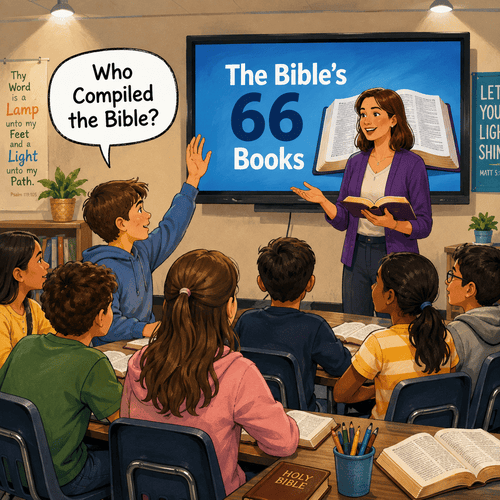
Pick up a Bible and you’re holding one book. Open it, and you find 66. They were written over roughly 1,500 years, on 3 continents, in 3 languages, by more than 40 different people—kings and shepherds, a doctor, a tax collector, a few fishermen. So a fair question comes to mind. Who gathered all this together? Who decided what went in? Or stayed out?
Many people assume there was a meeting. A room full of bishops, a long debate, a vote, and out came the Bible. Some go further and say a Roman emperor made the choice for political reasons. Others say the church simply invented the Bible and then told everyone to obey it.
None of that’s what happened. The real story is quieter, longer, and far more interesting.
The Question Behind the Question
The word canon comes from a Greek word meaning a measuring rod or ruler—a standard you measure other things against. When we talk about the canon of Scripture, we mean the list of books that carry God’s own authority.
Here’s the crucial point: nobody ever sat down and compiled the Bible. Two very different things happened, and people constantly mix them up.
- God gave the books. Over many centuries, God spoke through prophets and apostles, and their words were written down. This is what theologians call inspiration—God so guided the writers that what they wrote was His own word.
- God’s people recognised the books. As each book was given, the covenant community received it, copied it, read it publicly and lived by it. This is recognition—not creating authority, but noticing it.
Compilation is what happens at the end of that process, not the beginning. A gardener doesn’t make an apple. He picks it up and puts it in the basket because it’s already an apple.
The Westminster Confession of Faith puts it with beautiful precision. The authority of Scripture doesn’t depend on the testimony of any man or church, but wholly upon God, who is truth itself and the author of it. The church may move us to a high and reverent esteem for the Bible—but our full persuasion comes from the Holy Spirit working in our hearts alongside the evidence of Scripture itself.
TWO WORDS WORTH LEARNING
Inspiration—God’s act of giving the words. This makes a book Scripture.
Recognition—the church’s act of receiving what God gave. This doesn’t make a book Scripture; it acknowledges what God has already done.
Confuse the two and every question about the Bible becomes tangled. Keep them apart and the history becomes clear.
Written Words Were Built In from the Start
Long before there were councils, there was covenant—and covenants come with documents.
Meredith Kline, in The Structure of Biblical Authority, showed something that many readers find eye-opening. In the ancient Near East, when a king made a treaty with a smaller nation, the terms were written down, and a copy was deposited in the sanctuary of the smaller nation’s god. The written document was the relationship. Break the document, break the covenant.
Now look at how God deals with Israel at Sinai. Moses writes down all the words of the LORD (Exodus 24:4). The tablets are placed inside the ark. Later, Moses commands the Levites to take this Book of the Law and put it by the side of the ark of the covenant of the LORD your God, that it may be there for a witness against you (Deuteronomy 31:26).
This matters enormously. A written, authoritative, deposited collection isn’t a late invention of church politics. It’s built into the way God relates to His people from the very beginning. Canon is native to covenant.
How the Old Testament Grew
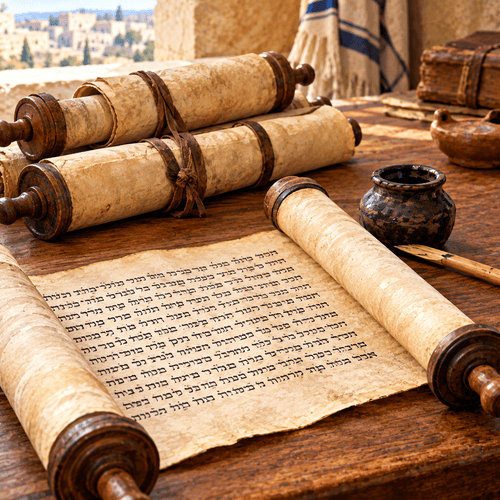
The Old Testament didn’t arrive as a finished library. It grew, book by book, as God kept speaking—and each time He spoke, His people added the new writing to what they already had.
Watch the pattern in the text itself:
| REFERENCE | WHAT HAPPENS |
|---|---|
| Exodus 24:4, 7 | Moses writes God’s words and reads them aloud to the people, who accept them. |
| Deuteronomy 31:24–26 | The completed Book of the Law is placed beside the ark as a permanent witness. |
| Joshua 24:26 | Joshua writes his words in the Book of the Law of God—adding to the existing collection. |
| 1 Samuel 10:25 | Samuel writes the rights and duties of kingship and laid it up before the LORD. |
| 2 Chronicles 34:14–21 | The rediscovered Book of the Law immediately carries binding authority over the king. |
| Proverbs 25:1 | Hezekiah’s men copy out more of Solomon’s proverbs—careful editorial work recorded inside Scripture. |
| Ezra 7:10; Nehemiah 8:1–8 | Ezra the scribe studies and teaches the Law; it is read publicly and explained to the people. |
Notice what’s missing from that list. There’s no committee. No vote. No moment where someone weighs competing books and picks winners. There’s only God speaking, and His people receiving, guarding and carefully copying what He said.
You’ll sometimes read that a body called the Great Synagogue, supposedly led by Ezra, fixed the Old Testament canon. Be careful here. That tradition comes from much later rabbinic sources and can’t be verified historically. The memory suggests scribal care, not a council that made canons.
Was the Old Testament Settled Before Jesus Came?
Yes—and the evidence is strong, varied and independent.
| WITNESS | DATE | WHAT IT SHOWS |
|---|---|---|
| Prologue to Ecclesiasticus | c. 132 BC | The translator refers to the Law and the Prophets and the other books—a recognised three-part collection already in place. |
| Dead Sea Scrolls | c. 250 BC–AD 68 | The Qumran community copied and commented on the Law and Prophets as authoritative. They treated no apocryphal book that way. |
| Josephus, Against Apion 1.38–41 | c. AD 95 | He mentions 22 books that the Jews trusted as sacred—and no book added since the days of King Artaxerxes, over 400 years earlier. (22, not 39, because several books were joined together on one scroll.) |
| Jesus, Luke 24:44 | c. AD 30 | He speaks of the Law of Moses and the Prophets and the Psalms—the same threefold division. |
| Jesus, Matthew 23:35 | c. AD 30 | From the blood of Abel to the blood of Zechariah: the first and last murders in the Hebrew ordering, which runs Genesis to 2 Chronicles. |
Two of those deserve a comment.
Josephus’ mention of 22 books isn’t a smaller Bible. The Hebrew Scriptures were counted differently—Judges and Ruth joined together, Jeremiah and Lamentations joined, the 12 minor prophets counted as one scroll, and so on. The content is our 39 books; only the accounting differs.
Christ’s testimony is the decisive one. In Matthew 23:35 Jesus does something remarkable. He assumes a fixed collection with a known beginning and a known end, and He expects His hearers to follow the reference without explanation. He never once corrects the Jewish canon, never adds a book, never removes one. He argues with the Pharisees about almost everything else. About the extent of Scripture there is silence—because there was no dispute.
MYTH CHECK: THE COUNCIL OF JAMNIA
You will still find websites claiming Jewish rabbis met at Jamnia around AD 90 and decided the Old Testament canon there.
The idea was proposed by Heinrich Graetz in 1871. It was a hypothesis, not a finding.
Jack P Lewis and Sid Z Leiman dismantled it in detailed studies. There’s no record of a council, no list produced, and no decision taken.
The rabbis did discuss whether Esther and Ecclesiastes defile the hands—but that was a discussion about books they already possessed and used, rather like debating why a classic is a classic.
The Old Testament was settled long before Jamnia, and the New Testament assumes it on every page.
Why Do Catholic and Protestant Bibles Differ?
Open a Roman Catholic Bible and you will find extra books between the Testaments—Tobit, Judith, Wisdom, Sirach, Baruch, 1 and 2 Maccabees, plus additions to Esther and Daniel. These are the Apocrypha, meaning hidden or obscure writings. Why the difference?
The honest answer is that the early church itself made a distinction, and that distinction held for over a thousand years.
- Jerome, who translated the Latin Vulgate around AD 400, separated the canonical books from books that the church reads for edification but does not use to establish doctrine. He said so plainly in his preface, and he was translating from the Hebrew precisely because he cared about the difference.
- Athanasius, in his Festal Letter of AD 367, listed the canonical books and then placed several others in a second class—useful for instruction, not for settling doctrine.
- Neither Christ nor any apostle ever quotes an Apocryphal book as Scripture. The New Testament cites the Old Testament hundreds of times, with formulas like it is written and God says. Not once for the Apocrypha.
- The Council of Trent, in 1546, raised most of these books to full canonical status—and it did so in direct reaction to the Reformation, twenty-nine years after Martin Luther posted his theses. Even then, Trent left out 1 and 2 Esdras and the Prayer of Manasseh, which had circulated in Latin Bibles for centuries.
So the Protestant position is not that the Reformers removed books. It is that the Reformers kept the older distinction, while Trent changed it. The Westminster Confession states the settled view: the Apocrypha, not being God-breathed, is no part of the canon of Scripture, and is to be regarded no differently from any other human writing.
The New Testament: Authority Came First
Here people often imagine the church slowly deciding which Christian writings it liked. The evidence points the other way. Apostolic authority came first; the collection followed it.
Start with the promise. On the night before He died, Jesus told the apostles that the Holy Spirit will teach you all things and bring to your remembrance all that I have said to you (John 14:26), and will guide you into all the truth (John 16:13). The New Testament is not an accident of history. It is the keeping of a promise.
The apostles knew what they were doing. Paul writes that what he commands is a command of the Lord (1 Corinthians 14:37). He thanks the Thessalonians for receiving his message not as the word of men but as what it really is, the word of God (1 Thessalonians 2:13). He instructs that letters be swapped between congregations (Colossians 4:16)—these documents were written to circulate.
Then come the two texts that settle the matter.
| TEXT | WHAT IT DOES |
|---|---|
| 1 Timothy 5:18 | Paul writes For the Scripture says, and then quotes two things: Deuteronomy 25:4 and the words of Jesus recorded in Luke 10:7. A Gospel is called Scripture, inside the New Testament. |
| 2 Peter 3:15–16 | Peter refers to Paul’s letters and notes that untaught people twist them as they do the other Scriptures. Paul’s writings are placed in the same category as the Old Testament, by an apostle. |
BB Warfield made the implication sharp. The canon of the New Testament was completed when the last authoritative book was given to any church by the apostles, and that was when John wrote the Revelation. Everything after that is the church gradually coming to know what it already had.
Herman Ridderbos put the same truth from another direction. The canon is bound to the once-for-all character of redemptive history. The apostolic era was foundational—built on the foundation of the apostles and prophets (Ephesians 2:20)—and foundations are not laid twice. When the apostles died, the possibility of new Scripture died with them.
How the 27 Books Were Gathered
If the books were already authoritative, why did it take time for the whole church to agree on the whole list? Because the church was spread across an empire, communication was slow, persecution was frequent, and a congregation in Gaul could not simply verify overnight whether a short letter claiming apostolic origin was genuine. Caution took time. Caution is a virtue.
Here’s what the record actually shows.
Late 1st to early 2nd century
- Clement of Rome (c. AD 96) quotes Paul’s letter to the Corinthians and expects the Corinthians to know it.
- Ignatius of Antioch and Polycarp (c. AD 110–115) use Paul’s letters and Gospel material freely, as common property of the churches.
Mid to late 2nd century
- Marcion (c. AD 144) rejected the Old Testament and cut the New down to an edited Luke and ten letters of Paul. Adolf von Harnack argued that Marcion thereby forced the church to create a canon. The evidence says the opposite: you cannot cut down a collection that does not yet exist. Marcion is a catalyst, not a creator. The church’s reply was not to invent a list but to reaffirm the books it was already using.
- Irenaeus (c. AD 180) treats the fourfold Gospel as an established fact of the universal church, so obvious to him that he reaches for cosmic analogies to explain why it could not be otherwise.
- Tatian’s Diatessaron (c. AD 170) weaves the Gospels into a single narrative—and weaves exactly four. You cannot harmonise four Gospels unless four Gospels are already the accepted set.
- The Muratorian Fragment lists most of our New Testament. It is usually dated around AD 170–200, though Albert Sundberg and Geoffrey Hahneman have argued for a fourth-century date. Even on the later dating, the other second-century evidence stands untouched.
3rd to 4th century
- Origen and Eusebius sort the writings into categories. In Ecclesiastical History 3.25, Eusebius lists the acknowledged books, the disputed books, and the outright spurious ones—and the spurious pile is where the Gnostic material sits.
- Athanasius, Festal Letter 39 (AD 367) gives us the earliest surviving list of exactly our twenty-seven books, no more and no fewer.
- The councils of Hippo (AD 393) and Carthage (AD 397) affirmed the list. These were regional North African synods, not worldwide councils, and they did not debate the books into existence. They ratified what the churches were already reading.
WHICH BOOKS WERE DISPUTED
Some books took longer to be universally received: Hebrews (its author was unknown), James, 2 Peter, 2 and 3 John, Jude and Revelation. Two things are worth noticing.
No core doctrine of the Christian faith rests on the disputed books alone. The Trinity, the deity of Christ, His atoning death, His bodily resurrection, justification by faith—all are taught fully in the books nobody ever questioned.
The disputes prove the church was careful, not careless. A body inventing a canon for political power would have moved fast and silenced doubt. Instead the churches asked hard questions for two centuries and refused to be hurried.
The slow patience of the early church isn’t a weakness in the story. It’s the best evidence we have that they believed they were receiving something rather than manufacturing it.
Did Constantine Choose the Books?
This is the most popular modern myth, spread far and wide by Dan Brown’s novel The Da Vinci Code and repeated in countless videos since. The claim is that the Emperor Constantine convened the Council of Nicaea in AD 325 and had the books chosen there, suppressing the alternatives.
Every part of that is false, and the facts are easy to check.
| THE CLAIM | THE REALITY |
|---|---|
| Nicaea decided the canon. | Nicaea met to address the teaching of Arius on the person of Christ. The canon does not appear in a single one of the council’s twenty canons, nor in its creed. |
| Constantine chose which books were in. | He commissioned Eusebius to prepare fifty copies of the Scriptures for the churches of Constantinople (Life of Constantine 4.36). Ordering copies of an existing collection is the opposite of choosing one. |
| Other gospels were banned and burned. | The Gnostic writings were never in general church use to begin with. Eusebius had already classed them as spurious, decades before Nicaea, and he was simply reporting the settled judgement of the churches. |
| The fourfold Gospel was imposed in the fourth century. | Irenaeus and Tatian show four Gospels firmly in place around AD 170–180, roughly a century and a half before Constantine was born into any of this. |
A useful test: if an emperor had imposed the Bible in 325, the churches of Syria, Egypt, North Africa, Gaul and Rome—who disagreed with each other about a great deal, and many of whom had recently been persecuted by emperors—would have had to be persuaded to abandon books they had been reading for generations. There is no trace of such a struggle in the historical record, because there was no such event.
What Tests Did the Early Church Use?
When churches did examine a writing, four questions came up again and again.
| TEST | THE QUESTION ASKED |
|---|---|
| Apostolicity | Does this come from an apostle, or from someone in the apostolic circle writing with apostolic backing—as Mark stood with Peter, and Luke with Paul? |
| Catholicity | Has this been received across the churches, not just in one region or by one faction? |
| Rule of faith | Does it agree with the gospel the apostles preached and the Scriptures already given? |
| Antiquity | Does it come from the apostolic age itself, rather than appearing suddenly a century later? |
Now the crucial qualification, and everything turns on it. These are recognition markers, not authority-granting tests. They’re how the church noticed which books bore the marks of God’s own voice. They’re not how the books got their authority.
Michael J Kruger, in Canon Revisited, has given a useful modern framework for this. He argues Scripture is self-authenticating, and that God provided the church with three things at once: the divine qualities of the books themselves, the apostolic origins that anchor them in redemptive history, and the corporate reception of the church guided by the Spirit. On this model we don’t need an infallible church to have an infallible Bible—any more than we need infallible eyes to see the sun.
John Calvin had said the same thing in his own way. In the Institutes he insists Scripture is self-authenticating, and that it is a wicked falsehood to make the certainty of God’s word depend on the judgement of men. The church is founded on the writings of the prophets and apostles (Ephesians 2:20). A house does not authorise its own foundation.
So Who Compiled the Bible?
Here’s the answer, as plainly as it can be put.
THE SHORT ANSWER
God gave the Bible. He spoke through prophets and apostles across 15 centuries, and His Spirit carried them along as they wrote.
God’s people received it. Israel guarded the Law and the Prophets. The churches copied, circulated and read the apostolic writings from the moment they were given.
No council ever created the canon. Councils recognised, listed and confirmed what the churches were already living by—often centuries after the fact.
No emperor ever chose the books. Constantine ordered copies of a Bible the church already had.
The Bible isn’t the church’s book about God. It is God’s book to the church.
That’s why the Reformers refused to let the question be framed as a contest between Bible and church. Rome asked, in effect: how do you know which books are Scripture unless the church tells you? Calvin’s answer was the sheep know the Shepherd’s voice. My sheep hear my voice, and I know them, and they follow me (John 10:27). The Westminster divines said the same when they declared the supreme judge in all controversies is nothing other than the Holy Spirit speaking in Scripture.
And this is why history should strengthen our confidence rather than shake it. The books were not chosen in a smoke-filled room. They were tested for centuries, across a divided empire, by churches with no central authority to enforce agreement, under persecution, with careful and sometimes uncomfortable honesty about which writings raised questions. Out of that long, slow, scattered process came one collection—recognised everywhere, by people who had every opportunity to disagree.
The Bible we hold hasn’t survived scrutiny by avoiding it. It has survived scrutiny by inviting it.
Tough Questions, Honest Answers
Who divided the Bible into chapters and verses?
The divisions we use today are recent additions and are not part of the inspired text. Chapter divisions are generally credited to Stephen Langton, Archbishop of Canterbury, working around AD 1227. Verse numbers for the New Testament came from the Parisian printer Robert Estienne in 1551, and he applied the system to the whole Bible in 1555. They are enormously useful for finding a passage, but they are human tools and occasionally unhelpful ones—a chapter break sometimes lands in the middle of an argument, as between Isaiah 52 and 53. The wise reader treats the numbers as signposts, not as walls, and always reads a verse in the flow of the paragraph around it.
Why does the Hebrew Bible arrange the books in a different order?
The Hebrew Scriptures are grouped as Law, Prophets and Writings, and end with 2 Chronicles rather than Malachi. Our English Bibles follow the ordering that came through the Greek Septuagint and the Latin Vulgate, which groups the books by type and finishes with the prophets. Both orders contain exactly the same books, so nothing is added or lost. The Hebrew order does explain a puzzle, though: when Jesus speaks of the blood of Abel to the blood of Zechariah in Matthew 23:35, He is naming the first and last murders of the Hebrew canon, which is a way of saying the whole of Scripture. The order is a matter of arrangement rather than authority, and knowing both helps us read Christ’s words as His first hearers did.
If Jude quotes 1 Enoch, does that make 1 Enoch part of the Bible?
No, and the principle is a simple one. Jude 14–15 does refer to a prophecy attributed to Enoch, but quoting a true statement from a book does not make the whole book Scripture. Paul does the same thing with pagan writers, citing the Greek poet Aratus in Acts 17:28 and the Cretan Epimenides in Titus 1:12, and nobody imagines Paul was canonising Greek poetry. Under inspiration, a biblical author may affirm a particular saying as true without endorsing the document it came from. What Jude affirms is that judgement is coming, which is thoroughly biblical; what he does not do is call 1 Enoch the word of God.
What about the letters mentioned in the Bible that we no longer have?
Scripture itself refers to writings we do not possess: an earlier letter to Corinth (1 Corinthians 5:9), a letter to Laodicea (Colossians 4:16), and older records such as the Book of Jashar (Joshua 10:13). This unsettles some readers, but it should not. Not everything an apostle wrote was intended by God to be Scripture for all time—Paul surely wrote notes about travel plans and greetings that served their moment. God preserved exactly what He purposed to preserve for the church in every age. The doctrine of preservation is not a promise that no piece of paper was ever lost; it is the promise that everything necessary for faith and life has been kept for us.
Does it matter that we don’t have the original manuscripts?
It matters less than people expect, and for a reason worth understanding. The original documents are called the autographs, and the copies are called apographs; what we possess are copies, in extraordinary abundance. For the New Testament there are thousands of Greek manuscripts, plus ancient translations and quotations in the church fathers, which lets scholars compare and cross-check with a thoroughness available for no other ancient text. The Westminster Confession makes a careful claim: the Scriptures were immediately inspired by God and by His singular care and providence kept pure in all ages. Note also that this is a different question from the one this article answers—which books belong is the question of canon, while how faithfully they have been copied is the question of transmission. Both have good answers, but they should not be muddled together.
Who compiled the first English Bible?
The first complete English Bibles came from the circle around John Wycliffe in 1382, translated from the Latin Vulgate and copied by hand. William Tyndale produced the first printed English New Testament from the Greek in 1526, and paid for it with his life. Miles Coverdale, the Great Bible, the Geneva Bible and finally the Authorised Version of 1611 followed, each building on Tyndale’s work more than most readers realise. It is important to see that this is translation history, not canon history—the list of books was long settled before a word of English was written. Confusing the two leads people to think the Bible was assembled in the sixteenth century, when what happened then was that an already-fixed collection was at last put into the language of ordinary people.
If the church recognised the canon, could the church have got it wrong?
This question assumes that our confidence rests on the church’s reliability, and that assumption is exactly what confessional Christianity denies. Our confidence rests on God’s determination that His people should hear His voice, and on the Spirit who works that recognition in them. God did not give His word and then leave the church without means to know it; the same Lord who inspired the Scriptures superintended their reception. This is why the Westminster Confession grounds assurance in the inward work of the Holy Spirit bearing witness by and with the word in our hearts, rather than in ecclesiastical authority. The remarkable historical convergence of scattered, divided, persecuted churches on one collection is not the ground of our confidence, but it is a striking confirmation of it.
Related Reads
- How Do We Know the Bible Hasn’t Been Changed?
- The Biblical Canon: The Journey from Scrolls to Scripture
- How Did Jews Know the Old Testament Canon Before Rome Did?
- Is the Biblical Canon Self-Authenticating?
- Does Jude Belong in the Bible?
- The Truth About Apocryphal Books: Why They’re Not in the Bible
- The Deuteronomy 34 Mystery: Who Wrote Moses’ Obituary?
- Why Didn't the Gnostic Gospels Make the Cut Into the Canon?
- Did Constantine Or the Church Invent the Trinity? What History Shows
- Why Isn't the Book of Tobit in the Bible? 5 Clear Reasons
- Why Isn’t the Book of Judith in the Protestant Bible?
- Letter of Jeremiah: Why Protestant Bibles Leave It Out
- Book of Jubilees: Why It Isn’t Scripture