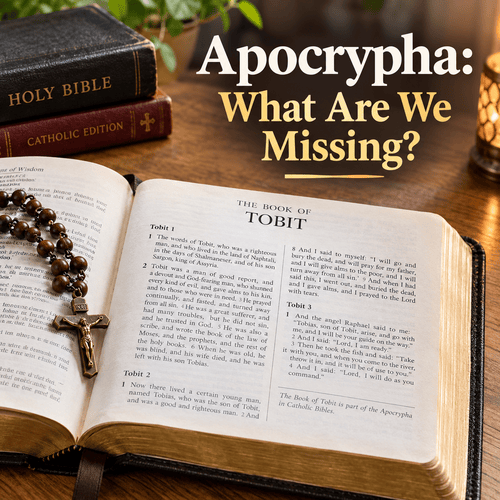
Picture this. An angel lies about who he is. A young man burns a fish’s heart and liver, and the smell chases away a demon. And a holy book promises giving money to the poor would wash away every sin.
This is the book of Tobit. It sits inside the Bibles of more than a billion Catholic and Orthodox Christians. But open a Protestant Bible and you will not find it.
So what happened? Did someone cut it out? Are Protestants missing part of God’s Word?
In this post, we shall look at five clear reasons why Tobit doesn’t belong in the Bible, and tackle the strongest arguments from the other side. But let’s be fair to Tobit. It isn’t a wicked book. It’s simply not God’s book.
THE SHORT ANSWER
Tobit was never in the Old Testament that Jesus used. The early church never agreed on it. It gets history wrong, clashes with Bible teaching and never claims a prophet’s voice. So Protestants may read it as an old Jewish story—but not as Scripture.
Key terms explained
| WORD | WHAT IT MEANS |
|---|---|
| Canon | The list of books that are truly God’s Word. It comes from a Greek word for a measuring rod. |
| Inspired | Breathed out by God. An inspired book has God as its true author (2 Timothy 3:16). |
| Apocrypha | Jewish books written mostly between the Old and New Testaments. The word means ‘hidden’. Protestants do not count them as Scripture. |
| Deuterocanonical | The Catholic name for the same books. It means ‘second canon’, as they were accepted later. |
| Septuagint | An ancient Greek translation of the Old Testament. Later Christian copies of it include Tobit. |
What’s the Book of Tobit?
Tobit is a short story. Here’s the plot in brief.
Tobit is a good Jewish man from the tribe of Naphtali, carried away by the Assyrians to the city of Nineveh. There he feeds the poor and risks his life to bury Jews the king has killed.
One night, bird droppings fall into his eyes and he goes blind. In his sorrow, he prays to die.
Far away, a young woman named Sarah prays the same prayer. She has been married 7 times, but each time a demon called Asmodeus has killed her husband on the wedding night.
God sends the angel Raphael to help. Tobit sends his son Tobias on a journey to collect some money, and Raphael goes with him, disguised as a man—along with the family dog.
On the way, Tobias catches a huge fish. He marries Sarah and burns the fish’s heart and liver, and the smoke drives the demon away. Back home, the fish’s gall cures Tobit’s eyes. Then Raphael reveals who he really is.
It’s a warm tale. But a good story isn’t the same thing as Scripture.
Tobit at a glance
| QUESTION | ANSWER |
|---|---|
| Where the story is set | Nineveh, after Assyria conquered northern Israel (700s BC) |
| When it was really written | Most scholars say about 225–175 BC—hundreds of years later |
| Original language | Aramaic or Hebrew (pieces were found among the Dead Sea Scrolls) |
| Length | 14 chapters |
| Counted as Scripture by | Catholic and Orthodox churches |
| Not counted as Scripture by | Jews (then and now) and Protestants |
Reason 1: It Was Never in the Bible Jesus Used
The first question isn’t, ‘Is Tobit a nice book?’ It is, ‘To whom did God give the Old Testament?’ Paul answers:
To begin with, the Jews were entrusted with the oracles of God.
Romans 3:2
‘Oracles’ means the very words God spoke. Israel received and kept them—and never counted Tobit among them.
Jesus Himself pointed to the same Bible. After He rose from the dead, He said:
Everything written about me in the Law of Moses and the Prophets and the Psalms must be fulfilled.
Luke 24:44
This was the 3-part Jewish Bible of His day. Tobit wasn’t in any of the 3.
Jesus gave an even sharper clue. He spoke of ‘the blood of Abel to the blood of Zechariah’ (Luke 11:51). Abel is the first murder in Genesis. Zechariah is the last in Chronicles (2 Chronicles 24:20–21), the last book in the Jewish order. So Jesus meant ‘from the first page to the last’—like our ‘from A to Z’. Tobit was outside those pages.
Jesus argued with the Jewish leaders about the Sabbath, divorce, the resurrection and their traditions. But He never said, ‘You have left books out of God’s Word.’
The New Testament quotes the Old Testament hundreds of times, but never quotes Tobit as ‘Scripture’.
Jewish historian Flavius Josephus, writing around AD 95, said the Jews had just 22 holy books. Later books lacked the same authority, ‘because of the failure of the exact succession of the prophets’ (Against Apion 1.8). In simple words: the prophets had stopped.
Roger Beckwith, in The Old Testament Canon of the New Testament Church (1985), showed this list was settled before Jesus was born. As BB Warfield argued, the church did not invent its Old Testament. It received it from Christ and the apostles.
WHY 22 BOOKS AND NOT 39?
The Jews counted the same books differently:
- The 12 Minor Prophets were counted as one book.
- First and Second Samuel were one book, and so were Kings and Chronicles.
- Ezra and Nehemiah were one book.
- Ruth was joined to Judges, and Lamentations to Jeremiah.
Same words, different counting.
Reason 2: The Early Church Never Agreed on It
Catholic friends often say, ‘The early church accepted Tobit.’ The real story is far more mixed.
Timeline: What Christians Said About Tobit
- AD 170—Melito of Sardis: This church leader travelled to the land of Israel to learn exactly which Old Testament books were accepted. His list doesn’t includeTobit.
- Early 200s—Origen: This great Bible scholar listed 22 Old Testament books, following the Jewish count. Tobit isn’t on his list.
- AD 367—Athanasius of Alexandria: He placed Tobit among books ‘not indeed included in the Canon, but appointed by the Fathers to be read’ by new believers.
- AD 390s—Jerome: The translator of the Latin Bible said books outside the Hebrew list ‘must be placed aside among the Apocrypha’. He translated Tobit only because 2 bishops asked—in a single day.
- AD 393 and 397—Hippo and Carthage: These local North African councils, guided by Augustine of Hippo, did include Tobit.
- 1532—Cardinal Thomas Cajetan: This senior Catholic leader followed Jerome: books like Tobit could build up believers but not prove doctrine.
- 1546—Council of Trent: Rome finally declared Tobit to be Scripture, with an ‘anathema’—a formal curse—on anyone who disagreed.
For 1,500 years the question stayed open. A book God’s people could not agree on for 15 centuries lacks the clear stamp of the books Jesus named.
Reason 3: It Gets Its History Wrong
‘Every word of God proves true,’ says Proverbs 30:5. God doesn’t make mistakes, so His Word doesn’t either.
Tobit isn’t set ‘once upon a time’. It names real kings and real events, so we can check it. When we do, cracks appear.
Tobit’s history check: the story against the facts
| TOPIC | WHAT TOBIT SAYS | WHAT REALLY HAPPENED |
|---|---|---|
| Sennacherib’s father | Sennacherib was the son of Shalmaneser (Tobit 1:15). | Sennacherib’s father was Sargon II, as Assyria’s own records show. |
| Who took Naphtali captive | Tobit’s tribe was taken away under Shalmaneser (Tobit 1:2). | The Bible says Tiglath-pileser took ‘all the land of Naphtali’ (2 Kings 15:29). |
| Tobit’s age | Tobit was a young man when his tribe turned away from Jerusalem (Tobit 1:4). That happened around 931 BC. | Tobit is still alive in Nineveh after 722 BC. Yet he dies at 112 (or 158 in some copies). The numbers cannot fit. |
| Who destroyed Nineveh | In many copies, Nebuchadnezzar and Ahasuerus captured Nineveh (Tobit 14:15). | Nineveh fell in 612 BC to Nabopolassar of Babylon and Cyaxares of the Medes. |
Princeton scholar Bruce Metzger noted errors like these in An Introduction to the Apocrypha (1957). They’re not copying slips. They’re built into the story.
Jesus’ parables never pretend to be history. Tobit dresses itself in real history—and gets it wrong.
Reason 4: It Teaches Things the Bible Doesn’t
Mistakes about kings are serious. Mistakes about salvation are far worse.
Where Tobit clashes with Scripture
| ISSUE | WHAT TOBIT TEACHES | WHAT THE BIBLE TEACHES |
|---|---|---|
| Paying for sin | Giving to the poor (‘almsgiving’) ‘delivers from death, and it will purge away every sin’ (Tobit 12:9). | Only Christ’s blood removes sin: ‘the blood of Jesus his Son cleanses us from all sin’ (1 John 1:7). |
| An angel who lies | Raphael says, ‘I am Azarias the son of the great Ananias, one of your relatives’ (Tobit 5:12). This is false. | ‘You shall not lie to one another’ (Leviticus 19:11). God’s holy angels serve ‘God, who never lies’ (Titus 1:2). |
| Magic cures | Smoke from a fish’s heart and liver drives off a demon (Tobit 6:7; 8:2–3). | God forbids charms and magic (Deuteronomy 18:10–12). Jesus ‘cast out the spirits with a word’ (Matthew 8:16). |
| A go-between for prayer | Raphael carries the prayers of God’s people up to God (Tobit 12:15). | ‘There is one mediator between God and men, the man Christ Jesus’ (1 Timothy 2:5). |
The Bible praises giving to the poor (Proverbs 19:17). The problem is making giving a way to pay for sin. That turns grace upside down:
For by grace you have been saved through faith. And this is not your own doing; it is the gift of God, not a result of works, so that no one may boast.
Ephesians 2:8–9
Some say ‘Azarias’ (‘the LORD helps’) is just a riddle-name. But Raphael also claims a human father and a family link to Tobit—both false. Cambridge scholar William Whitaker pressed this point in 1588: a holy angel wouldn’t lie.
John Calvin, in his Antidote to the Council of Trent (1547), warned Rome used these books to prove its own teachings—from Tobit, ‘satisfactions’ (good works done to pay for sin) and exorcisms. If Tobit were Scripture, free grace would be under attack.
Reason 5: It Never Claims to Speak for God
Scripture comes from God through His chosen messengers:
Long ago, at many times and in many ways, God spoke to our fathers by the prophets.
Hebrews 1:1
Peter adds ‘men spoke from God as they were carried along by the Holy Spirit’ (2 Peter 1:21).
Tobit never claims this. No prophet wrote it. It never says, ‘Thus says the LORD.’
The Apocrypha itself admits the prophets had gone silent. First Maccabees—also in Catholic Bibles—speaks of distress ‘such as had not been since the time that prophets ceased to appear among them’ (1 Maccabees 9:27).
Michael Kruger, in Canon Revisited (2012), argues God’s books carry God’s own marks, and His people recognise His voice in them. As Jesus said, ‘My sheep hear my voice’ (John 10:27). Believers hear that voice in the 39 books—not in Tobit.
Francis Turretin of Geneva summed it up in the 1600s: the Apocrypha weren’t written by prophets, were never received by the Jewish church and contain clear errors.
So the Protestant confessions—written statements of belief—speak plainly.
WHAT THE PROTESTANT CONFESSIONS SAY
Belgic Confession (1561), Article 6. This confession names Tobit directly. It says of these books: ‘All of which the Church may read and take instruction from, so far as they agree with the canonical books; but they are far from having such power and efficacy as that we may from their testimony confirm any point of faith or of the Christian religion.’
Westminster Confession (1646), Chapter 1.3. ‘The books commonly called Apocrypha, not being of divine inspiration, are no part of the canon of the Scripture; and therefore are of no authority in the Church of God, nor to be any otherwise approved, or made use of, than other human writings.’
In plain words: you may learn from Tobit, as you learn from any old book. But it cannot decide what Christians must believe.
‘But What About…?’ Answering the Strongest Objections
Here are the five most common objections, with short answers.
Five objections, five answers
| THE OBJECTION | OUR ANSWER |
|---|---|
| ‘The apostles used the Septuagint, and it had Tobit.’ | The Septuagint copies that include Tobit were made by Christians in the 300s and 400s, and they disagree on which extra books belong. Philo of Alexandria, a Jewish writer of Jesus’ time, used the Greek Old Testament but never quotes Tobit. |
| ‘Tobit was found among the Dead Sea Scrolls.’ | True. But the same caves held 1 Enoch and Jubilees, which even Rome rejects. Owning a book is not calling it Scripture. |
| ‘Church councils at Hippo and Carthage accepted it.’ | They were local councils, not the whole church. Athanasius and Jerome disagreed, and Rome did not settle it until 1546. |
| ‘Protestants removed seven books from the Bible.’ | You cannot remove what was never in. Martin Luther kept Tobit in his 1534 Bible, in a separate section of books ‘not held equal to the Holy Scriptures, and yet profitable and good to read’. |
| ‘The mistakes don’t matter. Tobit is a religious novel.’ | Catholic scholar Joseph Fitzmyer did treat it as a kind of novel. But Rome still calls it inspired—and an inspired book cannot teach that giving money purges sin. |
WHAT TOBIT GETS RIGHT
To be fair, Tobit has much to admire:
- Care for the poor: Tobit feeds the hungry and clothes the naked.
- Courage: he buries the dead even when it puts his life at risk.
- Honest prayer: Tobit and Sarah pour out their pain to God.
- Pure marriage: Tobias marries Sarah with prayer, not lust.
- Honour for parents: Tobias obeys and cares for his blind father.
Luther felt that even if it was not true history, it was a fine and godly play. That is its right place: a good story, not God’s Word.
Conclusion: Trust the Bible Jesus Trusted
This debate isn’t about losing a book. It’s about trusting the Bible Jesus trusted. He named its parts and marked its borders, from Abel to Zechariah. He never added Tobit.
The 66 books in your Bible aren’t missing anything you need. Paul says:
All Scripture is breathed out by God and profitable for teaching, for reproof, for correction, and for training in righteousness, that the man of God may be complete, equipped for every good work.
2 Timothy 3:16–17
Complete. Equipped. Nothing missing.
So build your faith on the books that carry the Good Shepherd’s voice. Salvation doesn’t come from fish smoke or from money given to the poor. It comes from the blood of Jesus, which ‘cleanses us from all sin’.
Tough Questions, Honest Answers
Is the archangel Raphael mentioned anywhere in the Protestant Bible?
No. Raphael’s name appears only in Tobit and in other books outside the Bible, such as 1 Enoch. The Bible names just two angels: Michael (Daniel 10:13; Jude 9) and Gabriel (Daniel 8:16; Luke 1:19). Revelation 8:2 does speak of ‘the seven angels who stand before God’, but it never gives their names. Because Raphael comes from a book that is not Scripture, Christians should not pray to him or build teaching around him. We can thank God that His angels are ‘ministering spirits sent out to serve’ His people (Hebrews 1:14), without needing to know their names.
Can Christians use the prayer of Tobias and Sarah at a wedding?
Tobit 8:5–8 is one of the most popular wedding readings in the world. In it, Tobias thanks God for marriage and asks for mercy so that he and Sarah may grow old together. There’s nothing wrong with a couple borrowing those words as a prayer, just as we might use a line from an old hymn. But it shouldn’t be introduced as ‘a reading from Scripture’, because it isn’t. Couples who want a Bible reading have rich choices, such as Genesis 2:18–24, Ephesians 5:22–33 or 1 Corinthians 13. That way, the service rests on God’s Word, and Tobit’s words can be shared simply as a beautiful old prayer.
Who is the demon Asmodeus?
Asmodeus is the evil spirit in Tobit who kills Sarah’s seven husbands. Many scholars think the name comes from Aeshma Daeva, a Persian name for a demon of anger. Later Jewish legends made him a ‘king of demons’, and today he turns up in films, games and fantasy books. The Bible itself never mentions him. Scripture does teach that evil spirits are real, but it never gives us a list of demon names and powers to study. Instead, it points us to Christ, who ‘disarmed the rulers and authorities’ at the cross (Colossians 2:15).
Did Jesus’ ‘Golden Rule’ come from Tobit 4:15?
Tobit 4:15 says, ‘What you hate, do not do to anyone.’ A similar saying is linked to Hillel, a Jewish teacher who lived just before Jesus. But Jesus did not simply copy either one. He turned the rule from a negative into a positive: ‘So whatever you wish that others would do to you, do also to them, for this is the Law and the Prophets’ (Matthew 7:12). The negative rule only asks us not to harm others; Jesus calls us to actively love them. And notice that He says this rule sums up ‘the Law and the Prophets’—the Bible of His day—not Tobit.
Is it wrong for a Christian to read the book of Tobit?
No. Reading Tobit is not a sin. It can help us understand how faithful Jews lived, prayed and suffered in the centuries before Christ came. The key is to read it the way we read any old religious book: with thanks for what is good, and with care where it departs from God’s Word. Never use it to settle a question of faith or practice. As Paul says, ‘test everything; hold fast what is good’ (1 Thessalonians 5:21).
Did the 1611 King James Bible include Tobit?
Yes. The first King James Bible of 1611 printed Tobit and the rest of the Apocrypha in a separate section between the Old and New Testaments. The earlier Geneva Bible did the same, with a note that these books were not to be used to prove Christian teaching. They were placed apart on purpose, to show they were not equal to Scripture. Over time, many printers left the section out, partly to save cost and partly to avoid confusion. In 1826 the British and Foreign Bible Society decided to stop printing it, and most Protestant Bibles since then have followed.
Why do Orthodox Bibles have even more books than Catholic Bibles?
Orthodox Bibles usually include all of Rome’s extra books, plus others such as 1 Esdras, 3 Maccabees, the Prayer of Manasseh and Psalm 151. The Ethiopian Orthodox Church goes further still, adding books such as 1 Enoch and Jubilees. The Orthodox churches have never fixed one single official list for all their members. This shows something important. Once you step outside the Hebrew Bible that Jesus used, there is no clear line where the list should stop. The Protestant Old Testament is not the ‘short’ list; it is the original list.
Related Reads
- Why Isn’t the Book of Judith in the Protestant Bible?
- The Truth About Apocryphal Books: Why They’re Not in the Bible
- How Did Jews Know the Old Testament Canon Before Rome Did?
- The Biblical Canon: The Journey from Scrolls to Scripture
- Is the Biblical Canon Self-Authenticating?
- Who Compiled the Bible? How 66 Books Became One
- The Masoretic and Septuagint: How Ancient Texts Shaped the Bible
- 400 Years of Silence: What Was God Doing Between the Testaments?
- Wisdom of Solomon: Wise Words but Not Scripture
- Why Is Maccabees Not in the Bible? The Case Explained