John is an old man now, exiled to the rocky island of Patmos “on account of the word of God and the testimony of Jesus” (Revelation 1:9). Decades have passed since he leaned against Jesus at the Last Supper and heard Him say “I am the way, the truth, and the life.” On this particular Lord’s day, “in the Spirit,” a voice like a trumpet turns him around. And what he sees drops him to the ground as though dead.
7 golden lampstands. A figure among them with hair white as wool, eyes like blazing fire, feet like burnished bronze, a voice like the roar of many waters, a face shining like the sun in full strength. This isn’t the itinerant rabbi John once walked beside in Galilee. This is the same Jesus, entirely unveiled.
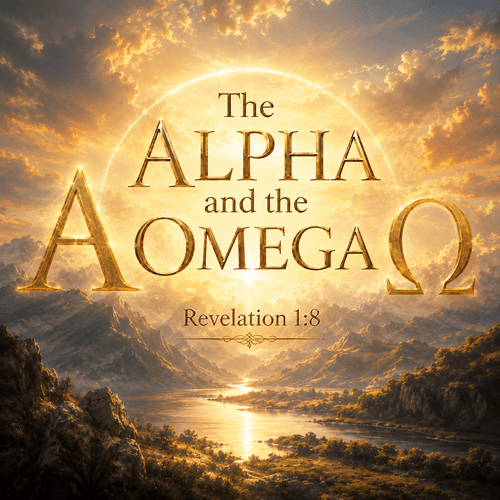
“Fear not,” the voice says. “I am the first and the last, and the living one. I died, and behold I am alive forevermore, and I have the keys of Death and Hades” (Revelation 1:17–18). A few verses earlier, the same book has already introduced this title in its opening greeting: “I am the Alpha and the Omega,” says the Lord God, “who is and who was and who is to come, the Almighty” (Revelation 1:8). 7 declarations were made in the ordinary daylight of an earthly ministry. This 8th and final one comes from the throne room.
I AM THE ALPHA AND THE OMEGA, AT A GLANCE
Reference: Revelation 1:8 (see also 22:13). Validating sign: John’s vision of the glorified Christ (Revelation 1:12–18)—white hair, eyes of fire, the keys of Death and Hades. Old Testament root: God’s repeated self-description as “the first and the last” (Isaiah 44:6; 41:4; 48:12). Core claim: Jesus is not merely eternal in the sense of existing forever—He is the beginning and the end of history itself, the one who authors, sustains, and will bring every story, including the reader’s, to its conclusion.
This post is Part 9 of a series on Jesus’ eight “I am” statements. Start with the series introduction for the full roadmap.
The Vision That Validates the Claim
Unlike the earlier signs in this series, this one isn’t a miracle performed in front of witnesses during Jesus’ earthly life. It’s a vision, given directly to John, of who Jesus already is now that death has been fully and finally conquered.
| STAGE | REVELATION 1 REFERENCE | WHAT HAPPENS |
|---|---|---|
| The setting | 1:9–11 | John, exiled on Patmos, is “in the Spirit on the Lord’s day” when he hears a voice like a trumpet behind him |
| The appearance | 1:12–16 | John turns and sees seven golden lampstands and “one like a son of man”—white hair, eyes like fire, feet like burnished bronze, a voice like many waters, seven stars in His right hand, a sword from His mouth, a face like the sun |
| John’s response | 1:17a | Overwhelmed, John falls at His feet “as though dead” |
| The self-identification | 1:17b–18 | “Fear not, I am the first and the last, and the living one. I died, and behold I am alive forevermore, and I have the keys of Death and Hades” |
| The commission | 1:19–20 | John is told to write what he has seen, and given the meaning of the lampstands and stars—the seven churches and their angels |
Every other sign in this series proves something Jesus can do. This one proves something Jesus already is—unveiled, glorified, and holding authority over the one power no human ruler has ever controlled.
An Ancient Claim, Made in a New Language
Centuries earlier, God had already described Himself to Israel in almost identical terms, reassuring an exiled people that no rival power, however impressive, could rival Him.
| “THE FIRST AND THE LAST” (ISAIAH 44:6) | I AM THE ALPHA AND THE OMEGA (REVELATION 1:8; 22:13) | |
|---|---|---|
| Source | “Thus says the Lord… I am the first and I am the last; besides me there is no god” | Spoken in the book’s greeting of “the Lord God… the Almighty,” and later placed explicitly in the risen Christ’s own mouth (Revelation 22:13) |
| Form | A Hebrew idiom for exclusive, eternal deity | The same claim rendered in Greek, using the first and last letters of the alphabet, for an empire-wide audience |
| Situation addressed | Reassuring exiled Israel that idols are powerless and only the Lord controls history | Reassuring seven persecuted churches that the risen Christ, not Caesar, holds ultimate power over history |
| Grounding | Establishes God as sole sovereign over Israel’s past, present, and future | “I have the keys of Death and Hades” (1:18)—the same sovereignty now grounded in a demonstrated victory over death itself |
Isaiah’s original hearers had only a promise to hold on to. John’s readers, under active Roman persecution, are given something sturdier: the same claim, now backed by a resurrection they could trace to living witnesses.
I Am the Alpha and the Omega (Revelation 1:8; 22:13)
Alpha and Omega are simply the first and last letters of the Greek alphabet—the equivalent of an English speaker saying “from A to Z.” The claim isn’t only that Jesus exists before and after all things, but that He comprehends and authors everything in between. Nothing in history falls outside the span these two letters bracket.
The vision’s details reinforce the claim in a striking way. “His head and his hair were white, like white wool, like snow” (Revelation 1:14) echoes, almost word for word, Daniel’s description of “the Ancient of Days,” whose “clothing was white as snow, and the hair of his head like pure wool” (Daniel 7:9). Daniel’s vision had shown two figures—the Ancient of Days and “one like a son of man” who approaches Him (Daniel 7:13). John’s vision applies the Ancient of Days’ own appearance directly to the risen Son of Man, merging what Daniel had shown as two figures into the one glorified Christ standing among the lampstands.
WHAT DOES “ALPHA AND OMEGA” ACTUALLY MEAN?
It is a merism—a figure of speech that names two extremes to represent everything between them, the way English speakers say “from A to Z” to mean the whole range, not just the first and last letters. “I am the Alpha and the Omega” claims comprehensive authority over the entire span of history, not merely existence at its two edges.
Older Roots: “First and Last” as God’s Own Signature
Isaiah’s “first and last” language is the direct root behind this claim, repeated across several chapters as God’s own answer to the idols Israel was tempted to trust instead.
| PASSAGE | WHAT HAPPENS | CONNECTION TO REVELATION 1 |
|---|---|---|
| Genesis 1:1 | “In the beginning, God created the heavens and the earth” | Establishes God as history’s starting point, the “Alpha” half of the claim |
| Isaiah 41:4 | “Who has performed and done this, calling the generations from the beginning? I, the Lord, the first, and with the last; I am he” | Ties the “first and last” title to God’s sovereign control over the rise and fall of nations |
| Isaiah 44:6 | “I am the first and I am the last; besides me there is no god” | The direct Old Testament root behind Revelation 1:8 and 22:13 |
| Isaiah 48:12 | “I am he; I am the first, and I am the last” | A third repetition of the same claim, underlining how central it was to Israel’s understanding of God |
| Daniel 7:9, 13 | The Ancient of Days, clothed in white, and “one like a son of man” approaching Him | The direct visual source behind John’s description of the glorified Christ (see above) |
Every one of these passages was Israel’s answer to a world full of rival claimants to ultimate power. Revelation simply applies the same answer to a new rival—Rome—and places the title, unmistakably, in the mouth of the risen Jesus.
What This Means for the Church
The 7 churches receiving this vision were living under real pressure to treat Caesar as lord, with the power of life and death that title implied. Revelation 1 answers that claim directly: Caesar does not hold the keys of Death and Hades. Jesus does. Whatever power a hostile world can actually exercise, it was never the ultimate power to begin with.
That same comfort holds for a very different kind of pressure today—the fear that history is chaotic, or that a person’s own story is too small or too damaged to matter within it. The Alpha and Omega does not merely observe history from outside it. He authored its beginning, and He has already secured its end.
Tough Questions, Honest Answers
Is “I am the Alpha and the Omega” in Revelation 1:8 actually spoken by Jesus, or by God the Father?
Verse 8 attributes the title to “the Lord God… the Almighty” in the book’s opening greeting, which on its own could be read as the Father speaking. Revelation removes the ambiguity by its final chapter, where the identical title is placed explicitly in the mouth of the risen Christ: “I am the Alpha and the Omega, the first and the last, the beginning and the end” (Revelation 22:13), spoken by the one who says, “Behold, I am coming soon” (22:12)—unmistakably Jesus. Revelation’s consistent pattern of applying the same divine titles to both the Father and the Son, without distinction, is itself among Scripture’s clearest statements of Christ’s full deity.
How does the description of the glorified Christ (white hair, eyes of fire) connect to Daniel’s vision of the “Ancient of Days”?
The connection is close to a direct quotation. “White… like wool, like snow” in Revelation 1:14 echoes Daniel 7:9’s description of the Ancient of Days almost word for word. Daniel’s vision presented the Ancient of Days and “one like a son of man” as two distinct figures in the same throne room (Daniel 7:9, 13). John’s vision applies the Ancient of Days’ own appearance to the glorified Son of Man, merging what Daniel had shown separately into a single person.
Why does this final “I am” statement come from a vision decades after the resurrection, rather than during Jesus’ earthly ministry like the other 7?
The first 7 were spoken in the ordinary circumstances of an earthly life, in a measure of humility Paul describes as Christ “emptying Himself” (Philippians 2:6–8). This 8th statement is spoken from unveiled glory, after death has already been defeated—fitting for a claim about holding “the keys of Death and Hades” (1:18), which could only be made with full authority once the resurrection had actually happened.
Does “the Almighty” (Revelation 1:8, from the Greek pantokrator) mean something more specific than simply “all-powerful”?
Yes—it emphasises active rule rather than raw power held in the abstract, closer to “the one who holds all things firmly in hand.” The term appears almost exclusively in Revelation among New Testament books, fitting for a book largely concerned with who actually governs history while it looks, on the surface, like chaos and persecution are winning.
What comfort would this vision have offered the seven churches, who were facing real persecution under Rome?
Rome’s imperial cult claimed Caesar as a divine lord with power of life and death over his subjects. Revelation 1 answers that claim directly: the true holder of “the keys of Death and Hades” (1:18) is not Caesar but the risen Christ. Rome’s power, however painfully real, was never the deepest or the last word.
Is “Alpha and Omega” simply another way of saying “eternal,” or does it claim something more specific?
It claims more than endless existence. “The beginning and the end” (22:13) implies purposeful authorship of history’s entire arc, not just presence before it started and after it finishes. The claim is not only that Jesus always was and always will be, but that the whole story in between belongs to Him too.
How does this final statement relate back to the very first one in this series—does the series actually go somewhere, or is it eight separate claims?
It gathers them all into one. The bread of life answered hunger. The light of the world answered darkness. The door answered the question of access. The good shepherd answered the cost of belonging to Him. The resurrection and the life answered death. The way, the truth, and the life answered where the road actually leads. The true vine answered how fruit keeps coming. The Alpha and Omega closes the circle: the one who met each of those specific needs is also the sovereign author and destination of history itself—the eternal “I AM” holding every story, including the reader’s own, securely within His own.
Continue the Series
THIS IS PART 9 OF 9—THE FINAL STATEMENT
Jesus makes eight “I am” declarations in Scripture, each validated by a sign and rooted in the Old Testament. Read the series introduction for the full roadmap, including the Bread of Life, the Light of the World, the Door, the Good Shepherd, the Resurrection and the Life, the Way the Truth and the Life, and the True Vine.
Related Reads
- Jesus’ ‘I AM’ Statements: Proclamations of Deity (Series Introduction)
- I Am the Bread of Life: Why Some Followers Walked Away (John 6:35)
- I Am the Light of the World: Sight Given, Sight Refused (John 8:12)
- I Am the Door: The Only Way Into the Fold (John 10:7)
- I Am the Good Shepherd: A Death Freely Chosen (John 10:11)
- I Am the Resurrection and the Life: Four Days Too Late? (John 11:25)
- I Am the Way, the Truth, and the Life: One Claim, Not Three (John 14:6)
- I Am the True Vine: What Israel’s Golden Vine Could Not Be (John 15:1)