
Every December, the question echoes on the social media, and in sanctuaries and living rooms alike: Why did God become man? The manger scene is beautiful, but what made it necessary? Hebrews 2:9-18 gives us the answer, and it’s far more profound than sentiment or symbolism. Christ’s incarnation wasn’t a divine option—it was an absolute requirement for our salvation. This passage reveals four compelling reasons why Jesus had to be born.
1. To Taste Death For Everyone
“But we see Him who for a little while was made lower than the angels, namely Jesus, crowned with glory and honour because of the suffering of death, so that by the grace of God He might taste death for everyone” (Hebrews 2:9).
Here’s the central paradox of Christmas: Jesus was born so He could die. The incarnation was the necessary prelude to the cross, speaking directly to penal substitutionary atonement—Christ standing in our place, bearing the punishment our sins deserved.
But why did God have to become human? Because justice required a human to pay humanity’s debt. We broke God’s law; one of us needed to satisfy it. Yet only God could make that payment infinitely valuable, sufficient to cover the sins of all His elect. The baby in Bethlehem was both—fully God and fully man. Only such a person could “taste death” in a way that would count for everyone God intended to save.
The phrase “by the grace of God” reminds us this was undeserved mercy. We earned death; Christ volunteered for it. His birth set the stage for the most magnificent exchange in history.
2. To Destroy The Devil’s Power
“Since therefore the children share in flesh and blood, He himself likewise partook of the same things, that through death He might destroy the one who has the power of death, that is, the devil” (Hebrews 2:14).
Christmas was an invasion. When Christ took on flesh and blood, God launched His decisive assault on enemy-occupied territory. Satan’s power wasn’t destroyed from a safe distance—Jesus entered the battlefield by being born as we are born.
This fulfils Genesis 3:15, where God promised the seed of the woman would crush the serpent’s head. But notice the method: “through death.” Christ had to die to destroy the one who wielded death as a weapon. The incarnation made this possible.
The irony is perfect: Satan’s greatest weapon became his downfall. When Christ died and rose again, death itself died. The devil’s power wasn’t negotiated away—it was destroyed. And it began with a birth in Bethlehem.
3. To Free Those In Bondage To Fear
“And deliver all those who through fear of death were subject to lifelong slavery” (Hebrews 2:15).
Why are we enslaved? Not primarily by external chains, but by internal terror—the fear of death. We spend our lives running from the inevitable, anxious about the appointment we cannot cancel.
Jesus was born to liberate us from this bondage. By conquering death, He removes its sting. By rising from the grave, He proves death is a doorway, not a dead end. Christ’s work doesn’t merely begin to free us—we ARE freed. The chains are already broken for those in Christ.
This is practical, not theoretical. Christians can face mortality differently. We can make decisions without death-fear as our master, sacrifice and give our lives away because we’re no longer slaves to self-preservation. Christ’s birth made this freedom possible.
4. To Become A Merciful And Faithful High Priest
“Therefore He had to be made like His brothers in every respect, so that He might become a merciful and faithful high priest in the service of God, to make propitiation for the sins of the people. For because He Himself has suffered when tempted, He is able to help those who are being tempted” (Hebrews 2:17-18).
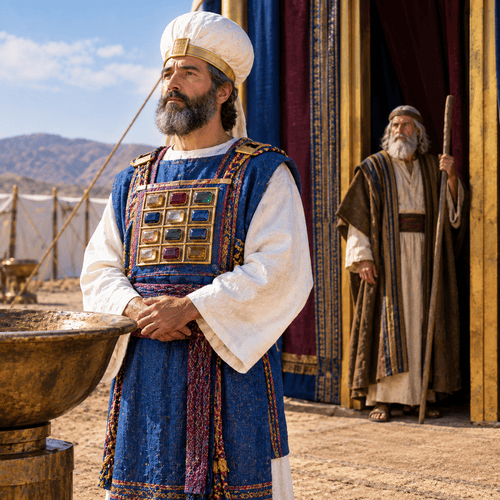
Here’s the fourth reason Jesus was born: to represent us before God as our High Priest. He “had to be made like His brothers in every respect.” Why? Because a priest represents his people, standing between them and God.
The Old Testament priests were human, offering sacrifices for human sins. But they were imperfect, and their sacrifices were temporary. Christ is the perfect High Priest because He combines full divinity with full humanity. He’s merciful because He experienced our struggles firsthand. He’s faithful because He perfectly fulfilled what the Levitical priesthood foreshadowed.
The word “propitiation” is crucial. Christ doesn’t merely sympathise with us; He satisfies God’s righteous wrath against our sin. This required His human nature. God’s justice demanded payment in the same currency as the debt—a human life.
And there’s profound comfort here: “He is able to help those who are being tempted.” Because Jesus was born, lived, and was tempted as we are, He understands. Our High Priest isn’t distant. He knows what it’s like to be us.
The Wisdom Of The Incarnation
Christmas celebrates the most necessary event in redemptive history. Jesus was born so He could die for us, destroy Satan’s power, free us from fear, and serve as our perfect High Priest. Each reason required the incarnation. Each reason reveals God’s wisdom and love.
The baby in the manger came to accomplish what no one else could. He became like us to save us. And that’s why we worship Him—not just during Christmas, but forever.
RELATED FAQs
What does “made lower than the angels” mean in Hebrews 2:9?
This refers to Christ’s voluntary humiliation in taking on human nature. As DA Carson notes, the author quotes Psalm 8, which originally spoke of humanity’s dignity, and applies it to Christ who became fully human. Jesus temporarily assumed a position lower than angels by entering our mortality and limitations. This “lowering” was essential—only by becoming truly human could He represent us and die in our place.
Why does Hebrews 2:10 say it was “fitting” for God to make Jesus perfect through suffering?
The word “fitting” (Greek: prepō) means “appropriate” or “becoming”—it aligned with God’s character and purposes. Thomas Schreiner explains that “perfect” here doesn’t mean Jesus lacked moral perfection, but that He was “completed” or “qualified” for His priestly work through experiential suffering. Christ’s suffering wasn’t arbitrary; it was the divinely ordained path to becoming our sympathetic High Priest. God’s wisdom determined that the Captain of our salvation would lead by example, enduring what we endure.
Does Hebrews 2:11 teach that we become divine like Jesus?
No, this verse teaches the opposite—that Jesus became human like us. When it says sanctifier and sanctified are “all of one,” modern Reformed scholars like Richard Phillips understand this to mean we share a common humanity with Christ through the incarnation. Jesus isn’t ashamed to call us brothers because He fully entered our human family. The point isn’t our elevation to divinity but Christ’s condescension to humanity, making genuine solidarity possible.
How does Hebrews 2:13 connect to Isaiah, and why does it matter?
The author quotes Isaiah 8:17-18, where the prophet and his children stood as signs to Israel, trusting God amid opposition. Bruce Waltke and other Old Testament scholars note the writer of Hebrews sees Jesus as the ultimate faithful Israelite who trusts the Father completely. By identifying with the “children God has given,” Christ demonstrates His full identification with God’s people. This shows Jesus didn’t just die for us abstractly—He lived in covenant relationship with the Father on our behalf.
What do modern scholars say about the phrase “taste death for everyone” in verse 9?
Reformed exegetes like Michael Horton note “everyone” (pantos) must be understood in context of Hebrews’ focus on “the children” and “brothers” (verses 10-13). It doesn’t mean universal salvation but the sufficiency and efficacy of Christ’s death for all God’s elect across all nations, not just Jews. FF Bruce emphasised this represents the completion of Christ’s atoning work—He fully experienced death’s bitterness so His people wouldn’t have to bear its ultimate sting. The tasting was complete, not partial.
Why does verse 16 say Jesus helps Abraham’s offspring, not angels?
This verse clarifies Christ’s mission: He came to redeem humanity, not fallen angels. As John Owen argued centuries ago (still influential in Reformed thought today), this reveals God’s sovereign choice—angels who sinned receive no Redeemer, but humans do. The reference to “Abraham’s offspring” emphasises covenant faithfulness; God keeps His promises to save His people. Modern scholars like Peter O’Brien see this as highlighting the incarnation’s specificity—Jesus became what we are (human) to save who God chose (His covenant people).
How does this passage address the problem of Jesus being tempted if He’s God?
Hebrews 2:18 states Jesus “suffered when tempted,” and verse 17 emphasises He was “made like his brothers in every respect.” Reformed theologian JI Packer explained that Christ’s deity didn’t shield His humanity from real temptation—His human nature experienced genuine testing. However, as Wayne Grudem notes, the incarnation allowed Christ to experience temptation’s full force without sinning, actually proving His strength, not weakness. Because He was tempted in His human nature yet never yielded, He perfectly understands our struggles and can genuinely help us.