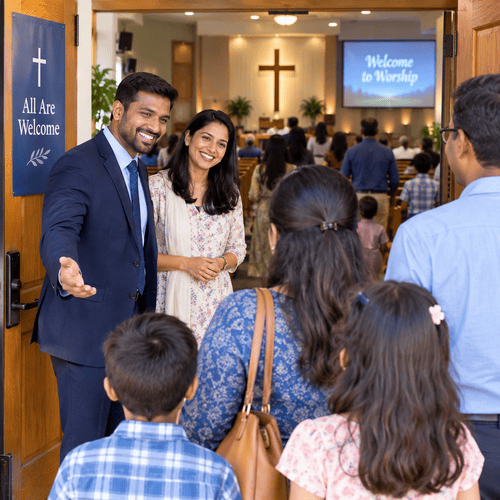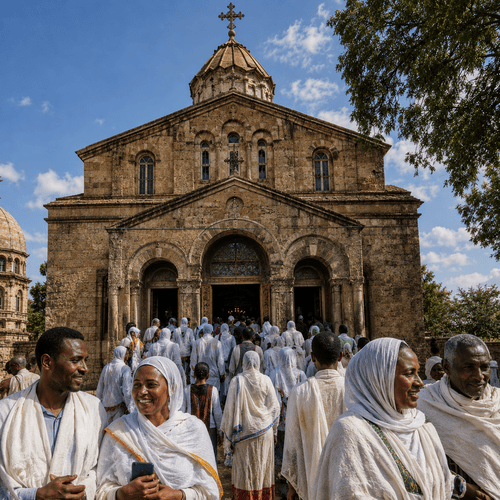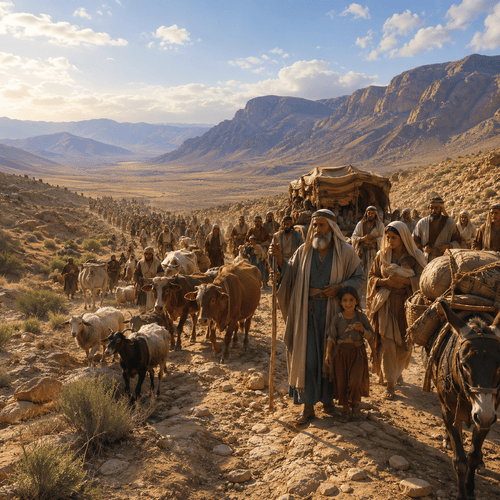
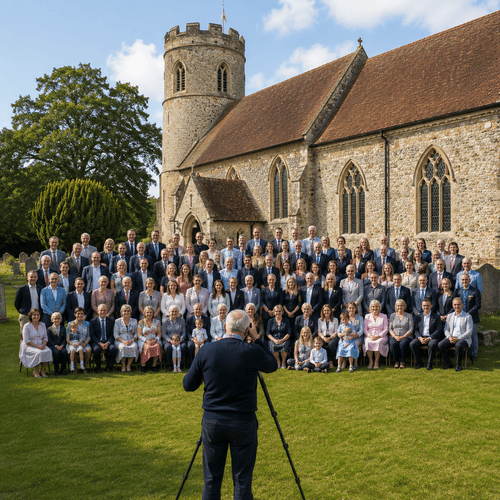
There’s an old children’s rhyme, acted out with folded hands: “Here’s the church, here’s the steeple, open the doors and see all the people.” It’s charming—but it’s almost exactly backwards. The rhyme puts the building first and the people inside it next, as though the church were the brick shell and the congregation merely its contents. Ask most people today where their church is, and they’ll give you a street address. Ask what it looks like, and they’ll describe a roof, a spire. Or perhaps some stained glass.
But when the first Christians used the word “church”, they pictured none of that. They had no buildings. They met in living rooms, in rented halls, beside rivers, and sometimes in hiding. When the apostle Paul greeted “the church” in someone’s house, he wasn’t greeting the house.
So is the church a building or the people? The Bible’s answer is clear and freeing: the church is the people, never the bricks. But there’s a catch worth knowing upfront—“not a building” doesn’t mean “so I can skip gathering”. This article unpacks what the church actually is, why the confusion runs so deep, and what it means for us.
The quick answer
The church is people, not a building. In the Bible, the word translated “church” always refers to a gathering of people who belong to God—never to bricks, timber, or a steeple. A building where Christians meet can fairly be called a church building, in the same way we call a house a “home”. But the church itself is the people. Everything below unpacks that one sentence.
Why we get this wrong: the word “church” misleads us
Part of the confusion isn’t our fault. It’s built into the English word itself. Two different Greek words sit behind our modern muddle, and English quietly swapped their jobs.
| GREEK WORD | WHAT IT MEANS | WHERE IT POINTS |
|---|---|---|
| ekklesia | “called-out ones”, an assembly | Always people. Used 114 times in the New Testament—never once of a building. |
| kyriakon | “belonging to the Lord” | A place or thing. This, not ekklesia, is the root of our English word “church”. |
Here’s the twist. The New Testament’s actual word for the church is ekklesia—and it always means people. Yet our English word “church” does not come from ekklesia at all. It descends from kyriakon, which meant “the Lord’s” and, over time, “the Lord’s house”—a building. The same root gives us the German Kirche, the Dutch kerk, and the Scots kirk.
So the word the Bible uses for the church never means a building, and the word we inherited for “church” began life as a building word. Notice what the Romance languages did instead: Spanish iglesia, French église and Portuguese igreja all descend from ekklesia—the people word—yet even they drifted, in everyday speech, to mean the building. The pull towards bricks is strong in every language.
One translator spotted the danger early. When William Tyndale rendered the Greek New Testament into English in the 1520s and 1530s, he deliberately translated ekklesia as “congregation” rather than “church”, so that readers would picture people, not a place. Later versions—above all the King James Version of AD 1611—put “church” back in, and the word has been doing double duty ever since, meaning both the people and the place they meet. The rhyme, then, has the history half-right and the theology upside down.
What “ekklesia” actually means
If ekklesia is the key word, it’s worth slowing down on it. It’s a compound of two smaller Greek words:
- ek—“out of” or “out from”.
- kaleo—“to call”.
Put together, ekklesia means the “called-out ones”: people summoned out and gathered together. In the ancient world it was an ordinary civic word, too. In Acts 19 it describes both a lawful town assembly (v.39) and, a few verses earlier, a confused rioting crowd (v.32). The word itself simply means an assembly of people; the context tells you which kind.
Crucially, this wasn’t a brand-new idea Jesus invented. The Greek Old Testament (the Septuagint) already used ekklesia to translate the Hebrew qahal, the “assembly” or “congregation” of Israel gathered before God. That’s why Stephen can speak of Israel in the wilderness as the congregation (Acts 7:38). So when Jesus says, I will build my church (Matthew 16:18), his hearers wouldn’t have imagined architecture. They’d have heard: I am gathering my people. The doctrine even takes its name from this word—“ecclesiology”—and it is a doctrine about a people, not a property.
What the Bible says the church is: five pictures
The Bible rarely defines the church with a dictionary sentence. Instead it hands us a gallery of living images—and every single one is a picture of people, never a building.
| PICTURE | KEY TEXTS | WHAT IT TEACHES |
|---|---|---|
| The body of Christ | Ephesians 1:22–23; 1 Corinthians 12:12–27 | People joined in living union, with Christ as the head and every member essential. |
| The temple of God | Ephesians 2:19–22; 1 Peter 2:5 | God now lives among and within his people, not in a structure. |
| The bride of Christ | Ephesians 5:25–32; Revelation 19:7 | A people loved, cleansed and pursued by Christ, awaiting the wedding feast. |
| The household of God | Ephesians 2:19; 1 Timothy 3:15 | A family who belong to one another and to their Father. |
| The flock and holy nation | John 10; 1 Peter 2:9 | One people under one Shepherd—a chosen and holy community. |
Look at the pattern. A body is people. A family is people. A flock is people. A bride is a person. Even the temple image—the one that sounds most like a building—turns out, on closer inspection, to be about people too. And that picture deserves its own moment.
You are the temple: where God now dwells
Of all the pictures, the temple is the most striking for our question, because it takes the building language and moves it inside the people. Follow the trajectory of where God “lives” across the Bible:
- Tabernacle—God dwells among Israel in a tent as they travel (Exodus 40).
- Temple—God’s presence fills a permanent building in Jerusalem (1 Kings 8)—though even Solomon admits no house can contain God.
- Christ—God dwells bodily in Jesus, the true temple (John 2:19–21; Colossians 2:9).
- The church—God’s Spirit now dwells in His gathered people (Ephesians 2:21–22).
- The New Jerusalem—in the end there is no temple at all, for God and the Lamb are its temple (Revelation 21:22).
When Paul tells the Corinthians, you are God’s temple and God’s Spirit dwells in you (1 Corinthians 3:16), he makes a point that’s easy to miss in English: the “you” is plural. He isn’t saying “each of you is a temple”; he’s saying “all of you together are the temple”. That’s remarkable, because the Corinthian believers had no building of their own—they met in homes. Yet Paul calls that ragtag gathering the dwelling place of the living God. Peter says the same with a different image: believers are living stones being built into a spiritual house (1 Peter 2:5). The stones are people. The house is the people. God’s address, in this age, is his church.
Two senses of “church”: visible and invisible
Here is where a careful answer gets more interesting than the bumper-sticker version. If the church is people, which people, exactly? Everyone who turns up on a Sunday? Only true believers? The Christian tradition has long answered: both—by distinguishing two aspects of the one church.
- The invisible church—every true believer across all of history, known with certainty only to God. It’s “invisible” not because it’s imaginary but because we cannot see the heart; only God knows infallibly who truly trusts Him.
- The visible church—everyone who professes the faith, together with their children: the church as we can actually see it, gathered and organised, with real members and real leaders.
These aren’t two rival churches but two ways of looking at one church—rather like two coins stacked slightly out of line. Most who profess faith truly belong to Christ; but the visible church always contains some who profess without possessing, and there are rare cases—the thief on the cross—of genuine faith outside any congregation. This is why the historic confessions can say, soberingly, that outside the visible church there’s “no ordinary possibility of salvation”. Not because a building saves. Not because membership saves. But because God ordinarily brings, feeds and keeps His people through the gathered church—its preaching, its baptism, its Lord’s Supper, its fellowship. Which leads to the correction our slogan badly needs.
“Not a building” doesn’t mean “don’t gather”
“The church isn’t a building, it’s the people” is true. It’s also one of the most abused sentences in modern Christianity—pressed into service to justify staying home, worshipping alone, and treating other believers as optional. That conclusion doesn’t follow, and the word itself tells us why.
Ekklesia means assembly. A church that never assembles is a contradiction in terms—like a choir that never sings or a team that never plays. The people are the church whether gathered or scattered; but they cannot be the church as God intends without gathering. Scripture is blunt about this: let us consider how to stir up one another to love and good works, not neglecting to meet together, as is the habit of some, but encouraging one another (Hebrews 10:24–25).
The word for “neglecting” there is a strong one—to abandon or desert. It’s the same idea used when Jesus cries, why have you forsaken me?, and in God’s promise, I will never leave you nor forsake you. To forsake the gathering is to forsake one another. Notice what’s negotiable and what’s not:
- Negotiable: the venue. Homes, rented halls, riverbanks, borrowed rooms and, yes, purpose-built church buildings have all served God’s people well. The building is a tool.
- Not negotiable: the gathering. Being the church means both being Christ’s body and meeting as Christ’s body.
A simple comparison helps. We rightly call a house a “home” even when it stands empty—but it only functions as a home when a family actually lives in it together. In the same way, a building may be called a church building, but the church is the people—who must still come together to be what they are.
What all this means for us
If the church is a people and not a place, several things change—quietly but completely.
- Our identity doesn’t switch off on Monday. We don’t merely go to church; we are the church. We carry our standing as God’s temple into our workplace, our street and our family all week long.
- Church stops being a service we consume. If the church is a people we belong to, it’s not a spiritual vending machine we visit to get our needs met. We are a member, not a customer.
- Belonging is normal, not optional. A “living stone” built into nothing is a contradiction. Committing to a local congregation is simply what being a Christian looks like.
- Buildings are gifts to steward, not idols to serve. We’re grateful for a place to meet; but we hold it loosely. A persecuted church that loses its building loses nothing essential.
- How we treat other believers is how we treat God’s temple. Gossip, faction and contempt are not minor faults—they vandalise the dwelling place of God (1 Corinthians 3:16–17).
So, back to the rhyme
“Here is the church, here is the steeple, open the doors and see all the people.” The history is right—our word “church” really did come from a word for a building. But the theology needs flipping. Open the doors and see all the people: there is the church. Not the steeple, not the stone, not the address on the sign—the people whom God has called out, joined to His Son, and filled with His Spirit. They’re His body, His temple, His bride, His household, His flock.
And precisely because the church is a people, it’s a people who gather. We don’t attend the church; we belong to it. We don’t visit the church; we are it—gathered on Sunday, scattered through the week, but always His. That’s a far bigger, warmer and more demanding thing than any building can ever be.
So let’s be church. Together.
Tough Questions, Honest Answers
When did Christians start meeting in dedicated church buildings?
For roughly the first two centuries, Christians mostly met in homes, being an often-persecuted movement with neither the freedom nor the funds to build. The earliest known Christian meeting place, at Dura-Europos in Syria, dates to around AD 240. It was a converted house, not a purpose-built church. Dedicated church buildings only became widespread in the AD 300s, after Constantine legalised Christianity. So for its first several generations, the church flourished with no buildings at all—which tells us how inessential they are to its identity.
Is it a sin not to go to church?
The Bible doesn’t frame it as ticking an attendance box, but it does treat deliberately forsaking the gathering as a serious spiritual danger (Hebrews 10:25). Wilfully cutting ourselves off from other believers, when we could gather, is disobedience, because God designed the Christian life to be lived in community rather than solo. That’s quite different from missing a Sunday through illness, work, disability or genuine hardship—which is no sin at all. The heart of the command is love and loyalty to God’s people, not a perfect attendance record.
Can a small group meeting in a home be a real church?
Yes—in fact that’s exactly how the New Testament church began. Paul repeatedly greets churches that met in homes (Romans 16:5; Colossians 4:15), and a house church is every bit as much the church as a cathedral congregation. That said, being a church is more than friends chatting over coffee; the New Testament assumes real gathering around God’s word, prayer, the Lord’s Supper, baptism and recognised leadership. Where those marks are present, the size of the room makes no difference to God.
What’s the difference between the universal church and a local church?
The universal church is every believer everywhere, across all time and all places—one worldwide people belonging to Christ. A local church is a specific, visible congregation in one place, like “the church in Corinth” or the fellowship down your road. The New Testament uses the word both ways, and both are real: we join the universal church the moment we trust Christ, and we express that membership by committing to a local one. Think of them as the whole family and the particular branch of it we actually live with.
Why do we call a church building “God’s house” if God doesn’t live in buildings?
It’s a figure of speech carried over from the Old Testament temple, and it’s fine so long as we hold it loosely. Scripture is explicit the Most High does not dwell in houses made by hands (Acts 7:48); even Solomon, dedicating the first temple, admitted heaven itself cannot contain God (1 Kings 8:27). Since the coming of Christ, God’s true “house” is His people, indwelt by the Spirit. Calling the building “God’s house” is harmless shorthand—but it misleads the moment we imagine God is somehow more present there than among His gathered people anywhere else.
What’1s the difference between a church and a denomination?
A church is a body of believers—whether one local congregation or the whole worldwide people of God. A denomination is an organised family of churches that share the same beliefs, structure and often history, such as Baptist, Presbyterian or Anglican. Denominations can be genuinely useful for accountability, training and cooperation, but they are a human arrangement, not the church itself. A Baptist church or a Presbyterian church is a local church; “the Church” in the fullest sense is bigger than any denomination and includes true believers across all of them.
If I worship online, am I still part of the church?
Watching a livestream can be a real blessing—especially for the housebound, the sick, the isolated or those first exploring the faith—and God certainly meets people through his word wherever it is heard. But a screen cannot fully deliver what the church is for: physically gathering, sharing the Lord’s Supper, being baptised, carrying one another’s burdens in person, and being known by a real community. Online worship is a good supplement and a mercy in hard seasons; it was never meant to be a permanent substitute for belonging to a flesh-and-blood congregation. If you can gather in person, the New Testament plainly calls you to.
Related Reads
- What Is the Church? A Biblical Definition of Ekklesia
- The Visible vs Invisible Church: Understanding the Critical Difference
- What Are the Marks of a True Church?
- Do I Really Need Church? What Do I Lose If I Stay Away?
- ‘Can’t I Be Spiritual Without Church?’—The Hard Truth
- Baptism and the Lord’s Supper: Why the Sacraments Truly Matter
- Gathered and Scattered Church: Why God’s People Need Both