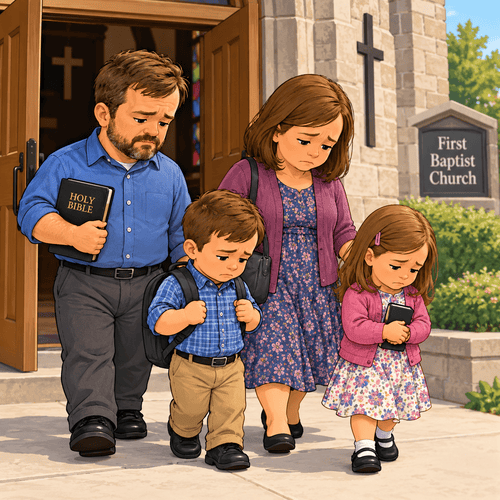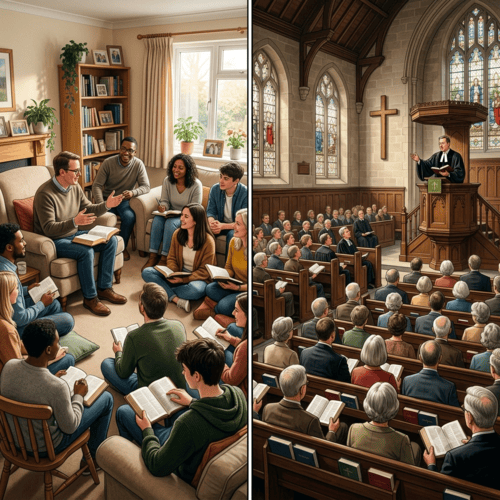

The numbers tell a sobering story. Church attendance hasn’t recovered post-COVID. Livestream sermons seem to have replaced Sunday mornings in church. And many Christians claim they’re far from missing it.
But here’s the question that won’t go away: Can we genuinely follow Christ while staying away from His church? What’s more, how do we address that gnawing feeling deep down inside that every lonely believer knows—that deep yearning for soul companionship? The knowledge that we’re wired for community?
Is every believer programmed to seek out the company of those who genuinely love Christ and His people? What if our deepest joy, our fullest health, the richest life come not from isolation but from the kind of committed, covenant community the church provides? Could the loving Holy Spirit in us be gently nudging us—today—to seek out such fellowship both for ourselves and for those in our care?
WE CANNOT BE UNITED TO CHRIST WITHOUT BEING UNITED TO HIS BODY
At the heart of the gospel lies a breathtaking truth: union with Christ. The great Reformed theologian John Murray declared it plainly: “Union with Christ is really the central truth of the whole doctrine of salvation.” Paul uses the phrase “in Christ” 216 times in his letters. Once we have our eyes opened to this concept, we’ll find it almost everywhere in the New Testament.
But here’s what we often miss: We cannot be united to Christ without being united to His body.
Consider Paul’s stunning declaration in 1 Corinthians 12:12: “For just as the body is one and has many members, and all the members of the body, though many, are one body, so it is with Christ.” Did you catch that? Paul doesn’t say “so it is with Christians” or “so it is with the church.” He says “so it is with Christ.” To be united to Christ means we’re united to His body—the church—so intimately that together we constitute “the one Christ.”
Or consider Jesus’s own metaphor in John 15: the vine and the branches. Branches cannot survive disconnected from the vine. But here’s what we forget—they also cannot thrive disconnected from other branches that share the same life source.
The logic is inescapable: To say “I love Christ but not His church” is like saying “I love the groom but despise His bride.” It’s theological incoherence. Christ didn’t abandon His body at the ascension. He retains our humanity and remains united to us—not as isolated individuals, but as a body, a bride, a building fitted together.
THE BIBLICAL PATTERN: CHURCH WASN’T EVER OPTIONAL
Scripture provides a clear pattern for how God’s people are meant to live in community:
- They devoted themselves to four irreplaceable elements (Acts 2:42). “They devoted themselves to the apostles’ teaching and to fellowship, to the breaking of bread and to prayer.” Notice that word—devoted. This wasn’t casual attendance or spiritual tourism. This was continuous, intentional commitment to teaching, fellowship, sacraments, and prayer. We simply cannot fulfil these through a screen or in isolation.
- They were commanded not to forsake gathering (Hebrews 10:24-25). “Let us consider how to stir up one another to love and good works, not neglecting to meet together, as is the habit of some, but encouraging one another, and all the more as you see the Day drawing near.” Context matters: this letter was written to persecuted believers who risked martyrdom for gathering together. If God didn’t excuse believers facing death for forsaking the assembly, our excuses—”I’m too busy,” “I don’t like the music,” “people are hypocrites”—carry exactly zero weight. The word translated “forsaking” or “neglecting” is egkataleipō—it means to utterly abandon, the same word Jesus cried from the cross: “My God, my God, why have You forsaken me?”
- Isolation breeds spiritual disaster. The very next verse warns about deliberate sin and judgment. Without the mutual encouragement of the gathered body, sin hardens our hearts (Hebrews 3:13), deception creeps in, and apostasy becomes a real danger. We need each other’s vigilance.
- Accountability requires community (Hebrews 13:17). “Obey your leaders and submit to them, for they are keeping watch over your souls, as those who will have to give an account.” Think about this: How can we obey leaders you don’t know? How can elders watch over souls they’ve never met? How can we submit to shepherds we’ve intentionally avoided? Church membership isn’t bureaucracy—it’s the biblical structure for spiritual care and accountability.
- The church displays God’s cosmic purposes (Ephesians 3:10). “Through the church the manifold wisdom of God might now be made known to the rulers and authorities in the heavenly places.” When God’s diverse, reconciled people gather, we accomplish purposes that echo into the spiritual realms. We display to hostile powers that Jesus has triumphed, that the dividing wall of hostility has been torn down, that God is making all things new. We can’t even begin to do that from our couches.
THE BODY OF CHRIST NEEDS US (BUT WE NEED IT MORE)
Collin Hansen and Jonathan Leeman, in their book Rediscover Church, offer this compelling definition: “A church is a group of Christians who assemble as an earthly embassy of Christ’s heavenly kingdom.” Read that again. When we gather, we’re not just having a religious meeting. We’re functioning as an embassy—an outpost of heaven on earth, displaying Christ’s reign to a watching world.
Our absence matters more than we think.
But here’s the kicker: We need the church far more than it needs us. Hansen and Leeman put it bluntly: “A Christian without a church is a Christian in trouble.” They write, “Generally relationships don’t change you for the better if they don’t challenge you at your worst.”
That’s the point. The church isn’t designed to be comfortable. God invites us “into a spiritual family of misfits and outcasts. He welcomes us into a home that’s rarely what we want yet just what we need.” We need people who will speak truth when we’re drifting. We need brothers and sisters who will love us enough to challenge our sin. We need the body of Christ to make us more like Christ.
As Miguel Núñez wisely observes, “It is hard to imagine a Christian who is maturing in Christ and living the gospel consistently apart from a local church.”
WHAT ABOUT THE OBJECTIONS?
- “But I can worship God alone.” Christianity is not an individualistic religion. The New Testament contains 58 “one another” commands—love one another, encourage one another, bear one another’s burdens. We cannot obey these in isolation. Private devotion is essential, but it supplements rather than replaces corporate worship. And crucially, we cannot receive the Lord’s Supper by ourselves. The sacraments require the gathered body.
- “But the church is full of hypocrites.” Absolutely true. Reformed theology has always acknowledged the visible church contains wheat and tares, believers and pretenders. As the Reformers said, the church is a hospital for sinners, not a museum for saints. But here’s what Hansen and Leeman remind us: the fact that church is messy is actually part of God’s design. The challenge of loving difficult people is how we grow.
- “But I watch sermons online.” That’s consumption, not communion. We can’t receive baptism or the Lord’s Supper through a screen. We can’t fulfil the “one another” commands via livestream. We can’t submit to elders who don’t know we exist, and we can’t be known or shepherded by a body we never see.
- “But church hurt is real.” Yes, it absolutely is, and it deserves our deepest compassion. Bad church experiences—abusive leaders, toxic cultures, deep betrayals—leave legitimate wounds. But here’s the truth: The solution to bad church isn’t no church. It’s finding a faithful church. Healing happens in community, not in isolation. Christ doesn’t excuse us from His bride simply because His bride has wounded us.
THE STAKES ARE HIGHER THAN WE THINK
Forsaking the assembly isn’t just missing out on a nice spiritual boost. It’s spiritually dangerous.
Notice how Hebrews 10 connects forsaking the assembly (v. 25) with deliberate sin and coming judgement (v. 26-27). Spiritual isolation makes us vulnerable. Without the regular preaching of God’s Word, we lose our bearings. Without fellow believers to encourage us, temptation gains power. Without the accountability of community, sin hardens our heart and self-deception flourishes.
The question isn’t whether the church is perfect. It’s whether we’ll submit to Christ’s design for our growth, our protection, and our joy.
THE INVITATION: COME HOME TO WHAT YOU WERE MADE FOR
The church needs us, but far more importantly, we need the church. And here’s something profound: we were actually designed to be happiest there. That’s how God has designed us. We’re made in the image of a relational God—Father, Son, and Holy Spirit—who exists in eternal fellowship. When God created humanity, He created us for fellowship, reflecting His triune nature. The deepest joy, the fullest health, the richest life—these come not from isolation but from the kind of committed, covenant community the church provides.
Let’s find a church where the Word of God is faithfully preached and the sacraments are rightly administered. But let’s not look for perfection—we won’t ever find it this side of heaven. Then, let’s do the hard, countercultural work of joining, committing, serving, and submitting. Not perfectly. But faithfully.
Christ is waiting—waiting to meet us not just in our private prayers, but in the gathered assembly of His blood-bought people. He’s waiting to give us what we were made for: the joy of life together in His body, where we’ll discover the deepest happiness comes not from isolation but from the messy, challenging, life-giving fellowship of the saints.
RELATED FAQs
What does J Todd Billings mean when he calls union with Christ “the sum of the gospel”?
Billings draws on John Calvin’s insight that union with Christ encompasses the “double grace” of justification and sanctification received through the Spirit. He argues this doctrine is not just one metaphor among many but the fundamental framework for understanding Christian identity. Union with Christ is a corporate image because the Spirit unites believers not only to Christ but to Christ’s body, the church. This means salvation isn’t individualistic—we can’t have Christ without His people. Billings explains that once we grasp this doctrine, we find it almost everywhere in the New Testament, shaping how we understand worship, mission, and the entirety of the Christian life.
How does Richard Gaffin’s work on resurrection reshape our understanding of church?
Richard Gaffin taught that for Paul, “soteriology is eschatology”—all salvation experience derives from solidarity in Christ’s resurrection and involves existence in the new creation age inaugurated by His resurrection. Believers “already” are the new creation and experience resurrection-life through faith-union with Christ, though that life is “not yet” fully realised bodily. This means church isn’t optional—it’s where we experience the powers of the age to come breaking into the present. If soteriology is eschatology, then salvation includes the restoration and renewal of personal relationships in a new community. You can’t have resurrection life in isolation.
Doesn’t the Westminster Confession allow for “invisible church” membership without joining a visible church?
The Westminster Confession of Faith (Chapter 25) does distinguish between the invisible church (all the elect) and the visible church (all who profess faith). However, this distinction was never meant to justify staying away from the visible church. The Confession immediately clarifies that “unto this catholic visible Church Christ hath given the ministry, oracles, and ordinances of God” (WCF 25.3). The invisible/visible distinction explains why some professors aren’t truly saved and why some true believers may be in imperfect churches—but it never excuses believers from joining visible congregations. Reformed theology has always insisted that claiming membership in the invisible church while refusing the visible church is a contradiction.
What if I live in an area with no solid Reformed churches? Am I excused then?
This is a legitimate challenge that deserves pastoral sensitivity. The Reformed tradition has always recognized that finding a faithful church can be difficult. However, the answer isn’t to stay home but to find the best available option. Calvin taught that where the Word is purely preached and the sacraments rightly administered, we must not separate—even if the church “swarms with many faults”. Look for a church where the gospel is clearly preached and Christ is honoured, even if it’s not your preferred tradition. If necessary, prayerfully consider whether God might be calling you to help strengthen a struggling congregation or even to relocate to be part of a healthier church. The principle remains: isolation isn’t the answer.
How does Michael Horton connect union with Christ to covenant theology?
Michael Horton argues union with Christ is a covenantal construct by which individuals are incorporated into the gospel at the heart of salvation history, and that union with Christ and the Covenant of Grace aren’t simply related themes but different ways of talking about one and the same reality. This is crucial because it means union with Christ isn’t a mystical add-on to salvation—it’s the way God has covenanted to save His people. Horton demonstrates the relationship between justification and union with Christ, between the forensic/legal and the participatory/relational/effective dimensions of salvation. Both are essential, and both happen within the context of God’s covenant people—the church. We can’t receive covenant blessings outside the covenant community.
Can I fulfil the “one another” commands through online small groups or video calls?
While technology can supplement fellowship, it cannot replace embodied presence. The “one another” commands (love one another, bear one another’s burdens, encourage one another, etc.) assume physical presence. We cannot observe the Lord’s Supper through a screen—it requires actual bread and wine shared in community. We cannot lay hands on someone digitally. We cannot fulfil “greet one another with a holy kiss” (Romans 16:16) virtually. Digital tools can enhance relationships, but they cannot substitute for the incarnational reality of gathering as Christ’s body. God designed us for face-to-face community.
What about Christians in persecuted regions who can’t safely attend church?
This is an entirely different situation from voluntarily choosing not to attend church when we have the freedom to do so. Hebrews 10:24-25 was written to believers facing persecution and potential martyrdom, yet they were still commanded not to forsake gathering—they simply gathered in secret, in homes, at great risk. Throughout church history, persecuted believers have found creative ways to maintain fellowship: house churches, underground gatherings, clandestine meetings. They recognised gathering was worth the risk precisely because it’s essential to spiritual survival. If first-century believers under threat of death still prioritised church, our excuses in contexts of religious freedom carry no weight. The question isn’t whether church is optional when dangerous—it’s how to gather faithfully despite the danger.
OUR RELATED POSTS
- Are Denominations Good Or Bad for the Church?
- Militant Yet Triumphant: How Can the Church Be Both?
- Church and Kingdom of God: What’s the Difference?
- The Visible vs Invisible Church: Understanding the Critical Difference
- Addressing the Charge: ‘The Church is Full of Hypocrites’
- Can Churches Conduct Same-Sex Weddings?
- Do Unbelieving Kids Disqualify Church Leaders?
- Is the Church a Building or the People? What the Bible Says
- Household of God: What It Means to Belong to the Church
- Is It Ever Okay to Leave a Church? What Does the Bible Say?
- Gathered and Scattered Church: Why God’s People Need Both