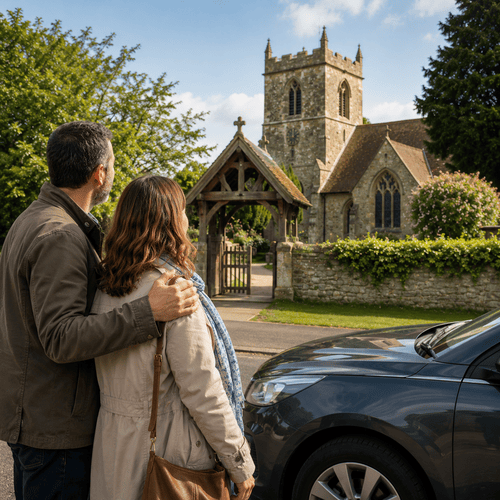
You’ve moved to a new town, or simply decided it’s time to take church seriously. So you open your laptop, type your area next to the word “church”, and there are dozens of them—different names, different service times. One has a coffee bar; one has a pipe organ. How on earth are you meant to choose?
Most advice at this point talks about atmosphere. Is the welcome warm? Are the songs your style? Those things aren’t nothing—but they can’t tell you the one thing you most need to know: is this actually a church at all, in the sense the Bible means, or just a religious club that has borrowed the name?
Here’s the good news: God hasn’t left us to guess from the vibe. Scripture gives us a short, sturdy set of tests—historically called the marks of a true church—that any ordinary believer can apply. Get them wrong and the friendliest welcome in the world won’t make up for it. Let’s walk through them, then turn them into a checklist we can use on a Sunday morning.
Why “does it feel right?” isn’t enough
Back in 1561, the Belgic Confession noted something dry but devastating: nearly every religious group going assigns itself the name “church”. Five centuries on, nothing has changed—the name on the sign proves nothing.
So the Reformers asked a sharper question—not “which group feels most spiritual?” but “what does Scripture say makes a church a church?” Their answer became the marks: objective, observable signs we can check, rather than impressions we have to trust.
Two quick clarifications first.
- First, the Bible speaks of the church in two senses: the invisible church—everyone genuinely saved, known perfectly only to God—and the visible church, the congregation that meets at a real address. Every visible church is a mixed body: true believers and pretenders in the same pews (Augustine called it a corpus permixtum, a “mixed multitude”). The marks help you spot a true visible church; they don’t promise that every last person in it is converted.
- Second—and this is the liberating part—the marks are objective. They don’t hang on how sincere the members are but on what the church does with the gospel. And that you can see, hear and test.
What actually makes a church a church?
When the very first church came into being, Luke summed up its whole life in a single line—they devoted themselves to the apostles’ teaching and the fellowship, to the breaking of bread and the prayers (Acts 2:42).
Teaching, fellowship, the Lord’s table, prayer—and notice what carries the weight: the apostles’ teaching comes first, and everything else grows out of it. The church doesn’t invent the truth or stand over it; it receives it. Paul calls the church a pillar and buttress of the truth (1 Timothy 3:15): the structure that holds it up and displays it, not its source. The Word makes the church, not the other way round.
From this soil the Reformers drew three marks by which a true church can be recognised:
| THE MARK | WHAT IT MEANS | KEY SCRIPTURE | IT GUARDS AGAINST |
|---|---|---|---|
| True preaching of the gospel | The Bible is faithfully taught and Christ crucified is proclaimed | Romans 10:14-17; Galatians 1:6-9 | A different gospel of works or self-help |
| Right use of the sacraments | Baptism and the Lord’s Supper administered as Christ commanded | Matthew 28:19; 1 Corinthians 11:23-26 | Adding to or subtracting from Christ’s ordinances |
| Loving church discipline | Sin is lovingly corrected and members held accountable | Matthew 18:15-20; 1 Corinthians 5 | A congregation drifting into corruption unchecked |
You’ll sometimes hear these counted differently:
- Theodore Beza named one—faithful preaching.
- John Calvin and Heinrich Bullinger named two—preaching and the sacraments.
- Zacharias Ursinus and Peter Martyr Vermigli named three, adding discipline.
The three-mark version won the day, and it’s the most useful for us—though Calvin’s instinct still holds: discipline is less about whether a church exists at all and more about whether it stays healthy. Let’s take them one at a time.
Mark one—the true preaching of the gospel
If a church gets only one thing right, it has to be this. Preaching is the beating heart of a true church, because it’s through the Word that God speaks and creates faith in the first place. So faith comes from hearing, and hearing through the word of Christ (Romans 10:17). Remove faithful preaching and you tear out the organ that keeps everything else alive.
“Faithful” needs defining, though, because it’s easy to set the bar in the wrong place. Louis Berkhof, one of the clearest writers on this, insisted the preaching need not be flawless on every point—no church clears that bar. It must be true to the fundamentals of the faith, and it must genuinely shape how the congregation believes and lives.
So where’s the line? The gospel itself. Paul could hardly be blunter: if anyone—even an angel from heaven—preaches a gospel other than the one he preached, let him be accursed (Galatians 1:8). A church can be wrong about secondary things and remain true. But the moment it swaps rescue by grace for “try harder and earn it”, it has traded the gospel for what Paul calls a different gospel—and that changes everything.
There’s one more layer, and John Calvin spotted it: a true church isn’t only a place where the Word is preached, but where it’s heard and received. A man shouting Bible verses on a street corner is preaching truly, yet he isn’t a church. The mark appears where God speaks and a gathered people actually listen, take it to heart and are changed.
Mark two—baptism and the Lord’s Supper, done Christ’s way
Jesus left His church two simple, physical signs: baptism (Matthew 28:19) and the Lord’s Supper (1 Corinthians 11:23-26)—just two, which is part of the point. The Reformers called them the sacraments, or ordinances, and described them as the visible Word: where preaching brings the gospel to your ears, these bring it to your eyes, hands and mouth.
- Baptism pictures being washed clean from sin and joined to Christ—the gospel you can see.
- The Lord’s Supper pictures living entirely on Christ’s body broken and blood shed for you—the gospel you can taste.
They aren’t magic, and they don’t save on their own. They’re, in the old language, signs and seals—God confirming His promise in a form we can physically hold, because we need more than words. “Rightly administered” means done as Christ commanded: tied to the Word, not added to, not subtracted from, not twisted into something He never intended.
Now, a fair question—don’t churches disagree about all this? They do, sometimes sharply: who should be baptised (believers only, or their children too), how (immersion or sprinkling), and how often the Supper is shared. But a church that faithfully practises both baptism and the Lord’s Supper as Christ instituted them bears this mark, even where it lands differently from us on the details. Differences over the how don’t unchurch a congregation; abandoning or corrupting the sacraments altogether does.
Mark three—loving church discipline
This is the mark people find most surprising, and the one most often missing today. “Church discipline” sounds harsh—but rightly understood, it’s one of the most loving things a church can do.
The pattern comes straight from Jesus. In Matthew 18:15-20 He sets out a careful, escalating process for sin: a private word first, then one or two others, and only as a last resort the wider church—always aiming to win an erring brother or sister back. Paul applies exactly this in 1 Corinthians 5. Discipline serves three ends, and restoration runs through all of them:
| THE AIM | WHAT IT PROTECTS |
|---|---|
| The honour of Christ | The church’s witness to a watching world |
| The purity of the church | The congregation from corruption spreading |
| The good of the sinner | The person themselves, called back to repentance |
In other words, discipline is the immune system that guards the first two marks.
But here’s the crucial guardrail, because this is exactly where abusive groups go wrong. Biblical discipline is the opposite of one-man control: it runs through a plurality of qualified elders (Acts 14:23), with gentleness, accountability and a clear way back. A leader who silences every question and wields “discipline” to control rather than restore is counterfeiting it, not displaying it. Loving correction aimed at recovery marks a true church; fear-based control is a warning sign of a false one.
How to spot a false church
If the marks tell us what to look for, they also tell us what to run from. The Belgic Confession drew the contrast directly, holding the true church against its counterfeit:
| A TRUE CHURCH… | A FALSE CHURCH… |
|---|---|
| Submits to the Word of God as its final authority | Puts its own authority or traditions above the Word |
| Holds Christ as the only head | Leans on human leaders more than on Christ |
| Uses the sacraments as Christ commanded | Alters the sacraments to suit itself |
| Welcomes correction from Scripture | Persecutes those who question it by the Word |
Dressed in modern clothes, the warning signs tend to look like this:
- Fundamentals denied or fudged. The Trinity, the deity and bodily resurrection of Christ, salvation by grace through faith—these aren’t up for negotiation. Where they go, the church goes with them.
- A rival authority beside the Bible. A leader’s private “revelations”, raw feelings, or an extra “sacred” text set alongside Scripture.
- A different gospel. Prosperity teaching that promises God wants you rich, or a universalism that waves everyone through regardless of Christ.
- Entertainment over the Word. When the production swallows the preaching, something has gone wrong at the centre.
- Unaccountable, controlling leadership. No elders, no questions, no way to disagree without being crushed.
None of this means a church must be flawless to be true—every real church has faults. It means these faults strike at the marks themselves. A church can limp badly and still be Christ’s; a church that surrenders the marks has stopped being a church at all.
How to find a good church—a checklist that works
Now let’s turn all this into something usable. When weighing up a church, we’re to sort what we see into three tiers—and keep them in this order:
| TIER | WHAT TO LOOK FOR | WEIGHT |
|---|---|---|
| Non-negotiables (the marks) | Is the gospel faithfully preached? Are baptism and the Supper rightly practised? Is there loving accountability? | Everything hangs here |
| Healthy signs | Plural, godly elders; real fellowship; genuine care for members; a heart for evangelism and discipleship; growing Christians | Very important |
| Personal preferences | Music style, size, service length, building, programmes | Legitimate, but last |
The great mistake—the one nearly every “how to choose a church” article quietly makes—is letting that bottom row drive the decision. John Piper puts it well: preferences Scripture doesn’t command can play a part, but only when they’re shaped by the Word and kept beneath the things that matter more. There’s nothing wrong with preferring hymns to a band; there’s something wrong with choosing on that basis while never asking whether the gospel is even preached.
A few practical steps cut through the noise:
- Read the statement of faith. Most churches post it online. It tells us what they actually believe before we ever walk through the door.
- Listen to a few sermons. Is the Bible being opened and explained, or merely quoted to decorate the speaker’s own ideas?
- Ask how they care for people. How are members supported, and how is sin gently addressed when it has to be?
- Look for real fellowship, not a slick foyer. Can we picture ourselves genuinely known here, not just attending?
And when we find such a church, let’s do the thing our age resists: commit. The New Testament knows nothing of the permanent spiritual spectator who never joins or serves. Let us consider how to stir up one another to love and good works, not neglecting to meet together (Hebrews 10:24-25). A good church isn’t a service we consume—it’s a family we belong to.
The bottom line
Choosing a church can feel overwhelming, but it needn’t be a guess. Strip it back and one question remains: does this church do what a church is for? Is the gospel faithfully preached? Are baptism and the Lord’s Supper treated as Christ’s? Is there loving accountability that guards them both?
Those three marks won’t tell us which church has the best car park. They’ll tell us something far more important—whether we’ve found a true church of Jesus Christ, or merely a religious club wearing its name. So we’re to test what we find against the Word, and when we find a faithful church, don’t just visit—belong, serve, and grow. The church was never our project to shop for. It’s Christ’s, bought with His own blood, and He has told us exactly what to look for.
Tough Questions, Honest Answers
Can I be a Christian without going to church?
Our salvation rests on Christ, not on our attendance record—so nobody is saved simply by turning up on a Sunday. But the New Testament can’t imagine a healthy Christian who deliberately lives detached from a local church. Believers are pictured as parts of one body, and a hand that saws itself off doesn’t flourish (1 Corinthians 12). Gathered fellowship is something Scripture commands us not to neglect—and if we love Christ, in time we’ll want His people too.
Is online church or a house church a “real” church?
A house church can absolutely be a true church—the earliest believers met in homes, and venue was never the test; the marks are. Online “church” is a different case: it can be a genuine lifeline for the housebound, the ill, or Christians with no faithful congregation nearby, and there’s no shame in leaning on it for a season. But a screen can’t fully deliver the sacraments, real fellowship or mutual accountability, so it makes a poor permanent substitute. Where we can gather in person with Christ’s people, that’s what Scripture assumes we’ll do.
What if there’s no good church near me?
This is a real and painful situation, and it deserves an honest answer. First, widen the net and check you’re not ruling churches out over style or size when their preaching and sacraments are actually sound. Second, be willing to travel further than feels convenient—a faithful church is worth a longer journey. Third, if there truly is nothing, pray hard, lean on trusted preaching for a season, and ask whether God might be calling you and a few others to help a faithful work take root where you are.
Does church size matter—small church or megachurch?
Size isn’t a mark of a true church in either direction—God has grown faithful churches both tiny and enormous. What matters is whether the marks and the healthy signs survive at that scale: a large church must work hard so members are genuinely known rather than lost in the crowd, while a small one can offer deep fellowship yet may stretch to sustain strong teaching and leadership. The better question isn’t “how big?” but “are the marks here, and can I actually be known and grow?”
Do the marks mean only my kind of church is the “true church”?
No—and that misunderstanding is worth clearing up. The marks were never meant to crown one denomination and damn the rest; they’re a test of faithfulness that congregations across many traditions can pass. Wherever the gospel is truly preached, the sacraments rightly used and loving discipline practised, there stands a true church of Christ, whatever the name over the door. The aim isn’t tribal pride but discernment—not sorting the world into “us” and “them”.
How many times should I visit before committing?
There’s no magic number, but a single Sunday is rarely enough. Give it a handful of visits so we’re seeing a church’s normal week, not a one-off. Use the time deliberately: listen to several sermons, read the statement of faith, meet a few members, and ask how the church cares for and, where needed, corrects its people. Beware both extremes—snap-judging after one service, and endlessly sampling churches while committing to none.
Can a church that was once faithful turn into a false one?
Sadly, yes—faithfulness in one generation is never guaranteed in the next. The risen Christ warns the church in Ephesus He will remove your lampstand from its place, unless you repent (Revelation 2:5), and history is littered with once-gospel-preaching churches that quietly drifted into something else. Decline usually creeps rather than crashes: the gospel gets assumed, then softened, then swapped out altogether. That’s exactly why the marks matter for churches, not just church-hunters—they’re the standard a healthy church keeps returning to.
Related Reads
- What Is the Church? A Biblical Definition of Ekklesia
- Is the Church a Building or the People? What the Bible Says
- What Does “One Holy Catholic Church” Mean?
- Salvation: By Faith Alone or by Works? The Biblical Answer
- Assurance of Salvation: How Can I Know I’m Truly Saved?
- What Do Jehovah’s Witnesses Believe? A Biblical Examination of JW Doctrine
- Baptism and the Lord’s Supper: Why the Sacraments Truly Matter
- Is Apostolic Succession Biblical?
- The Keys of the Kingdom: What Did Jesus Give the Church?
- What Does It Mean That the Church Is the Bride of Christ?
- Household of God: What It Means to Belong to the Church
- Congregational, Presbyterian, Episcopal: Forms of Church Government Compared
- Is The Purpose Driven Life Biblical? A Careful Assessment
- Is the Ethiopian Orthodox Church the First Church in the World?