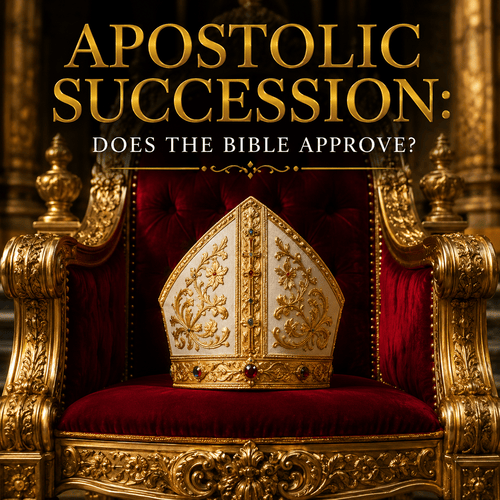
Trace the line of bishops back far enough, the argument runs, and we’ll arrive at Peter—and therefore at the one true Church. It’s a confident claim, and for many sincere believers it appears to settle the whole question of where genuine spiritual authority resides. It’s also a claim the New Testament never actually makes.
Apostolic succession is the belief that the authority Christ gave His apostles has been handed down, without a break, through an ordained line of bishops stretching from the first century to the present day. On this view, a church’s legitimacy—its right to ordain ministers, celebrate the sacraments, and teach with binding authority—depends on whether its bishops stand in that unbroken chain. Roman Catholic, Eastern Orthodox, and some Anglican traditions all appeal to it, though they define its reach in different ways.
The stakes aren’t trivial. If apostolic succession is true in the way Rome and the East insist, then most other churches are, at best, irregular and, at worst, cut off from valid ministry altogether. So the question deserves a careful answer—and the only place to find one is in Scripture itself. When we go there, a consistent picture emerges: the New Testament grounds a church’s authority in its fidelity to apostolic teaching, not in a pedigree of ordinations.
What Apostolic Succession Actually Claims
It helps to state the doctrine fairly before weighing it. Advocates aren’t merely saying that churches were planted by the apostles and continued afterwards—every Christian agrees with that. They are claiming something more specific:
- A transmitted office. Apostolic authority is conveyed physically, through the laying on of hands, from bishop to bishop in an uninterrupted line.
- A restricted power. Only clergy standing in that line may validly ordain others, consecrate the elements, and govern the church.
- A test of legitimacy. A body outside the line—however faithful its preaching—lacks a valid ministry.
Roman Catholic teaching adds Peter’s primacy to this framework, so that the Bishop of Rome inherits a supremacy the other bishops do not possess (Catechism of the Catholic Church, 862—63). Eastern Orthodoxy keeps the succession of bishops but rejects a single universal head. In both systems, the argument stands or falls on one assumption: that Christ intended the apostolic office to be perpetuated by ordination. That assumption is exactly what Scripture does not support.
The Apostolic Office Was Foundational, Not Ongoing
The clearest biblical obstacle to apostolic succession is that the New Testament treats the apostolic office as unrepeatable. Paul tells the Ephesians that the church is “built on the foundation of the apostles and prophets, Christ Jesus himself being the cornerstone” (Ephesians 2:20). A foundation is laid once. You do not keep re-laying it storey after storey; you build upon it. The apostles belong to the church’s founding generation in a way no later minister can.
This is confirmed by the qualifications for the office. To be an apostle in the strict sense, a man had to be an eyewitness of the risen Christ and personally commissioned by Him. Peter sets out the first requirement when a replacement for Judas is sought: the candidate must be someone who accompanied Jesus “beginning from the baptism of John until the day when he was taken up”, and must become a witness to his resurrection (Acts 1:21—22). Paul insists on the same credential—“Have I not seen Jesus our Lord?” (1 Corinthians 9:1)—and calls himself one untimely born, the last to whom the risen Christ appeared (1 Corinthians 15:8). Once that founding generation of eyewitnesses died, the qualifications could no longer be met.
The New Testament even lists distinguishing marks of a true apostle—“signs and wonders and mighty works” (2 Corinthians 12:12)—which are never presented as transferable to a successor. The office was foundational. It was never designed to be inherited.
Was Matthias the First Successor?
The strongest text advocates cite is the choosing of Matthias in Acts 1:15—26. If the apostles replaced Judas, does that not establish a mechanism of succession? On closer reading, the episode proves almost the opposite.
- It replaced an apostate, not the deceased. Matthias filled a vacancy created by Judas’s betrayal and fall (Acts 1:20), not by natural death. It is a case of restoring the symbolic Twelve, not of routine replacement.
- It required an eyewitness. The candidates had to have followed Jesus throughout His ministry and seen Him risen (Acts 1:21—22)—the very qualification later generations cannot supply.
- It was never repeated. When James the brother of John was killed (Acts 12:2), no one moved to replace him. If succession were the point, the church missed every opportunity to practise it.
The number twelve corresponds to the twelve tribes of Israel (Matthew 19:28); it marks the apostles as the foundational witnesses of the new-covenant people, not as the first two links in a chain of office-holders. Matthias is an argument for filling a unique founding college, not for perpetual ordination.
“On This Rock”: Does Matthew 16 Establish the Papacy?
Roman Catholic teaching leans heavily on Jesus’ words to Peter: “you are Peter, and on this rock I will build my church” (Matthew 16:18). The claim is that Peter is the rock, that he became the first pope, and that apostolic succession flows from him. Each link in that argument is contestable.
Jesus uses a deliberate play on words. He names the disciple Petros (a stone) and then speaks of the petra (bedrock) on which He will build. Many interpreters, following Augustine of Hippo and John Chrysostom at various points, understand the petra as Peter’s confession—the truth that Jesus is the Christ, the Son of the living God (Matthew 16:16)—or as Christ Himself, the object of that confession.
Even granting that Peter is in some sense the rock, he is only one stone in the foundation, not the foundation. Peter himself calls Christ the cornerstone and applies stone-imagery to every believer (1 Peter 2:4—7). Paul places all the apostles together in the one foundation (Ephesians 2:20). Gregg Allison and others note that the passage says nothing about successors, nothing about Rome, and nothing about an ongoing office. It grounds the church on the confessed identity of the Messiah.
The wider record also undercuts any notion of Peter’s supremacy. Paul withstands him to his face for hypocrisy at Antioch (Galatians 2:11—14)—hardly the posture of a lesser bishop toward a supreme pontiff. Peter is honoured, prominent, and Spirit-filled, but he is a fellow apostle, not a monarch over the others.
What the New Testament Does Hand On
Scripture is not silent about continuity. It simply locates it in the right place. What the apostles were anxious to transmit was not sacramental power but sound doctrine. Paul’s charge to Timothy is explicit: what you have heard from me in the presence of many witnesses entrust to faithful men, who will be able to teach others also (2 Timothy 2:2).
Notice what is passed on—“what you have heard”, the message—and to whom: faithful men who will be able to teach, chosen for fidelity and competence, not for a mystical ordination lineage. The same letter urges Timothy to follow the pattern of the sound words and to guard the good deposit (2 Timothy 1:13—14). Jude likewise appeals for the faith that was once for all delivered to the saints (Jude 3).
This is a real and vital succession—a succession of truth. The gospel preached today is legitimate when it is the same gospel the apostles preached, verifiable against their inspired writings. On this understanding, the New Testament is not a hindrance to apostolic continuity; it is the very instrument by which the apostles continue to govern the church.
Ordination by Elders, Not a Separate Order of Bishops
Apostolic succession assumes a distinct class of bishops, superior to ordinary presbyters, who alone can ordain. The New Testament does not know this distinction. In its pages the terms overseer (episkopos, “bishop”) and elder (presbyteros) describe the same office.
- Paul summons the elders of Ephesus (Acts 20:17) and then calls those same men overseers (Acts 20:28).
- Titus is told to appoint elders in every town, and in the next breath the qualifications are for an overseer (Titus 1:5—7).
- Timothy is ordained by the laying on of hands of the council of elders—a presbytery—not by a single bishop in a chain (1 Timothy 4:14).
Churches were governed by a plurality of elders (Acts 14:23; Philippians 1:1), appointed for their grasp of apostolic teaching and their godly character. The mono-episcopal structure on which apostolic succession depends is a later development, not an apostolic institution. Remove that assumption and the doctrine has no scaffolding to stand on.
Where the Doctrine Came From
If apostolic succession is not taught in the New Testament, where did it arise? The historical record is instructive, and it can be traced along a clear line.
A Brief Timeline
- c. AD 96 — Clement of Rome. Writing to Corinth amid a leadership dispute, Clement argues that ministers should be appointed in an orderly way and not deposed without cause. His concern is congregational order against factionalism—not a papal chain of command.
- c. AD 180 — Irenaeus of Lyons. Against Gnostics who claimed a secret tradition, Irenaeus appeals to the public teaching handed down in churches with a known succession of leaders. Succession here is a test of doctrine—a way of showing the Gnostics had no historical foothold—rather than a sacramental necessity.
- AD 431 and beyond — Growing centralisation. Over subsequent centuries the emphasis shifted from succession of teaching to succession of episcopal power, and eventually to the sweeping claims of the medieval papacy.
The Protestant patristics scholar JND Kelly observes that, for the early Fathers, the apostolic tradition was entirely public and open, visible to any who cared to look—a safeguard of shared doctrine rather than an esoteric pedigree. Notably, the confident lists of Roman bishops reaching back to Peter cannot be verified historically; they rest on later claims. The doctrine grew as a defensive weapon against heresy and was only afterwards recast as a mark of exclusive authority.
Apostolic Succession and Apostolicity: An Important Distinction
When the Nicene Creed confesses one holy catholic and apostolic church, it is affirming that the true church is apostolic—founded on and faithful to the apostles’ teaching. That is very different from claiming an unbroken line of ordinations.
The decisive question is not “can you trace your bishops back to Peter?” but “do you hold and proclaim what the apostles held and proclaimed?” A lineage that abandons the apostolic gospel forfeits any meaningful claim to be apostolic, whatever its pedigree. Conversely, a congregation that faithfully teaches the apostles’ doctrine is apostolic in the sense that matters most, even without a chain of consecrations.
This is why the mark of a true church has always been the pure preaching of the gospel and the right administration of the sacraments—not a genealogy. Authority in the church is derivative and ministerial: it belongs to the Word, and to ministers only insofar as they faithfully deliver that Word.
Conclusion
So, is apostolic succession biblical? Judged by Scripture, the answer is no—at least not in the sense that a church’s legitimacy hangs on an unbroken line of bishops reaching back to Peter. The apostolic office was foundational and unrepeatable. Matthias replaced an apostate, not a mechanism. Matthew 16 grounds the church on the confessed Christ, not on a papal succession. And the mono-episcopal structure the doctrine assumes is nowhere in the apostolic writings.
What the New Testament does secure is far more durable: a succession of truth, the apostolic gospel entrusted to faithful teachers and preserved in the inspired Scriptures. A church is apostolic when it stands on that word—and Christ Himself remains the one foundation, the cornerstone that cannot be moved. The gates of hell will not prevail against the church built on Him—not because of a lineage of hands, but because of the One in whom that church confesses its life.
Tough Questions, Honest Answers
Does 2 Timothy 2:2 teach apostolic succession?
It teaches a succession of teaching, not of sacramental office. Paul tells Timothy to entrust the message to faithful, capable men. The emphasis falls on preserving sound doctrine through reliable teachers, with no mention of ordination lineage, laying on of hands, or transferred apostolic authority. It is the strongest verse advocates cite, yet it describes exactly the kind of continuity Protestants affirm.
If Peter is not the rock, why did Jesus rename him?
Renaming marks Peter’s prominence as spokesman and leading witness, which no one disputes. But prominence is not primacy over the other apostles, and it is not a transferable office. Even if Peter is a rock, Scripture makes Christ the cornerstone and all the apostles the foundation together (Ephesians 2:20; 1 Peter 2:6—7). The text says nothing of successors or of Rome.
Doesn’t the laying on of hands prove sacramental succession?
The laying on of hands accompanies commissioning and blessing throughout Scripture, but it is performed by a body of elders (1 Timothy 4:14) and never presented as a channel that alone conveys valid ministry down an exclusive line. It signifies the church setting apart a qualified minister; it does not establish a mystical pedigree without which the sacraments are void.
Were there bishops in the New Testament?
Yes—but bishop (overseer) and elder name the same office, held by a plurality of men in each congregation (Acts 20:17, 28; Titus 1:5—7). The single ruling bishop set over many congregations, essential to the succession claim, emerges only later in church history and is not found in the apostolic writings.
Does rejecting apostolic succession mean rejecting church history?
Not at all. Church history is a great gift, and the early Fathers are worth reading closely. Rejecting apostolic succession simply means refusing to treat an unverifiable chain of ordinations as the test of a true church. The faith rests on Christ and the apostolic Scriptures; history illuminates that faith but is not its foundation.
What makes a church “apostolic,” then?
Fidelity to apostolic doctrine. A church is apostolic when it believes, teaches, and lives by what the apostles proclaimed, as recorded in the New Testament. That is the continuity Christ secured for His church—the gospel handed down, guarded, and preached in every generation.
Can a minister outside the “line” validly ordain and administer the sacraments?
Yes. If validity depended on an unbroken chain of bishops, assurance would rest on a historical record no one can actually verify. Scripture ties valid ministry to a lawful call, sound doctrine, and godly character, exercised within the church. A minister ordained by faithful elders, preaching the apostolic gospel, has everything the New Testament requires.
Related Reads
- What Is the Church? A Biblical Definition of Ekklesia
- What Are the Marks of a True Church?
- What Does “One Holy Catholic Church” Mean?
- ‘Where Two or Three Are Gathered’: What Does Matthew 18:20 Mean?
- The Keys of the Kingdom: What Did Jesus Give the Church?
- Congregational, Presbyterian, Episcopal: Forms of Church Government Compared
- Is the Ethiopian Orthodox Church the First Church in the World?
- What Does the Bible Say About Laying On of Hands?