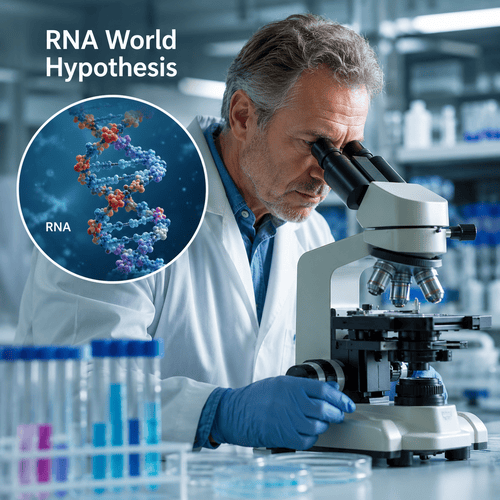
In February 2026, headlines announced scientists had produced an RNA molecule that could very nearly copy itself. The molecule, nicknamed QT45, was hailed as a glimpse of life’s opening act—the moment before there were cells, before there was DNA, when, according to one influential theory, a single molecule did the jobs thousands of molecules now share between them.
Is this the moment science finally explains life without a Creator? Or is there considerably less here than the headlines suggest? This article works through what the RNA World hypothesis actually claims, what the new research does and does not show, and why—even if every remaining problem were solved tomorrow—the deepest question about life would still be untouched.
What Is the RNA World Hypothesis?
Modern life runs on a puzzle. DNA stores the genetic instructions for building an organism, but DNA cannot copy itself or do anything else without proteins. Proteins carry out almost every task in a living cell, but proteins cannot be made without instructions from DNA. Each needs the other already in place. So which came first?
The RNA World hypothesis proposes a way through the puzzle. Before DNA and proteins existed, it suggests, a third molecule, RNA, did both jobs at once: storing genetic information, as DNA does now, and speeding up chemical reactions, as proteins do now. A molecule that speeds up a reaction without being used up itself is called a catalyst. When an RNA molecule acts as a catalyst, scientists call it a ribozyme, short for “ribonucleic acid enzyme.” On this view, a single molecule played both parts before the division of labour we see in every living cell today.
The idea has a long pedigree. Alexander Rich first proposed something like it in 1962. Carl Woese, Francis Crick, and Leslie Orgel independently developed the concept in the late 1960s. Walter Gilbert coined the term “RNA World” in 1986—the same decade in which Thomas Cech and Sidney Altman discovered RNA really can act as an enzyme, a finding that earned them the 1989 Nobel Prize in Chemistry.
The Evidence in Its Favour
Before assessing the weaknesses, it is worth stating plainly why serious scientists hold this view. The case rests on several genuine discoveries.
| CLUE | WHAT IT SHOWS |
|---|---|
| The ribosome is a ribozyme | The protein-building site inside every ribosome is made of RNA, not protein—confirmed by Ada Yonath, Thomas Steitz, and Venkatraman Ramakrishnan (Nobel Prize, 2009). |
| RNA fragments in cellular fuel | ATP, NAD⁺, and coenzyme A all contain a ribonucleotide doing no obvious chemical work—plausibly leftovers, as Harold White proposed in 1976. |
| DNA looks derived from RNA | Cells build DNA building blocks by modifying RNA ones, not the reverse. Chemically, DNA behaves like an edited, sturdier RNA. |
| Ribozymes can be made to order | Lab selection has produced RNA that cuts, joins, and copies other RNA—proof RNA can catalyse. |
| Prebiotic chemistry has advanced | John Sutherland’s 2009 and 2015 work found routes from simple chemicals to RNA and amino-acid building blocks, resolving an old dead end. |
This is genuine knowledge, gained by careful people. Christians have no reason to begrudge it; the ribosome’s structure is a true discovery about the world God made.
Enter QT45: What Actually Happened in February 2026
This is the discovery behind the recent headlines, and it deserves a careful look, because the popular reporting ran well ahead of the paper itself.
Writing in Science, a team led by biochemist Edoardo Gianni at the MRC Laboratory of Molecular Biology in Cambridge described a ribozyme just 45 nucleotides long. A nucleotide is a single chemical “letter” of RNA. Earlier copying ribozymes ran 150–300 nucleotides: long enough to work, but too long and complex for anyone to picture arising by chance. QT45 breaks that pattern, and the team demonstrated two separate capabilities—building a copy of its own mirror-image strand, and, separately, using defined building blocks to copy itself. The molecule was found by generating a trillion random RNA sequences in freezing eutectic ice and running repeated rounds of selection.
The reporting has largely presented this as “scientists are close to solving the origin of life.” The paper itself is more careful, and the details matter.
Reported vs. What It Means
- 0.2% yield over 72 days: orders of magnitude short of anything self-sustaining.
- 94.1% per-nucleotide fidelity: compounded over 45 letters, only around 6% of copies come out error-free.
- Trinucleotide triphosphate substrates: pre-activated building blocks supplied by chemists, not scavenged from any plausible early Earth.
- Mildly alkaline eutectic ice: a curated lab condition, not a known ancient environment.
- “Discovered from random pools”: true, but only after multiple rounds of deliberate, intelligent selection, nothing like an unguided ocean.
The fidelity figure cuts hardest against the celebratory reading. Manfred Eigen’s “error threshold” principle holds that a self-replicator can only sustain a genome up to a certain length before copying mistakes outrun natural selection and the system dissolves into noise. At a 5.9% error rate, that ceiling sits near 17 nucleotides. QT45 is 45, roughly two and a half times longer than the genome its own accuracy could sustain, so it cannot yet preserve its own information across generations. This is the field’s own mathematics, not a sceptic’s objection.
Six Problems the Headlines Left Out
- Getting RNA to form at all is hard. Ribose is chemically unstable, with a half-life of roughly 73 minutes at boiling point, and forming it prebiotically needs carefully ordered steps chemists supply.
- Handedness. RNA building blocks come in mirror-image forms, and mixing them poisons copying, as Leslie Orgel showed in 1984. A pure pool has never been produced outside the lab.
- Wrong chemical bonds. Unassisted reactions join nucleotides with a scattershot mix of bond types and are most unable to support a working strand.
- Concentration and phosphate scarcity. RNA formed in an open ocean would dilute toward uselessness, and soluble phosphate is scarce on the early Earth.
- Working ribozymes are exceedingly rare. Searches find roughly one functional ligase ribozyme per 10¹¹ sequences, against a space of roughly 10¹³².
- No one has built a genuine self-replicator, not once in over 40 years of directed effort by trained chemists.
Even the Experts Do Not Agree
Origin-of-life research has no settled consensus, and its leading figures have spent decades dismantling one another’s proposals.
- Replication-first (the RNA World). Leslie Orgel’s own 2008 paper dismantled the leading rival, metabolism-first chemistry, as implausible on the early Earth.
- Metabolism-first. Günter Wächtershauser, Michael Russell, and Nick Lane argue self-sustaining cycles at deep-sea vents came first. Robert Shapiro argued at length that the RNA World is itself implausible.
- RNA–peptide co-evolution. Charles Carter (University of North Carolina at Chapel Hill) and Peter Wills (University of Auckland) argue RNA’s catalytic ability is too limited and fragile to have run the show alone, calling it “an expedient proposal” with “no means of controlling its chemistry.” Thomas Carell’s 2022 Nature paper showed peptides can be synthesised directly on RNA.
Harold Bernhardt’s widely cited 2012 review captured the field in its title: the RNA World is “the worst theory of the early evolution of life, except for all the others.”
The Problem Chemistry Cannot Touch
Suppose every chemical difficulty above were solved tomorrow, and a molecule truly copied itself with high fidelity from freely available chemicals. We would still only have molecules making more of themselves. We wouldn’t yet have the genetic code.
The genetic code isn’t a chemical bond; it’s a correspondence. A sequence of three RNA letters, say CUG, is read as an instruction for the amino acid leucine—with no chemical attraction pulling CUG toward leucine specifically, any more than the letters C-A-T are chemically drawn toward a furry animal. The scientist and philosopher Michael Polanyi made this point in 1968: a DNA sequence is no more fixed by DNA’s chemistry than the ink on this page is fixed by the chemistry of ink. The message imposes a pattern on the chemistry; the chemistry doesn’t generate the message.
Worse, the system that reads the code is itself built using the code it reads. Peter Wills calls this a “strange loop”: “It’s the information which builds the system that interprets the information.” Chemistry has no vocabulary for one thing meaning another. Even Eugene Koonin, with no theological stake in the outcome, concedes the code’s origin remains genuinely unresolved.
No, we’re not claiming this gap will never close. Scientific gaps have closed before, sometimes overturning ideas that once seemed unassailable. In 1828, for example, Friedrich Wöhler synthesised urea in the laboratory, showing that a substance thought to require a living organism could be produced by ordinary chemistry. That discovery helped bring down the old doctrine of vitalism.
The point here is much narrower. While chemistry has proved capable of remarkable feats, it has never been shown to produce a genuine symbolic information system. And in our experience, there’s only one known cause that reliably generates such systems: an intelligent mind—the very kind involved in writing and reading these sentences.
A Framework, Not Just a Gap
Many Christian responses to origin-of-life research stop at “the gaps are large.” That’s true, but it sells short what Scripture actually teaches about how God works, and it leaves faith looking hostage to the next laboratory result.
God Works Through Means—That Is Still God Working
The Westminster Confession states God “in his ordinary providence maketh use of means, yet is free to work without, above, and against them at his pleasure” (5.3). John Calvin warned against imagining God a mere “momentary Creator” who set the world running and withdrew (Institutes, 1.16.1). If a self-replicating ribozyme is synthesised next year, no article of the faith is threatened. A Christian who has staked belief on that gap has quietly swapped providence for deism.
Genesis Already Describes Creation
Genesis itself pictures God commanding creation to bring things forth: “Let the earth sprout vegetation” (Genesis 1:11), and “Let the earth bring forth living creatures” (Genesis 1:24). Yet notice what the text doesn’t say: the dust doesn’t organise itself unaided. The command of God is the active cause throughout. “ The LORD God formed the man of dust from the ground and breathed into his nostrils the breath of life” (Genesis 2:7).
The Evidence Still Points Somewhere—Even Without Every Mechanism
The real argument was never about the gaps; it is about the whole pattern. “For his invisible attributes, namely, his eternal power and divine nature, have been clearly perceived, ever since the creation of the world, in the things that have been made” (Romans 1:20). The Belgic Confession, Article 2, calls creation “a most elegant book” leading us to contemplate the invisible things of God. The ribosome testifies to its Maker whether or not scientists ever fully trace its assembly. And Romans 1 explains why this testimony doesn’t automatically convince: people “suppress the truth” (Romans 1:18), for “the natural person does not accept the things of the Spirit of God” (1 Corinthians 2:14). That is not an excuse for weak evidence; it is a biblical prediction about how strong evidence gets received.
It is worth naming a control belief underneath this research: the assumption that only unguided chemistry counts as an explanation is a starting commitment, not a finding. As philosopher Alvin Plantinga argues, every fact is read within some larger framework; there is no neutral vantage point from which evidence simply speaks for itself.
A final irony: every advance in this field, including QT45, has come from chemists deliberately specifying substrates, buffers, and selection pressures. After 40 years of directed effort, the honest headline isn’t “we’ve shown life needs no designer”. It is that intelligent agents, working hard on purpose, have very nearly gotten two half-steps of copying to work, in ice, using building blocks they made themselves.
The Life That Actually Matters
Suppose, for the sake of argument, that every remaining chemical problem is one day solved and a genuine self-replicator is produced in a laboratory. It would answer a question that no human heart is actually asking. “With you is the fountain of life” (Psalm 36:9). “He himself gives to all mankind life and breath and everything” (Acts 17:25). “In him all things hold together” (Colossians 1:17). Life is not a property that arranges itself and then belongs to itself; it is derived, sustained, and continually held on loan from outside itself.
And the life human beings most conspicuously lack is not biological. “You were dead in the trespasses and sins in which you once walked” (Ephesians 2:1–2). The chemist who finally solved the origin of biological life would still be, in the fullest sense that matters, a dead man with a very impressive paper. “In him was life, and the life was the light of men” (John 1:4). God has already demonstrated His authority over life and death, not quietly, in a beaker, but publicly, on a datable morning, outside a tomb near Jerusalem, before witnesses who were willing to die for what they had seen.
That is where this question should finally rest. Not in triumph over a shrinking gap in the scientific literature, but in worship of “the true God; he is the living God and the everlasting King” (Jeremiah 10:10).
Tough Questions, Honest Answers
Does the RNA World hypothesis disprove God?
No. At most, it proposes a chemical pathway for one stage of life’s origin. Even a fully successful RNA World theory would only describe a mechanism—and Scripture has never claimed that God’s ordinary means of working are absent from creation. A discovered mechanism is not a discovered absence of God behind it.
Has anyone actually created life in a laboratory?
No. The most advanced result to date, the QT45 ribozyme announced in February 2026, demonstrated two separate copying reactions at extremely low yield and with an error rate too high to sustain its own genetic information across generations. A functioning, self-sustaining, evolving replicator has not been produced.
If scientists eventually build a genuine self-replicating molecule, would that refute Christianity?
No. Historic Christian teaching on providence already expects God to work through ordinary created means—the earth “bringing forth” life in Genesis 1 is itself a description of mediate action, not autonomous chance. A laboratory success would demonstrate a mechanism God could well have ordained and sustained, not an absence of God.
Isn’t appealing to God here just filling a gap in current knowledge?
The strongest form of the argument is not “science cannot yet explain this, therefore God.” It is that the genetic code is a symbol system, an assigned correspondence between a sequence and a meaning. And every symbol system we have ever directly observed being produced has come from an intelligent source. That is an inference from a positive pattern in all known cases, not merely silence where evidence should be.
Does the Bible specify how God made living things?
Genesis 1 and 2 describe both direct divine action, such as God forming man from the dust and breathing life into him, and commands to the created order to bring forth life. Scripture is far more concerned with who made life, and for what purpose, than with the biochemical mechanism, leaving room for Christians to weigh the scientific evidence for various mechanisms without threatening the text’s central claims.
Why do so many scientists still hold to the RNA World if the problems are this serious?
Because, among strictly naturalistic explanations, most researchers judge it the least implausible option currently on offer. It’s a judgement candidly captured in one influential paper’s own title, calling it the worst theory of life’s origin except for all the others. That’s a comment on the alternatives within a naturalistic frame, not evidence that the RNA World itself is well established.
Do I need to hold to a young earth to find the RNA World hypothesis unconvincing?
No. The scientific difficulties discussed here—fidelity, yield, handedness, the origin of the genetic code—are independent of the age of the earth and would apply whether the relevant events are thought to span thousands or billions of years. This is a question about the sufficiency of unguided chemistry, not about the calendar.
Related Reads
- Fine-Tuned Universe: Design or Random Chance?
- The Anthropic Principle: How’s Our Universe Designed for Life?
- Irreducible Complexity: A Compelling Case for Intelligent Design
- Is Intelligent Design Biblical? Addressing Christian Concerns
- The Fine-Tuning Argument: Why the Universe Looks Designed for Life
- The BGV Theorem: How Physics Points to a Spaceless, Timeless Creator