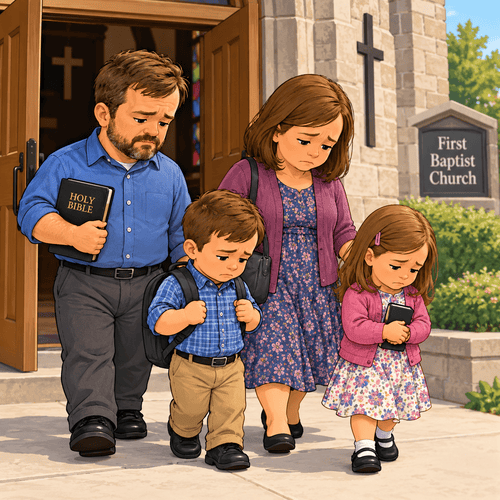

On a Sunday morning in a South Asian city, a young woman is baptised. By evening her father tells her not to come home. Her name will be struck from the family register. She will not inherit. She will not be married from that house, and she will not be buried from it.
She lost a household in a day. She also gained one—and the second isn’t a consolation prize handed to people who’ve run out of relatives. According to the New Testament, it’s the older and more durable of the two.
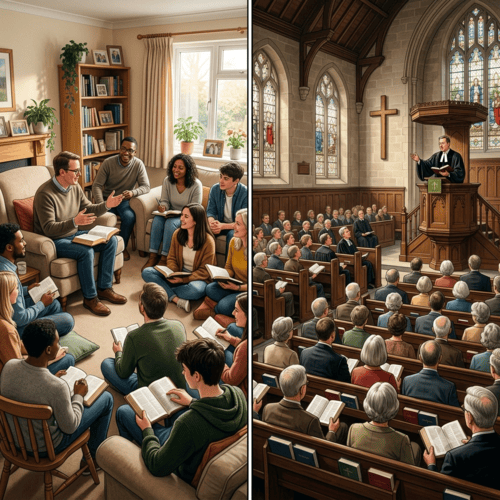
The claim makes us nervous, because we’ve heard it too often as a slogan. Someone says “we’re a family here” and means the coffee is good and nobody minds if you arrive late. That isn’t what the apostles meant. When they wanted a word for the church, they reached for the ordinary Greek word for a house full of people: oikos. A household.
The Family That Came First
Paul begins a prayer like this: For this reason I bow my knees before the Father, from whom every family in heaven and on earth is named (Ephesians 3:14–15).
There is a pun in the Greek. The word for father is patēr; the word for family or clan is patria. The family’s name is built out of the father’s name. Paul isn’t saying God resembles a father, the way a good king resembles a shepherd. He is describing the order of reality: every fatherhood that exists is derived from and named after the fatherhood of God.
Notice which way the arrow points. Two influential thinkers pointed it the other way. Ludwig Feuerbach argued God is humanity’s own nature projected onto the sky. Sigmund Freud, following him, described God as the exalted father of childhood, an illusion born of our longing for protection. We invented a heavenly Father, they said, because we already knew earthly ones.
Paul says the reverse. Human fatherhood is the copy.
The direction of derivation
- Projection theory: we know fathers, so we imagine a Father. Ephesians 3:15: there is a Father, so there are fathers.
- A projected deity would not be a Father who disciplines his children, disinherits pretenders, and finally dies for them. Wishes do not invent a cross.
- The consequence is worth stating bluntly, because it inverts the sentence most of us have heard from a pulpit. The church isn’t like a family. The church is the family. Your household is the metaphor.
The Word Behind the Idea
Once you see oikos, you find it everywhere. It’s not a stray image but a structural term running from the Old Testament into the New.
| TEXT | WHAT IT SAYS | WHAT IT ESTABLISHES |
|---|---|---|
| Numbers 12:7 | Moses is faithful in all God’s house | God has always had a household |
| Hebrews 3:5–6 | Moses served in the house; Christ is faithful over it as a son | The Son owns what the servant swept |
| 1 Timothy 3:15 | The church is the household of God, pillar and buttress of the truth | Truth is guarded by a family, not filed in an archive |
| Ephesians 2:19 | Gentiles are no longer strangers but members of the household of God | Outsiders are not admitted as guests but as kin |
| Galatians 6:10 | Do good to all, especially to those who are of the household of faith | Kinship creates real, ordered obligation |
| 1 Peter 4:17 | Judgement begins at the household of God | Family means accountability first, not exemption |
Beneath the word for house lies the word for brother. Adelphos appears roughly 230 times in the New Testament as the standard way one Christian refers to another. It’s not sentimental garnish. It’s the ordinary name.
The early church took the next step and called herself mother. Cyprian of Carthage put it starkly in the 3rd century, and John Calvin revived it: God is our Father, and the church our mother, who conceives us, carries us, feeds us, and keeps us until we’re grown. Nobody nurses himself. Preaching, sacraments, prayer and correction are how this mother feeds her children.
Adopted, Not Merely Acquitted
How does anyone get into a family they weren’t born into? By adoption. The Greek is huiothesia, literally the placing of a son.
But when the fullness of time had come, God sent forth his Son… so that we might receive adoption as sons. And because you are sons, God has sent the Spirit of his Son into our hearts, crying, “Abba! Father!” (Galatians 4:4–6).
Here the confessional Protestant tradition made a decision that matters enormously. It refused to fold adoption into justification. The Westminster Confession gives adoption its own chapter, between justification and sanctification, because the two aren’t the same act.
- Justification is a courtroom word. The judge declares me not guilty. I leave with a clean record.
- Adoption is a household word. The judge takes off His robe, takes me home, and gives me His name.
We can be acquitted by a judge who never wants to see us again. We cannot be adopted that way.
John Murray insisted adoption is a distinct act of God’s free grace, not a by-product of pardon. JI Packer called it the highest privilege the gospel offers, higher even than justification, since acquittal ends at the courtroom door and sonship never ends.
What adoption gives you
- The Father’s name (Revelation 3:12)
- The Spirit of adoption, who teaches us to say Abba (Romans 8:15)
- Free access to God, at any hour (Ephesians 3:12)
- His pity, protection and provision (Psalm 103:13; Matthew 6:32)
- His discipline, which is proof of sonship, not its denial (Hebrews 12:5–8)
- An inheritance that cannot be spent (1 Peter 1:4)
Is this legal fiction, a courtesy title? No—because it’s not free-standing. Believers are sons in the Son. Christ is the firstborn among many brothers (Romans 8:29), and the same Spirit who rests eternally on Him is given to us, crying the same word. We don’t resemble sons; we’re placed inside the sonship of the eternal Son. Election is therefore never merely rescue from wrath. It’s election to sonship, which was Calvin’s point exactly.
Jesus Redraws the Family Tree
Two scenes settle the matter.
In the first, the mother and brothers of Jesus stand outside a crowded house, sending word in. He looks at those seated around him and says: Here are my mother and my brothers! For whoever does the will of God, he is my brother and sister and mother (Mark 3:34–35). Obedience redraws the tree.
In the second, Jesus promises that whoever has left house, brothers, sisters, mother, father, children or lands for His sake will receive a hundredfold now in this time, houses and brothers and sisters and mothers and children and lands, with persecutions (Mark 10:29–30).
Read that list twice. Fathers are surrendered. Fathers aren’t returned.
The omission is deliberate. The church has brothers, sisters, mothers and children in abundance. It has exactly one Father. And call no man your father on earth, for you have one Father, who is in heaven (Matthew 23:9). Every attempt to install a human head over God’s household demolishes the doctrine it claims to honour.
What a Household Actually Does
Families aren’t defined by warm feeling. They’re defined by what they do with food, money, correction, speech and the front door. So is this one.
- The table. The Lord’s Supper is a family meal. In Corinth the rich ate while the poor were humiliated, and Paul told them that whoever eats without discerning the body eats and drinks judgement on himself (1 Corinthians 11:29). The body he means is not only the bread. Doctrinal precision at the table and social contempt at the table are the same sin.
- The purse. The first church had all things in common, selling possessions to meet need (Acts 2:44–45). The first deacons were appointed because widows—women with no household—were being overlooked (Acts 6:1–6). A household is measured by whether the vulnerable eat.
- The correction. The Lord disciplines the one He loves (Hebrews 12:6). Discipline isn’t the opposite of belonging; it’s the evidence of it. Excommunication makes sense only as a familial act—the withdrawal of the table from someone still bearing the family name.
- The speech. Do not rebuke an older man but encourage him as you would a father, younger men as brothers, older women as mothers, younger women as sisters, in all purity (1 Timothy 5:1–2). Note the last clause. Paul knew the language of family could be abused inside the church, and he wrote the safeguard into the sentence.
- The door. At Antioch, Peter stopped eating with Gentiles. Paul opposed him publicly, not for bad manners but because his conduct was not in step with the truth of the gospel (Galatians 2:14). A segregated table is a doctrinal error. Philemon is the lesson in miniature: a runaway slave is received no longer as a bondservant but… as a beloved brother (Philemon 16).
Households and the Covenant Sign
Because God deals with households, Christians disagree over who may receive the covenant sign. Paedobaptists point to Genesis 17:7, to the promise is for you and for your children (Acts 2:39), and to the households baptised in Acts. Baptists reply that those texts nowhere mention infants, and that the new covenant is composed of those who know the Lord (Hebrews 8:11).
What both sides confess is the point here: God’s saving purposes have always travelled through households, and the church is itself the household through which they travel.
Five Ways We Counterfeit the Family
Sentimentalism. “We’re a family” as a mood rather than a duty. A family that cannot correct anyone is not a family. It’s a club with better lighting.
Familialism. Treating the biological household as the primary unit and the church as an aggregate of them. This turns Ephesians 3:15 on its head, and quietly demotes the single, the widowed, the childless and the disowned convert to second class. God’s answer to the man who cannot have children is a name better than sons and daughters (Isaiah 56:5). Jesus was single. So was Paul.
Authoritarianism. Family language is the standard instrument of controlling groups. “Spiritual father”, “covering”, “your family here”—the words are used to make leaving feel like patricide. The corrective is textual, not therapeutic: one Father, and elders who lead not domineering… but being examples (1 Peter 5:3).
Tribalism. Congregations that reproduce caste, clan, class or ethnic lines have denied the doctrine at precisely the point where it costs something.
Cheap belonging. Family without membership, without a roll, without discipline. If nobody can be counted, nobody can be missed.
What It Costs Where Kinship Is Everything
Much Western writing on this subject drifts toward the therapeutic: the church as a place to find belonging. Read the same texts where kinship is the entire architecture of identity—where caste, clan and family determine whom you marry, where you eat, what you inherit and who buries you—and Mark 10:30 stops being a comfort and becomes a promissory note.
Christ pledged houses, mothers, brothers and sisters, now in this time. He didn’t pledge a feeling. He pledged people, and He sends the bill to the congregation. Where conversion costs a household, only a congregation that furnishes real houses, real money and real mothers is telling the truth about the gospel it preaches.
The Father’s House Is No Waiting Room
In my Father’s house are many rooms… I go to prepare a place for you (John 14:2). The household is provisional in form and permanent in substance. We’re not headed towards a crowd but towards a completed family: a marriage supper, a city, a new name.
Which is why Paul can say we already possess adoption and still wait eagerly for adoption as sons, the redemption of our bodies (Romans 8:23). The verdict is in. The homecoming is not yet. Nobody graduates out of sonship; we’re still walking into it.
The Roll Call
The woman disowned that Sunday will discover, if her congregation is faithful, that the men there are her brothers, the older women her mothers, the table her table, the purse her purse. She has one Father, who is delighted to have her home.
That’s not a metaphor offered to soften a loss. It’s a fact about where she now lives.
Tough Questions, Honest Answers
Is “family” simply a metaphor for the church?
The New Testament runs the metaphor the other way. Ephesians 3:15 makes God’s fatherhood the original from which every earthly family is named. The church is not a stand-in for the family you lost; it is the family your household was always imitating.
Does this devalue my actual family?
No. It secures it. Your marriage and children are real, God-given and duty-laden. What changes is the ranking. Your household is temporary—there is no marriage in the resurrection—while your place in God’s household is permanent. Loving your family as ultimate is the fastest way to crush it.
What about single, widowed or childless believers?
They are not partial members of a family of families. They are full sons and daughters of the only Father there is. Isaiah 56:3–5 gives the eunuch a name better than sons and daughters, and the two central figures of the New Testament were unmarried men.
Does the household principle settle infant baptism?
Not by itself. Both paedobaptists and Baptists affirm that God works through households; they differ on whether the covenant sign therefore extends to the children of believers. Honest advocates on each side concede the household texts alone do not close the argument.
Isn’t “spiritual family” exactly how cults control people?
Yes, and Scripture anticipated it. That is why Jesus forbids the title of father to any man on earth, why Peter forbids elders to domineer, and why Paul attaches in all purity to family language in 1 Timothy 5:2. Abuse of the doctrine is an argument against the abusers, not the doctrine.
What if my church feels nothing like a family?
Feeling is the last thing to arrive and the first thing to leave. Ask instead whether the table is open, the purse is shared, the vulnerable are fed, and correction is possible. Where those exist, the family exists, and warmth generally follows. Where they do not, no amount of language will manufacture it.
Can I be a Christian without belonging to a church?
You can be adopted and live nowhere near the house, but you cannot be fed, corrected, defended or missed. Hebrews 10:24–25 does not treat gathering as optional, and the same letter calls discipline the proof of sonship. Sonship without a household is a claim nobody can test—least of all you.
Related Reads
- What Is the Church? A Biblical Definition of Ekklesia
- What Does It Mean That the Church Is the Body of Christ?
- What Does It Mean That the Church Is the Bride of Christ?
- What Are the Marks of a True Church?
- Are House Churches Biblical? What the New Testament Prescribes
- Do I Really Need Church? What Do I Lose If I Stay Away?
- ‘Can’t I Be Spiritual Without Church?’—The Hard Truth
- Is It Ever Okay to Leave a Church? What Does the Bible Say?