If you’ve ever seen a chart of the last days—arrows, boxes, a seven-year block marked Tribulation, a dotted line where the church suddenly vanishes—you’ve already met dispensational premillennialism. Through study Bibles, radio preaching, prophecy conferences and best-selling novels, it has become the default end-times view for millions of English-speaking Christians. Many believers assume it’s simply what the Bible teaches.
It deserves better than a caricature. The people who hold it love Scripture, believe every word of it, and stand firm on the bodily return of Christ in an age when others seem to have quietly given that up. In this post, let’s examine what this millennial view holds and what it gets right. And let’s ask whether it does survive a careful reading of the New Testament.
First, the words
Millennium: Latin for a thousand years. The number comes from Revelation 20:1–6, the only passage in the Bible that mentions it.
Premillennialism: the belief that Christ returns before the thousand years and then reigns on earth.
Dispensation: a period of history in which God deals with humanity under a particular arrangement, each with its own test and its own failure.
Rapture: from the Latin rapiemur, meaning ‘we shall be caught up’ (1 Thessalonians 4:17). Every Christian believes in the catching up; the argument is over when it happens.
Tribulation: a season of intense suffering and judgement before the end.
Typology: the Bible’s habit of using earlier persons, places and events as living pictures that point forward to Christ.
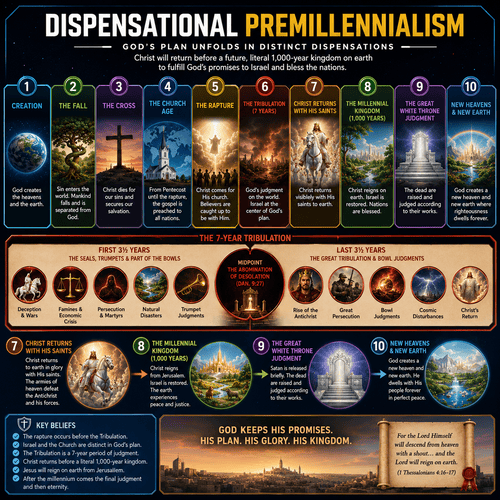
Put the words together and the system says this: God has run history through a series of distinct arrangements; Israel and the church are two separate peoples with two separate futures; Christ will come secretly to remove the church, then come visibly seven years later; and He will then reign for a thousand years from Jerusalem. In a rebuilt temple. With the sacrifices restored.
Where it came from
The system is much younger than most people assume. Its architect was John Nelson Darby (1800–1882), an Irish clergyman who left the Church of Ireland and became a leading teacher among the Plymouth Brethren. In the 1830s, Darby began teaching the church is a heavenly people whose hope is entirely separate from Israel’s earthly hope, and that Christ may come any moment to remove her before the final years of judgement fall on the world.
Darby travelled widely in North America, and his teaching was taken up by CI Scofield, whose Scofield Reference Bible (1909, revised 1917) printed the system in the margins of the King James text. For a whole generation of readers, the notes and the Word of God arrived on the same page. Lewis Chafer then gave it academic shape in his eight-volume Systematic Theology and founded Dallas Theological Seminary, which trained preachers and writers who carried the view across the evangelical world.
Being new does not make a teaching wrong. Fresh light can be true light. But it does place the burden of proof on the newcomer. For roughly 18 centuries no Christian writer taught a secret coming or two permanent peoples of God. The nearest earlier claim, an essay by the Baptist Morgan Edwards in 1788, is disputed and at best a single isolated voice. The Westminster Confession, the Belgic Confession and the Heidelberg Catechism all speak of one return of the Lord, one resurrection of the dead, and one final judgement.
The system on one page
Classic dispensationalism divides history into 7 dispensations. The number varies between teachers, but the pattern is constant: God grants a stewardship, humanity fails it, judgement follows, a new arrangement begins.
| DISPENSATION | ROUGHLY | ENDS IN |
|---|---|---|
| Innocence | Eden | The fall |
| Conscience | Adam to Noah | The flood |
| Human government | Noah to Abraham | Babel |
| Promise | Abraham to Moses | Slavery in Egypt |
| Law | Moses to Christ | The rejection of the Messiah |
| Grace, the church age | Pentecost to the rapture | Apostasy and tribulation |
| Kingdom | The millennium | A final rebellion |
On top of that framework sit five load-bearing claims.
- Two peoples, permanently. Israel is God’s earthly people with earthly promises; the church is His heavenly people. The two never merge—not now, and not in eternity.
- Consistent literalism. Old Testament prophecy must be fulfilled in the same terms in which it was given: the same land, the same city, the same throne, the same temple.
- The church as a parenthesis. Christ genuinely offered the kingdom to Israel. Israel refused. The kingdom was postponed, and the church age was inserted as an unforeseen gap in the prophetic timetable.
- A two-stage return. Christ comes secretly for His church, 7 years pass while Daniel’s 70th week runs its course, and then He comes visibly with His church.
- A literal millennium. Christ reigns from Jerusalem for a thousand years, Israel is exalted among the nations, and Ezekiel’s temple is rebuilt with its sacrificial system restored.
Not every premillennialist is a dispensationalist
This distinction matters, and confusing it produces a great deal of unfair argument. Dispensationalism itself comes in at least three forms, and they’re not equally far from the mainstream of Christian teaching.
| KIND | LEADING NAMES | DISTINCTIVE |
|---|---|---|
| Classic | Darby, Scofield, Chafer | Israel earthly, church heavenly, two destinies for ever |
| Revised | Charles Ryrie, John Walvoord, J Dwight Pentecost | One way of salvation for both, but the two peoples remain distinct for ever |
| Progressive | Craig Blaising, Darrell Bock, Robert Saucy | One people of God with different roles; Christ already reigns on David’s throne |
Progressive dispensationalism, which emerged in the 1990s, has moved so far it drops the parenthesis, admits an already-begun Davidic reign, and speaks of one people of God. Some within the older camp regard that as a defection. We would call it a welcome step towards the text.
Beyond all three stands historic premillennialism, held by George Eldon Ladd, Wayne Grudem and others. Historic premillennialists expect a future earthly reign of Christ, but they reject the secret rapture, the two peoples, the parenthesis and the rebuilt temple. They read the Bible covenantally and go through the tribulation with everyone else. So the argument in this article is with the dispensational system, not with premillennialism as such.
How the main views compare
| VIEW | THE THOUSAND YEARS | ISRAEL AND THE CHURCH | THE RETURN |
|---|---|---|---|
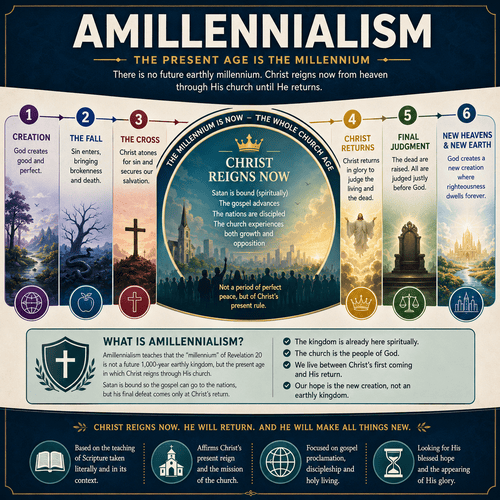
| Amillennialism | Christ reigns now from heaven; the thousand years is the whole church age | One people; Israel’s promises fulfilled in Christ | One visible return, one resurrection, one judgement |
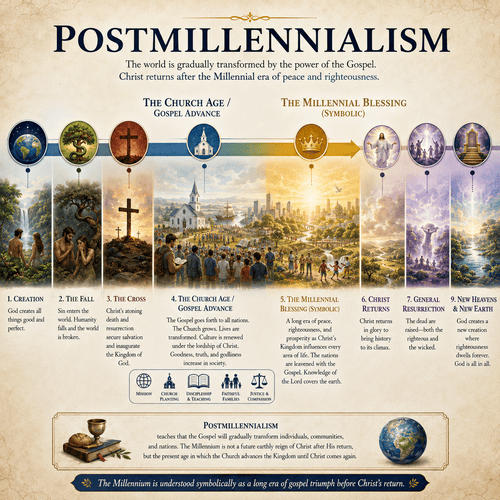
| Postmillennialism | The gospel gradually wins the nations before Christ returns | One people | One visible return at the end |
| Historic premillennialism | Christ returns, then reigns on earth a thousand years | One people; real mercy still to come for Jewish people | One visible return after the tribulation |
| Dispensational premillennialism | Christ returns, then reigns from Jerusalem with a rebuilt temple | Two peoples, permanently distinct | Two stages: a secret rapture, then a public return |
What the system gets right
Let’s first what’s true. Four things stand out.
- It refuses to empty prophecy of real content. The instinct that biblical hope concerns real history, real bodies and a real earth is a sound one. Any alternative that turns the prophets into pure poetry deserves the criticism it gets.
- It’s jealous for God’s faithfulness. The gifts and the calling of God are irrevocable (Romans 11:29). If God’s promises to Abraham’s children could simply be cancelled, no promise of ours would be safe either.
- It’s right God isn’t finished with the Jewish people. Romans 11 does hold out future mercy. Dispensationalism errs on the how, not on the whether.
- It notices genuine epochal progression. Scripture really does unfold in stages, and the Westminster Confession says so plainly. The error lies in the degree and kind of discontinuity, not in the observation itself.
Where the system breaks down
The apostles don’t read prophecy the way the view requires
This is the hinge of the whole discussion. Dispensationalism rests on consistent literalism. But the New Testament shows us the apostles handling Israel’s prophecies in a very different way.
- Amos 9. Amos promised that God would rebuild David’s fallen tent. At the Jerusalem Council, James quotes it to explain why Gentiles are being saved right now (Acts 15:13–18).
- Psalm 132 and 2 Samuel 7. Peter says God would set one of his descendants on his throne, and that this happened at the resurrection and ascension (Acts 2:30–36). The throne is occupied. Nothing was postponed.
- Jeremiah 31. The new covenant was promised to the house of Israel and the house of Judah. Hebrews applies it to the church (Hebrews 8:6–13), and we drink its cup every time we come to the Lord’s Table (1 Corinthians 11:25).
- Joel 2. Peter doesn’t say this is like Joel. He says this is what was uttered through the prophet Joel (Acts 2:16).
If flat literalism were God’s own method of fulfilment, the apostles broke their own rule repeatedly—and they broke it while preaching under the Spirit’s inspiration. Far better to conclude they were reading typologically, as Christ Himself taught them to on the Emmaus road.
The land promise is enlarged, not cancelled
We’re often accused of shrinking God’s promises into metaphors. In fact the New Testament does the opposite. It makes them bigger. Joshua records not one word of all the good promises that the Lord had made to the house of Israel had failed (Joshua 21:45), and Solomon’s borders reached the Euphrates of Genesis 15. Then Paul says Abraham was heir of the world (Romans 4:13), Hebrews says Abraham was looking for a better country, that is, a heavenly one (Hebrews 11:16), and Jesus says the meek shall inherit the earth (Matthew 5:5). To insist on a strip of land in the Middle East isn’t a bigger hope than a renewed creation.
3. One people, one body, one olive tree
Ephesians 2 is decisive. The dividing wall has been demolished, the two have been made one new man in place of the two, and together they’re being built into one temple (Ephesians 2:14–22). Gentiles are fellow heirs, members of the same body (Ephesians 3:6). Romans 11 gives us one olive tree with natural and grafted branches—not two trees growing side by side. Peter takes the language God gave Israel at Sinai and hands it to a mixed congregation of Jews and Gentiles (1 Peter 2:9–10). Two eternally separate peoples simply cannot be drawn out of these texts.
4. The church isn’t God’s plan B
This is the heaviest objection of all. If Christ sincerely offered an earthly kingdom, and Israel’s refusal caused a postponement, then the cross becomes a contingency—the response to an unexpected turn. But Paul grounds the church in the eternal purpose that the Father has realised in Christ Jesus our Lord (Ephesians 3:11), and Peter says Christ was delivered up according to the definite plan and foreknowledge of God (Acts 2:23). The church was never an interruption. She was always the point.
5. There’s no secret, separate coming
The New Testament vocabulary refuses to be split in two.
- The same word covers both. Parousia, the word for Christ’s coming, is used of the gathering of believers (1 Thessalonians 4:15) and of the destruction of the lawless one (2 Thessalonians 2:8).
- The rapture isn’t quiet. It happens with a cry of command, with the voice of an archangel, and with the sound of the trumpet of God (1 Thessalonians 4:16). That’s the loudest event in Scripture.
- The order is fixed. Jesus places the trumpet and the gathering of the elect immediately after the tribulation of those days (Matthew 24:29–31).
- There’s only one last day. Four times in John 6 Jesus promises to raise his people on the last day. Paul says it happens at the last trumpet (1 Corinthians 15:52). You cannot have two last days seven years apart.
- Relief and judgement arrive together. 2 Thessalonians 1:6–10 makes rest for the afflicted church and repayment for her persecutors a single event.
The seven-year window itself depends on a gap inserted into Daniel 9 between the 69th and 70th weeks. Yet the six achievements listed in Daniel 9:24—finishing transgression, atoning for iniquity, bringing in everlasting righteousness—are exactly what Calvary accomplished, and sacrifice truly ceased when the temple curtain tore. No other prophetic timeline in the Bible is treated to a 2000-year pause in the middle of a sentence.
6. A rebuilt temple would undo the cross
Here’s where this millennial view faces its hardest problem. Ezekiel 40–48 describes a temple with sin offerings that make atonement (Ezekiel 45:17). If that’s yet to be fulfilled literally, then animal sacrifice returns after the crucifixion. But Hebrews says Christ’s single offering has perfected for all time those who are being sanctified, and that where there is forgiveness, there is no longer any offering for sin (Hebrews 10:14, 18). Meanwhile Christ calls His own body the temple (John 2:19–21), Paul calls the church the temple (1 Corinthians 3:16), and John sees the city to come and reports: I saw no temple in the city (Revelation 21:22). The dispensationalist must either read Ezekiel non-literally—abandoning the rule the whole view is built on—or make redemptive history run backwards.
7. Revelation 20 cannot carry the whole system
One passage, in the most symbolic book in the Bible, is asked to determine the shape of everything else. That’s a fragile foundation. Read alongside the rest of Scripture, the binding of Satan echoes what Jesus already announced: the strong man has been tied up (Matthew 12:29), Satan has fallen (Luke 10:18), the ruler of this world has been cast out (John 12:31). Note carefully what he is stopped from doing—deceiving the nations (Revelation 20:3). That is precisely the change the Great Commission assumes. Note also John sees the souls of the martyrs reigning (Revelation 20:4), the same souls he saw under the altar in heaven (Revelation 6:9). The scene is heavenly. And the battle of Revelation 20:8 looks like the same battle already described in 16:14 and 19:19, which suggests John is circling back over the same period rather than marching forward in a straight line.
Where our own view has to work hard
Honesty requires this paragraph. Read on its own, Revelation 20 does sound like a sequence, and elsewhere in the New Testament resurrection language is bodily. Romans 11:25–26 most likely does point to a large future turning of Jewish people to Christ, and many confessional theologians say so—which is why the charge that we teach replacement is unfair. Isaiah 65:20, with its mention of death at a hundred years old, sits awkwardly in the final state, though Isaiah himself frames the passage with the new heavens and the new earth. These are real questions, and we answer them by letting the clear teaching of the epistles govern the visions, rather than the other way round.
Why any of this matters
This isn’t a hobby for chart-makers. Four things are at stake pastorally.
- Comfort in suffering, not escape from it. Jesus promised in the world you will have tribulation (John 16:33), and Paul told the churches that through many tribulations we must enter the kingdom of God (Acts 14:22). A theology built on being removed before the trouble starts leaves persecuted believers—in Nigeria, in China, in Iran—wondering what went wrong.
- The finality of the cross. If sacrifices resume, Christ’s finished work isn’t final. Nothing in Christian doctrine is more precious than the word finished.
- The unity of the church. Jew and Gentile in one body isn’t a temporary arrangement for an unplanned age. It’s the mystery of the ages, displayed to the powers.
- Faithfulness instead of speculation. Every failed date and every rewritten chart costs the church credibility with a watching world. We are told to occupy until he comes, not to decode the news.
What we hold in common
It’s worth ending where we began. Believers on both sides of the argument confess Christ will return bodily and visibly, that the dead will be raised, that every person will stand before the judgement seat, that punishment is real and eternal, and that God will make new heavens and a new earth in which righteousness dwells. Those convictions are the substance of Christian hope. The timetable isn’t. We hold our reading firmly, we defend it from the text, and we hold out our hand to those who read it differently—because the hope itself is one, and so is the Lord we are waiting for.
Tough Questions, Honest Answers
Where does the word “rapture” come from, and is it in the Bible?
The word itself is not in the English Bible, but the idea certainly is. Paul says believers will be caught up together with them in the clouds to meet the Lord in the air (1 Thessalonians 4:17). The Latin Vulgate translated caught up as rapiemur, and from that came rapture. So the disagreement is never about whether Christians will be caught up—every Christian believes that—but about when. We understand it as the church rising to meet her returning King and escorting him down, in the way a Greek city went out to welcome a visiting emperor. Nicholas Thomas Wright has pressed this civic imagery helpfully, and it fits a single glorious return rather than a secret removal.
Do dispensationalists teach two different ways of salvation?
Some early editions of the Scofield Reference Bible left that impression, suggesting Old Testament saints were saved by legal obedience and New Testament believers by grace. Modern dispensationalists reject this firmly, and it’s only fair to say so. Charles Ryrie insisted salvation has always been by grace through faith on the basis of Christ’s death, with the content of faith growing clearer over time. We would agree entirely with that sentence. Our objection isn’t that they teach two gospels, but that a system built on two permanent peoples struggles to explain why there’s only ever one.
Are the seven churches of Revelation 2–3 seven ages of church history?
This reading, popularised by Scofield’s notes, treats Ephesus as the apostolic age and Laodicea as our own lukewarm times. It has almost nothing to commend it. Those were seven real congregations on a real Roman postal route in Asia Minor, receiving real rebuke and real comfort, and John tells each of them to expect Christ soon. Gregory Beale points out the number seven throughout Revelation signals completeness, so the seven letters address the whole church in every age at once. That’s far more useful pastorally: every congregation can find itself somewhere in those chapters, and no church gets to blame its coldness on the calendar.
Was the founding of the modern state of Israel in 1948 a fulfilment of prophecy?
We’d separate two questions that are often tangled together. Politically, Jewish people have every right that any people has to a homeland and to safety, and Christians should say so plainly, especially given the church’s shameful record of anti-Semitism. Prophetically, the New Testament never points forward to a restored national state as a sign of the end; it points to Christ, in whom the land promise is enlarged to the whole renewed creation. Palmer Robertson observes in The Israel of God that the New Testament writers, given every opportunity to reassert a territorial hope, consistently expand it instead. Real events in the Middle East are important. They’re not a prophetic clock.
Can a Calvinist be premillennial?
Yes, and many have been. Historic premillennialism—Christ returning before an earthly reign, but with no secret rapture and no two peoples—has been held by thoroughly confessional men, including George Eldon Ladd, Wayne Grudem and James Montgomery Boice for a time. Charles Spurgeon expected a future earthly reign of Christ while rejecting Darby’s system entirely. What sits far less comfortably with confessional theology is dispensationalism proper, because the postponed kingdom implies a divine plan that can be knocked off course. That’s a question about the decree of God, not merely about the last days.
Who are the 144,000?
John hears a number and then sees a multitude, and the two are the same group viewed from different angles (Revelation 7:4–9). The list of tribes isn’t the tribal list of the Old Testament—Dan is missing, Joseph and Manasseh both appear—which signals something more than genealogy is in view. The number itself is 12 times 12 times 1000: the people of God in both Testaments, complete, not one missing. Richard Bauckham notes the census language is military, a mustering of God’s army before battle, and that this army then wins by the blood of the Lamb and the word of their testimony. Understood that way, the 144,000 aren’t an elite subgroup of evangelists but the whole church, sealed and safe.
Is your view of the end times a test of Christian fellowship?
No. We hold our position with conviction and we argue for it from Scripture, but we don’t make it a wall. Believers who differ from us here confess the same Christ, the same cross, the same empty tomb and the same coming judgement. The historic creeds say Christ will come again to judge the living and the dead, and they stop there—which is itself a lesson in proportion. Anthony Hoekema wrote our disagreements about the millennium should never obscure our agreement about the Lord of the millennium. We’d sit at the Table with any brother or sister who differs from us on this, and gladly.
Related Reads
- Christ’s Return: A Primer on the Four Millennial Views
- What Is Historic Premillennialism? A Biblical Assessment
- What Is Amillennialism? A Biblical Assessment
- What Is Postmillennialism? The Optimistic End-Times View Explained
- Covenant Theology Vs Dispensationalism: Bible Frameworks Explained
- Is “Left Behind” Theology Biblical?
- Will There Be a Third Jewish Temple in Jerusalem?
- The Mark of the Beast: What Revelation 13 Really Means by ‘666’
- Daniel’s 70 Weeks Prophecy: A Reformed Reading of Daniel 9
- Bible Mystery: Who Are the 144,000 Really?