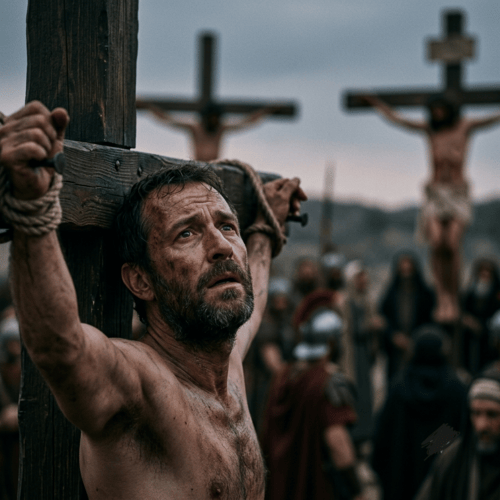
Two men were crucified alongside Jesus outside Jerusalem that Friday morning. Both were criminals, and both were guilty. They hung within a few feet of Jesus, heard the insults hurled at Him, and watched the sky turn murky at midday. Both had only hours left to live.
One died lost. The other died with a promise from the lips of the Son of God:
“Truly, I say to you, today you will be with me in paradise” (Luke 23:43).
The thieves committed perhaps similar crimes, received the same sentence, were crucified the same distance from Christ. And the two received completely different eternities. What made the difference?
Luke alone records this scene, and in a handful of verses he shows us what salvation is, how it comes, and who it is for.
Who Were the Two Men Beside Jesus?
We call them “the two thieves,” but the Bible’s language is stronger.
Luke’s word is kakourgoi, which simply means “evildoers” or “criminals” (Luke 23:32).
Matthew and Mark use lēstai (Matthew 27:38; Mark 15:27). This isn’t a pickpocket but a violent robber or bandit, and the word was often used of men who took up weapons against Rome. It’s the same word used of Barabbas (John 18:40).
Rome reserved that slow public horror for slaves, rebels and violent criminals. So the man Jesus saved that day was no likeable rogue. He was, by his own admission, getting what he deserved.
Did Both Criminals Mock Jesus?
Matthew and Mark say both criminals insulted Jesus (Matthew 27:44; Mark 15:32). Luke says one insulted him while the other defended him (Luke 23:39–42). Is this a contradiction?
No. Two explanations fit the evidence.
- A general statement. Writers in every language describe a group by its dominant behaviour. If we say “the crowd booed,” we’re not claiming every single person booed. Matthew and Mark may simply be reporting the general scene.
- A change of heart. Both men began by mocking, and then, over six long hours, one of them changed. This is the reading most commentators have preferred down the centuries.
The second reading makes the story stronger, not weaker. This man cursed the Son of God in the morning and called him King before sunset. Something happened to him on that cross that he did not do to himself.
The Fullest Confession Made at Calvary
Read his words slowly—they’re all we have of him.
“Do you not fear God, since you are under the same sentence of condemnation? And we indeed justly, for we are receiving the due reward of our deeds; but this man has done nothing wrong.” And he said, “Jesus, remember me when you come into your kingdom” (Luke 23:40–42).
That’s around 50 words. Yet inside them is a fuller confession of faith than anyone else offered at Calvary that day—including the disciples who’d all run away.
| WHAT HE SAID | WHAT IT SHOWS HE BELIEVED |
|---|---|
| “Do you not fear God, since you are under the same sentence of condemnation?” | The real judge at Calvary isn’t Rome. The sentence he is under is divine, not merely legal. |
| “We indeed justly… the due reward of our deeds” | Repentance with no excuses. God is right to condemn him. |
| “This man has done nothing wrong” | He confesses the sinlessness of Christ—the thing that makes a substitute possible. |
| “Jesus…” | The only person in the Gospels to address Jesus by His bare name—the language of trust. |
| “Remember me” | He asks for mercy, not rescue—no offer, no bargain, no achievement. |
| “When you come into your kingdom” | He calls a dying man a King who will still reign beyond death. |
That phrase “remember me” is richer than it looks. In the Old Testament, asking God to “remember” someone is never a request that He avoid forgetting; it’s a plea that He act in mercy. David prays, “according to your steadfast love remember me” (Psalm 25:7). This man isn’t asking for a passing thought. He’s asking God to do something about him.
Faith With Nothing to Look At
Now consider what this man actually saw.
THE EVIDENCE HE DIDN’T HAVE
No resurrection, no empty tomb, no angel. He’d be dead before any of it materialised. No miracle—only a beaten man who couldn’t carry His own cross. The leaders jeered; the disciples had scattered. Days later two of Jesus’ own followers said sadly, “We had hoped that he was the one to redeem Israel” (Luke 24:21). The criminal believed while they were still hoping.
Darrell Bock observes the thief’s request assumes something extraordinary: that Jesus will still possess royal authority after His execution, and the power to receive people into His kingdom. Everything visible seemed to say otherwise. Charles Spurgeon likewise refused to reduce this man’s faith to a last-minute scramble. He regarded it as faith of the first order, because the thief trusted Christ at the very moment when everything visible about Jesus seemed to contradict the claim that He was a King.
With nothing to rest on but Christ, he rested on Christ.
Two Criminals, One Difference
Here the passage becomes both uncomfortable and glorious. See how much the two men shared.
- The same guilt, and the same crime.
- The same sentence, on the same day.
- The same evidence in front of their eyes.
- The same three hours of darkness over their heads.
- The same nearness to Jesus—both within arm’s reach of the Saviour of the world.
Everything external was identical. The difference cannot be explained by background, opportunity, information, or nearness to Christ. Look instead at how each man opened his mouth.
The first: “Are you not the Christ? Save yourself and us!” (Luke 23:39). He wants rescue from sin’s consequences, not from sin. He admits no guilt and sets the terms.
The second: “Jesus, remember me…” (Luke 23:42). He admits his guilt first, asks only for mercy, and sets no terms.
One treats God as a service provider who failed to deliver. The other throws himself on God’s kindness with empty hands. That’s the difference between religion and salvation.
But where did that difference come from? Nothing in the man produced it, because there was nothing in him the other lacked. Scripture answers plainly: God gives sight to the blind. “No one can come to me unless the Father who sent me draws him” (John 6:44). When Lydia listened to Paul, Luke writes “the Lord opened her heart” (Acts 16:14). The heart does not open itself.
WHAT “GRACE” ACTUALLY MEANS
Grace is God’s undeserved kindness towards people who’ve earned the opposite. But it’s more than an offer left on a table; it’s the power that makes a dead heart live. If this man had possessed some spark of goodness the other lacked, he could have boasted in heaven. He couldn’t, and neither can we. Salvation is “the gift of God, not a result of works, so that no one may boast” (Ephesians 2:8–9).
Saved With Nothing in His Hands
Count what this man couldn’t do before he died.
- He couldn’t be baptised.
- He couldn’t repay anyone he’d robbed.
- He couldn’t join a church, sit under teaching, or receive the Lord’s Supper.
- He couldn’t perform one good deed. His hands were nailed.
- He couldn’t live one changed day to prove himself.
Jesus assured him of Paradise anyway. That tells us what salvation rests on, and it’s not us.
The Bible’s word for this is justification: God’s declaration that a guilty person now stands right before Him—not because he has become good, but because Christ’s perfect record is credited to him and his guilt is charged to Christ. Faith isn’t a work that earns the verdict. Faith is the empty hand that receives it.
DOES THIS MEAN BAPTISM DOESN’T MATTER?
No. Baptism is commanded by Christ, and treating it lightly is a serious sin. But it’s not what saves. The Westminster Confession puts it carefully: grace and salvation are “not so inseparably annexed unto it, as that no person can be regenerated, or saved, without it” (28.5). Note also what this man is not. He isn’t someone who could have obeyed but chose to delay; he disobeyed no command he had opportunity to obey. He’s an exception created by nails and time, not a permission slip.
Was There Any Fruit?
Some use this man to argue faith needs no evidence at all. Look at what he did with the little time he had.
- He feared God openly, in front of a hostile crowd.
- He confessed his own guilt without excuse.
- He rebuked a fellow sinner for blasphemy.
- He defended Christ’s innocence when almost no one else would, and submitted to him as King.
That’s confession, repentance, courage and public testimony—under torture, within hours. Genuine faith always shows itself. This man simply had little time to show it.
“Today”: What Jesus Promised About the Moment of Death
The criminal asked for something distant: “when you come into your kingdom.” Jesus gave him something immediate. Not “one day.” “Today.”
The Question of the Comma
Some groups, most notably Jehovah’s Witnesses, punctuate the verse differently: “Truly I tell you today, you will be with me in Paradise.” On that reading, “today” describes when Jesus spoke, not when the man would arrive. The earliest Greek manuscripts carried no punctuation, so the question is fair. Three things settle it.
- Luke’s own habit. “Truly, I say to you” is a set formula in Luke (4:24; 12:37; 18:17, 29; 21:32), and what follows is always the promise itself. Luke doesn’t tack a time word onto the end of it.
- It would be pointless. Jesus was obviously speaking that day. The other reading empties the word of meaning.
- It answers the question asked. The man asked about a future kingdom. Jesus’ reply is that He will not have to wait.
What Is Paradise?
The word paradeisos came into Greek from Persian, where it meant the walled garden of a king. The Greek Old Testament uses it of Eden (Genesis 2:8). It appears only three times in the New Testament: here; 2 Corinthians 12:4, where Paul is caught up into it; and Revelation 2:7, where the tree of life stands in it.
So Paradise isn’t a waiting room or a holding cell. It’s the restored garden—the presence of God, where the curse is undone.
WHAT THIS WORD RULES OUT
Soul sleep. The dead believer doesn’t lapse into unconsciousness until the resurrection.
Annihilation. He doesn’t cease to exist at death. He arrives somewhere, and arrives as himself.
Any period of purging. The least proven believer in the New Testament goes straight to Christ, on the strength of Christ’s work alone.
Anthony Hoekema summarises it simply: those who die in Christ are consciously and immediately in His presence, awaiting the resurrection of the body.
“But Jesus Said He Hadn’t Yet Ascended”
On Easter morning Jesus told Mary Magdalene, “I haven’t yet ascended to the Father” (John 20:17). This doesn’t contradict the promise, because the two statements concern different things. John 20:17 speaks of Christ’s bodily ascension, which hadn’t yet happened. Luke 23:43 speaks of where His spirit was. Jesus makes the distinction Himself at Calvary: “Father, into your hands I commit my spirit!” (Luke 23:46). His body went into Joseph’s tomb; his spirit went to the Father. Both were true at once, and the same is true of every believer who dies.
“With Me”: Paradise Is a Person
Notice the two words we rush past. Jesus didn’t say, “You will be in Paradise.” He said, “you will be with me in paradise.”
The place is defined by the Person. Whatever else heaven contains, its heart is Christ Himself. This is how Paul thinks about dying: he is not longing for a location. “My desire is to depart and be with Christ, for that is far better” (Philippians 1:23). To be absent from the body, he says, is “at home with the Lord” (2 Corinthians 5:8).
Sinclair Ferguson argues union with Christ is the thread holding all of salvation together: everything a believer receives comes to him because he has been united to Christ. That union began for this criminal in the last hour of a wasted life, and death could not touch it. He entered Paradise the way he entered faith—clinging to Jesus, and nothing else.
Neither Despair Nor Delay
There’s an old saying, usually traced to Augustine of Hippo: one thief was saved, so no one need despair; only one was saved, so no one may presume. Both halves must be heard.
Don’t Despair
If you think you’ve gone too far or delayed too long, look again at who received this promise: a violent criminal hours from death, with a public record of guilt and quite possibly a morning spent mocking Christ. He had nothing to bring and no time to fix anything. Jesus received him. No sin is too large and no hour too late for Christ to receive the person who says, in effect, “remember me.”
Don’t Presume
But the other man was equally close to Jesus and died without hope. Nearness to Christ saves nobody. Repentance isn’t a switch we flip whenever we decide the time is right—it’s a gift, and gifts arrive when the giver chooses. Scripture is urgent for this reason: “Today, if you hear his voice, do not harden your hearts” (Hebrews 3:15). Esau later sought the blessing with tears and found no way back (Hebrews 12:17).
A deathbed conversion is possible. It’s not something anyone can schedule.
The Only Man Who Read the Sign Correctly
Pontius Pilate had a placard nailed above Jesus’ head: “This is the King of the Jews” (Luke 23:38). It was meant as an insult, and everyone on that hill read it as a joke—soldiers, priests, passers-by, and at first both criminals.
One dying man read it as the truth. He had no time, no works, no baptism and no future on earth. He had Christ, and Christ was enough.
He still is.
Tough Questions, Honest Answers
What were the names of the two thieves crucified with Jesus?
Scripture never names them, and that silence is deliberate. The names Dismas for the believing criminal and Gestas for the other come from the Gospel of Nicodemus, also called the Acts of Pilate, a work written centuries after the event with no claim to historical reliability. Later tradition added a great deal of colourful detail about their lives, all of it invented. The Holy Spirit gave us what we need: one man’s words, one man’s silence, and one Saviour between them. Anonymity actually serves the point, because it stops us studying a personality instead of receiving a promise.
What crime had the two criminals committed?
Matthew and Mark call them lēstai, a word used for armed bandits and for insurrectionists—the same term applied to Barabbas, who is described as a man involved in rebellion and murder (Mark 15:7; John 18:40). Rome reserved crucifixion for slaves, rebels and violent offenders, so we are almost certainly dealing with serious, bloody crimes rather than theft. The believing criminal confirms it himself when he says they’re receiving what their deeds deserve. This matters pastorally: the first person Christ promised Paradise to was not a decent man who slipped, but a man the state had decided the world was better without.
Why did the soldiers break the criminals’ legs but not Jesus’ legs?
John records the soldiers broke the legs of both criminals to hasten their deaths before the Sabbath began, but found Jesus already dead and so did not break His (John 19:31–33). Breaking the legs removed a crucified man’s ability to push himself up to breathe, which brought death within minutes. So the believing criminal endured that final violence even after receiving the promise of Paradise—salvation didn’t spare him the last of his suffering, only the eternal consequence of his sin. In Jesus’ case, John tells us the omission fulfilled Scripture: not one of his bones would be broken, as required of the Passover lamb (Exodus 12:46; Psalm 34:20).
Is “Paradise” the same place as “Abraham’s side” in Luke 16?
They describe the same reality under different pictures. In the account of the rich man and Lazarus, Luke 16:22 speaks of the believer being carried to Abraham’s side, a Jewish image for the place of comfort where the righteous dead are gathered. Luke 23:43 uses the garden image instead, and adds the decisive detail that Abraham’s side never supplied: the believer is with Christ. It’s best not to build elaborate maps of the afterlife out of these images. What both passages teach is that death does not interrupt the believer’s conscious life, and that the destinies of the saved and the lost are fixed and separated the moment they die.
If the Apostles’ Creed says Christ “descended into hell,” how could He be in Paradise the same day?
There’s no conflict, because that clause isn’t describing a journey Jesus took after His death. John Calvin understood it to mean the full weight of God’s wrath that Christ bore in our place, endured on the cross itself, which is why He cried out He’d been forsaken (Matthew 27:46). Others take the phrase in its older, plainer sense of the state of death and the grave, which Christ genuinely entered. On either understanding, Christ’s suffering for sin was finished before He died—hence His cry, “It is finished” (John 19:30)—and His spirit went to the Father. His promise to the dying man stands untouched.
Why did Jesus demand everything of the rich young ruler but nothing of this criminal?
Because both men were being called away from the same thing: confidence in themselves. The rich ruler was asked to surrender the possessions he trusted instead of Christ, and he could not do it, so he went away sorrowful (Luke 18:18–23). The criminal had already lost everything and had no possessions, reputation or future to protect. The requirement was identical in both cases—faith that rests on Christ alone—but one man was still holding something and the other had nothing left in his hands. Christ never asks for a payment; he asks for the surrender of every rival trust.
Is the believing criminal in heaven now, or is he waiting for the resurrection?
Both are true at once. His spirit has been consciously in the presence of Christ since that Friday afternoon, exactly as Jesus promised. But he doesn’t yet have his body back, and the Bible never treats a disembodied soul as the final goal of salvation. At Christ’s return the dead in Christ will be raised imperishable and their bodies transformed (1 Corinthians 15:52–53; Philippians 3:21). The Heidelberg Catechism captures the two stages neatly, teaching that the believer’s soul is taken immediately to Christ while the body awaits reunion with it in glory (Question 57). So the man who was promised Paradise is enjoying it now, and has not yet received all of it.
Related Reads
- ‘Today You Will Be With Me in Paradise’: What Did Jesus Mean?
- Salvation: By Faith Alone or by Works? The Biblical Answer
- Assurance of Salvation: How Can I Know I’m Truly Saved?
- Faith Vs Works: Are Paul and James at War?
- What The Demon-Possessed Man Teaches Us About True Conversion
- What Can The Ethiopian Eunuch Teach Us About True Conversion?
- Encounter on Damascus Road: How Saul’s Conversion Mirrors Ours
- Did Jesus Preach Works? Examining the Hardest Passages