In late 1990, a work crew was widening a road in the Peace Forest, just south of the Old City of Jerusalem. A machine broke through the roof of something hollow. Work stopped. Archaeologists were called. Underneath was a burial cave that had been sealed for nearly 2000 years.
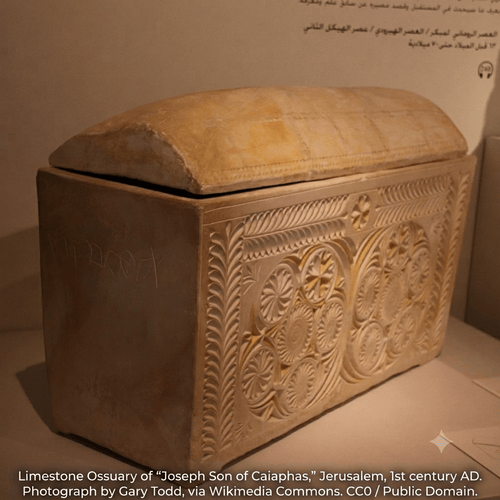
Inside were limestone boxes. On one of them, carved twice by an unsteady hand, were the Aramaic words: Yehosef bar Qayafa—Joseph, son of Caiaphas.
If that name is the name we think it is, the road crew had stumbled onto the bones of the man who presided over the trial of Jesus Christ. The Gospels call him simply Caiaphas. But Josephus, writing in the 1st century, gives his fuller identity: he was appointed high priest under the name Joseph, and was “also called Caiaphas”—meaning Caiaphas functioned like a family or clan name, with Joseph as the personal name. The name is an exact match. The tomb’s location, the wealth evident in its craftsmanship, and the rarity of Caiaphas as a name in this period all point the same direction.
That still sounds like a tall claim. So this post will do two things at once. It will show you what the Caiaphas finds really do establish, which is more than sceptics usually admit. And it will show you what these finds cannot establish. Both halves matter. A case that overstates the evidence isn’t a strong case. It’s a fragile one waiting to be embarrassed.
FIRST, THREE WORDS YOU WILL NEED
Ossuary (say it: OSS-you-ary). A small stone chest, about the size of a large toolbox. Jewish families around Jerusalem used these for roughly 130 years, from shortly before Christ until soon after the Temple fell in AD 70. A body was laid in a tomb and left about a year until only bones remained; the bones were then gathered into the box. This is called secondary burial.
High priest. The most senior religious official in Israel, who alone entered the Most Holy Place on the Day of Atonement. By the first century Rome appointed and dismissed high priests at will, which turned a sacred office into a political prize.
Provenance (say it: PROV-en-ance). The recorded history of where an object was found and by whom. An object dug up by licensed archaeologists has good provenance. One bought from a dealer with no known find-spot does not, and that difference will matter later.
What was actually found in 1990
The cave was excavated as a salvage dig by Zvi Greenhut of the Israel Antiquities Authority. A salvage dig is an emergency excavation, carried out quickly because building work has exposed an ancient site. Nobody went looking for Caiaphas. The tomb found the archaeologists, not the other way round.
12 ossuaries were recovered, 6 intact and 6 in fragments. 6 carried inscriptions. 2 carried a form of the name Caiaphas, one of which is among the most beautifully decorated ossuaries ever found in Israel, carved with rosettes inside circles. The decoration was cut by a professional stonemason in the workshop; the name was scratched on afterwards, roughly, by a family member on the day of reburial.
| WHAT WAS FOUND | THE DETAIL | WHY IT MATTERS |
|---|---|---|
| The inscription | Yehosef bar Qayafa on the plain long side; Yehosef bar Qafa on the decorated end | The name Caiaphas appears twice on one box, in two spellings, exactly as a family nickname would |
| The bones inside | Six people: two infants, a child of about two to five, a teenage boy, an adult woman, and a man of about 60 | Caiaphas held office for around 18 years and would have died an older man; the age fits |
| The dating evidence | Pottery and coins from the first century AD | The tomb was in use exactly when the Gospels place Caiaphas in Jerusalem |
| A coin in a skull | A small bronze coin of Herod Agrippa I, struck in AD 42 or 43 | A pagan burial custom, the fee for the ferryman of the dead, inside a priestly tomb |
| The location | A wealthy burial zone outside the city walls | Consistent with a rich, aristocratic Jerusalem family |
That last detail deserves a moment. A high priest’s family placed a coin in the mouth of one of their dead, in imitation of Greek and Roman superstition. The Gospels present the priestly aristocracy as men who had made their peace with the pagan world around them. The archaeology, quite by accident, shows a family doing exactly that.
The bones were not kept in a museum. Following Israeli practice they were handed to the Ministry of Religious Affairs and reburied on the Mount of Olives. The ossuary is on display in the Israel Museum in Jerusalem.
The second find: Miriam, granddaughter of Caiaphas
In June 2011 the Israel Antiquities Authority announced a second Caiaphas object. This one has a much less happy story behind it.
Around 2008 the Authority’s anti-looting unit seized an ossuary from tomb robbers. It had been stripped out of a burial cave somewhere near the Valley of Elah, the valley where David faced Goliath, south-west of Jerusalem. Because it had been stolen rather than excavated, its exact find-spot is lost forever.
The inscription on the front is unusually long: Miriam daughter of Yeshua son of Caiaphas, priests of Ma’aziah from Beth ‘Imri.
Forgery is a real industry in this field, so the box was tested rather than simply believed. Yuval Goren of Tel Aviv University and Boaz Zissu of Bar-Ilan University examined it under an electron microscope, studying the patina, the thin natural crust that builds up on stone over centuries. If a forger cuts letters into an ancient box, the grooves have no patina, or a fake one the microscope exposes. Here the crust ran continuously through the letters. The inscription was judged genuine and ancient, and the study appeared in the Israel Exploration Journal.
Why this small box matters so much
- It names 3 generations at once: Miriam, her father Yeshua (Jesus), and her grandfather Caiaphas. Genealogy carved in stone is rare.
- It’s the first time the name Qayafa has turned up anywhere outside the 1990 tomb. Before this, sceptics could say the name appeared in one place only.
- It names the priestly course of Ma’aziah. The 24 courses, or rotas of Temple service, are listed in 1 Chronicles 24, where Ma’aziah comes last. This is the first time that course has ever appeared in a written find from the Second Temple period. A list many readers skim past turned out to describe a living institution.
- It gives a place of origin, Beth ‘Imri, probably a village on the slopes of the Hebron hills, telling us where the family came from before the Temple fell.
So the Caiaphas family were priests of the course of Ma’aziah, from Beth ‘Imri, wealthy enough for the finest stonework in Jerusalem, and they named their children Joseph, Jesus and Mary. Those are the commonest names in first-century Judea.
Mount Zion: the neighbourhood, not the house
Since 2013, a team from the University of North Carolina at Charlotte, directed by Shimon Gibson and James Tabor, has been digging on Mount Zion. They’ve uncovered a large first-century house standing immediately south-east of the palace compound of Herod the Great, which later served as the residence of the Roman governor.
The house has features ordinary people simply didn’t have:
- A proper bathtub in a vaulted chamber. Only 3 other first-century bathtubs are known in the whole country: 2 in Herod’s palaces at Jericho and Masada, and 1 in a priestly mansion in the Jewish Quarter.
- A private mikveh, a stepped pool for ritual washing, essential for anyone serving in the Temple.
- An oven with 3 pits, a deep cistern for water, and a stone measuring cup with a priestly inscription.
Later Byzantine tradition placed the mansion of Caiaphas, or of his father-in-law Annas, in roughly this area, and it’s tempting to join the dots. Some Christian websites already have. But Shimon Gibson himself keeps saying it’s too early to draw conclusions.
A RULE OF THUMB WORTH KEEPING
Archaeology is good at telling us what kind of world a text describes. It is poor at telling us which particular person stood in which particular room.
The Mount Zion mansion confirms the Gospel picture of a small, immensely wealthy priestly elite living in the shadow of the governor’s palace. That’s a real result. It’s not the same as finding Caiaphas’s front door, and we lose credibility the moment we pretend otherwise.
What the finds prove, in three levels
Let’s sort the results into levels.
| LEVEL | WHAT IT MEANS | DOES THE CAIAPHAS EVIDENCE REACH IT? |
|---|---|---|
| 1. Existence | A person named in Scripture really lived | Yes. Named by the Gospels, by Acts, by the Jewish historian Josephus, and now by two stone inscriptions |
| 2. Status and setting | The person held the position and lived the life Scripture describes | Yes. Priestly family, enormous wealth, Temple service, burial among the elite |
| 3. Texture | The small background details of the narrative ring true | Yes. Names, burial customs, Roman-era politics, the accommodating temper of the Sadducean elite |
Levels 1 to 3 are exactly where the Caiaphas finds land, and they land there firmly.
The objections, stated at full strength
Not every scholar accepts that the 1990 ossuary belonged to the high priest. Helen Bond, who wrote a full-length study of Caiaphas, is notably cautious. Others, including Emile Puech and William Horbury, have raised specific technical difficulties. Here are their best arguments, and our responses.
| The objection | The response |
|---|---|
| The box doesn’t say ‘high priest’. Surely a family would record the highest office in the land? | Titles are rare across hundreds of known ossuaries. These were private family labels, scratched on so relatives could find the right box. Everyone present knew who he was |
| The lettering is crude on a beautifully carved box | The carving was workshop work; the writing was family work, done at the graveside a year after death. The mismatch is a normal pattern |
| The spellings differ, Qafa and Qayafa, and neither matches the Greek Kaiaphas exactly | Aramaic spelling was loose and Greek transliteration looser. Two spellings on one box is what a real nickname looks like, not what a forger produces |
| The tomb is fairly plain for so grand a family | The tomb is plain; the ossuary is not. The family spent their money on the box, which is what visitors would see |
| ‘Son of Caiaphas’ may be a clan name, not a father’s name | Almost certainly true, and it helps rather than hurts. Josephus calls him ‘Joseph who was called Caiaphas’, which is exactly how a family nickname works. Richard Bauckham has argued this in detail |
| The Miriam ossuary was looted, so its context is gone | Conceded without qualification. Laboratory testing supports its authenticity, but a looted object can never be as strong as an excavated one, and we should say so plainly |
Weigh it honestly and the position is this. Absolute certainty isn’t available, and no serious scholar claims it. But the name, the spelling variants, the date, the wealth, the location, the age of the man and the second independent inscription all point the same way.
A USEFUL CONTRAST: HOW TO TELL GOOD EVIDENCE FROM BAD
Good: found by accident, dug under licence, recorded in place, published in a peer-reviewed journal, and openly criticised by named specialists in print. That’s the 1990 Caiaphas ossuary.
Weaker: no known find-spot, surfaced through the antiquities trade, tested only after the fact. That’s the Miriam ossuary, which we can still use, but with a stated caution attached.
Worthless: announced through a press release or a documentary, never published for scholars to examine, and defended by attacking anyone who asks questions.
Now the harder question: what’s any of this for?
Suppose every objection above were answered tomorrow. Suppose we had Caiaphas’s signature, his household accounts and a portrait. Would that make the Bible the Word of God?
No. And the confession our churches hold has said so for hundreds of years.
The Westminster Confession on evidence and authority (Chapter 1, Section 5)
The Confession freely grants that many things move us to a high regard for Scripture: the testimony of the church, the heavenliness of its subject matter, the agreement of all its parts, and its whole purpose of giving glory to God. These, it says, are arguments by which Scripture abundantly proves itself to be the Word of God.
Then it adds the decisive clause. Our full persuasion and assurance of its infallible truth and divine authority comes from the inward work of the Holy Spirit, bearing witness by and with the Word in our hearts.
Read that carefully. Evidence isn’t dismissed. It’s welcomed. But it’s placed in the second rank. Scripture is not on trial before archaeology, waiting for a verdict.
The detail Luke could not have invented
Here is where the archaeology quietly does its most impressive work.
Luke opens Chapter 3 by fixing his story in world history with unusual precision: the 15th year of Tiberius Caesar, Pontius Pilate governing Judea, Herod ruling Galilee, and then this odd phrase, during the high priesthood of Annas and Caiaphas. Two high priests at once, when there was only ever meant to be one. Critics once treated this as proof that Luke didn’t understand the Judaism he was writing about.
Then look at what we now know. Annas, whose full name was Ananus son of Seth, was high priest from AD 6 to AD 15, when the Romans removed him. Rome could take the office away. Rome could not take away a family’s grip on Jerusalem. Five of Annas’s sons went on to hold the high priesthood, and so did his son-in-law, Joseph Caiaphas. Josephus records the family’s extraordinary run, and John’s Gospel matches it exactly, sending the arrested Jesus first to Annas and only afterwards to Caiaphas, who was high priest that year.
Now add the digs. The priestly quarter on Mount Zion and in the Jewish Quarter shows a tiny circle of enormously rich families living together beside the governor’s palace. In the Burnt House, destroyed in the fire of AD 70, excavators found a stone weight inscribed with the name of the Kathros family, another priestly clan. The Talmud preserves a bitter cry of woe against these houses, including the house of Hanin, which is the house of Annas, for their greed and their violence against ordinary people.
What the evidence lines up into
The Gospels describe a dynasty: one family, several office-holders, an elder statesman still calling the shots after his term ended.
Josephus, writing independently and with no interest in helping Christians, describes the same dynasty.
The Talmud, writing later and with open hostility, remembers the same families and resents them.
The spade uncovers their mansions, ritual baths, imported luxury and bone boxes.
Luke’s strange phrase isn’t a blunder. It’s an indication the man knew how power actually worked in that city.
Peter Williams has drawn attention to how often the Gospel writers get this kind of incidental background detail right, in ways that are easy to check and would have been very hard to fake from a distance. Nobody inventing a religion decades later and hundreds of miles away gets the local political plumbing right by accident. Luke was not guessing.
The prophecy Caiaphas didn’t know he was making
Caiaphas is named nine times in the New Testament: Matthew 26:3 and 26:57, Luke 3:2, John 11:49, John 18:13-14, 24 and 28, and Acts 4:6. The most extraordinary of these is the first one in John.
The council is panicking. Jesus is drawing crowds, and the leaders fear a Roman crackdown. Caiaphas cuts through the debate with the cold clarity of a professional politician: it’s better for you that one man should die for the people, not that the whole nation should perish. He means, kill him and save our position. It’s a calculation—a wicked one.
Then John adds a comment that should stop us in our tracks. He didn’t say this of his own accord, but being high priest that year he prophesied Jesus would die for the nation.
The high priest of Israel, in the act of arranging a judicial murder, preached the substitutionary atonement. One man dies so that the people do not perish. It’s the gospel, in the mouth of the man plotting against the gospel, and he had no idea what he was saying.
The early church understood exactly what had happened. Praying in Acts 4, in the very presence of Annas and Caiaphas, the believers say Herod, Pilate, the Gentiles and the peoples of Israel gathered to do whatever God’s hand and plan had predestined to take place. Peter had already said it at Pentecost: Jesus was delivered up according to the definite plan and foreknowledge of God, and you crucified him by the hands of lawless men.
Two truths held together, not balanced against each other
Caiaphas acted freely. Nobody forced his hand. He weighed his options, chose his words and pursued his own interests. He is fully guilty, and Scripture doesn’t soften that.
God had decreed it. The cross wasn’t an emergency response. It was the plan, settled before the world began, and every actor in the drama served it exactly.
Both are true at once, and neither cancels the other. God ordains the free and guilty acts of men without becoming the author of their sin. Here that doctrine stands in flesh and blood.
Here are the remains of a man who thought he was managing a crisis. He was serving a purpose set before the foundation of the world.
This should unsettle anyone who imagines they can outmanoeuvre God, and it should comfort every Christian whose life feels handed over to other people’s decisions. The worst injustice in human history was, at the same moment, the centre of God’s plan of mercy.
Two high priests, two priesthoods
Joseph Caiaphas received the high priesthood around AD 18 from the Roman official Valerius Gratus, and lost it in AD 36 or 37 when Vitellius, the Roman legate of Syria, removed him, in the same season that Pilate was recalled to Rome. Rome gave the office; Rome took it back. He held it longer than anyone else in that period, which tells us he was politically skilful, not that he was godly.
Set that beside the argument of Hebrews. The former priests were many in number, because death kept preventing them from continuing in office. Christ holds His priesthood permanently, because He continues for ever, and so He is able to save completely, since He always lives to make intercession. The Caiaphas ossuary is the physical proof of that argument.
| JOSEPH CAIAPHAS | JESUS CHRIST | |
|---|---|---|
| How he received the office | Appointed by a Roman official | Appointed by the oath of God |
| How long he held it | About 18 years, then dismissed | For ever, by the power of an indestructible life |
| What he offered | The blood of animals, year after year | Himself, once for all |
| What it achieved | A covering that had to be repeated | An eternal redemption, finished |
| Where he is now | A limestone box, and bones reburied on the Mount of Olives | Seated at the right hand of the Majesty on high |
There’s one more detail, and it’s almost too neat to be true. At the trial, when Jesus answers under oath, Caiaphas tears his robes. Readers of Matthew are meant to notice that the law of Leviticus forbids the high priest to tear his clothes. In the moment of condemning the Messiah, the high priest breaks the very law that gave him his office.
A few hours later, as Christ dies, the curtain of the temple is torn in two from top to bottom. Caiaphas tore what he had no right to tear. God tore what nobody else could tear, and He tore it downwards, from His own side, opening the way in.
The man tore his robe and kept his job a few more years. God tore the curtain and ended the whole system Caiaphas served. Within 40 years the Temple was ash, the priestly mansions were burnt, and the Caiaphas family had scattered to Galilee, which is where the rabbinic sources next find them.
Why we refuse to overclaim
There is a strong temptation, when we have evidence this good, to squeeze it for more than it holds. Headlines announce the house of Caiaphas, or the tomb of the man who killed Jesus, with no trace of the caution the excavators themselves insist on.
Our confidence doesn’t rest on archaeology, so we’re free to report archaeology accurately. That freedom is one of the practical gifts of a high view of Scripture. If the Bible needed the spade to hold it up, every disputed find would be a crisis. It does not, so it is not.
The empty box and the empty tomb
All of this brings us back to that limestone box in the Israel Museum, with its rosettes and its clumsy scratched name. We have the tomb of the man who condemned Jesus Christ. We have his family’s burial cave, his granddaughter’s ossuary, his neighbourhood and, in all likelihood, his bones. Everything mortal about him was gathered up, labelled and put on a shelf.
We do not have the body of the man he condemned. That tomb is empty, and it has been empty since the third day.
The archaeology of the Passion has given us the judge. It has never been able to give us the accused. That is not a gap in the evidence. That is the evidence.
Tough Questions, Honest Answers
What happened to the family of Caiaphas after AD 70?
When the Romans destroyed Jerusalem in AD 70, the Temple was burnt and the whole priestly system collapsed overnight. Rabbinic sources trace priestly families, including the Caiaphas clan, moving north into Galilee, where the courses of priests were remembered long after there was nothing left for them to do. The Talmud also preserves a scathing lament against the great high-priestly houses, naming the house of Hanin, which is the family of Annas, and complaining of their greed. The memory of these families among their own people wasn’t a fond one. Scripture had already pronounced sentence on a priesthood that had become a business, and it’s a sober reminder that religious office is no protection when the heart is wrong.
Is the ‘James, brother of Jesus’ ossuary genuine, and does it help our case?
That box surfaced on the antiquities market in 2002 with no known find-spot, which puts it in an entirely different category from the Caiaphas ossuary. Israeli authorities prosecuted its owner, Oded Golan, and after a long trial he was acquitted of the forgery charges in 2012, though the court was careful to say that the acquittal did not prove the inscription authentic. Specialists remain divided to this day. Our counsel is simple: don’t build anything on it. We have no need of a disputed artefact when we have properly excavated ones, and the discipline of setting aside evidence we cannot verify is part of what makes our other claims trustworthy.
The Caiaphas tomb was in Talpiot. Isn’t that where the ‘Jesus family tomb’ was found?
Yes, and the coincidence has caused a great deal of confusion. A separate tomb in East Talpiot, found in 1980, held ossuaries with the names Jesus son of Joseph, Mary and Joseph, and a 2007 documentary claimed this was the family tomb of Christ. The difficulty is that these were among the commonest names in first-century Judea, so finding them together is rather like finding Smiths and Johns in an English graveyard, and the great majority of archaeologists, including many with no Christian commitment, rejected the identification. Beyond the statistics the claim founders on history: the first Christians preached a bodily resurrection in the very city where the body could have been produced, and the one thing their enemies never did was produce it.
Where was Jesus actually tried by Pilate, at the Antonia Fortress or at Herod’s palace?
For centuries the traditional route of the Via Dolorosa began at the Antonia Fortress, north of the Temple, and pilgrims still walk it. Most archaeologists now think the Roman governor more likely used Herod’s palace on the western hill when he came up to Jerusalem, the very area beside the Mount Zion excavations. The Gospels do not settle it; they simply say the praetorium, meaning the governor’s headquarters, wherever he happened to be. Notice how little the New Testament depends on such details. The saving significance of the trial lies in who stood there and what he accomplished, not in the address.
Did the Sanhedrin break its own laws in condemning Jesus?
The later rabbinic law code, the Mishnah, forbids trying a capital case at night, requires a second sitting on a following day before any death sentence, and bans such trials on the eve of a festival. Judged by those rules the night hearing before Caiaphas was gravely irregular. The honest complication is that the Mishnah was written down around AD 200, so we cannot be certain those exact rules were binding in AD 30. Even setting that aside, the Gospels themselves report false witnesses who could not agree, which was a scandal by anyone’s standards. The deeper point is theological: no legal process however careful could have reached a just verdict, because the accused was innocent, and God used the injustice of men to accomplish the salvation he had planned.
Is there any archaeological evidence for Jesus Himself?
There is no inscription naming Jesus of Nazareth from His own lifetime, and we should say so plainly. That’s not surprising: he held no office, minted no coins, commissioned no buildings, and was executed as a provincial criminal. What archaeology does provide is a dense web of confirmation around Him, including Pilate’s dedication stone from Caesarea, the bones of a crucified man from Giv’at ha-Mivtar with an iron nail still through the heel, the pool of Siloam, and the Caiaphas finds themselves, alongside early non-Christian writers such as Tacitus and Josephus who mention Jesus and His execution under Pilate. But the primary evidence for Jesus has always been what it was in the first century: the testimony of eyewitnesses, written down within living memory and preserved for us in Scripture. And the willingness of these eyewitnesses to endure torture, even martyrdom for their faith in Him.
The Sadducees denied the resurrection, so why did they bury their dead in ossuaries?
Acts records the Sadducees, the priestly party to which Caiaphas belonged, denied the resurrection, angels and spirits. Scholars debate what ossuary burial actually signified; some argue it expressed hope in a bodily resurrection, others that it was mainly a matter of family space, fashion and reverence for the bones. The Caiaphas tomb is a useful caution against tidy theories, since here is a family gathering bones with great care while officially denying that those bones had any future. There is a small human irony in it that we all recognise: people often treat their dead more hopefully than their doctrine allows. Christians bury with hope for a better reason, because our confidence rests not on how carefully the bones are kept but on the risen Christ, the firstfruits of those who have fallen asleep.
Related Reads
- Is the Bible Historically Reliable? Here’s What the Evidence Shows
- Hezekiah and Assyria: 7 Archaeological Discoveries Confirm Scripture
- The Ketef Hinnom Scrolls: The Oldest Biblical Text Ever Found
- What Do the Dead Sea Scrolls Prove? The Case for Bible Reliability
- Did Jesus Really Exist? The Historical Evidence Sceptics Can’t Ignore
- Nineveh Archaeology and the Bible: What the 2026 Digs Found
- The Burial of Jesus: Is Joseph of Arimathea’s Tomb Real History?