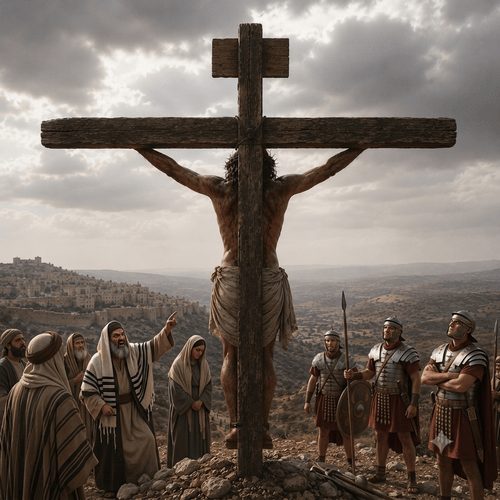
On a Friday afternoon in spring, around AD 30, a wealthy man walked into the Roman governor’s headquarters in Jerusalem and asked for the body of an executed criminal. It was a risky thing to do. The dead man had been crucified for claiming to be a king. To ask for his body was to tie your name to his.
The man’s name was Joseph, from a town called Arimathea. Before sunset he had taken the body down, wrapped it in linen and laid it in a new tomb cut into the rock. Then he rolled a stone across the entrance and went home.
Most people hurry past this part of the Easter story. We go straight from the cross to the empty tomb. But the burial matters more than you might think. If there was no known tomb, there could be no empty tomb. And some modern scholars say there was no tomb at all: that Jesus’ body was left on the cross, or thrown into a common pit.
So was the burial of Jesus real history? Let’s look at what the earliest sources say, what Jewish law required, what archaeologists have found in Jerusalem’s ancient tombs, and why the burial is part of the gospel itself.
THE SHORT ANSWER
Yes. The burial of Jesus is one of the best-attested events in his life. It appears in a very early creed (1 Corinthians 15:3–4), in all four Gospels and in the preaching in Acts. A named member of the Jewish council is an unlikely invention, Jewish law required burial before sunset, and archaeology shows crucified men could be buried in family tombs.
The exact site of the tomb is less certain, but the Church of the Holy Sepulchre has by far the strongest claim.
What the Earliest Sources Say
The oldest written mention of the burial isn’t in the Gospels at all. It’s in a summary of the gospel that Paul passed on to the church in Corinth:
‘For I delivered to you as of first importance what I also received: that Christ died for our sins in accordance with the Scriptures, that he was buried, that he was raised on the third day in accordance with the Scriptures.’
1 Corinthians 15:3–4
Paul wrote this letter around AD 55, but he says he ‘received’ these words from others. Many scholars, including some sceptics, date this creed to within a few years of the cross. Notice where the burial sits: right between the death and the resurrection. From the very start, ‘he was buried’ was part of the message.
The burial in the New Testament: who says what
| Source | Rough date | What it tells us |
|---|---|---|
| 1 Corinthians 15:3–5 (early creed) | Within a few years of the cross | Christ died, was buried, and was raised on the third day. |
| Mark 15:42–47 | AD 50s–60s | Joseph of Arimathea, a respected council member, asks Pilate for the body, wraps it in linen and lays it in a rock-cut tomb. |
| Matthew 27:57–61 | AD 60s–70s | Joseph is rich and a disciple. The tomb is his own new tomb. He rolls a great stone to the entrance. |
| Luke 23:50–56 | AD 60s–70s | Joseph is good and righteous and had not agreed with the council. The women see the tomb and how the body was laid. |
| John 19:38–42 | AD 80s–90s | Nicodemus helps, bringing about 75 pounds of spices. The tomb is new, in a garden near the place of crucifixion. |
| Acts 13:29 | Paul’s sermon, AD 40s | “They took him down from the tree and laid him in a tomb.” |
The four Gospels tell the story in their own words, each adding details the others leave out. That’s what we expect from independent witnesses, not from writers copying a script.
Why Would Anyone Invent Joseph of Arimathea?
Here’s one of the strongest clues that the burial story is true. Mark tells us exactly who buried Jesus:
‘Joseph of Arimathea, a respected member of the council, who was also himself looking for the kingdom of God, took courage and went to Pilate and asked for the body of Jesus.’
Mark 15:43
Think about what that means. The ‘council’ was the Sanhedrin, the very court that had just handed Jesus over to Rome. Early Christians had every reason to be angry with that council. Inventing a hero from among its members would be a strange thing to do. And naming him would be riskier still. A council member was a public figure in a small city. If no such man existed, or if he had never owned a tomb near Golgotha, people in Jerusalem could easily say so.
Even Arimathea is an odd detail. It was an obscure town, probably Ramathaim, the home of the prophet Samuel (1 Samuel 1:1). It proves no point of doctrine and fulfils no famous prophecy. It’s just the kind of detail people remember when something really happened.
This is why the British scholar John A. T. Robinson, who was no conservative, called the burial of Jesus in a tomb ‘one of the earliest and best-attested facts about Jesus’.
Did the Romans Leave Jesus on the Cross?
Some scholars disagree. John Dominic Crossan suggested Jesus’ body may have been left on the cross or thrown into a shallow grave, where wild dogs would have found it. Bart Ehrman has argued that Romans usually left crucified bodies to rot as a warning, so Pilate had no reason to make an exception.
It’s true that Romans often did this. But Judea was a special case, and three pieces of evidence show it.
1. Jewish Law Required Burial Before Sunset
Moses’ law was clear:
‘His body shall not remain all night on the tree, but you shall bury him the same day, for a hanged man is cursed by God.’
Deuteronomy 21:23
The Jewish historian Josephus, writing in the AD 70s, tells us this rule was still kept in his day. Jews, he says, took such care over burial ‘that they took down those that were condemned and crucified, and buried them before the going down of the sun’ (Jewish War 4.317). Rome generally let its subject peoples keep their own customs in peacetime, especially at a festival, when a riot was the last thing a governor wanted. The Gospels also tell us that the next day was a Sabbath, and a special one at that (John 19:31).
2. Roman Officials Did Release Bodies
The Jewish writer Philo, who lived at the same time as Jesus, mentions governors handing bodies of the crucified to their families before a festival (Flaccus 83). Later Roman law said the bodies of executed people should be given to anyone who asked for them for burial. Pilate had no love for the Jewish leaders, but releasing one body to a respected council member cost him nothing.
3. A Crucified Man in a Family Tomb
In 1968, builders in north Jerusalem uncovered a group of first-century tombs. Inside one of them was an ossuary (a stone bone box) holding the bones of a man named Yehohanan. An iron nail was still stuck through his heel bone, with a piece of olive wood attached. He had been crucified, yet his bones were laid to rest in a family tomb with care. Here is physical proof that a crucified Jew in Jesus’ day could receive a proper burial.
New Testament scholar Craig Evans has gathered this evidence and more. His conclusion is that, in peacetime Judea, burial before sunset was the normal practice, not a rare exception.
KEY WORDS EXPLAINED
- Rock-cut tomb: a burial cave carved into the limestone hills around Jerusalem, usually for a whole family.
- Bench (arcosolium): a shelf cut along the wall of a tomb, where a body was laid.
- Kokhim: long narrow niches cut into the tomb walls, each holding one body.
- Ossuary: a stone box. About a year after burial, the bones were gathered into it to make room for others.
- Sanhedrin: the ruling Jewish council in Jerusalem, often simply called “the council”.
A Hurried Burial in a New Tomb
Now look again at how the Gospels describe the burial. Every detail fits a rushed job done at the end of a long Friday.
‘Now in the place where he was crucified there was a garden, and in the garden a new tomb in which no one had yet been laid. So because of the Jewish day of Preparation, since the tomb was close at hand, they laid Jesus there.’
John 19:41–42
Why Joseph’s own tomb? Because it was near and the sun was going down. The Mishnah, a collection of Jewish teaching written down around AD 200, says the court kept two separate burial places for people it had executed (Sanhedrin 6:5). Joseph may have chosen his own tomb because there wasn’t time to reach one of those, or because he refused to see Jesus buried with criminals. Either way, the prophet Isaiah had said of the Servant of the LORD:
‘And they made his grave with the wicked and with a rich man in his death, although he had done no violence, and there was no deceit in his mouth.’
Isaiah 53:9
He died between two criminals. He was buried in a rich man’s tomb.
Nicodemus brought ‘a mixture of myrrh and aloes, about seventy-five pounds in weight’ (John 19:39). That’s an enormous amount, the kind of gift given at a king’s burial. The two men wrapped the body in linen cloths with the spices, ‘as is the burial custom of the Jews’ (John 19:40). But there wasn’t time to finish everything. That’s why the women came back on Sunday morning with more spices (Mark 16:1; Luke 23:56). Fiction rarely includes loose ends like that.
The Stone and the Tomb: What Archaeology Shows
Archaeologists have studied hundreds of tombs from Jesus’ time around Jerusalem. They help us picture the scene.
- The tomb was cut out of rock (Mark 15:46). That matches the limestone caves found all around the old city.
- There was a place where his body lay. The young man in the tomb was “sitting on the right side” (Mark 16:5), and Peter saw the linen cloths lying where the body had been (John 20:5–7). That fits a tomb with a bench along the wall.
- A stone closed the entrance. Israeli archaeologist Amos Kloner found that of more than 900 tombs from this period around Jerusalem, only four had large round rolling stones. Most were closed with square stone plugs. Round stones belonged to the wealthy, which fits a rich man’s tomb. Either kind could be “rolled” into place.
Matthew adds that the stone was sealed and a guard was posted (Matthew 27:62–66). The chief priests remembered Jesus saying he would rise after three days. They wanted to make sure nobody could fake it. Their plan had one unintended result: it put an official guard at the exact tomb where Jesus lay.
Where Is Jesus’ Tomb Today?
Visitors to Jerusalem today are shown three different places linked to Jesus’ burial. Here’s how they compare.
3 claimed tombs of Jesus: how the evidence stacks up
| Site | The claim | The evidence | Verdict |
|---|---|---|---|
| Church of the Holy Sepulchre | The place of Jesus’ crucifixion and burial, marked since the 4th century. | Outside the city walls in AD 30, in an old quarry with other 1st-century tombs. Local Christians remembered it, and the Roman emperor Hadrian built a temple over it around AD 135. Constantine’s builders removed that temple and found a tomb beneath. Restorers in 2016 exposed the original rock burial bench. | The strongest claim by far. |
| The Garden Tomb | A peaceful garden tomb outside the Damascus Gate, popular since the 1880s. | British general Charles Gordon promoted it in 1883. Archaeologist Gabriel Barkay dates the tomb to the 8th–7th century BC, so it was not a “new tomb” in Jesus’ day. | A lovely place to pray, but very unlikely to be the tomb. |
| Talpiot tomb | A 2007 documentary claimed it was the family tomb of Jesus, holding his bones. | Found in 1980 with ossuaries bearing names such as “Yeshua son of Yehosef”. But these were some of the most common names of the time. Amos Kloner, who excavated it, rejected the claim. | No credible link to Jesus of Nazareth. |
WHERE WE SHOULD BE CAREFUL
Honest defence of the Bible means not claiming more than the evidence shows.
- We cannot prove beyond doubt which tomb was Jesus’ tomb. The Holy Sepulchre has a strong early tradition, but tradition is not the same as proof.
- The “Nazareth Inscription”, a marble slab warning against robbing graves, was once linked to the empty tomb. A 2020 study traced its marble to the Greek island of Kos, so it probably has nothing to do with Jesus.
- Our faith doesn’t rest on finding the tomb. It rests on the tomb being empty.
Did the Women Go to the Wrong Tomb?
In 1907, the scholar Kirsopp Lake suggested a simple answer to the empty tomb: the women went to the wrong one in the early-morning dark. It sounds possible until you read the texts.
- The women watched the burial. “Mary Magdalene and Mary the mother of Joses saw where he was laid” (Mark 15:47). Luke adds that they “saw the tomb and how his body was laid” (Luke 23:55).
- Joseph knew his own tomb. If the women had made a mistake, the owner of the tomb could have corrected them within the hour.
- The authorities knew it too. They had sealed and guarded it. If the body was still in a tomb nearby, the quickest way to end Christianity was to show it. Nobody did.
- Jesus’ enemies never argued about the location. Their story was that the disciples stole the body (Matthew 28:11–15). That story assumes the right tomb was empty.
So the burial gives us a known place, known witnesses and a known owner. That’s exactly why the empty tomb could not be ignored. For more on the stolen-body theory, see The Empty Tomb: Did the Disciples Steal Jesus’ Body?
Why the Burial Is Part of the Gospel
Burial might seem like a detail. But Paul put it in the creed, and the church has kept it in the Apostles’ Creed ever since: ‘crucified, dead, and buried’. Why?
It Proves He Really Died
The Heidelberg Catechism (1563) asks, ‘Why was he “buried”?’ and answers simply: ‘His burial testifies that he really died.’ Nobody wraps a living man in 75 pounds of spices and seals him in a cave. Friends who loved him, and soldiers who had seen many die, all agreed he was gone. We look at the medical side of this in How Did Jesus Die? What Doctors Say About the Cross.
It Was Part of His Humiliation
The Westminster Shorter Catechism (1647) says Christ’s humiliation included ‘being buried, and continuing under the power of death for a time’. The eternal Son of God went all the way down. He lay in a borrowed grave, as Jonah had lain in the fish (Matthew 12:40). He did not stop at the edge of death; he went into it.
It Changes Our Graves
Because Jesus lay in a tomb, the grave is no longer a place without hope for those who belong to him. Paul says believers are joined to Christ in his burial too:
‘We were buried therefore with him by baptism into death, in order that, just as Christ was raised from the dead by the glory of the Father, we too might walk in newness of life.’
Romans 6:4
Christians have always buried their dead with care and hope. We lay our loved ones down the way Joseph laid down Jesus, knowing whose tomb is empty.
WHAT THIS MEANS FOR US
Jesus has been where we will go. When a believer’s body is laid in the ground, it is laid in a place the Saviour has already passed through and come out of.
The angel’s words on Easter morning are still true: “He is not here, for he has risen, as he said. Come, see the place where he lay” (Matthew 28:6).
Conclusion: A Real Tomb, Truly Empty
So was the burial of Jesus real history? The evidence says yes. It’s in the earliest creed. It names a man nobody would invent. It fits Jewish law, Roman practice and the tombs archaeologists have dug up around Jerusalem. And it explains why, three days later, everyone knew exactly which tomb to check.
Joseph of Arimathea gave Jesus his own grave. He only needed it for three days. The question for each of us is whether we’ll give Jesus what Joseph gave him: our courage, our honour and our trust.
Tough Questions, Honest Answers
Why was Jesus buried so quickly?
Jewish law said a hanged man’s body must not stay on the tree overnight (Deuteronomy 21:23), and the next day was the Sabbath, a special one during Passover week (John 19:31). Joseph had only a few hours between Jesus’ death at about 3 p.m. and sunset. That’s why he used a tomb ‘close at hand’ (John 19:42).
Was Jesus’ body washed and anointed before burial?
Partly. Joseph and Nicodemus wrapped the body in linen with a large amount of myrrh and aloes, ‘as is the burial custom of the Jews’ (John 19:40). But the rush meant the women planned to return after the Sabbath with more spices to finish the work (Mark 16:1). When they came, there was no body to anoint.
Was Jesus really in the tomb for 3 days and 3 nights?
Jews counted any part of a day as a whole day. Friday afternoon, all of Saturday and early Sunday make up ‘three days’ in that way of speaking. Jesus himself also said he would rise ‘on the third day’ (Matthew 16:21). We explain this further in Could Jonah Have Survived in a Whale’s Belly? What Science Says.
What happened to Jesus’ grave clothes?
John says Peter saw ‘the linen cloths lying there, and the face cloth, which had been on Jesus’ head, not lying with the linen cloths but folded up in a place by itself’ (John 20:6–7). Grave robbers would hardly have unwrapped a body soaked in spices and left the expensive linen behind. The scene convinced John to believe (John 20:8).
Was the Shroud of Turin Jesus’ burial cloth?
Nobody can prove it either way, and Christians disagree. The Bible doesn’t depend on it. We weigh the arguments in Is the Shroud of Turin Real or Fake? The Evidence Weighed.
Where was Jesus between his burial and his resurrection?
His body lay in the tomb, but his soul was with the Father. On the cross he said, ‘Father, into your hands I commit my spirit’ (Luke 23:46), and he promised the thief, ‘today you will be with me in paradise’ (Luke 23:43). See Where Was Jesus Between Good Friday and Easter? A Biblical Answer.
Why do the Gospels mention a guard at the tomb?
Matthew says the chief priests asked Pilate to secure the tomb because they remembered Jesus’ promise to rise (Matthew 27:62–66). The guard made it far harder for anyone to remove the body secretly. When the tomb was found empty, the authorities had to explain it, and their only answer was that the disciples stole the body while the guards slept (Matthew 28:13).
Related Reads
- How Did Jesus Die? What Doctors Say About the Cross
- The Empty Tomb: Did the Disciples Steal Jesus’ Body?
- Women at Jesus’ Tomb: Answers to Sceptics’ Toughest Objections
- Did Jesus Rise from the Dead? The Historical Case for the Resurrection
- Is the Shroud of Turin Real or Fake? The Evidence Weighed
- Where Was Jesus Between Good Friday and Easter? A Biblical Answer
- Caiaphas Ossuary: How the Finds Back Bible Reliability
- Evidence for the Resurrection Outside the Bible: 12 Ancient Witnesses
- Resurrection Hope: Why Joseph Requested Burial in Canaan