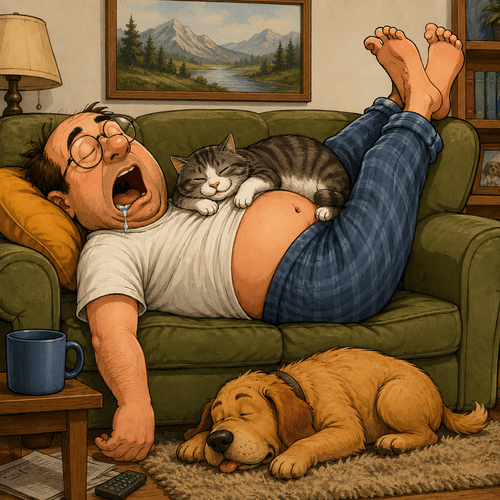
Every night we do something strange. We lie down, close our eyes, and switch ourselves off. For about a third of our lives we’re helpless—unable to see danger, unable to run, unable to fight back.
Now think like an engineer. Would we design a machine that must stop for 6-8 hours out of every 24? Would we design creatures that become defenceless every night?
No sensible designer would—unless the shutdown were doing something so important there was no other way to do it. That’s exactly what science has found. Sleep isn’t the body giving up. It’s the body running a maintenance programme that cannot be run while we’re awake.
The Mistake Evolution Never Fixed
Evolution is said to work by natural selection. Creatures that survive pass on their features; creatures that die young don’t. So any feature that makes an animal easier to kill should be weeded out over time. Sleep is exactly such a feature.
| WHAT SLEEP COSTS AN ANIMAL | WHY SELECTION SHOULD HAVE REMOVED IT |
|---|---|
| You cannot move | A sleeping animal cannot escape a predator that finds it. |
| You cannot sense danger | Hearing, sight and touch are all reduced. Warnings are missed. |
| You cannot eat | Hours of possible feeding time are lost every day. |
| You cannot reproduce | Time spent unconscious is time not spent finding a mate. |
| You cannot guard your young | Offspring are left unprotected for long stretches. |
Allan Rechtschaffen, a sleep researcher at the University of Chicago, summed up the puzzle in a sentence now quoted in almost every sleep textbook: if sleep doesn’t serve an absolutely vital function, it’s the biggest mistake the evolutionary process ever made.
He went looking for that function. In the 1980s his laboratory kept rats awake. They didn’t merely grow tired. Their bodies broke down. And they died within 2 to 3 weeks.
We’re no different. Fatal familial insomnia is a rare inherited disease caused by a prion—a wrongly folded protein that damages the brain. It destroys the ability to fall asleep, and every patient dies. There’s no recovery.
So sleep isn’t optional. It’s a requirement written into animal life, and the price of ignoring it is death.
Everything Sleeps—Even Creatures With No Brain
If sleep were an evolutionary accident, we’d expect to find it in some branches of animal life and not others. Wherever researchers look carefully, they find it.
- Jellyfish. In 2017, researchers at the California Institute of Technology showed Cassiopea—which has no brain at all, only a loose net of nerves—has a nightly quiet phase and needs extra rest if it’s disturbed.
- Roundworms. Caenorhabditis elegans, with just 302 nerve cells, enters a sleep-like state.
- Fruit flies. They rest, resist being woken, and sleep longer after being kept awake.
- Octopuses. Studies in 2021 and 2023 found a two-stage sleep cycle, including an active phase with rapid skin colour changes.
- Fish, reptiles, birds and mammals. All show organised sleep with measurable brain wave patterns.
A jellyfish nerve net, an insect nerve cluster, an octopus brain spread through its arms and a folded human cortex aren’t variations on one blueprint. Evolution can’t explain the shared behaviour by inheritance. After all, by its own account these creatures parted company long before any such brain existed. So a different explanation is offered: convergent evolution.
WHAT’S “CONVERGENT EVOLUTION”?
It’s the name given to a complex feature appearing in creatures too distantly related to have inherited it from a shared ancestor.
Notice what the term does: it names the pattern, but doesn’t explain it. Saying that sleep “evolved independently many times” is the problem restated as though it were the answer.
A designer, by contrast, reuses a good solution wherever it’s needed. The same architect can fit the same staircase into a cottage and a cathedral. Repeated solutions in unrelated places are what design looks like.
Jonathan Sarfati, a physical chemist writing for Creation Ministries International, argues convergence is now invoked so often it has stopped being a rare exception and become a standard patch, applied whenever the evolutionary family tree fails to fit the data.
The Night Cleaning Shift Inside Our Heads
So what’s worth all that vulnerability? The clearest answer came in 2013, when Maiken Nedergaard and her team at the University of Rochester described what they named the glymphatic system. The name joins two words: glial, meaning the support cells of the brain, and lymphatic, meaning the drainage system that clears waste from the rest of the body.
Here’s the problem it solves. Every other organ has lymphatic vessels to carry waste away. The brain has none. Yet it burns about a 5th of our energy and produces waste to match. Its solution is to wait until we’re asleep, and then to flood.
- The gaps open. During deep sleep the tiny spaces between brain cells widen by around 60%.
- The fluid flows. Cerebrospinal fluid, the clear liquid surrounding the brain, is driven through those widened gaps.
- The waste is flushed. Out goes the day’s rubbish, including beta-amyloid and tau—the two proteins that build up in the brains of Alzheimer’s patients.
- The brain waves are the pump. The slow electrical waves of deep sleep help push the fluid through the tissue.
Look at what must be true at the same moment. The chemical noradrenaline must fall. Support cells called astrocytes must shrink, which they do through water channels called aquaporin-4. The slow waves must be running. Consciousness must be off, because the gaps cannot open while the brain is fully active. Remove one part and nothing works. We cannot flush a brain running at full speed, and half-opened gaps don’t give us half a cleaning.
This is what engineered maintenance looks like. Airlines don’t service engines in flight. Factories schedule shutdowns. Computers back up overnight. Every engineer builds downtime into a complex system, because some jobs can’t be done while it’s live. Our brains have that downtime, and we call it sleep.
The Clock God Set in Every Cell
Sleep must also happen at the right time, and our body carries extraordinary machinery to ensure it does. In 2017 the Nobel Prize in Physiology or Medicine went to Jeffrey Hall, Michael Rosbash and Michael Young for working out how the biological clock is built. It turned out to be a feedback loop made of genes and proteins.
| STEP IN THE 24-HOUR LOOP | WHAT HAPPENS |
|---|---|
| 1. Switch on | Two proteins, CLOCK and BMAL1, join and switch on two genes, period and cryptochrome. |
| 2. Build up | Those genes make PER and CRY proteins, which gather in the cell through the day. |
| 3. Switch off | The proteins move back into the nucleus and shut down the genes that made them. |
| 4. Break down | Production having stopped, the proteins are destroyed and the blockage clears. |
| 5. Restart | CLOCK and BMAL1 are free again, and the cycle begins once more. |
That loop takes about 24 hours and keeps running in total darkness; volunteers cut off from daylight still cycle at roughly 24.2 hours. The master copy sits in some 20,000 nerve cells called the suprachiasmatic nucleus. But liver, gut, kidney and skin each carry their own. We don’t carry one clock. We carry millions, all needing to agree.
A dedicated component keeps them agreeing. Around 2002, David Berson, Samer Hattar and Ignacio Provencio identified a third kind of light detector in the eye. Rods and cones let us see; these cells, containing a pigment called melanopsin, play no part in vision at all. Their only job is to measure light and tell the clock what time of day it is. That’s why blind people, who’ve lost their rods and cones still keep a normal daily rhythm.
A clock is useless unless it’s set against a standard. The body holds a molecular timer, a control centre, millions of local copies, and a purpose-built sensor whose sole task is to check that timer against the turning of the earth.
And God said, “Let there be lights in the expanse of the heavens to separate the day from the night. And let them be for signs and for seasons, and for days and years,” Genesis 1:14
Scripture says the lights were given as timekeepers. Molecular biology has now shown our cells were built to read them.
WHY A 24-HOUR CLOCK MATTERS FOR GENESIS
The clock isn’t set to a vague stretch of time. It’s set to roughly 24 hours, matching one rotation of the earth.
Genesis 1 describes creation in days bounded by “evening and morning”, and says the sun and moon were given to govern days and years. If those days were long ages, the rhythm our cells keep has nothing to correspond to.
Notice the order, too. Light and the evening-and-morning cycle appear on day one; the sun appears on day four. The pattern comes first, the instrument that maintains it afterwards—which answers the objection that a “day” is meaningless before the sun exists.
Ken Ham, founder of Answers in Genesis, has built a ministry on the argument that Genesis is the foundation the rest of Scripture rests on, and that ordinary days are what the text plainly asks us to read. Georgia Purdom, a molecular geneticist, makes the matching scientific point: the circadian loop is an information-rich control system, and information of that kind has never been observed to write itself. Douglas Kelly, writing as a theologian, argues the days of Genesis 1 must be ordinary days because the text takes care to number them and to bound them with evening and morning.
Built in Stages, With Safety Locks
Sleep is often described as the brain switching off. That’s simply wrong. During one phase our brain burns almost as much energy as it does when we’re awake. Sleep isn’t an absence of activity but a different programme, and it runs in a fixed order.
| STAGE | WHAT IT LOOKS LIKE | WHAT IT IS DOING |
|---|---|---|
| Stage 1 (light sleep) | The few minutes of drifting off. | Handing control from waking to sleeping systems. |
| Stage 2 | Temperature drops; heart rate slows. | Settling the body; memory sorting begins. |
| Stage 3 (deep sleep) | Slow, large brain waves; very hard to wake. | Brain cleaning, growth hormone, tissue repair. |
| Rapid eye movement (REM) stage | Darting eyes, vivid dreams, brain highly active. | Emotional processing; fixing memories in place. |
These stages form a cycle of about 90 minutes, repeated 4-6 times a night—but not identically. Deep sleep is loaded into the early hours; REM grows longer towards morning. The jobs are scheduled in sequence, as a maintenance engineer would schedule them. Underneath sits a control system described by Alexander Borbély, a Swiss sleep researcher, in 1982, in which two separate processes work together.
- Sleep pressure. A chemical called adenosine builds up the longer we stay awake, and the more energy our brain spends, the faster it gathers. Sleep clears it. Caffeine works by blocking the receptors adenosine uses, which is why coffee hides tiredness without removing it.
- The daily clock. The circadian system pushes us towards sleep at night and alertness by day, whatever our sleep pressure happens to be.
Notice how elegant the first of these is. The signal telling you to rest is produced by the very act of spending energy. The system measures its own wear.
Then there’s the safety lock. During REM, the brain is intensely active and we’re dreaming. If our muscles obeyed those signals we’d leap up and act the dream out. So the body switches on a deliberate paralysis, using the chemicals glycine and GABA to block the nerve signals reaching the muscles. Our eyes and breathing muscles are exempted; everything else is locked down.
We know this is a real mechanism because it can fail. In REM sleep behaviour disorder the paralysis often doesn’t engage, and sufferers punch, kick, even run in their sleep, injuring themselves and their spouses. A system that causes injury when it stops working isn’t a leftover. It’s a safety interlock: it exists because the part of us that dreams has to be disconnected from the part of us that moves.
Custom Designs for Custom Problems
If sleep were merely an inherited constraint, all animals would sleep in much the same way. They don’t. We find particular solutions fitted to particular difficulties.
A dolphin is a mammal and must surface to breathe, and for a dolphin breathing is a conscious act rather than an automatic one. Full sleep would drown it. The solution is unihemispheric slow-wave sleep: half the brain sleeps while the other half stays awake, one eye open, the animal still swimming and surfacing. After a few hours the halves swap over. Whales and some seals do the same.
Birds use the trick differently. Ducks resting in a row sleep with both halves in the middle of the group and with one half on the end, the outward-facing eye kept open. In 2016 Niels Rattenborg and colleagues fitted recorders to great frigatebirds and caught them sleeping in mid-flight over the ocean.
| CREATURE | SLEEP PER DAY | WHAT IT SHOWS |
|---|---|---|
| Brown bat | About 19 hours | A huge requirement in a tiny mammal. |
| Human | About 7 to 8 hours | A middling need, in one night-time block. |
| Elephant | About 3 to 4 hours | A very large brain with a very small need. |
| Giraffe | Under 5 hours | Prey animal; deep sleep is brief and risky. |
| Dolphin | About 8 hours, half a brain at a time | A different mechanism entirely, fitted to water. |
Sleep need doesn’t track brain size. The elephant’s brain is far larger than ours and needs a fraction of the sleep; the bat’s is smaller than a grape and needs more than twice as much. Nor does it follow the evolutionary family tree tidily. What it follows is the way each creature actually lives.
Randy Guliuzza, of the Institute for Creation Research, argues living things look less like clay shaped from outside by their environments and more like machines shipped with built-in systems for tracking and responding to them. Sleep fits precisely: one function, many implementations, each suited to the conditions the creature faces. That’s a design catalogue, not a single inherited accident.
The Day and the Week
There’s one more piece of evidence, and it’s easy to miss because it’s so familiar. Three of our units of time have an astronomical basis. The day is one rotation of the earth. The month roughly follows the moon. The year is one orbit of the sun. Anyone anywhere could work these out by watching the sky.
The week has no such basis. Nothing in the sky takes seven days to do anything. Yet the seven-day week is nearly universal across human cultures and has survived every attempt to replace it—revolutionary France tried ten-day weeks and the Soviet Union tried five and six. And both collapsed within a few years.
Scripture tells us where it came from.
For in six days the LORD made heaven and earth, the sea, and all that is in them, and rested on the seventh day. Therefore the LORD blessed the Sabbath day and made it holy. Exodus 20:11
So we keep two rhythms. The daily one is written into our cells and can be measured in a laboratory. The weekly one is written into the fourth commandment. Notice that the commandment appeals not to a symbol but to a history—six days of work followed by one of rest—and makes that history the reason our week looks as it does. If those six days were vast ages, the argument has nothing left to stand on. The pattern only holds if they are the same kind of days we are being told to keep.
Answering the Objections Honestly
A case is only watertight if it faces the strongest replies. Here are the four we meet most often.
| THE OBJECTION | THE ANSWER |
|---|---|
| “Sleep disorders prove the design is bad.” | A fault can only be named against a standard. We call apnoea a disorder precisely because we know what breathing during sleep is supposed to do. Broken things point towards design, not away from it, and Scripture tells us plainly creation was subjected to futility (Romans 8:20-21). Much modern sleep trouble is self-inflicted besides: artificial light, screens at midnight and night shifts all confuse a clock built to read sunlight. That’s misuse, not faulty manufacture. |
| “Sleep evolved to save energy.” | The saving is small. A sleeping human uses only a little less energy than one lying quietly awake—nowhere near enough to buy off hours of total defencelessness. And the argument fails completely for dolphins, whose half-brain sleep saves almost no energy at all yet is elaborate and precise. |
| “Blind cave fish sleep far less, so sleep can evolve.” | The Mexican cave fish Astyanax mexicanus is a genuine case. But notice the direction: something was lost, not gained. Losing a function in an isolated population is what we expect in a world running down, and it tells us nothing about how the system was built. |
| “Sleep survived because it is useful, and that is how evolution works.” | The reasoning goes in a circle: sleep evolved because it was beneficial, and is known to be beneficial because it evolved and survived. Meanwhile no mechanism is ever produced for building a co-ordinated system—brain flushing, memory sorting, clock regulation and protective paralysis together—by small steps, each useful on its own. |
What This Evidence Can and Cannot Do
It is worth being clear about what an argument like this achieves, because overstating it helps nobody. The design in sleep doesn’t compel belief. Many researchers whose work is described above aren’t Christians, and they know these facts far better than most believers do. Evidence alone has never yet changed a heart. The difficulty was never the data.
For his invisible attributes, namely, his eternal power and divine nature, have been clearly perceived, ever since the creation of the world, in the things that have been made. So they are without excuse. Romans 1:20
That’s what the evidence does. It removes excuses. The clock in our cells, the flush in our brain, the paralysis that keeps us from acting out our dreams—none of it is hidden. It’s published in journals and taught in universities. What we do with it is a matter of the heart, not the head. For the believer the value is different but no less real: the God who speaks in Scripture is the same God who made the body, and the two accounts agree.
A closing thought for a tired world
Our age is peculiarly hostile to sleep. Hustle culture treats rest as weakness. Stimulants promise more hours. Sleep-hacking schemes promise to squeeze 8 hours into 4, and some technologists hope openly to abolish sleep altogether.
Every one of these is an attempt to refuse a creaturely limit. But the limit isn’t a design flaw waiting to be engineered away. It’s a mercy, fitted into us before there was any sin in the world, teaching us every night that the world runs perfectly well for 8 hours without our supervision.
We weren’t made to be the one who never sleeps. That role is taken.
Tough Questions, Honest Answers
How many hours of sleep does the Bible say we should get?
Scripture never gives a number, and we should be glad it doesn’t. What it gives instead is a rhythm—work and rest, day and night, six days and a sabbath—which can be lived out faithfully by a farmer, a nurse on night duty, a nursing mother and an elderly widow, whose needs are all very different. Ecclesiastes speaks of the sweet sleep of the working man, and Proverbs warns against the sluggard, but neither sets a target. Turning sleep into a rule with a fixed number would lay on people a burden God has not laid on them, and would condemn those whose circumstances or health make that number impossible. Aim for what allows you to serve God and your neighbour tomorrow with a clear head, and treat the usual medical guidance of seven to nine hours for adults as wisdom rather than law.
Is it sin to take naps or to sleep late?
No. Jesus Himself told his weary disciples to come away and rest a while, and napping has been normal practice across most of the world and most of history. What Proverbs condemns is the sluggard who loves sleep, who turns on his bed as a door turns on its hinges, and who comes to poverty because he will not rise to his duties. The question is therefore not the clock but the heart: are you resting so that you can work, or resting so that you need not? A tired man sleeping late on his day off and a lazy man sleeping late every day are doing the same thing physically and opposite things morally.
Are dreams a way that God still speaks to people today?
God certainly used dreams in the past, as he told Israel plainly in Numbers 12:6, and Joseph and Daniel received real revelation through them. But those dreams came while God was still giving His written word, and they were given to prophets whose messages could be tested and were preserved. Now that Scripture is complete, we are told it is sufficient to make the man of God complete and equipped for every good work. That means we need no new revelation, and we should be slow to treat a vivid dream as a message from heaven. Most dreams are your brain sorting the previous day. If something in one stirs you, test it against Scripture: if it agrees, you already had it in the Bible; if it disagrees, it’s not from God.
Is sleep paralysis a demonic attack?
Sleep paralysis is the safety mechanism described in this article failing to switch off at the right moment. You wake up mentally while your body is still locked in REM paralysis, and because the dreaming brain is still partly running, many people also feel a terrifying presence in the room. It is frightening, it is common, and it is well understood physically. We should not deny that spiritual conflict is real, but neither should we attach a demon to every unexplained sensation, and we should be especially wary of the charms and rituals folk religion offers as remedies, which Scripture forbids outright. The right response is prayer, sensible sleep habits, and a doctor if it happens often.
Will there be sleep in the new creation?
The Bible does not tell us directly, so we should hold any answer loosely. We are told there will be no night in the new Jerusalem, and that those who die in the Lord rest from their labours, which some take to mean that sleep as we know it will not be needed. On the other hand, our resurrection bodies will be genuinely physical and we will remain genuinely creatures, and creaturely life has always carried rhythms of rest. What we can say with confidence is that whatever the new creation holds, it will not hold the exhausted, anxious, never-quite-enough tiredness we know now, because the curse that produced it will be gone. That promise is enough to be going on with.
Do angels sleep, and did God really need to rest on the seventh day?
Scripture never describes angels sleeping; it shows them continually serving and worshipping, though they too are creatures with limits and are not everywhere at once. As for God, the seventh day was not recovery from tiredness—Isaiah says explicitly that the Creator does not faint or grow weary. His rest was cessation, the marking of a finished work, and it was given as a pattern for us rather than arising from any need in him. That is why Genesis says he blessed the seventh day and made it holy: he was establishing a rhythm for creatures who genuinely would grow tired. The difference between his rest and ours is the whole point.
Is it wrong for a Christian to take melatonin or sleeping tablets?
There’s no verse forbidding it, and medicine is a good gift Christians are free to use with thanksgiving. Melatonin is simply the hormone our own body releases as darkness falls, so taking it differs little in kind from any other supplement, though it works best for shifting a disrupted body clock rather than as a general sedative. The questions worth asking are pastoral. Are you medicating a symptom while ignoring its cause—unconfessed anxiety, an unsustainable workload, a habit of screens at midnight? Are you becoming dependent on a tablet rather than on God? Use it if it helps, speak to your doctor about anything long-term, and do not let it silence a conscience that may be telling you something about how you are living.
Related Reads
- Irreducible Complexity: A Compelling Case for Intelligent Design
- Specified Complexity: Fresh Arguments for Design in Nature
- Life’s Blueprint: Why Embryology Shouts Intelligent Design
- ‘Bad’ Design: Flaw in Nature Or Flaw in Our Perspective?
- Fine-tuned Universe: Design Or Random Chance?
- Did Aliens Create the Universe? The Fatal Flaw