
Some questions are too big to hold in your head all at once. “Is Jesus God?” is one of them. The Bible says a great deal about this, spread across many books, written by many authors, over many years. Where do we even begin?
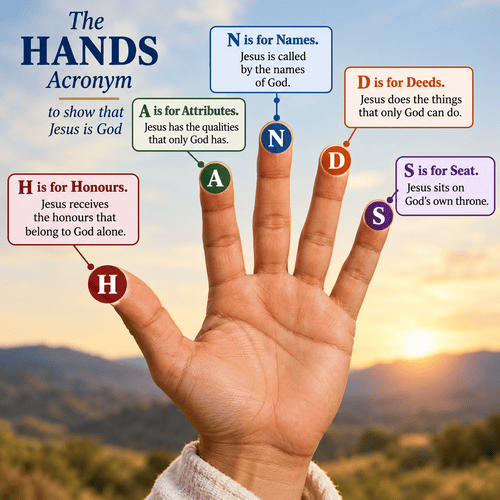
That’s why 2 writers came up with a simple memory tool. It’s a 5-letter word we already know: HANDS. Each letter stands for one line of evidence from the Bible. Together, the 5 lines build a case that’s very hard to answer.
A quick note before we start. This has nothing to do with the old picture of God as a hand reaching down from heaven. HANDS here is simply a word made from five first letters, used to help you remember five arguments. Nothing more, and nothing less.
Where the Acronym Came From
The idea began in a classroom. Ed Komoszewski was teaching college students and needed a way to help them remember what the Bible teaches about Jesus. He worked out five categories that all began with the right letters.
He then joined with Robert Bowman Jr to write a book built around it: Putting Jesus in His Place: The Case for the Deity of Christ (Kregel, 2007), with a foreword by Darrell Bock. In 2024 the two men returned to the subject with a much larger academic book, The Incarnate Christ and His Critics: A Biblical Defense (Kregel Academic), running to nearly 900 pages, with a foreword by Michael F Bird.
The second book was written for a reason. Surveys kept showing many churchgoers would happily say they believe in God the Son, and then, a few questions later, also agree Jesus was the first and greatest thing God created. The two beliefs cannot both be true. The confusion needed a clear answer.
WHAT THE FIVE LETTERS STAND FOR
H is for Honours. Jesus receives the honours that belong to God alone.
A is for Attributes. Jesus has the qualities that only God has.
N is for Names. Jesus is called by the names of God.
D is for Deeds. Jesus does the things that only God can do.
S is for Seat. Jesus sits on God’s own throne.
H is for Honours: Jesus Receives Worship
Start with what people do, not with what they say. In the Bible, worship isn’t a compliment we pay to anyone impressive. It’s fenced off. It belongs to God, and to no one else.
The Bible is strict about this to the point of being blunt. When John falls down before an angel in Revelation, the angel stops him at once and tells him to worship God (Revelation 22:8-9). When the crowd at Lystra tries to offer sacrifices to Paul and Barnabas, the two men tear their clothes in horror (Acts 14:14-15). Good men and holy angels refuse worship. Every time.
Now watch what happens around Jesus.
- Worship is offered and accepted. The women meet the risen Christ and take hold of his feet and worship him (Matthew 28:9). He doesn’t stop them. Neither does He stop Thomas.
- Prayer is directed to Him. Stephen, dying, prays “Lord Jesus, receive my spirit” (Acts 7:59). Paul pleads with the Lord Jesus three times about his thorn (2 Corinthians 12:8-9).
- Songs are sung to Him. In Revelation 5, the same praise is offered to the Lamb as to the one on the throne. Heaven doesn’t divide its worship into a higher kind and a lower kind.
- The whole universe joins in. Every knee will bow and every tongue confess Jesus Christ is Lord (Philippians 2:10-11). We will see in a moment where Paul got those words.
This was the argument Athanasius pressed against those who said Jesus was a created being. His logic was simple and hard to escape: the church worships Jesus; the church isn’t idolatrous; therefore Jesus isn’t a creature. If Jesus is less than God, Christian worship has been a mistake from the very first Easter.
A is for Attributes: Jesus Has Qualities Only God Has
An “attribute” simply means a quality that belongs to someone. Some of God’s qualities can be shared with us in a small way. God is loving, and we can love. God is wise, and we can be wise.
But other qualities can’t be shared, copied or handed out. God alone is without beginning. God alone is everywhere at once. God alone never changes. A creature that suddenly had these qualities would no longer be a creature.
The New Testament gives these very qualities to Jesus.
| QUALITY ONLY GOD HAS | WHAT IT MEANS IN PLAIN WORDS | WHERE THE BIBLE SAYS IT OF JESUS |
|---|---|---|
| Existing before creation | He didn’t begin when He was born in Bethlehem | John 1:1; John 8:58; John 17:5 |
| Being eternal | He has no starting point and no ending point | Hebrews 1:10-12; Revelation 1:17-18 |
| Never changing | He is the same yesterday, today and forever | Hebrews 13:8 |
| Omniscient: Knowing all things | Nothing is hidden from Him, including the heart | John 2:24-25; John 21:17 |
| Omnipresent: Being everywhere | He is present with all His people at once | Matthew 18:20; Matthew 28:20 |
| Omnipotent: Holding all power | All authority in heaven and on earth is His | Matthew 28:18 |
Notice how strange these claims are if Jesus is only a great teacher. A teacher can be wise. A teacher can’t promise to be present with every follower in every country in every century at the same time.
N is for Names: Jesus Is Called by God’s Own Names
In the Old Testament, God has a personal name. In Hebrew it’s written with four letters, and English Bibles usually print it as LORD in capital letters. Israel treated that name as holy. It was never given to anyone else.
Then the New Testament writers do something astonishing. They take passages that speak about the LORD, and apply them to Jesus, as though it were the most natural thing in the world.
| THE OLD TESTAMENT PASSAGE | WHO IT’S ABOUT THERE | WHERE IT’S APPLIED TO JESUS |
|---|---|---|
| Joel 2:32—all who call on the name of the LORD will be saved | The LORD, the God of Israel | Romans 10:13, of Jesus |
| Isaiah 45:23—every knee shall bow to me | The LORD, who shares glory with no one | Philippians 2:10-11, of Jesus |
| Isaiah 8:13—honour the LORD as holy | The LORD of hosts | 1 Peter 3:14-15, of Christ |
| Psalm 102:25-27—you laid the foundation of the earth | The eternal, unchanging LORD | Hebrews 1:10-12, of the Son |
| Isaiah 44:6—I am the first and I am the last | The LORD, the King of Israel | Revelation 1:17; 22:13, of Jesus |
Alongside this, the New Testament simply calls Jesus God. Thomas, who’d refused to believe, falls before the risen Christ and says, “My Lord and my God!” (John 20:28). John Calvin made a sharp observation here: Thomas ended up confessing far more than he’d been asked to believe, and Jesus accepted the confession rather than correcting it.
There are other such places. The Word was God (John 1:1). The Father says to the Son, “Your throne, O God, is forever and ever” (Hebrews 1:8). We wait for “our great God and Saviour Jesus Christ” (Titus 2:13). Peter writes of “our God and Saviour Jesus Christ” (2 Peter 1:1).
WHY “THE WORD WAS A GOD” DOESN’T WORK
Some argue John 1:1 should read “the Word was a god”, because the Greek word for God there has no “the” in front of it. Greek grammar doesn’t work that way. As Daniel Wallace has shown, when a word like this comes before the verb without “the”, it normally describes what something is by nature, not which individual it is. John is telling us the Word has the very nature of God, while still being distinct from the Father He is with. Translating it “a god” would also leave John contradicting himself 18 verses later.
D is for Deeds: Jesus Does What Only God Can Do
Words can be argued about. Actions are harder to explain away. The Bible reserves certain works for God, and then hands them to Jesus.
- He made everything. All things were made through Him, and without Him was not any thing made that was made (John 1:3). Paul says the same in Colossians 1:16, and the writer to the Hebrews in Hebrews 1:2. Creation is the one work the Old Testament uses again and again to separate the true God from every false one (Isaiah 44:24).
- He keeps everything going. In Him all things hold together (Colossians 1:17). He upholds the universe by the word of his power (Hebrews 1:3). Take Him away and reality stops.
- He forgives sins. When Jesus tells a paralysed man his sins are forgiven, the scribes react instantly: “Who can forgive sins but God alone?” (Mark 2:7). Their theology was correct. Their conclusion about Jesus wasn’t.
- He raises the dead and judges the world. The Son gives life to whom He will, and the Father has given all judgement to the Son (John 5:21-22). The judge of all the earth is a role no creature may hold.
It’s worth pausing on how Jesus does these things. Elijah raised the dead, but he prayed and God answered. Peter healed, but he said plainly the power wasn’t his own. Jesus heals, commands storms and raises the dead by His own word. He never borrows.
S is for Seat: Jesus Sits on God’s Throne
In the ancient world, seating wasn’t a small matter. Where you sat told everyone who you were. To sit on the king’s own throne wasn’t an honour a servant could receive. It was the throne of God, and God says clearly He will not give His glory to another (Isaiah 42:8).
So it’s remarkable the most quoted Old Testament verse in the whole New Testament is Psalm 110:1, where the LORD invites David’s Lord to sit at His right hand. Jesus quotes it about Himself before the high priest. The court tears its clothes and calls it blasphemy (Mark 14:62-64). They understood the claim perfectly. That’s why they reacted as they did.
The last book of the Bible finishes the thought. In Revelation the throne is described as “the throne of God and of the Lamb” (Revelation 22:1, 3). One throne. Not two thrones side by side, and not a lesser stool set beside a greater chair. The Lamb is on the inside of God’s own rule.
WHY THE FIFTH LETTER MATTERS MOST
Honours, attributes, names and deeds could each be argued over one at a time. The seat cannot. A throne is a place, and either you’re on it or you’re not. Richard Bauckham has argued the Jewish way of marking out the one God wasn’t a list of abstract qualities but a matter of identity: God alone rules over all things, and God alone created all things. Jesus is placed on both sides of that line. He sits where God sits, and He made what God made.
Why the Five Lines Are Stronger Together
The strength of the acronym, HANDS, is that the five are independent of one another, and yet all point the same way.
Think of it like a court case. One witness may be mistaken. Five witnesses, who never met, who wrote in different decades, in different places, for different readers, and who all say the same thing without having agreed it in advance, are a different matter entirely.
There’s a further point many miss. Larry Hurtado spent a career studying how the earliest Christians actually behaved. He found devotion to Jesus alongside God appears astonishingly early, among Jewish believers who’d rather have died than worship a creature. This wasn’t slow drift over centuries. It was there within a few years of the crucifixion. Long before any church council met.
So the popular claim the church invented the deity of Christ at Nicaea in AD 325 falls apart. Every piece of the HANDS evidence comes from the first century. Nicaea didn’t create the belief. It defended a belief the church already had, using new words to fence off a very old truth.
What the HANDS Acronym Doesn’t Do
HANDS is a memory tool, not a full theology. It’s worth knowing what it doesn’t attempt.
- It doesn’t explain how. HANDS shows us Jesus shares in the being of God. It doesn’t tell us how one God exists as Father, Son and Holy Spirit. That’s a different question, and the historic creeds answer it with careful words such as “of one substance with the Father”.
- It doesn’t deal with the Holy Spirit. The acronym was built to answer a question about Jesus. The Spirit’s deity is taught just as clearly, but on its own evidence, such as Acts 5:3-4, where lying to the Spirit is called lying to God.
- It doesn’t stand alone. HANDS assumes what the Bible everywhere teaches, that there is only one God (Deuteronomy 6:4; 1 Corinthians 8:4-6). Remove that, and the evidence could be misread as describing a second god. Keep it, and the evidence points where the church has always said it points.
Herman Bavinck warned against treating this doctrine as an extra topic added on at the end of syllabus. He saw it as the beating heart of the Christian faith, the thing from which everything else in Christianity draws its life.
Four Objections, Answered Briefly
| THE OBJECTION | WHO RAISES IT | THE SHORT ANSWER |
|---|---|---|
| Jesus said, “The Father is greater than I” (John 14:28) | Muslims, Unitarians | Jesus is here speaking of His position while on earth as a servant, not of His nature. A prince on a mission abroad isn’t less royal than his father. |
| Jesus did not know the day or hour (Mark 13:32) | Sceptics, progressive writers | The Son took a real human mind as well as a divine nature. What He knew as God He didn’t always draw upon as man. Two natures, one person. |
| Jesus is the firstborn of creation (Colossians 1:15) | Jehovah’s Witnesses | “Firstborn” in the Bible means rank and right of inheritance, not order of birth. God calls David the firstborn in Psalm 89:27, and David was the youngest son. |
| Jesus never said “I am God” in those words | Many ordinary readers | He said something harder to dismiss: He forgave sins, received worship, claimed the divine name in John 8:58, and took His seat on God’s throne. His enemies understood Him and tried to stone Him for it. |
Why This Matters
This isn’t a puzzle for scholars. It touches everything.
If Jesus is God, the cross isn’t a good man suffering for a cause. It’s God Himself stepping into our place. The love of God stops being a claim we’re asked to accept and becomes something we can point at.
If Jesus is God, His promises can hold our weight. A creature promising to be with us always would be making a promise he couldn’t keep. A creature promising to raise us on the last day would be offering something he doesn’t own.
But if Jesus is God, prayer to Him isn’t misplaced. John Owen wrote movingly about how believers may have real fellowship with the Father, with the Son and with the Spirit, each in a way that fits who that person is. That isn’t a doctrine you file away. It’s an invitation.
Tough Questions, Honest Answers
Is the word “Trinity” in the Bible?
No, and you won’t find it there. The word was coined later, by Tertullian around AD 200, as a shorthand for something the Bible clearly teaches. This is quite normal. The Bible doesn’t use the word “monotheism” either, but it certainly teaches it. A word can be absent while the truth it describes is present on almost every page. The church needed the term because vague language kept letting serious errors slip through, and a good label is a fence.
Did the Council of Nicaea invent the belief that Jesus is God?
No. Nicaea met in AD 325 to settle a dispute that had already broken out, and it settled it by appealing to what Christians had always believed. Every line of the HANDS evidence was written down in the first century, two hundred years earlier. Even hostile witnesses help here: the Roman governor Pliny the Younger reported around AD 112 that Christians met before dawn to sing to Christ as to a god. Nicaea did not add a belief. It drew a line around one that was already there.
Why do pictures like the egg, the water and the shamrock fail?
Because every one of them ends up teaching something the Bible denies. The egg has a shell, a white and a yolk, but no part of an egg is the whole egg, which makes God into three pieces. Water as ice, liquid and steam suggests one person wearing three costumes at different times, which the Bible rules out when the Father speaks from heaven while the Son stands in the river. The shamrock has the same problem as the egg. The safest course is to say plainly that God is not like anything else, which is exactly what God says of himself in Isaiah 46:9.
Does 1 John 5:7 prove Jesus is God, and why is it missing from my Bible?
The extra words about three bearing witness in heaven are absent from every early Greek manuscript and appear only much later. Modern translations leave them out, and they are right to do so. This is not a loss. The case for Christ’s deity never rested on that verse, and building on a disputed text only weakens an argument that is strong without it. It is far better to stand on John 1:1, John 20:28, Hebrews 1:8 and Titus 2:13, which no one disputes are original.
If Jesus is God, who was He praying to?
He was praying to his Father. This is the point where careful language matters. Christians do not say that Jesus is the Father, and never have. We say that Father, Son and Spirit are distinct persons who share one undivided divine being. So the Son can pray to the Father without praying to himself, just as the Father can speak from heaven about the Son at the baptism. If Jesus were simply the Father wearing a different mask, the prayers of John 17 would be play-acting, and the Gospels would make no sense.
Do Muslims and Christians worship the same God?
Both faiths say there is one God who made everything, and that shared statement is real. But Islam denies precisely the point this article has been making, and does so deliberately. A God who has no eternal Son is not the same God as the one revealed in Jesus Christ. The New Testament is unusually direct here: whoever denies the Son does not have the Father either (1 John 2:23). This should be said with kindness and without sneering, but it should be said.
Do you have to believe that Jesus is God in order to be saved?
Saving faith is trust in a person, not a mark on an examination paper, and many new believers trust Christ genuinely before they can explain very much. So we should be patient with those still learning. But the question changes when someone knowingly rejects the truth after being taught it. To refuse the deity of Christ is to trust a Saviour who cannot save, since only God can bear the sins of the world. The right approach is generous with the ignorant and firm with the teacher who leads people away.