Imagine a man who’s just been converted. He has read one of the Gospels. He trusts Christ. He weeps over his sin. He’s baptised. And he still believes, quite sincerely, human beings came from apes over millions of years.
Is he saved?
Now imagine a different man. He has sat in church for 30 years. He can quote Genesis by heart. He insists on a 6-day creation and gets angry with anyone who disagrees. But he has never once rested his soul on Jesus Christ.
Is he saved?
If those 2 questions make you uncomfortable, good. They should. Because most arguments about creation and Christianity collapse two very different questions into one. The first question is: what must a person believe to be saved? The second is: what does the Christian faith actually teach? Those are not the same question, and confusing them has caused enormous damage in both directions.
So let us take them apart carefully.
THE SHORT ANSWER
No, you don’t have to understand or accept the creation account in order to be saved. Salvation comes through trusting Jesus Christ, not through passing a test on Genesis.
But yes, the creation account is part of what the Christian faith teaches. A person who knowingly rejects it isn’t losing his salvation. He’s quietly loosening the foundation his salvation stands on.
In one sentence: creation isn’t a condition of salvation, but it’s part of the faith that saves.
First, What Do We Even Mean by “Believing in Creation”?
People use the word “creation” to mean at least 3 different things. They then end up arguing past each other for hours. The table below separates them. Read it slowly, because almost everything that follows depends on it.
| LEVEL | WHAT IT CLAIMS | WHAT HAPPENS IF YOU DENY IT | WHERE THE BIBLE SAYS IT |
|---|---|---|---|
| Level 1 The bare fact | God made everything out of nothing. Nothing exists that He didn’t make. | What’s left is no longer Christianity at all. Every Christian creed in history begins here. | Hebrews 11:3; John 1:3; Colossians 1:16 |
| Level 2 The storyline | Adam was a real man. He was made good. He fell. Death entered the world as the punishment for his sin. | The gospel loses its logic. If there was no real fall, there’s nothing for Christ to reverse. | Romans 5:12–21; 1 Corinthians 15:21–22; Acts 17:26 |
| Level 3 The details | God made everything in 6 ordinary days, not long ago, and there was no death of any kind before Adam sinned. | This is a serious inconsistency with what Scripture plainly says, but it isn’t a denial of the gospel itself. | Exodus 20:11; Mark 10:6; Genesis 1 |
Why this matters. When a critic says “you cannot demand belief in creation for salvation”, he’s usually thinking of Level 3. When a Christian replies “but creation is essential”, he’s usually thinking of Levels 1 and 2. Both are half right. Keep the 3 levels clear and the fog lifts.
We hold all 3 levels. We believe God made everything in 6 ordinary days, that the earth is young, and that death came only after Adam sinned. But we don’t confuse the 3 levels, and we never turn Level 3 into the doorway to heaven.
What Saving Faith Actually Is
Here is where people get tangled. So let us define our terms in plain English.
Saving faith is not simply agreeing that certain facts are true. The devil agrees that God is one, and it does him no good (James 2:19). Saving faith is trusting yourself to a Person. It is the difference between believing a bridge is strong and actually walking across it.
The Westminster Confession of Faith, written in 1646 and still the clearest summary of these things in English, makes a distinction that solves our whole problem. It says that faith believes to be true whatever is revealed in the Word of God. That is the content of faith. But then it adds that the main acts of saving faith are accepting, receiving and resting upon Christ alone for salvation. That is the object of faith.
CONTENT AND OBJECT: THE DISTINCTION THAT SETTLES IT
The content of faith is everything God has revealed, including creation. Faith says yes to all of it, as it comes to understand it.
The object of faith is Christ alone. This is what actually saves. A person is not justified by the size of his knowledge but by the Saviour he leans on.
Therefore: a new believer who has never read Genesis is genuinely saved. His faith has the right object, even though its content is still small. It will grow.
And therefore also: a man who has read Genesis, understood it, and decided Scripture is wrong has a different problem. He has not merely misread a chapter. He has set himself up as the judge of God’s Word.
That last point is worth pressing. Jesus said to men who honoured Moses in theory: “If you do not believe his writings, how will you believe my words?” (John 5:47). Notice the order. Jesus treats confidence in Moses as the training ground for confidence in Himself. Doubt at the beginning of the Bible does not stay at the beginning of the Bible.
There is a world of difference between not yet knowing something and refusing it. A child who cannot explain the Trinity is not a heretic. An adult who studies the doctrine and rejects it is. The same rule applies to Genesis.
Why the Gospel Cannot Do Without Genesis
Now for the positive case. Why do we say creation is part of the faith that saves, even though it is not the condition of salvation? Because if you pull Genesis out, the gospel stops making sense. Follow the chain one link at a time.
- He made us, so He may command us. God has the right to tell you how to live because He made you. Take away creation and God becomes one voice among many, with no particular authority over your life.
- He made us good, so our sin is our fault. Scripture says plainly: “God made man upright, but they have sought out many schemes” (Ecclesiastes 7:29). Sin is a corruption of something that was once whole. It is not how we were designed.
- Sin is rebellion, not immaturity. If human beings were never upright, then our selfishness is simply an early stage of development, and we need education rather than a Saviour.
- Death is an intruder, not a tool. “Sin came into the world through one man, and death through sin” (Romans 5:12). Death arrived as a punishment. It was not part of the original good world.
- So the cross makes sense. Christ died because death is the wage of sin (Romans 6:23). If death was always here, doing useful work, then the cross becomes a gesture rather than a payment.
- And so does the resurrection. Paul calls death “the last enemy” that Christ destroys (1 Corinthians 15:26). An enemy is something that invaded. You cannot call death an enemy and also call it God’s chosen method of making us.
Herman Bavinck, the Dutch theologian whose four-volume dogmatics appeared between 1895 and 1901, put the principle memorably: grace doesn’t destroy nature but restores it. That only works if nature was good to begin with, and if we know what it originally was. Genesis tells us what the world is meant to be. The gospel is God putting it back.
Two Men, Two Outcomes: The Argument of Romans 5
If you want one passage that shows why a real Adam matters, it is Romans 5:12–21. Paul is not telling a moral story there. He is making an argument with a precise shape.
The argument is about representation. In the Bible, a head can act on behalf of those he represents, and what he does counts for them. Paul says: “As by the one man’s disobedience the many were made sinners, so by the one man’s obedience the many will be made righteous” (Romans 5:19).
| THE COMPARISON | ADAM, THE FIRST HEAD | CHRIST, THE SECOND HEAD |
|---|---|---|
| Who he acts for | Every human being descended from him | Everyone united to Him by faith |
| What he did | One act of disobedience | One act of obedience, right up to death on a cross |
| What it earned | Guilt, condemnation and death for those he represents | Righteousness, acquittal and life for those He represents |
| How it reaches us | By our natural birth, before we have personally done anything | By God’s gift, received through faith, before we have earned anything |
Now look at what happens if Adam was not a real man. The left column becomes a myth. And a comparison only works if both sides are the same kind of thing. Turn the first Adam into a symbol and you have quietly suggested that the second Adam might be a symbol too.
John Murray, who taught theology at Westminster Theological Seminary and wrote The Imputation of Adam’s Sin in 1959, argued that the whole structure of our salvation depends on this parallel holding at both ends. Richard Gaffin made the same point more bluntly in a 2010 essay titled “No Adam, No Gospel”. The title is the argument.
PUT SIMPLY
Romans 5 isn’t decoration. It’s the engine room of how we’re saved.
We’re counted guilty because of what our first representative did. We’re counted righteous because of what our second representative did.
Remove the first man and you haven’t trimmed a detail. You’ve removed the pattern that explains how Christ’s righteousness can possibly count as yours.
Answering the Usual Objections
“You’re adding requirements to the gospel.”
No. We’re distinguishing the condition of salvation from the content of the faith. The same distinction applies elsewhere. A new believer may not yet understand the Trinity or the two natures of Christ. He’s still saved. But nobody concludes these doctrines are therefore optional for the church. Creation works exactly the same way.
“The thief on the cross knew nothing and Jesus saved him.”
True, and it’s a wonderful comfort. But notice what the example proves. It proves small knowledge doesn’t prevent salvation. It doesn’t prove Scripture may be contradicted. The thief was a Jewish man raised on Moses. His knowledge was thin, not hostile. There is a difference between an empty cup and a cup turned upside down.
“Great theologians accepted an old earth, so it cannot matter.”
Charles Hodge and BB Warfield did make room for an old earth under the pressure of the geology of their day. That’s worth admitting honestly. But notice what they did not give up. Hodge wrote What Is Darwinism? in 1874 and answered his own question in one word: it is atheism, because it removes design from nature. Both men held firmly to a real Adam and a real fall. They conceded at Level 3 while defending Levels 1 and 2. Their example doesn’t license going further than they went.
“Augustine didn’t read the days literally, so neither should we.”
Augustine of Hippo is often enlisted here, and unfairly. He did struggle with the 6 days, but his solution was that God made everything instantly, in a single moment, not over long ages. He also held to a real Adam and wrote in The City of God that the world was less than 6000 years old. He shortens the timescale. He doesn’t lengthen it. Basil of Caesarea, writing his sermons on the 6 days in the fourth century, argued that “one day” means a single day of 24 hours.
“Genesis is ancient poetry, not a report.“
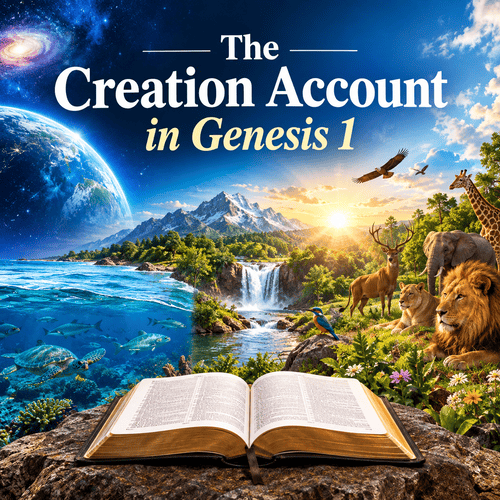
Hebrew poetry has recognisable features, and Genesis 1 doesn’t have them. It uses the ordinary Hebrew grammar of narrative, the same grammar used in the historical books. And the rest of Scripture treats it as history. The Fourth Commandment grounds the working week in it: “For in six days the LORD made heaven and earth” (Exodus 20:11). Jesus grounds marriage in it: “from the beginning of creation, God made them male and female” (Mark 10:6). Luke traces a family tree from Jesus back to Adam without changing gear (Luke 3:38). John Calvin, in his 1554 commentary on Genesis, says God took six days in order to fit His works to our capacity, which assumes the days were real.
“This will drive scientists away from the church.“
The opposite risk is greater and better documented. If a young believer is taught that Scripture must be corrected wherever it meets the current consensus, he learns a method, not merely a conclusion. And that method does not stop at Genesis. The consensus also says that virgins do not conceive and dead men stay dead.
What the Church Has Actually Confessed: A Timeline
It is often claimed that taking Genesis as history is a modern American invention. The record says otherwise.
- 4th century. Basil of Caesarea preaches through the six days and insists that a day means a day.
- 5th century. Augustine prefers instant creation, yet holds to a historical Adam and a world only thousands of years old.
- 1554. John Calvin writes that God spread His work over six days as an act of kindness to slow human minds, and elsewhere notes that the world had not yet completed six thousand years.
- 1646. The Westminster Confession states that God created all things “in the space of six days; and all very good”. The phrase was chosen deliberately, as Robert Letham showed in a detailed 1999 study of the assembly’s own debates.
- 1874. Charles Hodge publishes What Is Darwinism? and concludes that a nature without design is a nature without God.
- 2000 to 2004. Major denominational reports in America allow some freedom on the length of the days while holding the line firmly on a historical Adam.
- 2010 onwards. Peter Enns argues in The Evolution of Adam that the historical Adam can be surrendered. Richard Gaffin and others reply that the gospel goes with him. The debate proves the point of this article: Levels 2 and 3 are connected, and the slide runs downhill.
Where Christians May Differ, and Where They May Not
Honesty requires a clear map. Not every disagreement is the same size.
| THE QUESTION | HOW SERIOUS | WHY |
|---|---|---|
| Did God create everything out of nothing? | Essential | Denying it puts a person outside the Christian faith entirely. |
| Was Adam a real man whose sin brought death? | Essential | The gospel of Romans 5 and 1 Corinthians 15 cannot be stated without him. |
| Were the days ordinary days, and is the earth young? | Important | This is what Scripture plainly teaches and what the church confessed. Denying it is a real error about God’s Word, but not a denial of the gospel. |
| Exactly how old is the earth in years? | Open | The genealogies give us an order of magnitude, not a precise date on a calendar. |
| How did the flood shape the geology we see? | Open | Faithful Christians who agree on Scripture still work out the mechanisms differently. |
Use this map in conversation. It stops you from treating a brother’s honest question as apostasy, and it stops you from shrugging at the things that genuinely cannot be given away.
Why Any of This Matters
This isn’t a hobby for people who enjoy arguments. Creation touches ordinary life at every point.
- Our worth. We’re made in God’s image, not a well-organised accident. That’s the ground of human dignity, and there’s no other ground that holds.
- Our marriage. Jesus settled the question of marriage by quoting Genesis, not by quoting culture (Mark 10:6–9).
- Our rest. The command to work 6 days and rest 1 day is grounded in the pattern of the creation week itself (Exodus 20:11).
- Our grief. Death is an enemy, not a natural friend. We’re allowed to hate it. And it is going.
- Our hope. The Bible ends where it began, with a renewed heaven and earth (Revelation 21:1–5). The story is a circle that closes.
SO, DO YOU HAVE TO BELIEVE IN CREATION TO BE A CHRISTIAN?
If we’re are asking whether God will turn away a person who trusts Christ but hasn’t yet worked out Genesis, the answer is no. We come as we are. Christ receives sinners, not experts.
If we’re asking whether the creation account is optional for the Christian faith, the answer is also no. It’s where the gospel begins, and it’ the reason the gospel is good news.
Trust Christ first. Then read Genesis with the confidence of a child who has been told the truth by his Father.
Tough Questions, Honest Answers
Did Jesus Himself treat Genesis as real history?
Yes, and He did it at the most serious moments. When He was asked about divorce, He settled the question by quoting Genesis as fact: “from the beginning of creation, God made them male and female” (Mark 10:6). He spoke of Abel’s blood and of Noah’s flood as real events (Luke 11:51; Matthew 24:37–39). He never treated the early chapters as a nice story with a hidden moral. If Genesis were myth, then Jesus built His teaching on marriage and judgement on a foundation that was not there.
Can someone who believes in evolution still be a genuine Christian?
Very often, yes. Many people come to Christ out of a background where evolution was simply the air they breathed, and they’re truly born again while still holding it. Salvation rests on Christ, not on a correct view of biology. But we’d say such a believer is holding two things that pull against each other, and that over time one will give way. The kind thing isn’t to pretend the tension isn’t there, but to open Genesis and Romans 5 with him patiently.
What does the Hebrew word for “day” mean in Genesis 1?
The word is yom. Like the English word “day”, it can mean a twenty-four hour period, the daylight hours, or a vague period such as “in my grandfather’s day”. Context decides. In Genesis 1 the context is about as tight as Hebrew gets: each day is numbered, and each is defined by “evening and morning”. Everywhere else in the Old Testament where yom appears with a number or with evening and morning, it means an ordinary day. Exodus 20:11 then uses the creation week as the pattern for our working week, which only makes sense if the days match.
Is Genesis 1 written as poetry or as history?
Hebrew poetry has clear marks, especially parallel lines that repeat an idea in different words, as in the Psalms. Genesis 1 does not work that way. It uses the ordinary grammar of Hebrew narrative, the same grammar found in Exodus, Joshua and Kings. It is certainly beautiful and carefully structured, but so are many true accounts. Orderly writing is not the same as fictional writing.
Did the early church really believe in a 6-day creation?
The great majority did, and they said so long before any modern debate existed. Basil of Caesarea preached a whole series on the 6 days in the fourth century and argued for ordinary days. Ambrose of Milan did the same. Augustine is the famous exception, but his alternative was that God created everything in a single instant, which is shorter than six days, not longer. No significant early writer proposed millions of years, because nobody was asking them to.
Does the Bible actually tell us how old the earth is?
It doesn’t give a date, but it does give the material for an estimate. The genealogies in Genesis 5 and 11 link Adam to Abraham with ages attached, and from Abraham the history is reasonably firm. Adding it up gives a world of roughly 6000 years. There’s room for discussion about whether a few names are skipped, which could stretch the figure somewhat. What the text doesn’t allow is an extra several billion years, because the gaps would have to be unimaginably large.
Should a church require belief in 6-day creation for membership?
We’d say no for church membership, and yes for those who teach. Membership asks for a credible profession of faith in Christ, and we must not fence the table with a doctrine Scripture doesn’t make the test of salvation. Teachers and elders are different, because they shape how a whole congregation reads the Bible. A church can welcome a doubting new believer warmly while still expecting its pulpit to handle Genesis as God’s Word. Welcome widely, and teach carefully.
Related Reads
- The Genetic Bottleneck and Adam and Eve: Can Two Be Enough?
- Did Humanity Really Begin with Just One Couple?
- The Necessary Adam: Why We Must Affirm the First Man
- Historicity of Adam & Eve: The New Testament’s Validation
- Creation From Nothing: What Do We Truly Mean?
- Population Math: The Overlooked Evidence for a Young Earth