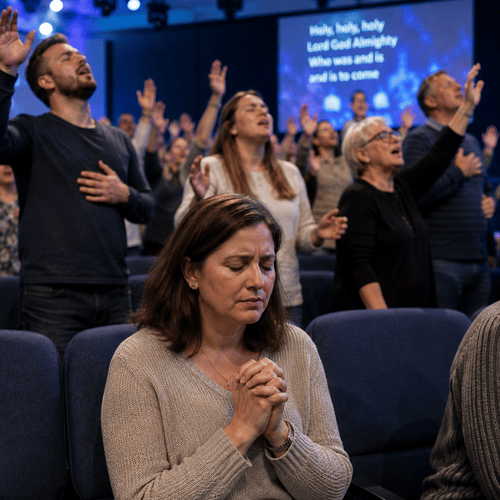

A young mother sits in a hospital corridor at 2 in the morning. Her son is ill. Her church has told her she mustn’t say the name of his illness out loud, or she will give the sickness permission to stay. So she doesn’t say the word. She hasn’t told her family what the doctors found. She hasn’t gone back to the specialist, because going back would look like doubt.
She isn’t foolish. She loves God with everything she has. She has simply been handed a system that has turned her faith into a trap.
That system has a name. The Word of Faith movement. It’s one of the fastest-growing religious ideas on earth. It’s also, from top to bottom, a different religion—it’s only wearing Christian clothes.
First, what does the movement actually teach?
The Word of Faith movement travels under several names. You’ve probably met at least one of them:
- The prosperity gospel—the teaching that God has guaranteed wealth to those who believe.
- The health and wealth gospel—the same idea, with guaranteed healing added.
- Name it and claim it—decide what you want, then declare that it already belongs to you.
- Positive confession—here “confession” doesn’t mean admitting sin. It means speaking something out loud so it becomes real.
Underneath all the labels sits one simple engine. The whole system runs in 4 steps:
- Faith is a force, like electricity or gravity. It’s a power to be used, not a relationship to be trusted.
- That force is released by words. What you say out loud is what you get.
- God Himself used this force to create the world, and He has bound himself to honour it whenever anyone uses it correctly.
- Therefore health and money are already yours. You only have to speak them into your life.
And then comes the step nobody advertises. If you’re still poor, still sick, still grieving, the fault must be yours. You didn’t believe hard enough. Or you said the wrong thing.
Hold on to that last sentence. Everything wrong about this movement grows out of it.
Where it came from: a short timeline
The movement didn’t fall out of heaven. It has a paper trail, and the trail matters.
- 1860s–1900s—New Thought. American healer, Phineas Quimby, and writers such as Ralph Waldo Trine, insisted the mind shapes physical reality and that sickness is really an error in thinking. This isn’t Christianity, but a blend of philosophy, mysticism and self-help.
- 1867–1948—EW Kenyon. Kenyon trained at a college soaked in New Thought ideas, then translated that framework into Bible language. He invented the movement’s vocabulary, including the split between “revelation knowledge” (what God supposedly tells us directly) and “sense knowledge” (what our eyes, our doctor and our bank statement tell u).
- 1917–2003—Kenneth Hagin. Hagin turned the ideas into an institution through his Bible training centre in Tulsa, Oklahoma. He insisted his teaching came to him directly, through visions of Jesus.
- 1970s–1990s—television. Kenneth Copeland, Frederick Price, Charles Capps, Benny Hinn and Creflo Dollar carried the message to millions through Christian broadcasting networks.
- 1980s to today—the world. The message reached South Korea through David Yonggi Cho, then spread rapidly through Nigeria, Ghana, Kenya, Brazil and India. A survey found that in most countries of sub-Saharan Africa, more than half of all Christians believe God will grant wealth and health to those with enough faith.
WHY THE PAPER TRAIL MATTERS: THE REVELATION’S SOURCE
In 1988, scholar DR McConnell published a study, A Different Gospel. He placed Kenneth Hagin’s writings beside EW Kenyon’s books and showed long passages had been copied. Almost word for word.
Here’s the problem. Hagin said his teaching came straight from Jesus in a vision. If you can find the same words in a dead man’s paperback, it didn’t come from a vision. The movement’s claim to special authority collapses at its own foundation, before we examine a single doctrine.
The strongest case they can make
Here’s what intelligent, sincere believers inside the movement would say in support of what they affirm:
- The Bible really does promise blessing. Deuteronomy 28 is full of it. Psalm 1 says the godly man prospers in what he does. Nobody invented those verses.
- Jesus really did heal. He healed crowds. He never once told a sick person God wanted them to stay ill.
- Jesus really did say astonishing things about prayer. “Whatever you ask in prayer, believe that you have received it, and it will be yours” (Mark 11:24).
- Words really do matter. “Death and life are in the power of the tongue” (Proverbs 18:21). James gives a whole chapter to the tongue.
- Unbelief really is rebuked. Jesus marvelled at the unbelief of His own town, and performed several mighty works there (Mark 6:5–6).
- Much of the church really is small-minded in prayer. Many congregations expect God to do nothing at all, and are never disappointed. This movement, whatever else it is, expects God to act.
- It reached the poor when others didn’t. It grew fastest exactly where older churches had very little to say to a mother with a sick child and no food
That’s a real case. It’s not stupid, and it isn’t simply greedy. Now watch what happens when those same verses are read slowly. Every single one of them turns in the hand.
Error 1: A Different God
In this system, faith is a law of the universe—and God used that law when He made the world. Kenneth Copeland taught that God released His faith when He spoke creation into being.
Think carefully about what that means. If God had to use force in order to create, that force existed before He used it and stands over Him. God’s no longer the source of everything. He becomes the most skilful operator of a system He didn’t invent.
The Bible says the exact opposite. God needs nothing:
“nor is he served by human hands, as though he needed anything, since he himself gives to all mankind life and breath and everything.” Acts 17:25
And He answers to nothing:
“Our God is in the heavens; he does all that he pleases.” Psalm 115:3
There’s a word for this: aseity. It simply means God has life in Himself. He isn’t plugged into anything. Dutch theologian Herman Bavinck argued God’s complete self-sufficiency is the ground beneath every other Christian doctrine—remove it and the whole building sags.
A God who must respond to a correctly worded sentence isn’t the God of the Bible. He is a machine we have to learn to operate.
Error 2: A Different You
This is usually called the “little gods” doctrine. Kenneth Hagin taught man was created on terms of equality with God. Kenneth Copeland has said the believer doesn’t merely have a god inside him—he is one.
Their evidence is Psalm 82:6, which Jesus quotes in John 10:34: “I said, you are gods.”
So read the psalm. It’s addressed to corrupt human judges who’d been given authority to judge on God’s behalf and had abused it. God’s next line is they will die like men (Psalm 82:7). It’s a sentence of judgement, not a promotion. And when Jesus quotes it, He’s arguing from the lesser to the greater about Himself. He isn’t handing out divinity to the crowd.
The line between Creator and creature is the most important line in the Bible, and it never moves:
“before me no god was formed, nor shall there be any after me.” Isaiah 43:10
HEARD THIS OFFER BEFORE?
The promise of divine status isn’t a new idea. It’s the oldest lie on record.
“For God knows that when you eat of it your eyes will be opened, and you will be like God, knowing good and evil.” Genesis 3:5
Notice what the serpent didn’t do. He didn’t tell Eve to stop believing in God. He told her she could become one. The oldest sales pitch in the world doesn’t remove God from the picture. It simply adds us to it.
Error 3: A Different Jesus
This is the sharpest point in the whole discussion, and most people who defend the movement have never heard of it.
Its founders taught what’s called the JDS doctrine, short for “Jesus Died Spiritually”. In this teaching:
- On the cross, Jesus didn’t only die physically. He took Satan’s own nature into himself.
- He then went down to hell, where demons tormented him for three days.
- In hell, he was “born again”.
- That moment—not Calvary—is where salvation was actually purchased.
EW Kenyon, Kenneth Hagin and Kenneth Copeland taught it. If it’s true, the cross saved nobody; it was only the opening round.
Scripture answers this with 4 hammer blows, and none of them can be dodged.
- “It is finished.” Jesus says this on the cross, before He dies (John 19:30). The word He uses was written across paid invoices in the ancient world. It means: paid in full. Nothing’s now outstanding.
- “Today you will be with me in Paradise.” He tells the dying thief where He is going that very day (Luke 23:43). It isn’t hell.
- “Father, into your hands I commit my spirit!” His spirit goes to the Father, not to the devil (Luke 23:46).
- “…by means of His own blood, thus securing an eternal redemption.” Blood, once, secured (Hebrews 9:12). Not 3 days of torture.
And then Colossians 2:15 closes the door:
“He disarmed the rulers and authorities and put them to open shame, by triumphing over them in him.” Colossians 2:15
The victory over the powers of evil happened at the cross, in public, in daylight. There was no secret rematch in hell. John Owen gave his greatest book the title The Death of Death in the Death of Christ. Death died at the cross—not somewhere afterwards.
There’s also a problem the movement never faces. Christians confess Jesus is fully God and fully man in one person. A person who is God can’t take Satan’s nature into Himself. To say that He did isn’t an exaggeration or a matter of emphasis. It’s a different Christ altogether.
Error 4: A Different Gospel
Now we reach the part everyone recognises. The claim is that healing and wealth were bought at the cross alongside forgiveness, and are therefore yours to claim today.
The verses used seldom change: they’re always the same 6. Here’s what they actually say and what they’re made to say.
| THE VERSE | HOW THE MOVEMENT READS IT | WHAT THE PASSAGE ACTUALLY SAYS |
|---|---|---|
| Isaiah 53:5—“with his wounds we are healed” | Guaranteed physical healing, today, for anyone with faith | Peter quotes this verse and applies it to healing from sin (1 Peter 2:24). Bodily healing is promised too—at the resurrection |
| Deuteronomy 28 | God’s blessing formula for every Christian | The terms of a national covenant with Israel in the land. The same chapter lists the curses, which nobody claims |
| Galatians 3:13–14—“the blessing of Abraham” | Abraham was rich, so wealth is your inheritance | Paul tells us what the blessing is in the very next line: “so that we might receive the promised Spirit through faith” |
| 3 John 2—“that all may go well with you” | A doctrinal promise of prosperity | A normal friendly greeting at the top of a personal letter, like “hope you are keeping well” |
| Malachi 3:10—“bring the full tithe” | Give money to this ministry and God must repay you | Spoken to a nation robbing God through a neglected temple system. It isn’t an investment scheme |
| 2 Corinthians 8:9—“he became poor” | Jesus became poor so that you can become rich | The whole passage is an appeal to give generously to poor believers, not a promise of getting |
3 answers follow, and together they’re decisive.
First, it reads the Bible’s story backwards
Galatians 3:14 is the quiet killer. Paul tells us precisely what Abraham’s blessing becomes for people in Christ, and it isn’t property. It’s the Spirit. The movement stops reading one line too early.
Second, it demands heaven early
Theologians call this over-realised eschatology—a long phrase for a simple mistake. “Eschatology” means the study of last things. To “over-realise” it is to demand now what God has promised for later.
“we ourselves, who have the firstfruits of the Spirit, groan inwardly as we wait eagerly for adoption as sons, the redemption of our bodies.” Romans 8:23
The healing is real. The receipt is signed. The delivery date is the resurrection. Christians live in the gap between the two. That gap is called groaning.
Paul met this exact error in the first century and answered it with biting sarcasm: “Already you have all you want! Already you have become rich!” (1 Corinthians 4:8). He then describes what apostolic life actually looks like—hungry, thirsty, poorly dressed, beaten, homeless. The most successful Christian who ever lived looked, by prosperity standards, like a complete failure.
Third, the apostles themselves disprove it
- Paul asked three times for his “thorn” to be removed, and was refused: “My grace is sufficient for you, for my power is made perfect in weakness” (2 Corinthians 12:9).
- “Trophimus I left ill at Miletus” (2 Timothy 4:20). Paul, who had healed complete strangers, left a co-worker behind sick.
- Epaphroditus nearly died and Paul calls it God’s mercy that he recovered (Philippians 2:27)—mercy, not entitlement.
- Timothy had frequent stomach trouble and was told to take something for it (1 Timothy 5:23).
If health and wealth were guaranteed in the atonement, the man who wrote most of the New Testament somehow failed to notice.
Error 5: A Different Kind of Faith
Almost everything in the movement balances on one translation choice in Mark 11:22.
“And Jesus answered them, ‘Have faith in God.’” Mark 11:22
Word of Faith teachers read it instead as “have the faith of God”—meaning, use the same God-force that God uses. With that one move, faith stops being trust in a Person and becomes a substance we own and aim.
The Greek can be stretched either way on its own. The rest of the Bible settles it. Faith in Scripture always has an object outside itself. Faith never does the work; God does the work, and faith is simply how we lean on him. Hebrews 11 defines faith as “the assurance of things hoped for, the conviction of things not seen”—and then lists heroes who “did not receive what was promised” (Hebrews 11:39) and commends them anyway. On the movement’s terms, that chapter is a list of failures. On the Bible’s terms, it’s the roll of honour.
When faith becomes a force, words become spells. You’re no longer praying; you’re performing a ritual, and a ritual must be performed correctly or the result fails. Many of our readers will recognise that logic immediately from the religions around them, where the right syllable, correctly spoken, is believed to produce the right outcome. It’s also the exact machinery of the “law of attraction” and the “manifesting” videos filling social media today. The vocabulary is Christian. The engine underneath isn’t.
And there’s a dark twin to positive confession: negative confession. If speaking creates, then speaking about your illness creates more illness. So you must never name it. Whole congregations are trained to lie about their own lives at the very moment they most need help. That’s what put the young mother in the hospital corridor.
Error 6: A Different Authority
EW Kenyon’s split between “revelation knowledge” and “sense knowledge” handed the movement a permanent escape hatch. Any objection—from the Bible, from medicine, from plain reality—can be waved away as mere sense knowledge.
Add to that the endless “God told me”, which nobody can check, and the misuse of “Touch not my anointed” (1 Chronicles 16:22) to shield leaders from every question, and you have a sealed system. A teaching that can’t be tested can’t be corrected.
Scripture builds the opposite culture. The Bereans listened to an apostle preach and then went home to check him:
“they received the word with all eagerness, examining the Scriptures daily to see if these things were so.” Acts 17:11
Luke calls them noble for doing it. If the apostle Paul could be audited, so can your pastor.
What this costs real people
Doctrine is never just paper. This one bleeds.
- It blames the dying. If enough faith always heals, the person still lying in bed has failed. Job’s three friends argued exactly this, and God’s verdict on them at the end of the book is not gentle (Job 42:7). The movement has taken the theology of Job’s comforters and made it a system.
- It takes money from those with least. “Seed faith” teaches a gift to the ministry produces a multiplied return. The poorest give the most, and the return arrives most reliably in one direction.
- It costs lives. Believers have stopped medication, refused treatment and hidden diagnoses, because admitting the illness would be admitting defeat.
- It empties churches of Christians. This is the cruellest part. People who leave prosperity churches very often leave Christianity altogether. They were promised a God who pays; when He didn’t pay, they concluded there was no God. Nobody ever told them the actual gospel, so they had nothing to fall back on.
A TURNING POINT: THE AFRICA STATEMENT, AUGUST 2025
For years, prosperity preachers dismissed criticism as a rich Western complaint—easy for comfortable Americans to tell poor Africans not to expect money.
In August 2025 that defence ran out. Pastors and theologians meeting in Nairobi published the Africa Statement on the Prosperity Gospel and Word of Faith Theology. It was released in English, Swahili and Amharic, signed first by 38 leaders from Kenya, Uganda, Zambia, Malawi, South Africa and Cameroon, and has since gathered hundreds of signatures. It describes prosperity teaching as a set of mutually reinforcing doctrines that falsely promise health and wealth as guaranteed entitlements of the atonement.
The criticism now comes from inside the churches that have suffered most from it.
4 things we’re not saying
A fair case has to state plainly what it doesn’t claim. So, clearly:
- We’re not saying every charismatic Christian is Word of Faith. Whether the miraculous gifts continue today is a separate question, and sincere Christians disagree about it. Many who fully expect God to heal reject positive confession outright.
- We’re not saying God never heals or gives. He does both, freely and often. “Every good gift and every perfect gift is from above” (James 1:17). The error isn’t in expecting God to be generous. It’s in claiming He’s under contract.
- We’re not saying wealth is sinful. Abraham, Job, Lydia and Joseph of Arimathea were all wealthy and all commended. Money is a tool and a test, not a sin.
- We’re not saying the people in these churches are frauds. Most are sincere. Many are desperate. A good number are genuinely converted—despite the teaching, not because of it. Attack the doctrine. Never the sufferer.
So what do we put in its place?
Tearing down is easy. The question is what’s left standing. And what’s left standing is far better than a promise of money.
| THE QUESTION BEING ASKED | WHAT THE MOVEMENT ANSWERS | WHAT THE BIBLE ANSWERS |
|---|---|---|
| What is faith? | A force we release with our words | Trust in a Person who keeps His promises |
| Who is God? | A being who works within spiritual laws | The Lord who does all that He pleases |
| Who are you? | A little god with creative power | A creature—loved, redeemed, never divine |
| What did the cross do? | Began a work that was finished in hell | Finished everything: “It is finished” |
| Why are you suffering? | Our faith or our words failed | God is at work in it, and we will be raised |
| What is real prosperity? | Health and money, now | Every spiritual blessing in Christ now, and a new body then |
God is in charge of your suffering, and He is good
Nothing reaches us by accident. Joseph said it to the brothers who sold him: “you meant evil against me, but God meant it for good” (Genesis 50:20). Romans 8:28 promises all things work together for good—and the very next verse tells us what that good is: being made like Jesus. That’s why the road runs through hard country. John Calvin argued at length in his Institutes nothing ever happens by chance; a world of accidents would be a world without our Father in it.
Suffering isn’t proof God has left
Writing in 1518, Martin Luther drew a line between two kinds of religion. A theologian of glory, he said, “calls evil good and good evil”; a theologian of the cross “calls the thing what it is”. The Word of Faith movement is the purest theology of glory alive today. It can’t look at a cross and admit it’s a cross. It has to call it a delay.
The movement’s favourite verse is actually about going without
“I can do all things through him who strengthens me” (Philippians 4:13) is printed on sports clothing and claimed over business deals. Read the two verses before it. Paul is describing how he survives hunger and need: “I have learned in whatever situation I am to be content” (Philippians 4:11). The strength he is talking about is strength to manage with nothing.
The prosperity we were actually promised
“Blessed be the God and Father of our Lord Jesus Christ, who has blessed us in Christ with every spiritual blessing in the heavenly places” (Ephesians 1:3). Every one. Already. Add to that “godliness with contentment is great gain” (1 Timothy 6:6), and the prayer Jesus actually taught us, which asks for bread for today (Matthew 6:11)—enough, not excess.
It’s worth noticing who has taught the church best. BB Warfield, one of the finest scholars America ever produced, spent 39 years caring for an invalid wife and rarely left her side for more than 2 hours. Charles Spurgeon preached to thousands while fighting depression and gout, and is remembered for saying he had learned to kiss the wave that threw him against the Rock of Ages. Thomas Watson wrote God’s ‘rod’ is a pencil, drawing the likeness of Christ more clearly on us. JI Packer described long-term pain as a chisel God uses to sculpt a life. Not one of these men would have lasted a week in a prosperity church. Every one of them knew God better than the men with the private jets.
7 WARNING SIGNS TO WATCH FOR IN ANY CHURCH
None of these on its own proves anything. 3 or 4 together should stop us where we stand.
Money is the recurring theme of the preaching, not an occasional subject.
We’re taught to speak things into existence rather than ask God for them.
We’re told never to say a negative word about your health.
Giving is presented as an investment with an expected return.
The leader can’t be questioned, and questioners are called rebellious.
Illness that continues is quietly treated as our personal failure.
The cross is mentioned far less often than your breakthrough.
The bottom line
So what’s desperately wrong with the Word of Faith movement? Not its energy. Not its expectation. Not its confidence that God is able to act.
What’s wrong is that it has quietly replaced God with a system, replaced us with a small deity, replaced the cross with a rescue mission in hell, replaced the gospel with a payout, and replaced faith with a technique. Change 5 things of that size and you’ve not adjusted Christianity. You’ve left it and built something else on the same street.
Paul saw it coming, and what he assumed is the most chilling part:
“For if someone comes and proclaims another Jesus than the one we proclaimed… you put up with it readily enough.” 2 Corinthians 11:4
He takes for granted the counterfeit will use the real name. That’s exactly why it works, and why it’s so hard to see from inside.
And the young mother in the hospital corridor? She needs to hear her son’s illness isn’t her fault. That she may say the word out loud. That she may ring the doctor in the morning. And that the God she is so frightened of disappointing went to a cross for her and announced, before He died it was finished.
There’s nothing left for her to earn. That’s better news than anything they’re selling.
Tough Questions, Honest Answers
Is Joel Osteen a Word of Faith preacher?
He sits inside that stream, though at its softest end. His late father, John Osteen, was part of the charismatic faith movement, and the familiar building blocks are still there: declaring favour over your life, speaking positive words to change your circumstances, and a strong emphasis on personal breakthrough.
What’s largely missing is the hard doctrinal material—you won’t usually hear the “little gods” teaching or the claim that Jesus was tormented in hell. That makes his version less heretical but no less dangerous—because it’s far easier to swallow. The real problem is what’s absent: sin, judgement, repentance and the cross barely appear. A message that never mentions the disease can’t deliver the cure.
Is Bethel Church part of the Word of Faith movement?
Not identical to it, but heavily overlapping. Bethel’s teaching shares the movement’s confidence that healing is always available now and that believers should declare outcomes rather than request them, and the same pastoral cruelty follows when healing doesn’t come.
Its distinctive emphases come from a related stream often labelled the New Apostolic Reformation, which adds modern apostles and prophets with authority over churches. Weigh it by the same tests used throughout this article: what does it say about the finished work of the cross, and can its leaders be corrected from Scripture by ordinary members?
Can a person be truly saved in a prosperity church?
Yes. God isn’t limited by the quality of the preaching, and people are converted through fragments of truth in very poor settings all the time. Scripture is still read aloud in those buildings, and the Spirit uses it.
But that’s a statement about God’s mercy, not a defence of the teaching. A person is saved there in spite of the system, never because of it. If you know someone in that position, the kindest thing you can do is feed them the gospel itself—the cross, forgiveness, adoption—rather than beginning with an argument about the pastor.
Is it a lack of faith to take medicine or see a doctor?
Not at all. Luke, who wrote a Gospel and Acts, was a doctor, and Paul calls him “the beloved physician” (Colossians 4:14) without a hint of embarrassment. Paul told Timothy to take something for his stomach (1 Timothy 5:23), and that advice is in the Bible.
Medicine is one of the ordinary means God uses to heal, in the same way bread is the ordinary means he uses to feed you. Praying for your daily bread doesn’t stop you going to the shop. Refusing treatment is not stronger faith; it’s testing God, which is the thing Jesus refused to do in the wilderness (Matthew 4:7).
Is it wrong to pray for money, or to want to be comfortable?
No. Jesus taught us to ask for daily bread, which is a request for material provision. Proverbs 30:8 contains one of the wisest prayers in Scripture: give me neither poverty nor riches, but feed me with the food that is needful for me.
Wanting enough isn’t greed. Wanting security for our family isn’t greed. The line is crossed when wealth stops being something we ask for and becomes something we believe God owes us, or when it becomes the measure of whether He loves us. “The love of money is a root of all kinds of evils” (1 Timothy 6:10)—the love of it, note, not the having of it.
Is it wrong to say “I declare it” or “I claim it” when I pray?
It depends entirely on what we think the words are doing. If we’re echoing a promise God has actually made—that He forgives those who confess, that nothing separates us from His love—then declaring it back to Him is simply faith speaking, and the Psalms are full of it.
It becomes something else when the declaration is treated as the mechanism, as though the sentence itself produces the result. That’s not prayer; it’s a spell in Christian vocabulary. A simple test: can we add “if it is your will” without the whole thing collapsing? Jesus prayed that way in Gethsemane, and James 4:15 tells us to speak the same way. If those 5 words ruin our prayer, the prayer wasn’t aimed at God.
How do I talk to a family member who follows a prosperity preacher?
Start by remembering why they’re there. Most people are drawn in by real pain—illness, debt, a marriage in trouble—and mocking the preacher will feel to them like mocking their hope. You’ll lose the conversation even before it begins.
Ask questions rather than making speeches. What happens, in their church, to the person who isn’t healed? Where does the Bible say the blessing of Abraham is money? Open the passage together and read the next verse. Then be patient: this usually takes years, not one evening. And when the promises fail, as they eventually do, be the person who’s still there and still kind—because that’s the moment they will need somewhere to go.