Here’s a strange fact. The book of Ruth never mentions a coming Messiah. No prophet speaks. No angel appears. And only twice in the whole story does the writer even mention God acted directly (Ruth 1:6; 4:13).
Why then do Christians say there’s so much of Jesus in the book of Ruth?
Some say we’re simply reading our own ideas into this old love story. That’s a fair challenge. So let’s test it against what Ruth says, and see how the rest of the Bible mentions Ruth, and what Jesus taught about the Old Testament.
By the end, we think you’ll agree: preachers are right to see Jesus in Ruth. God put Him there.
Jesus in the Old Testament — Book 8 of 39
This post is the eighth instalment in our series tracing Christ through every book of the Old Testament. See the full series index.
Why Look for Jesus in the Book of Ruth at All?
After His resurrection, Jesus walked with two confused disciples. Luke tells us what He did:
“And beginning with Moses and all the Prophets, he interpreted to them in all the Scriptures the things concerning himself.”
Luke 24:27
Later He said everything written about him “in the Law of Moses and the Prophets and the Psalms must be fulfilled” (Luke 24:44). That was the whole Jewish Bible, Ruth included.
Jesus also said the Scriptures “bear witness about me” (John 5:39). John Calvin drew a simple lesson from that verse: “the Scriptures must be read with the intention of finding Christ in them.” The Westminster Confession of Faith agrees. It says the Old Testament types were “all foresignifying Christ to come” (7.5). That long word means “pointing ahead to”.
KEY TERM: WHAT’S A “TYPE”?
A type is a real person, event or object in the Old Testament that God designed as a picture of something greater in Christ. A true type has three marks:
- Real: it truly happened in history.
- Signalled: the Bible itself gives us clues to the link.
- Greater: Jesus fulfils it and goes far beyond it.
Example: “Christ, our Passover lamb, has been sacrificed” (1 Corinthians 5:7). A type isn’t an allegory, where readers turn small details into secret codes.
Ruth at a Glance
The story happens “in the days when the judges ruled” (Ruth 1:1). The judges were leaders God raised up before Israel had kings. The book before Ruth ends sadly: “In those days there was no king in Israel. Everyone did what was right in his own eyes” (Judges 21:25).
Here’s the story in 4 chapters, with the thread that leads to Jesus:
| CHAPTER | WHAT HAPPENS | HOW IT POINTS TO JESUS |
|---|---|---|
| Ruth 1 | Naomi loses her husband and sons in Moab. Ruth, her foreign daughter-in-law, follows her to Bethlehem. | God delights in bringing outsiders in, who join by faith. |
| Ruth 2 | Ruth gathers leftover grain in the field of Boaz, a rich relative, who protects and feeds her. | The Lord of the harvest provides for the poor and hungry. |
| Ruth 3 | At night, Ruth humbly asks Boaz to marry her and “spread [his] wings” over her. | The Bridegroom who shelters and marries his people. |
| Ruth 4 | Boaz buys back the land and marries Ruth. Their son Obed is King David’s grandfather. | The Redeemer King who comes from Bethlehem. |
The Royal Line: A Story That Ends With a King
Ruth begins with no king. It ends with one name: “David” (Ruth 4:22). That’s no accident. The last verses are a genealogy—a family list that shows who was the father of whom.
Mitchell Chase notes Ruth is the only Old Testament book to close with a genealogy. He suggests this list may be the very reason the book was written. In his words, “Jesus is a true and greater Boaz.”
Timeline: From Judah to Jesus
- Judah and Tamar (Genesis 38): Perez is born. The people of Bethlehem pray Boaz’s family will be “like the house of Perez” (Ruth 4:12).
- Salmon and Rahab: Boaz is born to Rahab, a Canaanite (Matthew 1:5).
- Boaz and Ruth: Obed is born in Bethlehem (Ruth 4:17).
- Around 1000 BC: Obed’s grandson David becomes king.
- A thousand years later: Jesus, “the son of David”, is born in the same town (Matthew 1:1; Luke 2:4).
Long ago, God had promised a king from the tribe of Judah: “The sceptre shall not depart from Judah” (Genesis 49:10). Ruth shows God keeping that promise through a famine, three funerals and a foreign widow. Both Matthew and Luke name Boaz in Jesus’ family line (Luke 3:32). This first link isn’t a picture. It’s plain history.
The Kinsman-Redeemer: Boaz and the Greater Boaz
KEY TERM: GO’EL (KINSMAN-REDEEMER)
In Hebrew, go’el means a redeemer from inside the family. When an Israelite became poor, lost his land or was sold as a slave, a close relative had the right and the duty to pay the price and buy back what was lost (Leviticus 25:25, 47–49). To “redeem” simply means to set free by paying a price.
Naomi and Ruth had lost husbands, land and hope. Then Naomi realises who Boaz is: “The man is a close relative of ours, one of our redeemers” (Ruth 2:20). In these 4 short chapters, the Hebrew words for “redeem” and “redeemer” appear more than 20 times. This is the heartbeat of the book.
Crucially, the Bible uses this same word for God: “your Redeemer is the Holy One of Israel” (Isaiah 41:14). So when we see Boaz as a picture of God’s redeeming love, we’re using the Bible’s own language.
A redeemer needed 4 things. Boaz had each in a small way; Jesus has each in full:
| A REDEEMER HAD TO BE… | BOAZ | JESUS |
|---|---|---|
| Related to the person in need | A relative of Naomi’s husband (Ruth 2:1) | Became human, “like his brothers in every respect” (Hebrews 2:17) |
| Able to pay | “A worthy man” with wealth (Ruth 2:1) | Sinless, so able to pay for others’ sins |
| Willing to act | Promised to act quickly (Ruth 3:11–13) | “I lay it down of my own accord” (John 10:18) |
| Ready to pay the price | Bought the land and married Ruth (Ruth 4:9–10) | Paid with “the precious blood of Christ” (1 Peter 1:19) |
Now notice the closer relative in Chapter 4. He refused: “I cannot redeem it for myself, lest I impair my own inheritance” (Ruth 4:6). He wanted the field, but not the widow. Many preachers hear an echo here of the law: the law is good but cannot rescue sinners (Romans 8:3). That’s an application, not the verse’s main meaning. Still, the contrast is striking. One man protects himself. The true Redeemer gives himself.
(For a deeper study of this theme, see our post on Boaz as the kinsman-redeemer.)
Under His Wings: Redeemer and Bridegroom
In Chapter 2, Boaz blesses Ruth: “a full reward be given you by the LORD, the God of Israel, under whose wings you have come to take refuge!” (Ruth 2:12).
At midnight in Chapter 3, Ruth gives Boaz’s words back to him: “Spread your wings over your servant, for you are a redeemer” (Ruth 3:9). The Hebrew word kanaph means both “wing” and “the corner of a garment”. In that culture, a man spreading his garment over a woman was a promise. Of marriage and of protection. Ruth is, in effect, saying: “You prayed God would shelter me. Now be the answer to your own prayer.” And Boaz does so.
This picture runs through the Bible. The same Hebrew word appears in the first three verses below, and Jesus uses the picture of Himself:
| BIBLE VERSE | WHO SPEAKS | WHAT THE “WINGS” MEAN |
|---|---|---|
| Ruth 2:12 | Boaz | God’s shelter for a poor foreign widow |
| Ruth 3:9 | Ruth | Boaz’s shelter through marriage |
| Ezekiel 16:8 | God | God covering His people and taking them as his bride |
| Matthew 23:37 | Jesus | Jesus longing to gather His people “as a hen gathers her brood under her wings” |
In Ezekiel 16:8, God says to His people, “I spread the corner of my garment over you… I made my vow to you and entered into a covenant with you.” Ruth’s request echoes the way God marries His people. Christ “loved the church and gave Himself up for her” (Ephesians 5:25), and history ends with “the marriage of the Lamb” (Revelation 19:7). Jesus is both Redeemer and Bridegroom for ever.
Bread, Bethlehem and the Lord Who Visits
The name Bethlehem means “house of bread”. Ironically, the story begins with a famine in the house of bread (Ruth 1:1). Naomi later says, “I went away full, and the LORD has brought me back empty” (Ruth 1:21).
Then comes the news: “the LORD had visited his people and given them food” (Ruth 1:6). To “visit” means God comes near to help.
Now listen to Zechariah, father of John the Baptist: “Blessed be the Lord God of Israel, for He has visited and redeemed His people and has raised up a horn of salvation for us in the house of his servant David” (Luke 1:68–69). Visited. Redeemed. David. Ruth’s three great themes appear in one sentence.
Watch how Naomi now moves from being empty to full:
- Empty: Naomi asks to be called Mara, meaning “bitter” (Ruth 1:20).
- Filling: Boaz invites Ruth, “Come here and eat some bread” (Ruth 2:14), then sends her home not “empty-handed” (Ruth 3:17).
- Full: Naomi holds a baby grandson in her lap (Ruth 4:16).
Charles Spurgeon preached a whole sermon on Boaz’s mealtime invitation, hearing in it Christ’s call to hungry sinners. Micah promised a ruler from Bethlehem (Micah 5:2). Jesus was born there, and He said, “I am the bread of life” (John 6:35). The house of bread finally gave the world its true Bread.
A Redeemer Child Born in Bethlehem
Readers tend to miss this detail. When Obed is born, the women say to Naomi:
“Blessed be the LORD, who has not left you this day without a redeemer, and may his name be renowned in Israel! He shall be to you a restorer of life and a nourisher of your old age.”
Ruth 4:14–15
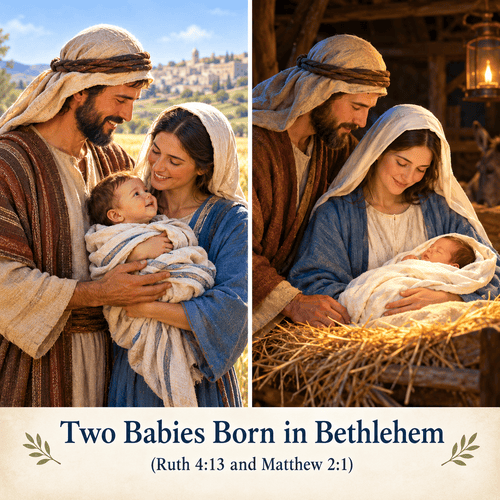
Who is this redeemer? Not Boaz. It’s the baby. “A son has been born to Naomi,” the women sing (Ruth 4:17).
Did You Notice?
- Born in Bethlehem: a baby boy, who is called a redeemer.
- From Judah: his line leads to a king.
- Life-giver: he is “a restorer of life”.
Think of Christmas: “to us a son is given” (Isaiah 9:6). Obed restored one grieving widow. Jesus came so His people “may have life and have it abundantly” (John 10:10).
A Moabite Outsider Brought In
Ruth was a Moabite. Moab began with Lot’s shameful sin (Genesis 19:36–37), worshipped other gods, and was kept out of Israel’s worship assembly (Deuteronomy 23:3). If anyone was an outsider, this woman was.
Yet listen to her words to Naomi: “Your people shall be my people, and your God my God” (Ruth 1:16). This is more than loyalty. It’s a conversion from Moab’s gods to the LORD. Boaz sees it clearly: she has come to take refuge under the LORD’s wings (Ruth 2:12).
Ruth fits a pattern that runs through the Bible:
- God’s promise: through Abraham, “all the families of the earth shall be blessed” (Genesis 12:3).
- Christ’s work: “you who once were far off have been brought near by the blood of Christ” (Ephesians 2:13).
Ruth is in Jesus’ family tree (Matthew 1:5). Long before Jesus sent His disciples to the nations, God wrote a foreign widow into the Messiah’s family. If you feel like an outsider to God, Ruth’s story is for you.
Hesed and Providence: God’s Hidden Hand
The Hebrew word hesed is hard to translate. It means loyal, faithful love that goes beyond what duty requires. The ESV often renders it “kindness” in Ruth (Ruth 1:8; 2:20; 3:10). Ruth shows hesed to Naomi, Boaz shows it to Ruth, and behind them both stands God.
When God revealed his name to Moses, he said he is “abounding in steadfast love and faithfulness” (Exodus 34:6). Many scholars believe John echoes those words when he says Jesus came “full of grace and truth” (John 1:14). Jesus is God’s hesed with a human face.
Ruth also shows God’s providence—His wise and quiet control over every event. The writer says Ruth “happened to come” to the field of Boaz (Ruth 2:3). He’s smiling. Nothing here “just happens”. Matthew Henry observed many great events turn on small moments that look like chance to us but are guided by God. Sinclair Ferguson titled his exposition of Ruth Faithful God—a fine name for the book’s true hero.
What Did Ancient Jewish Readers See?
NOT A CHRISTIAN INVENTION
Old Jewish writings also saw the Messiah in Ruth. They come from after Jesus’ time, but they show this reading is not just a Christian idea.
- The Targum of Ruth (an Aramaic paraphrase read in synagogues) says history’s tenth and final famine will come in the days of King Messiah (on Ruth 1:1).
- The same Targum links the six measures of barley (Ruth 3:15) to six righteous descendants, including the Messiah.
- Ruth Rabbah (a rabbinic commentary) applies “dip your morsel in the wine” (Ruth 2:14) to the Messiah’s sufferings, quoting Isaiah 53:5.
Guardrails: Type, Not Allegory
Seeing Jesus in Ruth doesn’t mean turning every detail into a code. Geerhardus Vos taught that a type must first carry real meaning in its own time; only then can it point forward to Christ. Edmund Clowney gave preachers a simple test: first ask what truth an event showed God’s people then, and only then ask how Christ fulfils it. Skipping the first step is how allegory begins.
Which links are sound, and which go too far?
| LINK TO CHRIST | SOUND OR STRETCH? | WHY |
|---|---|---|
| Boaz as redeemer | Sound | The Bible calls God “Redeemer” with the same word. |
| Ruth’s “wings” request | Sound | The same word describes God’s covenant marriage (Ezekiel 16:8). |
| The family line to David | Sound | The book ends there, and the Gospels follow it to Jesus. |
| Six measures of barley as the six days of creation | Stretch | No verse in the Bible makes this link. |
| The threshing floor as the cross | Stretch | Nothing in the text points there. |
Boaz was a good man, but he wasn’t Jesus. Old Testament types are “a shadow of the good things to come” (Hebrews 10:1)—they show the shape of the real thing, but only partly. Boaz redeemed one family for one lifetime. Jesus redeems a people from every nation for ever.
Some object that Boaz wasn’t Ruth’s brother-in-law, so the law didn’t require this. Exactly. He went beyond duty. That’s grace.
Conclusion: Come Under His Wings
Ruth never names Jesus, yet the whole book leans towards Him. It begins with famine, funerals and no king. It ends with bread, a baby redeemer and the name David.
Charles Spurgeon passed on advice he once heard: just as every English village has a road to London, “from every text in Scripture, there is a road towards the great metropolis, Christ.” Ruth is one of the loveliest roads in the Bible. To Christ.
Ruth took refuge under the wings of the LORD. That shelter is offered to you today. You may feel empty like Naomi or far away like Ruth. The true Redeemer is related to you through His human birth. He’s able to pay your debt, and willing to take you as His own. Come to Him, and say with Ruth: “Your people shall be my people, and your God my God.”
Tough Questions, Honest Answers
What did Ruth do on the threshing floor, and was it immoral?
A threshing floor was an open place where farmers separated grain from straw, and men often slept there at night to guard the harvest. Naomi told Ruth to “uncover his feet and lie down” (Ruth 3:4). Some claim this describes a sexual act, but the text points the other way. The Hebrew word refers to the place around his feet, and Boaz praises Ruth as “a worthy woman” (Ruth 3:11). He protects her good name by sending her home before anyone could recognise her (Ruth 3:14), and then settles the matter publicly at the town gate. Sure, Ruth’s action was bold and unusual, but it was more of a humble request for marriage, than a gesture with sinful overtones.
How could a Moabite join Israel when Deuteronomy 23:3 banned Moabites?
Deuteronomy 23:3 says, “No Ammonite or Moabite may enter the assembly of the LORD.” The next verse explains why: Moab refused Israel bread and water and hired Balaam to curse them (Deuteronomy 23:4). So the law was aimed at Moab as a hostile, idol-worshipping nation. Later Jewish teachers in the Mishnah (Yevamot 8:3) ruled that the ban applied to Moabite men, not women. But the deeper answer is faith. Ruth left the gods of Moab and took the LORD as her God (Ruth 1:16). God promised a welcome to foreigners who join themselves to him (Isaiah 56:3–7), and Christ “has broken down in his flesh the dividing wall of hostility” (Ephesians 2:14).
Who wrote the book of Ruth, and when?
The book does not name its human author. An old Jewish tradition in the Talmud (Bava Batra 14b) says the prophet Samuel wrote it. But the closing family list treats David as already famous, and Samuel died before David became king (1 Samuel 25:1). The writer also explains an old custom that his readers no longer knew (Ruth 4:7). So Ruth was most likely written during or after David’s reign. We don’t need the author’s name to trust the book, because “all Scripture is breathed out by God” (2 Timothy 3:16).
Is the book of Ruth a true story or just a moral tale?
Some modern scholars call Ruth a “novella”, a short made-up story, because it’s so beautifully written. But good writing doesn’t make a story untrue. Ruth names real towns, real families and real legal customs, and it ties itself to the history of King David. Matthew and Luke both treat Boaz, Ruth and Obed as real people in Jesus’ family tree (Matthew 1:5; Luke 3:32). Jesus’ own human ancestry runs through this family, so the story must be real history. God’s Word tells true history in beautiful ways.
Should “Where you go I will go” be used at weddings?
Ruth spoke these words to her mother-in-law, Naomi, not to a husband (Ruth 1:16–17). So we shouldn’t pretend they were a marriage vow. But they fit marriage well. They’re a promise of lifelong loyalty (“Where you die I will die”), and they put God at the centre (“your God my God”). Christian couples may use them, as long as they understand the original setting. The words also remind us a believer should marry “only in the Lord” (1 Corinthians 7:39), sharing the same God.
Did Naomi’s husband and sons die as a judgement from God?
The book doesn’t say. Elimelech, whose name means “my God is King”, left the Promised Land during a famine, and his sons married Moabite women. Many readers see sad consequences in what followed. But we must be careful, because Jesus warned against assuming every tragedy is a direct punishment for a particular sin (Luke 13:1–5; John 9:3). What the book shows clearly is Naomi’s honest pain—“the Almighty has dealt very bitterly with me” (Ruth 1:20)—and God’s grace that turned her bitterness into joy. Even in our worst losses, God is still working out His good purpose.
Why is Ruth in a different place in the Hebrew Bible?
English Bibles place Ruth after Judges because the story happens in that period. This order comes from the ancient Greek and Latin Bibles. The Hebrew Bible places Ruth in its third section, the Writings, among five short scrolls read at Jewish festivals; Ruth is read at the Feast of Weeks, or Pentecost. In the Leningrad Codex, the oldest complete Hebrew Bible manuscript, Ruth comes straight after Proverbs. Proverbs ends by praising “an excellent wife” (Proverbs 31:10), and Ruth 3:11 calls Ruth “a worthy woman”—the same Hebrew phrase. Both orders help us: one shows Ruth’s place in history, and the other shows Ruth as a living picture of godly wisdom.