Joel doesn’t cite the title ‘Messiah’. Or mention a king from David’s family. He says nothing about a baby in Bethlehem. Or of a man on a cross.
So is it honest to say Jesus is in the book of Joel?
Here’s the surprise. Peter’s very first Christian sermon opened with Joel. When Paul explained how anyone can be saved, he quoted Joel. The first Christians didn’t think Joel was silent about Jesus. They believed Joel showed them who Jesus really is.
Here are 9 clear connections, each drawn from the New Testament, rather than from imagination. Together they lead to one conclusion: the LORD that Joel mentions is Jesus.
Jesus in the Old Testament — Book 29 of 39
This post is the 29th instalment in our series tracing Christ through every book of the Old Testament. See the full series index.
Joel in 2 Minutes
Joel’s name means ‘the LORD is God’.
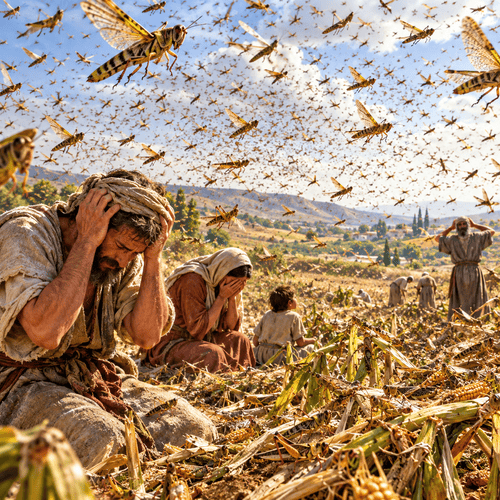
Joel lived in Judah, the southern kingdom of Israel, though we don’t know exactly when. A huge swarm of locusts had eaten every crop. Farmers wept. The land went hungry.
Joel saw the disaster as a warning of something far bigger: the Day of the LORD. So he called the people back to God, and gave some of the most hopeful promises in the Old Testament.
KEY WORDS IN THIS POST
LORD (in capital letters): English Bibles print God’s personal name, YHWH (often said ‘Yahweh’), as LORD. When you see it, think of ‘the one true God of Israel’.
Lord (Greek word kyrios): The Greek word for ‘Lord’. The Greek Old Testament used this word for YHWH. The New Testament writers used the same word for Jesus.
Day of the LORD: The time when God steps into history to judge evil and rescue His people.
Pentecost: A Jewish harvest feast held 50 days after Passover. That day, weeks after Jesus rose again, was when the Holy Spirit came on His followers (Acts 2).
How Do We Find Jesus in the Old Testament?
After He rose from the dead, Jesus gave two friends a Bible lesson on the road to Emmaus. ‘Beginning with Moses and all the Prophets, He interpreted to them in all the Scriptures the things concerning Himself’ (Luke 24:27). Joel is one of those Prophets.
John Calvin wrote ‘We ought to read the Scriptures with the express design of finding Christ in them.’
Many Old Testament books show Jesus through types—people or events that picture Him, like the Passover lamb or the bronze serpent. Joel works differently. He doesn’t picture the Messiah. He shows us God Himself. The New Testament tells us the God Joel describes is Jesus.
9 Clear Connections Between Joel and Jesus
1. Jesus Is the LORD We Call On to Be Saved
‘And it shall come to pass that everyone who calls on the name of the LORD shall be saved.’ (Joel 2:32)
To ‘call on the name of the LORD’ means to pray to, trust and worship YHWH, the God of Israel. Now watch what Paul does with this verse:
- Romans 10:9: ‘If you confess with your mouth that Jesus is Lord … you will be saved.’
- Romans 10:12: ‘The same Lord is Lord of all, bestowing his riches on all who call on him.’
- Romans 10:13: ‘For “everyone who calls on the name of the Lord will be saved.”’
The ‘Lord’ in verse 13 is the same Lord as in verse 9: Jesus. Paul puts Jesus at the centre of Joel’s verse about YHWH. Peter does the same: he quotes Joel 2:32 (Acts 2:21), then tells the crowd God made ‘this Jesus’ both ‘Lord and Christ’ (Acts 2:36). The name they must now call on is ‘the name of Jesus Christ’ (Acts 2:38).
WHY THIS IS SO STRIKING
Paul was a strict Jewish teacher who prayed, ‘The LORD our God, the LORD is one’ (Deuteronomy 6:4). He would never give God’s name to a mere man.
BB Warfield argued that when the New Testament calls Jesus ‘Lord’, it often means the full Old Testament name of God. Richard Bauckham agrees: the first Christians placed Jesus inside the identity of Israel’s one God.
2. Jesus Pours Out the Holy Spirit
‘And it shall come to pass afterward, that I will pour out my Spirit on all flesh; your sons and your daughters shall prophesy, your old men shall dream dreams, and your young men shall see visions.’ (Joel 2:28)
In Joel, the one who pours out the Spirit is God: ‘I will pour out my Spirit’. ‘All flesh’ means all kinds of people—young and old, men and women, even servants—not just prophets and kings.
At Pentecost, Peter explains who did this: the exalted Jesus ‘has poured out this that you yourselves are seeing and hearing’ (Acts 2:33).
Only God can give God. Yet Jesus gives the Holy Spirit, just as John the Baptist promised: ‘He will baptise you with the Holy Spirit’ (Mark 1:8).
Theologian Richard Gaffin has shown that Pentecost belongs with Jesus’ death, resurrection and ascension. It’s one of the great, once-for-all events in the work of Christ, not a pattern we’re to repeat.
3. Jesus Opens ‘the Last Days’
Joel said, ‘It shall come to pass afterward’. Peter says, ‘In the last days it shall be’ (Acts 2:17). Peter is telling us when Joel’s ‘afterward’ arrived: with Jesus.
In the New Testament, the ‘last days’ are the whole time between Jesus’ first coming and His return, not just the final years. ‘In these last days He has spoken to us by His Son’ (Hebrews 1:2).
Geerhardus Vos, a Dutch-American Bible scholar, showed Jesus’ resurrection brought ‘the age to come’ into the present, while ‘this age’ still goes on. We live in the overlap—the ‘already and not yet’. God’s kingdom has already begun, but is not yet complete.
4. Jesus Is the Judge on the Day of the LORD
Joel speaks about ‘the day of the LORD’ 5 times. It’s a fearful day: ‘the day of the LORD is great and very awesome; who can endure it?’ (Joel 2:11). O Palmer Robertson saw Joel’s locusts as a small warning of that far greater day.
The New Testament renames it. Paul calls it ‘the day of our Lord Jesus Christ’ (1 Corinthians 1:8) and ‘the day of Jesus Christ’ (Philippians 1:6).
Why? Because Jesus is the Judge. ‘The Father judges no one, but has given all judgement to the Son’ (John 5:22). God ‘will judge the world in righteousness by a man whom he has appointed’ (Acts 17:31).
So Joel’s question—‘Who can endure it?’—has a gospel answer. The Judge Himself took God’s judgement on the cross for all who trust Him. The one who will sit on the throne once hung on the cross.
5. Jesus Holds the Sickle at the Final Harvest
‘Let the nations stir themselves up and come up to the Valley of Jehoshaphat; for there I will sit to judge all the surrounding nations. Put in the sickle, for the harvest is ripe.’ (Joel 3:12–13)
‘Jehoshaphat’ means ‘the LORD judges’. Here the LORD sits as Judge and calls for the sickle—a curved blade for cutting grain.
Now read Revelation 14:14–16. John sees ‘one like a son of man, with a golden crown on his head, and a sharp sickle in his hand’. An angel cries, ‘Put in your sickle, and reap … for the harvest of the earth is fully ripe.’ ‘Son of Man’ was Jesus’ favourite title for himself. Revelation puts Jesus in YHWH’s judgement seat.
Jesus said the same: the Son of Man ‘will sit on His glorious throne. Before Him will be gathered all the nations’ (Matthew 25:31–32).
A VERSE OFTEN MISREAD
Joel 3:14 speaks of ‘multitudes, multitudes, in the valley of decision!’ Preachers often use it to urge a decision for Christ. But in Joel, the ‘decision’ is God’s decision—His verdict of judgement. The valley of decision is a courtroom, and Jesus is the Judge. Our decision to trust him matters because His decision is coming.
6. The Darkened Sun: From the Cross to His Return
‘The sun shall be turned to darkness, and the moon to blood, before the great and awesome day of the LORD comes.’ (Joel 2:31)
When Peter quoted these words, his listeners remembered something. 7 weeks earlier, as Jesus hung on the cross, ‘there was darkness over the whole land … while the sun’s light failed’ (Luke 23:44–45).
Joel’s signs began at Calvary, but they’re not finished. Before His return, Jesus said, ‘the sun will be darkened, and the moon will not give its light’ (Matthew 24:29). The darkness at the cross was the first sign. The darkness at the end will be the last.
7. Jesus Shows Us the Heart of Joel’s God
‘Rend your hearts and not your garments. Return to the LORD your God, for he is gracious and merciful, slow to anger, and abounding in steadfast love.’ (Joel 2:13)
In Bible times, people tore (‘rent’) their clothes to show sorrow. God wants torn hearts, not torn clothes—real change on the inside, not a religious show.
Joel is quoting Exodus 34:6, where God reveals his character to Moses. John echoes that verse when he describes Jesus as ‘full of grace and truth’ (John 1:14). In Jesus, the gracious God of Joel 2:13 has a human face.
Joel could only say, ‘Who knows whether he will not turn and relent?’ (Joel 2:14). At the cross, we know.
TWO PRAYERS: ‘SPARE’ AND ‘DID NOT SPARE’
In Joel 2:17 the priests weep at the altar: ‘Spare your people, O LORD.’ Jesus is our great High Priest, who ‘always lives to make intercession’ for His people (Hebrews 7:25). Intercession means praying to God on behalf of someone else.
God answered the priests’ prayer in the most costly way: ‘He who did not spare his own Son but gave him up for us all’ (Romans 8:32). God spares His people because He did not spare his Son.
8. Jesus Is the Lord Who Calls His People
Look again at the end of Joel 2:32: ‘among the survivors shall be those whom the LORD calls.’ Two callings sit in one verse: people call on the LORD, and the LORD calls people.
Peter ends his sermon the same way. He commands, ‘Repent’ (Acts 2:38), then promises that the gift is ‘for all who are far off, everyone whom the Lord our God calls to himself’ (Acts 2:39).
This is God’s effectual call—the inner call of the Holy Spirit that really brings a person to Christ. The Westminster Shorter Catechism (1647) says that in this call God’s Spirit ‘doth persuade and enable us to embrace Jesus Christ, freely offered to us in the gospel.’
‘My sheep hear my voice … and they follow me’ (John 10:27). We call on him because he first called us. Your prayer for mercy is the echo of his voice.
9. Jesus Is God Living Among His People
Joel ends with a beautiful promise: ‘you shall know that I am the LORD your God, who dwells in Zion’ (Joel 3:17). The book’s last words repeat it (Joel 3:21). Zion was the hill in Jerusalem where the temple stood. The New Testament shows how this came true:
- God came to live with us. ‘The Word became flesh and dwelt among us’ (John 1:14). ‘Dwelt’ literally means ‘pitched His tent’.
- Jesus is the true temple. He called His own body ‘this temple’ (John 2:19–21).
- The fountain flows from him. Joel saw ‘a fountain’ flowing ‘from the house of the LORD’ (Joel 3:18). Jesus promised ‘rivers of living water’—meaning the Spirit (John 7:37–39).
- Zion is now the church. Christians ‘have come to Mount Zion … the heavenly Jerusalem’ (Hebrews 12:22).
The Bible ends where Joel ends: in the new creation, ‘the river of the water of life’ flows ‘from the throne of God and of the Lamb’ (Revelation 22:1).
The 9 Connections at a Glance
Where Joel points to Jesus, and where the New Testament confirms it
| # | IN JOEL | IN THE NEW TESTAMENT | WHAT IT SHOWS ABOUT JESUS |
|---|---|---|---|
| 1 | Call on the LORD and be saved (2:32) | Romans 10:9–13; Acts 2:21, 36 | He is the LORD, God himself |
| 2 | God pours out his Spirit (2:28–29) | Acts 2:33 | He gives the Spirit, as only God can |
| 3 | ‘Afterward’ (2:28) | ‘In the last days’ (Acts 2:17) | He begins the final age |
| 4 | The Day of the LORD (1:15; 2:11) | ‘The day of our Lord Jesus Christ’ (1 Corinthians 1:8) | He is the coming Judge |
| 5 | The LORD sits to judge; the sickle (3:12–13) | Revelation 14:14–16; Matthew 25:31–32 | He brings in the final harvest |
| 6 | The sun turned to darkness (2:31) | The cross (Luke 23:44–45); his return (Matthew 24:29) | His death and return are the great signs |
| 7 | ‘Gracious and merciful’; ‘Spare your people’ (2:13, 17) | John 1:14; Romans 8:32; Hebrews 7:25 | He shows God’s grace and prays for us |
| 8 | ‘Those whom the LORD calls’ (2:32) | Acts 2:39; John 10:27 | He calls his people to himself |
| 9 | ‘The LORD dwells in Zion’ (3:17, 21) | John 1:14; 2:21; 7:37–39 | He is God living with us |
But Are We Reading Jesus Into Joel?
Here are four common objections, with short answers.
- ‘Joel never mentions the Messiah.’ True—and our case does not need him. Joel speaks of YHWH, and the apostles tell us Jesus is YHWH. That is a stronger claim, not a weaker one.
- ‘In Romans 10:13, “Lord” means God the Father.’ Verse 9 says ‘Jesus is Lord’; verse 12 says ‘the same Lord’. Paul gives no hint that he has changed persons.
- ‘Pentecost was only a preview. Joel’s real fulfilment is still future.’ Peter did not say ‘this is like’ Joel. He said, ‘this is what was uttered through the prophet Joel’ (Acts 2:16). The final signs and judgement are still ahead—that is the ‘already and not yet’, not a second Pentecost.
- ‘Finding Jesus here is just allegory.’ Allegory means inventing hidden meanings. Every connection here comes straight from the New Testament. Sidney Greidanus, who trained preachers for decades, urged them to travel only on roads to Christ that Scripture itself has built.
A ROAD TO LONDON
Charles Spurgeon retold an old Welsh preacher’s advice: every village in England has a road to London. ‘So from every text of Scripture there is a road to the metropolis of the Scriptures, that is Christ.’ In Joel, the apostles have already paved the roads.
Joel’s Promises on God’s Timeline
- Joel’s day (date unknown): Locusts destroy Judah’s crops; Joel calls for repentance.
- About AD 30, Passover: The sun goes dark as Jesus dies on the cross.
- Fifty days later, Pentecost: Jesus pours out the Spirit; about 3,000 people are saved (Acts 2:41).
- Today, ‘the last days’: People in every nation call on the name of Jesus.
- When Jesus returns: The final harvest is gathered, and God lives with his people forever.
What Joel Asks of Us Today
To take disasters seriously. When disaster struck, Jesus didn’t blame the victims. He said, ‘unless you repent, you will all likewise perish’ (Luke 13:3). Every locust swarm, pandemic or war warns of a bigger day.
To rend our hearts. Outward religion cannot save. God wants honest sorrow for sin.
To call on the name of Jesus. Joel’s promise is still open to ‘everyone’. No one is too far off.
Joel asked, ‘Who can endure it?’ The gospel answers: everyone who calls on the name of the Lord Jesus. Meet the Judge now as your Saviour, and you will not need to fear him on that day.
Tough Questions, Honest Answers
What does ‘I will restore to you the years that the swarming locust has eaten’ mean?
In Joel 2:25, this was a promise to the farmers of Judah. After they turned back to God, He’d send rain and good harvests to make up for the crops the locusts had destroyed. It isn’t a promise that God will give back every lost job, friendship or sum of money in this life. But it does show God’s heart: He loves to repair what sin and judgement have ruined. In Christ, even wasted years can be used for good (Romans 8:28). The full restoration will come in the new creation, when Christ makes all things new.
Were the locusts in Joel real insects or an army?
Chapter 1 describes a real locust plague that stripped the land bare. In chapter 2 the locusts are described like an invading army, and God even calls them ‘my great army’ (Joel 2:25). Some interpreters think Chapter 2 still describes the same insects. Others think it warns of a human army still to come. Either way, the point is the same: the LORD controls every disaster and uses it to call people back to himself. Revelation 9 uses Joel’s locust pictures again to describe God’s judgements before the end.
Who was Joel, and when was the book written?
Joel was ‘the son of Pethuel’ (Joel 1:1). That’s almost all we know about him. Suggested dates range from about 800 BC to about 400 BC, because Joel names no king and no famous enemy. The temple was standing and in use, so he wrote either before it was destroyed in 586 BC or after it was rebuilt. The good news is that the message doesn’t depend on the date. Its promises are clearly fulfilled in Christ.
Does Joel 2:28 mean God still speaks through dreams and visions today?
Joel 2:28 was fulfilled at Pentecost, when the Spirit came on all God’s people, not only a few leaders. Many Bible teachers believe that gifts which brought new words from God were given to lay the church’s foundation (Ephesians 2:20), and ended when Scripture was complete. Other sincere Christians believe these gifts continue today. All should agree on this: God has now spoken finally and fully ‘by his Son’ (Hebrews 1:2), and Scripture is the test for every dream or impression. In a wider sense, every believer ‘prophesies’ when they speak God’s truth about Christ to others.
Is Joel 3 about the Battle of Armageddon?
Some teachers link Joel’s ‘Valley of Jehoshaphat’ with ‘Armageddon’ (Revelation 16:16) and expect a literal war in the Middle East. But ‘Jehoshaphat’ means ‘the LORD judges’, and no valley by that name appears anywhere else in the Bible. It’s most likely a symbolic name for the place of God’s judgement. The New Testament uses Joel 3 to describe the final judgement of all nations by Christ (Matthew 25:31–32; Revelation 14:14–20). So Joel 3 is less a battle map and more a courtroom scene—with Jesus on the throne.
Why does Joel say ‘beat your ploughshares into swords’ when Isaiah says the opposite?
Isaiah 2:4 and Micah 4:3 picture the peace of God’s kingdom: ‘they shall beat their swords into plowshares’. Joel 3:10 turns this around on purpose. God’s mocking the nations who gather to fight against him: go ahead, turn your farm tools into weapons—it won’t help you. The 2 pictures fit together. First comes the defeat of every rebel power, then the lasting peace of Christ’s kingdom. Jesus is both the Judge who ends the war and the Prince of Peace who rules afterwards.
Is the Day of the LORD the same as the rapture?
Some teach Jesus will first take Christians away secretly (the ‘rapture’), and that the Day of the LORD will come years later. But the New Testament describes Christ’s return as one loud, public event, with ‘a cry of command’ and ‘the sound of the trumpet of God’ (1 Thessalonians 4:16). Believers will be ‘caught up … to meet the Lord in the air’ (4:17), like citizens going out to welcome a king and walk back with him into the city. In the very next verses, Paul moves straight on to ‘the day of the Lord’ (1 Thessalonians 5:2). So the gathering of believers and the Day of the LORD are two sides of the same return of Jesus.