About 2,500 years ago, God made a remarkable promise about a humble building in Jerusalem: the Jewish temple that a small band of returning exiles had begun to rebuild. One day, God said, its glory would surpass that of King Solomon’s magnificent temple—the richest and most splendid building Israel had ever known.
But there was a problem. About 590 years later, the Romans destroyed that temple. They burned it to the ground, and it has never been rebuilt.
So what happened? Did God break His promise—or was He promising something the builders couldn’t yet see?
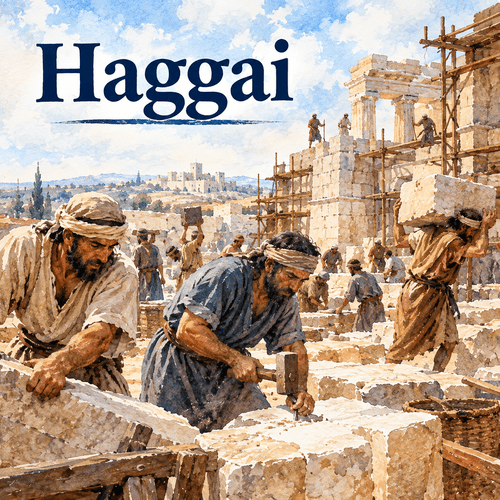
The promise is found in Haggai, one of the shortest books in the Old Testament. Haggai was a prophet, sent by God to speak to His people. In 520 BC, he spoke to Jews who’d returned to Jerusalem after decades of captivity in Babylon. Their task was to rebuild the temple—the place where God had promised to dwell among His people.
But the returning exiles were poor, frightened and discouraged. The work had stalled, and the new temple looked painfully unimpressive compared with Solomon’s. Then Haggai delivered God’s astonishing promise.
His entire book contains only 38 verses. Yet those 38 verses point us toward Jesus in 5 remarkable ways. And the case isn’t built on guesswork or imaginative symbolism. It rests on the Bible’s own words—and on what happened in history.
Jesus in the Old Testament — Book 37 of 39
This post is the 37th instalment in our series tracing Christ through every book of the Old Testament. See the full series index.
KEY TERMS USED IN THIS POST
Temple: the house of God in Jerusalem. It was where God lived among His people and priests offered sacrifices.
Messiah: a Hebrew word meaning “anointed one”. It means the promised King from the family of David. The Greek word for it is “Christ”.
What was happening when Haggai spoke?
In 586 BC Babylon destroyed Jerusalem and burned Solomon’s beautiful temple. God’s people were taken away as prisoners—this is called the exile. About 50 years later, King Cyrus of Persia let them go home and rebuild. They laid the foundation, but something sad happened that day:
But many of the priests and Levites and heads of fathers’ houses, old men who had seen the first house, wept with a loud voice when they saw the foundation of this house being laid. (Ezra 3:12)
The old men cried because the new temple was so poor. Then enemies frightened the builders, and the work stopped while the people built fine homes. So God sent Haggai:
Is it a time for you yourselves to dwell in your panelled houses, while this house lies in ruins? (Haggai 1:4)
This time the people listened.
Timeline: Haggai’s world at a glance
- 538 BC: King Cyrus of Persia lets the Jews return home (Ezra 1:1–4).
- 536 BC: The foundation of the new temple is laid (Ezra 3:8–13).
- 536–520 BC: Enemies scare the builders; work stops (Ezra 4:4–5).
- 29 August 520 BC: Haggai’s first message: “Consider your ways” (1:1–11).
- 21 September 520 BC: Just 24 days later, the people start building again (1:14–15).
- 17 October 520 BC: Second message: the latter glory will be greater (2:1–9).
- 18 December 520 BC: Messages on holiness and the signet ring (2:10–23).
- 12 March 515 BC: The temple is finished (Ezra 6:15).
- AD 70: The Romans destroy the temple.
Strand 1: God will shake heaven and earth
Haggai’s second message came when the people felt small and weak:
For thus says the LORD of hosts: Yet once more, in a little while, I will shake the heavens and the earth and the sea and the dry land. And I will shake all nations, so that the treasures of all nations shall come in, and I will fill this house with glory, says the LORD of hosts. (Haggai 2:6–7)
When God “shakes” the earth, He is stepping into history with great power, as He did at Mount Sinai when He gave His law (Exodus 19:18). Haggai points back to that time in 2:5. So “yet once more” means God will do something like Sinai again—only bigger.
Here is the key point. We do not have to guess what this shaking means. The writer of Hebrews quotes Haggai directly:
At that time his voice shook the earth, but now he has promised, ‘Yet once more I will shake not only the earth but also the heavens.’ … Therefore let us be grateful for receiving a kingdom that cannot be shaken. (Hebrews 12:26, 28)
For Hebrews, Haggai’s great shaking began when Jesus came. The old system of temple and sacrifice was taken away, and God gave a kingdom that can never fall.
AREN’T WE JUST READING JESUS INTO THE OLD TESTAMENT?
No. After He rose, Jesus, “beginning with Moses and all the Prophets, … interpreted to them in all the Scriptures the things concerning himself” (Luke 24:27).
Edmund P. Clowney argued that the Old Testament is a story waiting for its ending—and Jesus is that ending. Seeing Christ in Haggai means following Jesus and His apostles, not our own imagination.
Strand 2: A greater glory in a poorer house
In the same message, God asked an honest question:
Who is left among you who saw this house in its former glory? How do you see it now? Is it not as nothing in your eyes? (Haggai 2:3)
Then He made a promise:
The latter glory of this house shall be greater than the former, says the LORD of hosts. And in this place I will give peace, declares the LORD of hosts. (Haggai 2:9)
The Hebrew word for glory, kabod, comes from a word for “weight”. God’s glory is the weight of His presence—His greatness shining out.
Here’s the problem. By every visible measure, the new temple was less glorious than Solomon’s.
Solomon’s temple and the rebuilt temple compared
| WHAT WE COMPARE | SOLOMON’S TEMPLE (BUILT ABOUT 960 BC) | THE REBUILT TEMPLE (FINISHED 515 BC) |
|---|---|---|
| Wealth | Covered in gold; the richest building of its time | Small and plain; old men wept when they saw it |
| The ark of the covenant (the holy chest that held God’s law) | Kept in the Most Holy Place | Missing; lost when Babylon destroyed Jerusalem |
| The cloud of God’s glory | Filled the temple on the day it opened (1 Kings 8:10–11) | Never seen filling this temple |
| Who came to it? | Kings, priests and worshippers | God the Son Himself, in human flesh |
Even the Talmud, a large collection of Jewish teaching, admits the second temple lacked the ark and the Shekinah—God’s visible, dwelling presence (Yoma 21b).
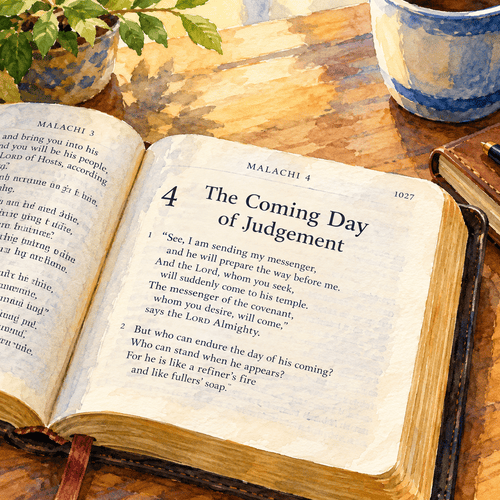
So how could this poorer house have a greater glory? Only one answer fits: God Himself would come to it. Malachi, writing soon after Haggai, said exactly that: “the Lord whom you seek will suddenly come to His temple” (Malachi 3:1).
And He did. As a baby, Jesus was carried into this temple. Old Simeon took Him in his arms and called Him “glory to your people Israel” (Luke 2:32). Later Jesus said there, “something greater than the temple is here” (Matthew 12:6). John sums it up: “the Word became flesh and dwelt among us, and we have seen his glory” (John 1:14). The glory did not return as a cloud. It came as a Man.
And Christ is the promised “peace” (Ephesians 2:14). The church has long read Haggai this way. Augustine of Hippo (The City of God, Book 18) saw it fulfilled not in stones but in Christ and His church. Matthew Henry taught that the true glory of the second temple was the presence of the Messiah in it.
WHY THIS MATTERS: THE AD 70 DEADLINE
God tied His promise to “this house”. The Romans destroyed that house in AD 70, and it was never rebuilt. So the greater glory had to come before AD 70. Only one person fits: Jesus of Nazareth. Genesis 49:10 and Daniel 9 also set deadlines for the Messiah.
DID YOU KNOW?
Haggai gave this promise on the last day of the Feast of Booths (2:1), a harvest festival when Israel lived in shelters to remember the wilderness.
Centuries later, in the same temple at the same feast, “on the last day of the feast, the great day, Jesus stood up and cried out, ‘If anyone thirsts, let him come to me and drink'” (John 7:37). Not proof—but a striking echo.
Strand 3: “The Desire of all nations” or “the treasures”?
Many Christians know Haggai 2:7 from the King James Version: “the desire of all nations shall come”. Charles Wesley’s Christmas hymn even calls Jesus the “dear desire of every nation”. But the ESV says “the treasures of all nations”. Why?
The Hebrew word chemdah means “something desired” or “precious”. Its verb is plural—”they shall come”—so most scholars read it as precious things, not one person. The personal reading came mainly from Jerome’s Latin Bible (about AD 400).
We should be honest here. Even John Calvin, the great Reformer of Geneva, preferred “precious things”—yet he still believed Haggai was speaking of the kingdom of Christ, when the nations would give their best to God. Joyce G. Baldwin reads it the same way. The good news is that our case does not depend on which reading is right.
Two ways to read Haggai 2:7—and both lead to Jesus
| QUESTION | “DESIRE OF ALL NATIONS” (KJV) | “TREASURES OF ALL NATIONS” (ESV) |
|---|---|---|
| What does it mean? | A Person whom all nations long for will come | The nations will bring their best gifts to God’s house |
| Where does it come from? | Jerome’s Latin Bible and older English Bibles | The Hebrew grammar (the verb is plural) |
| How does it point to Jesus? | Jesus is the One every nation truly needs | The nations bring their treasures to Jesus (Matthew 2:11; Revelation 21:24–26) |
Think of the wise men. When they found Jesus, “opening their treasures, they offered him gifts” (Matthew 2:11). The treasures of the nations had begun to arrive—not at a building, but at a Child.
Strand 4: Zerubbabel and the signet ring
Haggai’s last message was for Zerubbabel, the governor of Judah. He was the grandson of King Jehoiachin (also called Coniah or Jeconiah), so he came from the royal family of David.
KEY TERM: SIGNET RING
A king’s ring with his personal seal on it. He pressed it into soft clay or wax to stamp letters and laws, like an official signature. It carried the king’s authority.
To see why Haggai’s words matter, go back to Jeremiah. Because King Coniah was wicked, God said:
As I live, declares the LORD, though Coniah the son of Jehoiakim, king of Judah, were the signet ring on my right hand, yet I would tear you off. (Jeremiah 22:24)
God even said none of Coniah’s children would sit “on the throne of David” (Jeremiah 22:30). Now listen to Haggai, speaking to Coniah’s grandson:
On that day, declares the LORD of hosts, I will take you, O Zerubbabel my servant, the son of Shealtiel, declares the LORD, and make you like a signet ring, for I have chosen you, declares the LORD of hosts. (Haggai 2:23)
The signet ring: taken away, then given back
| WHAT WE COMPARE | JEREMIAH 22:24–30 | HAGGAI 2:23 |
|---|---|---|
| Who is spoken to? | King Coniah (Jehoiachin) | Zerubbabel, Coniah’s grandson |
| The signet ring | Torn off God’s hand | Put back on |
| God’s word | “Write this man down as childless” | “I have chosen you” |
| What it means | David’s royal line seems finished | David’s royal line is alive again |
But here is the twist. Zerubbabel never became a king, and God’s promise to “overthrow the throne of kingdoms” (2:22) did not happen in his lifetime. So the promise must reach beyond him.
It does. Zerubbabel’s name appears in the family lists of Jesus in both Matthew (1:12–13) and Luke (3:27). O. Palmer Robertson (The Christ of the Prophets) shows how the prophets after the exile kept this hope alive. Zechariah, speaking the same year, describes “the man whose name is the Branch”, who “shall build the temple of the LORD” and will be both priest and king (Zechariah 6:12–13).
PROPHET, PRIEST AND KING
Haggai was a prophet: he brought God’s word.
Joshua was the high priest: in Ezra his name is Yeshua—the same name as Jesus.
Zerubbabel was of the royal line: he carried David’s hope.
Each man died. Calvin taught Jesus holds all three offices forever (Institutes, Book 2, Chapter 15).
Strand 5: Holiness that cleanses
Haggai’s third message asked the priests two questions about the law of Moses (2:12–13):
- Question 1: If holy meat touches ordinary food, does the food become holy? The priests said, “No.”
- Question 2: If someone who is unclean—not fit to come near God in worship—touches that food, does it become unclean? The priests said, “It does become unclean.”
The point: holiness does not spread by touch, but uncleanness does. The people’s sin was making even their work unclean (2:14).
Then Jesus came, and everything turned the other way. When He touched a man with leprosy, Jesus did not become unclean—the man became clean (Mark 1:41–42). When a sick woman touched Him, and when He held a dead girl’s hand, His life flowed out to them (Mark 5:25–42). In Jesus, holiness is stronger than sin.
Haggai also gives a lovely hint of grace. God said, “But from this day on I will bless you” (2:19). He said it before the harvest came in. Iain M. Duguid, in his commentary on Haggai, stresses this order: grace comes first, and obedience follows. That is the gospel. We do not earn God’s favour; He gives it.
Answering the objections
- “Haggai only meant Zerubbabel, and he was wrong.” God promised David a son who would reign forever (2 Samuel 7:12–16), and Solomon was only the start. In the same way, “on that day” (Haggai 2:23) is the language of God’s great future day, and Zechariah was already pointing beyond Zerubbabel to “the Branch”.
- “Herod’s temple was a different building.” Herod enlarged the temple from about 20 BC, but worship never stopped, and Jews still called it the second temple. Haggai himself called Solomon’s temple and the rebuilt one “this house” (2:3). It was one house on one site, through every change.
5 ways Haggai points to Jesus
Haggai’s promises and how Jesus fulfils them
| WHAT HAGGAI SAYS | HOW JESUS FULFILS IT |
|---|---|
| God will shake heaven and earth (2:6–7) | Jesus brings a kingdom that cannot be shaken (Hebrews 12:26–28) |
| The latter glory of this house will be greater (2:9) | God the Son came to that very temple in person (Luke 2:32; John 1:14) |
| The treasures of all nations will come in (2:7) | The nations bring their gifts and worship to Jesus (Matthew 2:11) |
| Zerubbabel will be God’s signet ring (2:23) | David’s royal line lives on in Jesus, the true King (Matthew 1:12–16) |
| Holiness does not spread, but God blesses by grace (2:12–19) | Jesus’ holiness makes unclean people clean (Mark 1:41–42) |
Conclusion: consider your ways
Haggai’s first word to God’s people was “Consider your ways” (1:5). Today God’s temple is not a building in Jerusalem. Jesus is the true temple (John 2:19–21), and all who trust Him are being built into God’s house (1 Peter 2:5). GK Beale has shown the Bible tells one story of God coming to live with His people, from Eden to the new creation, where there is no temple building, “for its temple is the Lord God the Almighty and the Lamb” (Revelation 21:22).
So let’s ask ourselves: are we busy with our own “panelled house” while Christ’s kingdom waits? Jesus said, “seek first the kingdom of God” (Matthew 6:33).
The old men wept over a small, plain house. They couldn’t know who would one day walk through its gates. God didn’t break His promise. The glory came. His name is Jesus.
Tough Questions, Honest Answers
Who was Haggai, and what does his name mean?
Haggai was a prophet who spoke God’s word to the Jews in Jerusalem in 520 BC. His name comes from the Hebrew word hag, which means “feast”, so it probably means “festive” or “my feast”. Some think he was born on one of Israel’s feast days, but the Bible does not tell us. We know very little about his life, except that he and Zechariah encouraged the people until the temple was finished (Ezra 5:1; 6:14). His book is the second shortest in the Old Testament, after Obadiah. Yet in about four months of preaching, God used him to wake up a whole nation.
Why did the Jews stop rebuilding the temple for 16 years?
Ezra 4:4–5 tells us that the people around them discouraged them, made them afraid and even paid officials to work against them. Poor harvests and hard times made things worse. Slowly, fear turned into excuses, and the people said, “the time has not yet come to rebuild the house of the LORD” (Haggai 1:2). This is a warning for us: fear of people can quietly become comfortable disobedience. Yet God did not give up on them. He “stirred up the spirit” of the leaders and the people (1:14), which shows that it is God who moves hearts to do His work.
How are Haggai and Zechariah connected?
They were prophets at the same time, in the same city, with the same goal. Haggai began in August 520 BC, and Zechariah began about two months later (Zechariah 1:1). Ezra 5:1 names them together as the men who got the building moving again. Haggai’s messages are short and practical: get up and build. Zechariah’s messages are full of visions about the future and the coming King. Together they are like two sides of one coin—Haggai tells the people what to do today, and Zechariah shows them why it matters for tomorrow.
Why is Zerubbabel called the son of Shealtiel and also the son of Pedaiah?
Most of the Bible calls Zerubbabel “the son of Shealtiel” (Ezra 3:2; Haggai 1:1; Matthew 1:12). But 1 Chronicles 3:19 lists him as a son of Pedaiah, Shealtiel’s brother. This is not a contradiction, and there are good explanations. One is levirate marriage (Deuteronomy 25:5–6): if a man died without children, his brother could marry the widow, and the first son was counted as the dead man’s son. Another is that Shealtiel adopted or raised his nephew. Either way, Zerubbabel was a grandson of King Jehoiachin and part of David’s royal line. Ancient family lists often counted legal sons as well as natural sons.
Did the curse on Jeconiah stop Jesus from being David’s King?
Jeremiah 22:30 said none of Jeconiah’s offspring would sit on David’s throne “and rule again in Judah”. Since Matthew traces Jesus’ legal line through Jeconiah (Matthew 1:11–12), some say Jesus cannot be the Messiah. Three answers work together. First, Haggai 2:23 shows God Himself reversing the curse by grace for Zerubbabel’s line. Second, Jesus was Joseph’s legal son but not his natural son, because He was born of a virgin, and Luke traces His line back to David through Nathan, another son of David. Third, Jesus does not rule from an earthly throne in Judah as Jeconiah did—He reigns from heaven at God’s right hand (Acts 2:30–36).
Does Haggai predict a third temple in Jerusalem?
Some Christians believe a new stone temple will be built in Jerusalem, with animal sacrifices again. But Haggai tied his promise to “this house”—the temple of his own day (2:3, 9). Hebrews 12 applies Haggai’s shaking to the kingdom Jesus has already brought. The New Testament calls Jesus the true temple (John 2:19–21) and calls His people God’s temple (1 Corinthians 3:16; Ephesians 2:21). Hebrews 10:12–14 says Christ offered one sacrifice for sins for all time, so there is no need for animal sacrifices ever again. And the Bible’s final picture has no temple building at all, “for its temple is the Lord God the Almighty and the Lamb” (Revelation 21:22).
Should churches use Haggai to raise money for new buildings?
Haggai is often preached before church building projects, but we must be careful. The temple in Haggai was unique: under the old covenant it was the one place God chose for sacrifice and for His special presence. A church building today is not a temple. It is a meeting place for God’s people, who are the real temple. So it is wrong to use Haggai to make people feel guilty for not paying for a building. But the heart of the message still applies: Haggai 1:4 challenges anyone who puts personal comfort before God’s work. Jesus said, “seek first the kingdom of God” (Matthew 6:33), and that may mean giving generously to gospel ministry, mission and the local church.
Related Reads
- Jesus in the Old Testament: Where He Appears In All 39 Books
- Jesus in Zephaniah: The King Who Sings Over His People
- Jesus in Zechariah: The Priest-King Foretold 500 Years Early
- Jehoiachin’s Ration Tablets: Vindicating Bible Accounts
- Will There Be a Third Jewish Temple in Jerusalem?
- Why Did Jesus Say He Is Greater Than the Temple?