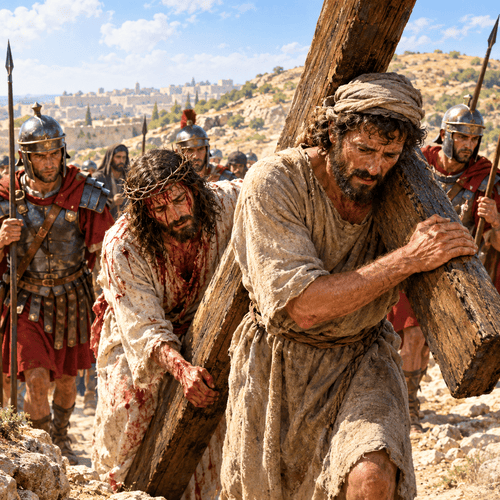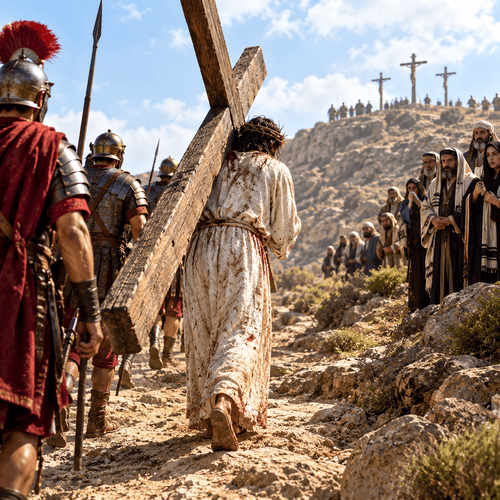
Here’s a hard question. Imagine Jesus died on the cross and rose again—and then not one single person ever believed in Him. Would the cross have failed?
Most Christians would say, ‘That could never happen!’ But think about it carefully. If the cross only opens a door, and every person is free to stay outside, then the cross by itself guarantees nobody’s salvation. It makes forgiveness available. Whether anyone actually receives it depends on us.
This isn’t a made-up idea. It’s close to the view of William Lane Craig. And it raises a question that goes right to the heart of the gospel: did Jesus actually save people at the cross, or did He only make salvation possible?
In this post we shall consider William Lane Craig’s atonement theory. We will see where he’s right, where he goes wrong, and why the answer matters for every believer who wants to know, ‘Am I really safe?’
KEY WORDS EXPLAINED
- Atonement: how Jesus’ death brings sinners back to God (‘at-one-ment’).
- Penal substitution: Jesus took the penalty (punishment) we deserved, in our place. ‘Penal’ means ‘to do with punishment’.
- Propitiation: turning away God’s holy anger against sin by fully meeting the demands of his justice.
- Imputation: counting something to another person’s account—our sin to Christ, and His righteousness to us.
- Definite atonement: Christ died to save particular people, and He will surely save every one of them. Also called ‘limited atonement’ or ‘particular redemption’.
- Pardon: when a judge or ruler sets a guilty person free from punishment.
- Molinism: Craig’s belief that God knows what every free person would choose in every possible situation, and plans history around those choices.
What Craig Gets Right
Before we disagree, we should give thanks. Craig defends several truths that many modern scholars have abandoned:
- Sin truly deserves punishment. God isn’t just a teacher trying to correct us. He’s a Judge, and the guilty deserve punishment because of what they’ve done.
- Jesus really stood in our place. Craig shows from Isaiah 53 and from Paul’s letters that Christ carried the penalty of our sin.
- It’s not unfair for one to carry another’s guilt. He points out even human courts sometimes hold one person responsible for another’s wrong—for example, an employer for an employee.
- Modern critics can be answered. He carefully replies to philosopher Eleonore Stump, who argued penal substitution clashes with God’s love.
All of this is good and helpful. But on 5 key questions, Craig takes a different road from the one Scripture marks out. Let’s walk through them one by one.
Question 1: Did Jesus Die for Particular People?
Craig believes Christ died in the same way for every person who has ever lived. He also says the question of who Christ died for is one he’d rather avoid, because he thinks it is a side issue.
But it isn’t a side issue. It tells us what the cross actually did. Puritan John Owen (1616–1683) put the problem like this. If Jesus paid the full penalty for every sin of every person, how can God justly punish anyone in hell for those same sins? That would be punishing the same sin twice.
Craig’s reply is simple: Christ’s payment only helps us when we freely receive it by faith. So, he says, there’s no double punishment.
JOHN OWEN’S FAMOUS PUZZLE
In The Death of Death in the Death of Christ (1647), Owen said Christ suffered for 1 of 3 things:
- All the sins of all people—then everyone would be saved.
- Some of the sins of all people—then everyone still carries some sin, and no one could be saved.
- All the sins of some people—the elect, whom God chose. This is the biblical answer.
Someone may say, ‘People are lost because of their unbelief.’ Owen replies with his own question: ‘Is this unbelief a sin, or not?’ If it’s a sin, then either Christ paid for it or He didn’t. If He paid for it, it can’t condemn anyone.
Here’s the weak point in Craig’s answer. Where does faith come from? The Bible says faith isn’t something we produce on our own. It’s a gift: ‘For it has been granted to you that for the sake of Christ you should not only believe in him…’ (Philippians 1:29). And Luke writes, ‘as many as were appointed to eternal life believed’ (Acts 13:48).
So faith itself is one of the blessings Christ bought by His death. If Christ purchased the faith of His people, the ‘condition’ of faith can’t make His work uncertain. He paid for the condition too.
Charles Spurgeon (1834–1892) said: ‘I would rather believe a limited atonement that is efficacious for all men for whom it was intended, than a universal atonement that is not efficacious for anybody, except the will of man be added to it.’ (‘Efficacious’ simply means ‘effective—it really works’.)
Interestingly, Craig himself admits his Molinist philosophy would allow someone to hold definite atonement while still offering salvation to everyone. In other words, his own system leaves room for the very view he rejects.
What About ‘the Whole World’? Three Verses Explained
| VERSE | WHAT IT SEEMS TO SAY | WHAT IT MEANS IN ITS SETTING |
|---|---|---|
| 1 John 2:2 | Christ died for every single person. | John, a Jewish believer, says Christ is the propitiation not just for Jewish believers but for people everywhere. Compare John 11:51–52, where the same writer says Jesus died ‘to gather into one the children of God who are scattered abroad’. |
| 1 Timothy 2:4–6 | God plans to save every individual. | Paul has just told Timothy to pray for ‘all people’, including kings (2:1–2). ‘All’ here means all kinds of people, not just one class. |
| 2 Peter 3:9 | God wants every person to be saved. | Peter writes that God is ‘patient toward you’—his readers. God delays the end so that all his people will come to repentance. |
Does this mean we cannot tell everyone the good news? Not at all. The Canons of Dort (1619) say Christ’s death is ‘of infinite worth and value, abundantly sufficient to expiate the sins of the whole world’ (II.3). So we can say to every person: ‘Christ is enough for you. Come to him!’ No one who comes will be turned away (John 6:37).
Question 2: Did Jesus Have to Die?
Could God simply have forgiven sin without the cross? Craig leaves this door open. He is sympathetic to Hugo Grotius (1583–1645), a Dutch lawyer who defended the cross but believed God could have forgiven sin without punishing Christ. God simply chose the cross because it was the wisest way.
But Scripture points the other way. Look at Jesus in the garden of Gethsemane. He prayed, ‘My Father, if it be possible, let this cup pass from me; nevertheless, not as I will, but as you will’ (Matthew 26:39). If there had been another way, would a loving Father have said no to his beloved Son? The silence of heaven tells us there was no other way.
Paul agrees. God put Christ forward as a propitiation ‘so that he might be just and the justifier of the one who has faith in Jesus’ (Romans 3:26). God could not just wave sin away and stay just. And Paul adds, ‘if righteousness were through the law, then Christ died for no purpose’ (Galatians 2:21). The cross wasn’t one option among many. It was the only way.
CRAIG’S OWN STARTING POINT LEADS HERE
Craig himself believes that, by his very nature, God punishes the guilty because they deserve it. Follow that idea to its end:
- Step 1: Craig says punishing the guilty flows from God’s own nature.
- Step 2: God can never act against His own nature—‘He cannot deny himself’ (2 Timothy 2:13).
- Step 3: So God cannot simply let sin go unpunished.
- Conclusion: Either sinners bear their own punishment, or a substitute bears it for them. The cross was necessary.
Genevan theologian Francis Turretin (1623–1687) argued exactly this. Justice isn’t a switch God may turn on or off. It’s who He is.
Question 3: Does the Cross Save or Only Make Salvation Possible?
This is the biggest question of all. Craig says that by bearing our punishment, Christ frees us from liability and makes divine pardon possible. That pardon must then be freely accepted. Craig agrees we need God’s grace to accept it, but he believes we can still say yes or no to that grace.
Now listen to how the Bible actually describes what the cross did. Notice the verbs:
- It finished the work. ‘It is finished’ (John 19:30).
- It secured redemption. ‘…by means of His own blood, thus securing an eternal redemption’ (Hebrews 9:12).
- It made believers perfect before God. ‘For by a single offering He has perfected for all time those who are being sanctified’ (Hebrews 10:14).
- It bought a people. ‘by your blood you ransomed people for God from every tribe and language and people and nation’ (Revelation 5:9).
- It guarantees rescue from wrath. ‘Since, therefore, we have now been justified by His blood, much more shall we be saved by Him from the wrath of God’ (Romans 5:9).
Not one of these verses says the cross made salvation ‘possible’. They say it accomplished salvation.
Theologian John Murray (1898–1975) asked the key question in his classic Redemption Accomplished and Applied (1955). Did Christ come merely to remove obstacles and make provision for salvation? Or, as Murray put it, ‘did He come to save His people?’ JI Packer (1926–2020) answered in the same spirit: Christ didn’t win ‘a hypothetical salvation for hypothetical believers’, but a real salvation for real people.
Loraine Boettner (1901–1990) used a helpful picture. Definite atonement, he said, is like ‘a narrow bridge which goes all the way across’ the river. A universal atonement that only makes salvation possible is like ‘a great wide bridge which goes only half-way across.’ A wide bridge that stops in the middle of the river does not get anyone home.
ONE GOD, ONE PLAN, ONE PEOPLE
The Father, the Son and the Holy Spirit never work against each other. Their saving work aims at the same people:
- The Father gives a people to his Son: ‘All that the Father gives me will come to me’ (John 6:37).
- The Son lays down his life for them: ‘The good shepherd lays down his life for the sheep’ (John 10:11).
- The Spirit brings each of them to new life (Titus 3:5), so that Jesus loses ‘nothing of all that he has given me’ (John 6:39).
If the Son died for people the Father never gave and the Spirit never brings, the Trinity would be working at cross purposes. Scripture shows the opposite.
Scottish theologian Donald Macleod made this point in his review of Craig’s book. Without God’s grace that cannot fail, every sinner would say ‘No!’ to the gospel—and Christ would have died in vain. Definite atonement guards the truth that the cross does not just make salvation possible. It makes it certain.
Question 4: Is Imputation Just a ‘Legal Fiction’?
A ‘legal fiction’ is when a court treats something as true even though it isn’t really true. For example, the law treats a company as if it were a ‘person’. Craig suggests God could treat Christ as if He had committed our sins, so that Christ could be punished in our place.
Craig means well. But the word ‘fiction’ makes the cross sound like pretending. Even Christian lawyer John Montgomery warned that legal fictions are hardly used in the law systems of continental Europe and aren’t a source of law in themselves. The Bible gives us something far stronger than a fiction.
- Real union with Christ. Believers are truly joined to Christ, so what is his becomes theirs: ‘For our sake he made him to be sin who knew no sin, so that in him we might become the righteousness of God’ (2 Corinthians 5:21).
- Real covenant headship. Adam really acted for his family, and Christ really acted for his: ‘so by the one man’s obedience the many will be made righteous’ (Romans 5:19).
- A real eternal agreement. Craig speaks of God appointing Christ to be our proxy. Macleod worried this makes the Son look lower than the Father. Scripture shows an eternal agreement among the three equal persons, in which the Son is ‘an eternally willing penal substitute’: ‘I lay it down of my own accord’ (John 10:18).
A Pardon Alone vs Full Justification
| QUESTION | A PARDON ALONE | FULL BIBLICAL JUSTIFICATION |
|---|---|---|
| What happens to the punishment? | It is cancelled. | It is cancelled, because Christ bore it. |
| Is the person counted righteous? | No—only released. | Yes—Christ’s obedience is counted to them (Romans 5:19). |
| What is their new status? | A released prisoner. | An adopted child of God (Galatians 4:4–5). |
| What is it based on? | The judge’s decision. | Real union with Christ (2 Corinthians 5:21). |
Craig rightly speaks about pardon. But the gospel gives us more than a pardon. Isaiah saw it long ago: ‘by His knowledge shall the righteous one, my servant, make many to be accounted righteous, and He shall bear their iniquities’ (Isaiah 53:11). Christ doesn’t just get us off. He makes us right with God.
Question 5: Did Jesus Suffer the Punishment of Hell?
Here we find more agreement. Craig points out Christ didn’t suffer eternal separation from God—He rose on the third day. Yet Craig also says Christ’s suffering wasn’t unlike the punishment of hell, because He truly felt abandoned by God.
So how can a few hours of suffering pay for the sins of many? The answer lies in who suffered. The one on the cross was the eternal Son of God. Anselm of Canterbury (1033–1109), in Why God Became Man, warned we have ‘not yet considered how great the weight of sin is’. But the worth of the Saviour is even greater. Because Christ is infinite in dignity, His suffering has infinite value. On this point Craig and the historic Protestant teachers like Turretin largely stand together.
The Verdict at a Glance
| QUESTION | CRAIG’S ANSWER | THE BIBLE’S ANSWER | VERDICT |
|---|---|---|---|
| Did Jesus take our punishment? | Yes | Yes (Isaiah 53:5) | Full agreement |
| For whom did he die? | For everyone equally | To save his sheep (John 10:11) | Craig is wrong |
| Was the cross necessary? | Perhaps not | Yes (Romans 3:26) | Craig is wrong |
| What did the cross do? | Made pardon possible | Secured salvation (Hebrews 9:12) | Craig is wrong |
| How is our sin counted to Christ? | Like a legal fiction | Through real union (2 Corinthians 5:21) | Craig is weak |
| How could finite suffering pay? | Not eternal, yet like hell | Infinite worth of the Son | Close agreement |
Why This Matters
This isn’t just a debate for professors. It touches our peace with God. If the cross only made salvation possible, our safety finally rests on how well we hold on to Christ. But if the cross secured salvation, our safety rests on how well Christ holds on to us.
Listen to Paul’s confidence: ‘Who shall bring any charge against God’s elect? It is God who justifies. Who is to condemn? Christ Jesus is the one who died—more than that, who was raised—who is at the right hand of God, who indeed is interceding for us’ (Romans 8:33–34).
Hymn writer Augustus Toplady (1740–1778) turned this truth into song:
Payment God cannot twice demand,
First at my bleeding Surety’s hand,
And then again at mine.
A ‘surety’ is someone who promises to pay another person’s debt. Jesus is that Surety. He didn’t put down a deposit and leave the rest to us. He paid it all. So here’s the answer to our opening question: the cross doesn’t merely make salvation possible. The cross saves. If you haven’t yet trusted Him, come to Him today. He will not turn you away.
Tough Questions, Honest Answers
What is penal substitutionary atonement in simple words?
It means Jesus took the punishment we deserved, in our place. ‘Penal’ means ‘to do with punishment’, and ‘substitution’ means one person standing in for another. All people have broken God’s law, and the just penalty is death and separation from God (Romans 6:23). On the cross, Jesus willingly carried that penalty for his people. ‘He was pierced for our transgressions; he was crushed for our iniquities’ (Isaiah 53:5). Because he paid it, God can forgive us and still be perfectly fair.
Isn’t penal substitution a kind of ‘divine child abuse’?
No. This charge forgets that the Father, Son and Holy Spirit are one God with one will. The Father did not force an unwilling victim. The Son came gladly: ‘No one takes it from me, but I lay it down of my own accord’ (John 10:18). In the cross, God himself pays the price of our sin, not some third party. Far from abuse, it is the greatest act of self-giving love ever seen (1 John 4:10).
Did the Father turn his face away from Jesus on the cross?
Jesus cried, ‘My God, my God, why have you forsaken me?’ (Mark 15:34), quoting Psalm 22:1. This shows he truly felt the weight of God’s judgement against sin. Yet the Father never stopped loving his Son; in fact, the Father loved him for laying down his life (John 10:17). What was withdrawn was the sense of the Father’s comfort, not his love. Notice too that Jesus still calls him ‘My God’—he trusted the Father even in the dark. And Psalm 22 itself ends in victory and praise.
Is substitution a new idea invented at the Reformation?
No. It runs right through the Old Testament, from the Passover lamb (Exodus 12) to the Day of Atonement goat that carried Israel’s sins (Leviticus 16) and the Suffering Servant (Isaiah 53). The early church saw it too. The second-century Letter to Diognetus praises God for giving his Son as a ransom, the holy one for the lawless, and cries, ‘O sweet exchange!’ Later fathers such as Athanasius and Augustine also spoke of Christ dying in our place. The Reformers did not invent this truth; they explained it more clearly.
What is ‘Christus Victor’, and does it contradict penal substitution?
‘Christus Victor’ is Latin for ‘Christ the Victor’. It is the biblical truth that at the cross Jesus defeated Satan, sin and death. It does not contradict penal substitution—it depends on it. Paul says God cancelled ‘the record of debt that stood against us’ and in that same act ‘disarmed the rulers and authorities’ (Colossians 2:14–15). Satan’s main weapon is accusation. Once Christ has paid for our sins, the accuser has nothing left to say.
Is William Lane Craig a Calvinist?
No. Craig is a Molinist. He believes humans have a kind of free will that God does not determine, and that God plans history using his knowledge of what people would freely choose. So he rejects the beliefs that God chooses people for salvation unconditionally and that his saving grace cannot finally be resisted. He does agree with Calvinists that Jesus died as our substitute. But Scripture teaches that salvation ‘depends not on human will or exertion, but on God, who has mercy’ (Romans 9:16).
Did Jesus go to hell after he died?
The Apostles’ Creed says Jesus ‘descended into hell’, but this phrase was added later and has been understood in different ways. John Calvin taught that it describes the hellish agony Christ suffered on the cross under God’s judgement. The Westminster Larger Catechism (Q. 50) explains it as Christ remaining under the power of death until the third day. What we know for sure is that Jesus told the dying thief, ‘today you will be with me in paradise’ (Luke 23:43). His suffering for sin ended at the cross, when he said, ‘It is finished.’
Related Reads
- How Did Jesus Die? What Doctors Say About the Cross
- For Whom Did Christ Die? The Biblical Case for Definite Atonement
- Limited Atonement: The Biblical Case for Particular Redemption
- 4-Point Calvinism: Can I Be a Calvinist and Deny Limited Atonement?
- Calvinism vs Molinism: A Deep Dive into the Debate
- Penal Substitutionary Atonement: The Heart of the Gospel Explained
- 5 Atonement Theories: Can Any Surpass Penal Substitution?
- Sin’s Eternal Penalty: Why Isn’t Jesus Our Substitute Still Paying?
- Why Does Jesus Cry, ‘My God My God’?
- No Hope Without It: Why Christ’s Active Obedience Matters