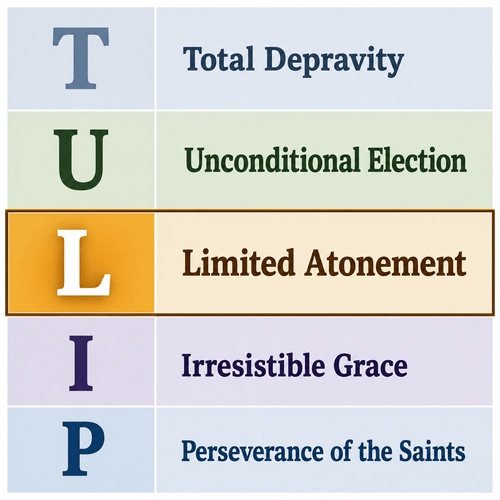
This post is part of our five-part series on the Doctrines of Grace—the biblical teachings known by the acronym TULIP. The name “Doctrines of Grace” reflects the Reformed conviction that every one of the five points answers the same question from a different angle: whose doing is salvation? Total Depravity shows why we cannot save ourselves. Unconditional Election shows us God’s choice rests on His grace, not our merit. Limited Atonement shows Christ’s death actually secured our redemption. Irresistible Grace shows us God’s call overcomes our resistance. Perseverance of the Saints shows us God keeps us to the end. Together, the five make the case that salvation belongs to God—from first to last.
Of all five points of Calvinism, limited atonement is the one that makes people most uncomfortable. The very name sounds cold, even cruel. Did Christ really die only for some people? Is God’s saving love genuinely that selective?
It’s worth sitting with that discomfort for a moment—because the doctrine that produces it turns out, on closer inspection, to be one of the most personally comforting truths in all of Scripture. The question isn’t whether the atonement is “limited” in some sense. The real question is: in what direction does the limitation run? And that’s precisely where the biblical evidence leads us somewhere surprising.
Today we’re making the case for the “L” in TULIP.
What Is Limited Atonement?
Limited atonement—also known as Particular Redemption or Definite Atonement—teaches that when Christ died on the cross, His death was specifically designed to secure the salvation of the elect: those whom the Father had chosen and given to the Son.
This doesn’t mean Christ’s atoning work is somehow insufficient or weak. Reformed theologians have long affirmed the sacrifice of the Son of God is of infinite worth—more than enough to save every human being who has ever lived. The limitation isn’t in its value but in its design. Christ’s death wasn’t a vague offer extended to all in the hope that some might accept it. It was a definite, purposeful act of substitution for a definite people.
The contrast with other views is important here. Arminian theology holds Christ’s death made salvation possible for everyone but actually secures it for no one—its application depends entirely on the free choice of the individual. Reformed theology, by contrast, holds Christ’s death actually accomplished what it set out to do. It didn’t open a door that may or may not be walked through; it ransomed a people and secured their redemption.
The Biblical Case for Particular Redemption
The Scriptures don’t speak of the atonement in vague, indiscriminate terms. Again and again, the intended beneficiaries of Christ’s death are identified in specific language.
- The Good Shepherd and his sheep (John 10:11, 14-15): “I am the good shepherd. The good shepherd lays down his life for the sheep… I know my own and my own know me… and I lay down my life for the sheep.” Jesus doesn’t say He dies for the world at large. He dies for His sheep—those who belong to Him. In the same chapter (v.26), He explicitly tells the Pharisees: “you do not believe because you are not among my sheep.”
- The High Priestly Prayer (John 17:9): On the night before the cross, Jesus prays with remarkable specificity: “I am praying for them. I am not praying for the world but for those whom you have given me, for they are yours.” The one who is about to offer Himself makes clear His intercession—and by extension His atoning work—is for a particular people.
- The church purchased by blood (Acts 20:28): Paul exhorts the Ephesian elders to “care for the church of God, which He obtained with His own blood.” The blood of Christ purchased the church, not every individual indiscriminately.
- Christ’s love for the church (Ephesians 5:25-27): “Christ loved the church and gave Himself up for her, that He might sanctify her… so that He might present the church to Himself in splendour, without spot or wrinkle.” The giving of Himself is coextensive with Hs love for the church—specific, purposeful, effective.
- Isaiah 53 (v.8): “For the transgression of my people He was stricken.” The Servant of the LORD doesn’t die for everyone without distinction; He bears the transgression of God’s people.
- Matthew 1:21: The angel’s announcement is precise: “He will save His people from their sins.” Not “He will make it possible for people to save themselves” but “He will save His people”—the completion of the saving act is guaranteed.
- Revelation 5:9: Heaven’s song celebrates the scope of redemption in the most glorious terms: Christ has “ransomed people for God from every tribe and language and people and nation.” Note what this verse doesn’t say. It doesn’t say He tried to ransom everyone and succeeded only with some. It says He ransomed—past tense, accomplished fact—a people drawn from every corner of the earth.
The Trinitarian Argument
Perhaps the most powerful case for definite atonement isn’t a single verse but the internal logic of the Trinity’s unified purpose in salvation.
The Father elected a specific people from before the foundation of the world (Ephesians 1:4-5). The Spirit is given to apply redemption to those same people—regenerating them, indwelling them, sealing them (Ephesians 1:13-14). If the Son’s atoning work was intended for a different, larger group—one that includes people the Father never elected and the Spirit will never regenerate—the three Persons of the Trinity would be working at cross-purposes.
Reformed theology insists on the harmony of the Godhead in the work of salvation. The Father’s electing love, the Son’s redeeming death, and the Spirit’s applying grace all have the same scope and the same object: the people of God. To insist Christ died for those the Father never intended to save is to introduce incoherence into the very heart of the Trinity.
John Owen’s “Double Payment” Argument
The 17-century Puritan John Owen put the dilemma with characteristic precision. If Christ paid the debt of sin for every human being, one of two things must follow. Either
- all human beings will be saved—universal salvation—or
- God demands payment twice: once from Christ and again from unbelievers in hell.
But demanding double payment for the same debt is manifestly unjust. The only coherent alternative is that Christ’s payment was made for those whose debt it actually cancels—namely, the elect.
This argument has never been satisfactorily answered by those who affirm universal atonement. It isn’t merely a theological puzzle; it goes to the heart of what the cross actually achieved.
What About “World” and “All”?
The most common objection to limited atonement draws on texts that speak of Christ dying for the “world” or for “all people.” These deserve honest engagement.
When John writes “God so loved the world that He gave His only Son” (John 3:16), he’s not counting heads. The word kosmos in John’s Gospel regularly refers to humanity across all peoples and nations—all kinds of people—rather than every individual without exception. Look for instance at 1 John 2:15, where the same author commands us not to love “the world.” Clearly John doesn’t mean we should refuse to love any human being; he means we shouldn’t love the world-system of sin.
When Paul writes God “desires all people to be saved” (1 Timothy 2:4), the context is an instruction to pray for “kings and all who are in high positions” (v.2)—people of all ranks and nationalities. “All people” means all without distinction, not all without exception.
When Peter writes God is “not wishing that any should perish, but that all should reach repentance” (2 Peter 3:9), the “any” and “all” refer back to “you”—the elect believers he’s addressing throughout the letter. God will bring all of His own to repentance; not one will be lost.
And when John writes Christ is “the propitiation for our sins, and not for ours only but also for the sins of the whole world” (1 John 2:2), he is countering Jewish exclusivism. The atonement isn’t only for Jewish believers (“our sins”) but for God’s people from every nation (“the whole world”).
Read in context, the verse is a striking affirmation of the gospel’s universal reach—not a claim that every individual is propitiated.
Does It Kill Evangelism?
One objection deserves special attention because it’s so widely felt: if Christ only died for the elect, doesn’t that make gospel preaching pointless? Why preach to everyone if only some are intended to be saved?
This gets things exactly backwards. Particular Redemption isn’t a constraint on evangelism—it’s the preacher’s greatest confidence. Before Paul planted the church in Corinth, the Lord told him in a vision: “Don’t be afraid, but go on speaking… for I have many in this city who are my people” (Acts 18:9-10). Paul didn’t know who those people were. His job was to preach to all indiscriminately. God’s job was to apply the gospel effectively to his own.
Reformed preachers throughout history—Whitefield, Spurgeon, Lloyd-Jones—have been among the most passionate evangelists the church has ever produced, precisely because they believed in a God who actually saves rather than one who merely offers. When you believe God has a people He will reconcile to Himself through the preaching of the word, you preach with urgency and assurance rather than anxiety.
The Personal Comfort of Definite Atonement
Here’s what limited atonement—Particular Redemption—ultimately means for the believer.
Christ didn’t die for us in the vague hope we might one day respond. He secured our salvation. The cross didn’t merely open a door; it accomplished a rescue. The Father elected us, the Son died in our place and absorbed every penalty our sin deserved, and the Spirit drew us irresistibly to faith. Our salvation isn’t a fragile thing that depends on the constancy of our free will. It’s as certain as the finished work of Christ.
This is the foundation of Christian assurance. Not “I hope I’m saved if I keep believing” but “I know I’m saved because Christ has actually, definitively, permanently secured my redemption.” The words of Revelation 5:9 aren’t about a transaction that might fall through. They celebrate a completed redemption: “by your blood you ransomed people for God from every tribe and language and people and nation.”
Definite atonement doesn’t narrow the gospel. It anchors it.
Tough Questions, Honest Answers
Doesn’t “limited atonement” mean Christ’s sacrifice wasn’t valuable enough for everyone?
Not at all. The limitation is in its design, not its worth. Christ’s atoning death is of infinite value—sufficient to save every person who has ever lived. What Reformed theology affirms is that it was intended and designed to secure the salvation of the elect, not that it lacked the power to do more. Think of it this way: a cheque may be written for a specific person without being too small to cover a much larger sum.
What about John 3:16—”God so loved the world”?
“The world” (kosmos) in John doesn’t mean every individual without exception. It refers to the whole of humanity across all peoples and nations—as opposed to, say, Israel alone. God’s love in John 3:16 is genuinely universal in its scope across humanity, but His saving love is directed to those He gives to the Son (John 6:37-39). The verse is a celebration of the gospel’s breadth, not a refutation of election.
If Christ only died for the elect, can I be sure he died for me?
Yes—if we’re trusting in Christ, that very faith is proof that we’re among His people. John Owen put it memorably: the warrant for faith is the gospel command, not prior knowledge of our election. We come to Christ because He calls all to come (Matthew 11:28). If we come, we are His; and if we are His, He has secured our redemption.
Isn’t it unjust for God to send people to hell whose sins Christ already paid for?
This is John Owen’s double-payment argument in reverse. If Christ paid for the sins of all humanity, it would indeed be unjust to punish unbelievers a second time for those same sins. Definite atonement is precisely the doctrine that preserves God’s justice: Christ paid for particular sins of particular people, and those people will not face condemnation—because “there is therefore now no condemnation for those who are in Christ Jesus” (Romans 8:1).
How does limited atonement relate to the offer of the gospel?
The gospel is to be proclaimed indiscriminately to all. “Everyone who calls on the name of the Lord will be saved” (Romans 10:13) is an unconditional promise—it doesn’t say “everyone who is elect.” The preacher doesn’t know who the elect are; his task is to offer Christ freely to all and urge all to repent and believe. The doctrine of particular redemption explains why that preaching is effective, not to whom it may be directed.
Does this make God unloving towards the non-elect?
God’s love operates at different levels. There’s a general love God has for all His creatures—common grace, the kindness of rain and sunshine, the offer of the gospel—which is genuine. And there is His particular, saving, redeeming love for His elect. The distinction isn’t between a loving God and an unloving one; it’s between different modes of divine love. A parent’s special love for their child doesn’t mean they hate all other children.
Why is the term “Particular Redemption” sometimes preferred?
Because it emphasises the positive content of the doctrine rather than its apparent restriction. “Particular Redemption” tells you what Christ’s death accomplished: the definite, particular, effective redemption of a specific people drawn from every nation. It’s a celebration of the cross’s power, not a restriction of God’s love.