For nearly 200 years, doctors have argued about what killed Jesus. Was it heart failure? Suffocation? Blood loss? A blood clot? They still don’t agree.
That sounds like bad news for Christians. It’s not. It’s some of the best news we have.
Here’s why. Every doctor in this debate is arguing about how Jesus died. Not one serious medical writer doubts He died. They’re like detectives arguing over which wound was fatal—while standing around the same body.
Yet many Muslims are taught Jesus was never crucified at all. Others say he only fainted and woke up later in a cool tomb. So who is right? Let us look at the evidence—and then go one step further than any doctor can go.
What Happened to Jesus’ Body? An Hour-by-Hour Look
Doctors always start with a patient’s history. The Gospels give us a careful one.
Timeline: Jesus’ Last 18 Hours
- Thursday night, Gethsemane: Jesus prays in deep anguish (Luke 22:44). He gets no sleep.
- Thursday night to early Friday, the trials: He is arrested, mocked and beaten (Mark 14:65).
- Early Friday, the scourging: Roman soldiers whip him (Matthew 27:26). Scourging means beating with leather straps tied with pieces of bone or metal. It tore open the back. Some men died from scourging alone.
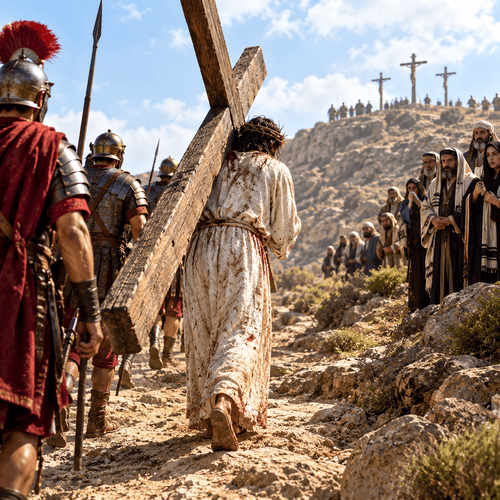
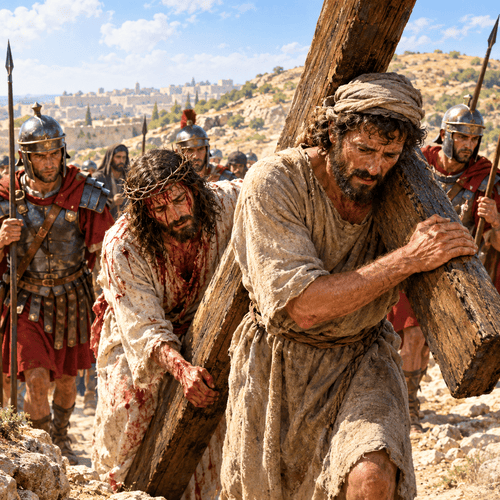
- Morning, the walk to Golgotha: Jesus starts out ‘bearing his own cross’ (John 19:17)—most likely the crossbeam. Soon He’s too weak, and Simon of Cyrene is forced to carry it (Mark 15:21).
- About 9 a.m., crucifixion: ‘And it was the third hour when they crucified Him’ (Mark 15:25).
- Noon to 3 p.m., darkness: Darkness covers the land (Mark 15:33). Jesus says, ‘I thirst’ (John 19:28).
- About 3 pm, death: Jesus cries out with a loud voice and dies (Mark 15:37).
- Before sunset, the spear: A soldier pierces his side, and blood and water flow out (John 19:34).
CRUCIFIXION: WHAT ARCHAEOLOGISTS HAVE FOUND
In 1968, builders near Jerusalem found the heel bone of a man named Yehohanan with an iron nail still stuck through it. In 2017, archaeologists in Fenstanton, England, found a second nailed heel bone, from a man aged 25 to 35 who died between AD 130 and 360.
Finds like these are rare, because nails were usually pulled out and reused. But they show exactly the kind of execution the Gospels describe.
The One Thing Every Doctor Agrees On
Doctors disagree about details. But on the main question there is no debate: Jesus was dead when he came down from the cross.
- The soldiers were experts. Roman execution squads knew death when they saw it. If a condemned man survived, they could pay with their own lives.
- The governor checked. ‘Pilate was surprised to hear that he should have already died’ (Mark 15:44). He asked the centurion—an officer over about a 100 soldiers—and released the body only when he confirmed it (Mark 15:45).
- The spear made sure. The soldiers ‘saw that He was already dead’, so one of them pierced His side instead (John 19:33–34). John insists, ‘He who saw it has borne witness—his testimony is true’ (John 19:35).
- Historians outside the Bible agree. Roman historian Tacitus and the Jewish historian Josephus both say Jesus was executed under Pontius Pilate.
Even sceptics accept this. John Dominic Crossan wrote Jesus’ crucifixion ‘is as sure as anything historical can ever be’. Gerd Lüdemann, a German scholar who left the Christian faith, called it ‘indisputable’.
In 1986, the Journal of the American Medical Association (JAMA) published a famous study by pathologist William Edwards, pastor Wesley Gabel and medical illustrator Floyd Hosmer. Their verdict: ‘the weight of historical and medical evidence indicates that Jesus was dead before the wound to His side was inflicted’.
WHY THE DOCTORS’ DISAGREEMENT IS ACTUALLY GOOD NEWS
In 2006, Matthew Maslen and Piers Mitchell studied more than 40 books and articles by doctors. They found over 10 different theories about how crucifixion kills. But every single theory describes a way to die. The doctors aren’t asking, ‘Did he die?’ Only, ‘Which deadly thing killed Him first?’
So What Actually Killed Jesus? The Main Theories
Here are the main ideas doctors have put forward, in simple words, with a fair verdict on each.
| THEORY | WHAT IT MEANS IN SIMPLE WORDS | WHO ARGUES FOR IT | HOW STRONG IS IT? |
|---|---|---|---|
| Asphyxia | Suffocation. Hanging by the arms makes breathing out hard, so the victim must push up on his nailed feet to breathe. When too tired, he suffocates. | Pierre Barbet, a French surgeon (mid-1900s). A 2021 survey by Gary Habermas, Jonathan Kopel and Benjamin Shaw found many doctors favour it. | Popular, but questioned by experiments |
| Hypovolaemic shock | Shock from losing too much blood and fluid. The heart has too little blood to pump, so the organs shut down. | Frederick Zugibe, a medical examiner; Joseph Bergeron, a physician | Strong—fits the Gospel clues best |
| Mixed causes | Blood loss, exhaustion, breathing trouble and heart strain working together. | William Edwards and colleagues (JAMA, 1986) | Strong—careful and cautious |
| Pulmonary embolism | A blood clot travels from the legs to the lungs. | Benjamin Brenner, an Israeli physician | Weak—six hours is probably too short |
| Cardiac rupture | A ‘broken heart’: the heart wall tears under extreme stress. | William Stroud, a physician (1847) | Weak—very rare and hard to prove |
| Torn artery | A main artery near the shoulder tears as the arms are stretched. | Patrick Pullicino, a neurologist | Possible, but few hold it |
The Most Likely Answer
We should be humble—no one carried out a post-mortem. But the Gospel details point strongly to shock from blood loss, made worse by breathing trouble. Look at the clues:
- Heavy blood loss before the cross. Joseph Bergeron argues Jesus was already going into shock before He reached Golgotha.
- He couldn’t carry His cross. A strong working man collapsing under a beam signals serious blood loss.
- Desperate thirst. ‘I thirst’ (John 19:28) is a classic sign of shock. The body is crying out for lost fluid.
- A quick death. Victims often hung for a day or more. Jesus died in about 6 hours.
What about suffocation? Frederick Zugibe hung volunteers on a cross with their feet supported and arms outstretched. They felt rising pain, but no real trouble breathing. So suffocation was probably not the main cause.
Blood and Water: A Medical Clue in John’s Gospel
John records a strange detail: ‘one of the soldiers pierced his side with a spear, and at once there came out blood and water’ (John 19:34). Why mention water? John was a fisherman, not a doctor. He simply wrote what he saw.
Today, doctors can explain it. After severe shock, clear fluid often collects in the thin sac around the heart (the pericardium) and around the lungs. A spear in the side would release this fluid along with blood. Someone inventing a story wouldn’t make up a detail that only made medical sense centuries later. It’s the mark of an eyewitness.
Bible teachers have seen a deeper meaning too. John Calvin saw here a picture of what Christ gives us: blood to pay for sin, and water to wash us clean. Augustus Toplady put it into his hymn Rock of Ages (1776):
Let the water and the blood,
From thy riven side which flowed,
Be of sin the double cure,
Cleanse me from its guilt and power.Augustus Toplady
‘Did Jesus Just Faint?’ The Swoon Theory and the Kashmir Tomb
Some say Jesus fainted, or ‘swooned’, on the cross, woke up in the cool tomb and walked away. This is the swoon theory. In South Asia, a version is well known: Mirza Ghulam Ahmad, founder of the Ahmadiyya movement, taught that Jesus survived, travelled east and died of old age in Kashmir. Followers point to the Roza Bal tomb in Srinagar. Separately, many Muslims read the Qur’an (Surah 4:157) to say someone else was made to look like Jesus and crucified instead. Each claim runs into serious problems.
| THE CLAIM | THE PROBLEM WITH IT |
|---|---|
| ‘Jesus only fainted.’ | Soldiers, a centurion and the governor confirmed his death, and the spear settled it. The JAMA study said such ideas ‘appear to be at odds with modern medical knowledge’. |
| ‘He recovered in the tomb.’ | Scourged, nailed, speared and wrapped tightly in linen and spices (John 19:39–40), alone in a sealed tomb with no water or care? No one recovers from that. |
| ‘His disciples saw him and believed he had risen.’ | The sceptical German scholar David Friedrich Strauss saw the problem in 1865. A half-dead, limping Jesus would not look like the conqueror of death—only like a man who needed a doctor. |
| ‘He died later in Kashmir.’ | No ancient record says so. The story first appears in the late 1800s. |
| ‘Someone else was crucified instead.’ | The Qur’an came about 600 years later. The earliest witnesses, including enemies like Tacitus, all say Jesus himself was crucified. |
BUT HAVEN’T PEOPLE SURVIVED CRUCIFIXION?
Yes. Josephus saw 3 friends on crosses and begged the Roman commander Titus to take them down. They received the best medical care, yet 2 of the 3 still died (Josephus, Life 420–421). This shows how deadly crucifixion was, even with early rescue. Jesus had no rescue, no doctor and a spear in his side.
Was Jesus Killed, or Did He Choose to Die?
Now we come to something doctors cannot answer. Look at how the Gospels describe the moment Jesus died:
- Mark: ‘And Jesus uttered a loud cry and breathed his last’ (Mark 15:37).
- Matthew: ‘And Jesus cried out again with a loud voice and yielded up his spirit’ (Matthew 27:50).
- John: ‘he bowed his head and gave up his spirit’ (John 19:30).
Notice 2 things. Jesus shouted with a loud voice—a man dying slowly of exhaustion can barely whisper. And the writers never say His life was taken. He yielded up His spirit. He let it go, just as He had said: ‘No one takes it from me, but I lay it down of my own accord’ (John 10:18).
So did the wounds kill Jesus, or did he choose to die? The Bible’s answer is: both. Peter said so at Pentecost: ‘this Jesus, delivered up according to the definite plan and foreknowledge of God, you crucified and killed by the hands of lawless men’ (Acts 2:23). In one sentence, God planned it and wicked men did it.
The Westminster Confession of Faith (1646) gives us helpful words. God is the first cause of all things, but he normally works through second causes—ordinary things like whips, nails, blood loss and human choices. He does not push them aside. He works through them.
So the nails really did kill Jesus, and doctors are right to study them. Yet He died at the exact moment God had planned and He had chosen. He didn’t simply run out of strength. He finished His work. That’s why Hs last word wasn’t a groan but a cry of victory: ‘It is finished’ (John 19:30).
2 MISTAKES TO AVOID
- Mistake 1—‘Jesus didn’t really suffer.’ An early false teaching called Docetism (from a Greek word meaning ‘to seem’) said Jesus only seemed to suffer. The Bible shows real blood, real thirst and a real corpse.
- Mistake 2—‘Medicine explains everything.’ Doctors can describe what happened to Jesus’ body. Only God’s Word tells us why, and what it achieved.
Who Died on the Cross?
If Jesus is God, can God die? The Bible teaches Jesus is 1 person with 2 natures, fully God and fully man. When He died, His human body and soul were separated, as ours will be. His divine nature didn’t die—God cannot stop existing.
Yet the person who died was the eternal Son of God. So Paul can speak of ‘the church of God, which he obtained with his own blood’ (Acts 20:28). Human blood—but the blood of a person who is God. That’s why His death has infinite value. The Heidelberg Catechism (1563) says the Saviour had to be God ‘so that, by the power of his divinity, he might bear the weight of God’s anger in his humanity’. A mere man could never pay for the sins of the world.
What Really Killed Jesus? More Than Nails
The deepest suffering of the cross wasn’t physical. Rome crucified thousands of men, and many hung far longer. Yet none cried what Jesus cried: ‘My God, my God, why have you forsaken me?’ (Mark 15:34). He was bearing God’s judgement against sin. Isaiah had foretold it: ‘Yet it was the will of the LORD to crush him’ (Isaiah 53:10).
The Westminster Confession says Jesus ‘endured most grievous torments immediately in his soul, and most painful sufferings in his body’. Notice the order: the soul comes first. John Calvin wrote that if Christ ‘had died only a bodily death, it would have been ineffectual’. The Heidelberg Catechism agrees: ‘Christ sustained in body and soul the anger of God against the sin of the whole human race.’
So there are 2 ways to describe the same death:
| QUESTION | WHAT THE DOCTOR’S REPORT SAYS | WHAT THE BIBLE’S REPORT SAYS |
|---|---|---|
| What caused it? | Shock, blood loss and breathing failure | Our sins: ‘he was pierced for our transgressions’ (Isaiah 53:5) |
| Who did it? | Roman soldiers | Wicked men, carrying out God’s plan (Acts 2:23) |
| What did he suffer? | Pain, thirst and exhaustion | Being forsaken by God (Mark 15:34) |
| What was the result? | A dead body | A finished payment for sin (John 19:30) |
| What came next? | A burial | Resurrection on the third day (1 Corinthians 15:4) |
Why Jesus’ Death Matters for You
Everything depends on Jesus truly dying.
- No death, no payment. ‘Christ died for our sins in accordance with the Scriptures’ (1 Corinthians 15:3).
- No death, no curse removed. ‘Christ redeemed us from the curse of the law by becoming a curse for us’ (Galatians 3:13).
- No death, no resurrection. And ‘if Christ has not been raised, your faith is futile and you are still in your sins’ (1 Corinthians 15:17).
- No death, no victory over death. Jesus died ‘that through death he might destroy the one who has the power of death, that is, the devil’ (Hebrews 2:14).
Conclusion: How Did Jesus Die?
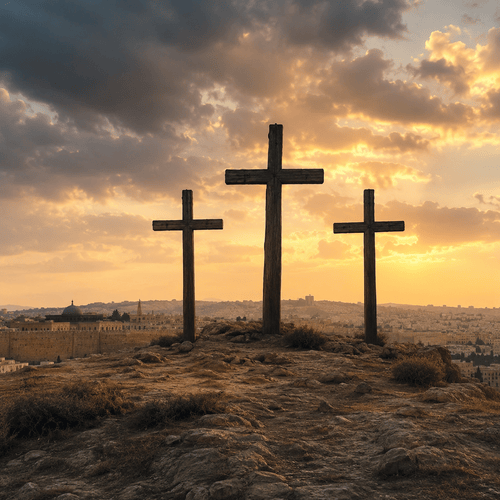
Doctors still argue over what killed Jesus. But they agree on what matters most: the man on the middle cross was dead. The Bible tells the rest. The nails and the thirst were real. But behind the soldiers stood the plan of God, and on the cross hung His Son, carrying our punishment and laying down His life of His own will. Isaac Watts captured it well:
See from His head, His hands, His feet,
Sorrow and love flow mingled down.Isaac Watts, When I Survey the Wondrous Cross
A doctor can tell you how Jesus died. Only Jesus can tell you why: for sinners like you and me. So the real question is no longer, ‘How did Jesus die?’ It’s this: ‘Will you trust the one who died—and rose again?’
Tough Questions, Honest Answers
How long was Jesus on the cross?
Jesus hung on the cross for about six hours. Mark says He was crucified at ‘the third hour’ (about 9 a.m.) and died soon after ‘the ninth hour’ (about 3 p.m.) (Mark 15:25, 34–37). That’s very short for crucifixion, since many victims lasted a day or longer. The short time fits the heavy blood loss from his scourging. But it also fits the Bible’s teaching that Jesus laid down his life when his work was done.
Were the nails through Jesus’ hands or his wrists?
After rising, Jesus showed his disciples his ‘hands’ (Luke 24:39; John 20:27). The Greek word for ‘hand’ was used loosely and may include the wrist. Pierre Barbet argued the nails went through the wrists, because the palms might tear under the body’s weight. Frederick Zugibe argued a nail through the lower palm could hold the body safely. Either way, the Bible’s wording is accurate. What matters most is not the exact spot, but that the risen Jesus still carries the marks of his love.
Did Jesus really sweat blood?
Luke says that in Gethsemane ‘his sweat became like great drops of blood falling down to the ground’ (Luke 22:44). Notice the word ‘like’—Luke may be describing how thick and heavy the drops were. But there is also a rare real condition called haematidrosis, where extreme stress makes tiny blood vessels near the sweat glands burst. Some early copies of Luke do not include these verses, so many Bibles add a note. Either way, Scripture clearly shows Jesus facing the cross in deep anguish of soul, because he knew he must drink the cup of God’s wrath.
Why didn’t the soldiers break Jesus’ legs?
Breaking the legs (in Latin, crurifragium) made death come faster. The victim could no longer push up to breathe, and the broken bones caused more bleeding and shock. The soldiers broke the legs of the two criminals, but when they came to Jesus, he was already dead (John 19:32–33). John says this fulfilled Scripture: ‘Not one of his bones will be broken’ (John 19:36). It points back to the Passover lamb, whose bones must not be broken (Exodus 12:46). Jesus is the true Passover Lamb.
Was Jesus crucified on a cross or on a stake?
Jehovah’s Witnesses teach that Jesus died on a single upright pole. The Greek word stauros can mean a stake, but by Jesus’ time the Romans usually fixed a crossbeam to an upright post. Thomas spoke of ‘the mark of the nails’ in Jesus’ hands (John 20:25)—more than one nail, which fits outstretched arms. Matthew says the charge was placed ‘over his head’ (Matthew 27:37), which also fits a cross. The shape is not the heart of the gospel, but the evidence clearly favours a cross.
Does the Shroud of Turin show how Jesus died?
The Shroud of Turin is an old linen cloth with the faint image of a crucified man. Some believe it was Jesus’ burial cloth. A carbon-dating test in 1988 placed it in the Middle Ages, though that result is still hotly debated. Christians do not need the Shroud to know that Jesus died. Our faith rests on the eyewitness record of Scripture, not on any object. As Jesus told Thomas, ‘Blessed are those who have not seen and yet have believed’ (John 20:29).
What day and year did Jesus die?
Jesus died on a Friday, ‘the day of Preparation, that is, the day before the Sabbath’ (Mark 15:42). Most scholars date his death to either AD 30 or AD 33, and both dates have strong support. He died at Passover, when lambs were being sacrificed in Jerusalem. This timing was no accident. Paul writes, ‘Christ, our Passover lamb, has been sacrificed’ (1 Corinthians 5:7). God set the calendar so that the true Lamb died when the picture-lambs were slain.
Related Reads
- Does the Cross Save or Only Make Salvation Possible?
- Could Jonah Have Survived in a Whale’s Belly? What Science Says
- The Burial of Jesus: Is Joseph of Arimathea’s Tomb Real History?
- Was Jesus Really Crucified? Evidence from History and Scripture
- Gethsemane’s Mystery: Why Did Jesus Sweat Blood?
- Is the Shroud of Turin Real or Fake? The Evidence Weighed
- Before or During Passover: When Was Jesus Really Crucified?
- The Hour Jesus Died: Do the Gospels Contradict Each Other?
- 1 John 5:6: How Do Water and Blood Reveal Jesus’ True Identity?
- Did Jesus Rise from the Dead? The Historical Case for the Resurrection