Welcome to our Famous Last Words series. In our main post, Famous Last Words: What Believers Said Before They Died, we gathered the dying words of Christians across 20 centuries. In this series we slow down and look closely at believers in the Bible whose final words still speak today.
We begin with Stephen, the first follower of Jesus to be killed for his faith. His death takes up only a few verses in Acts 7, but those verses have shaped how Christians have faced death ever since. In his final minutes Stephen saw heaven open, saw Jesus standing to meet him, handed his life to Christ and prayed for the men who were killing him. Then, as Luke quietly tells us, “he fell asleep.”
IN SHORT
Who: Stephen, a church servant in Jerusalem, “a man full of faith and of the Holy Spirit” (Acts 6:5).
When: About AD 33–35, a few years after Jesus rose from the dead.
His last words: “Lord Jesus, receive my spirit” and “Lord, do not hold this sin against them” (Acts 7:59–60).
Why they matter: They copy the dying prayers of Jesus, they show that Jesus is God, and they planted a seed that grew into the conversion of Saul.
Who Was Stephen?
Stephen first appears in Acts 6. The church in Jerusalem was growing fast, and a problem arose. The widows of Greek-speaking Jewish believers were being missed in the daily sharing of food. The apostles didn’t want to stop preaching and praying to manage this. So they told the church: “pick out from among you seven men of good repute, full of the Spirit and of wisdom, whom we will appoint to this duty” (Acts 6:3).
Stephen was the first name on the list. In other words, he began his ministry by serving tables. Yet God gave this humble servant far more to do.
- Full of the Spirit. Luke calls him “a man full of faith and of the Holy Spirit” (Acts 6:5).
- Full of power. “Stephen, full of grace and power, was doing great wonders and signs among the people” (Acts 6:8).
- Full of wisdom. When men from the Synagogue of the Freedmen argued with him, “they could not withstand the wisdom and the Spirit with which he was speaking” (Acts 6:10).
- A fitting name. Stephanos is the Greek word for a crown or victor’s wreath. The first Christian martyr carried a name that pointed to the promise of Revelation 2:10: “Be faithful unto death, and I will give you the crown of life.”
Unable to beat him in argument, his opponents found false witnesses. They charged him before the Jewish council, the Sanhedrin, saying, “This man never ceases to speak words against this holy place and the law” (Acts 6:13). It was almost the same charge brought against Jesus. Then Luke adds a striking detail: “all who sat in the council saw that his face was like the face of an angel” (Acts 6:15).
The Longest Sermon in Acts
Stephen’s reply in Acts 7 is the longest speech in the whole book. It can look like a simple history lesson. It’s actually a careful answer to the charges against him, built from Israel’s own Scriptures.
Timeline of Stephen’s Sermon
- Abraham (Acts 7:2–8). “The God of glory appeared to our father Abraham”—in Mesopotamia, far from the Promised Land and long before any temple.
- Joseph (Acts 7:9–16). His brothers rejected him out of jealousy, but God was with him and made him their saviour.
- Moses (Acts 7:17–43). Israel pushed him away—“Who made you a ruler and a judge over us?” (7:27)—yet God sent him as their deliverer. Even after the exodus, “our fathers refused to obey him” (7:39).
- Tabernacle and temple (Acts 7:44–50). God gave both, yet “the Most High does not dwell in houses made by hands” (7:48).
- The charge turned around (Acts 7:51–53). “You stiff-necked people… you always resist the Holy Spirit. As your fathers did, so do you.”
The message is clear. Stephen wasn’t against God’s law or God’s house. But Israel had a long habit of rejecting the deliverers God sent—Joseph, Moses and the prophets. Now they’d done it again with the greatest Deliverer of all, “the Righteous One, whom you have now betrayed and murdered” (7:52). The real lawbreakers weren’t in the dock. They were sitting on the council.
The Vision: Jesus Standing in Heaven
The council exploded in anger: “they were enraged, and they ground their teeth at him” (Acts 7:54). And at that very moment, God opened Stephen’s eyes.
“But he, full of the Holy Spirit, gazed into heaven and saw the glory of God, and Jesus standing at the right hand of God. And he said, ‘Behold, I see the heavens opened, and the Son of Man standing at the right hand of God’”
Acts 7:55–56
Notice how Stephen’s sermon and his vision fit together. His speech began, “The God of glory appeared to our father Abraham” (Acts 7:2). It ends with Stephen himself seeing “the glory of God” (7:55). The council thought God’s glory was locked inside their temple. But the same glory that met Abraham in a foreign land now met Stephen outside the city walls, in the face of death. God’s presence isn’t tied to a building. It’s found wherever Jesus is—and Jesus was with His servant.
2 details stand out. First, Stephen calls Jesus “the Son of Man.” Outside the Gospels, this is the only place in the New Testament where someone other than Jesus uses that title as a spoken name for Him. It comes from Daniel 7:13–14, where “one like a son of man” receives an everlasting kingdom. Only months earlier, Jesus had told this same council, “from now on the Son of Man shall be seated at the right hand of the power of God” (Luke 22:69). Stephen was telling them Jesus’ words had indeed come true.
Second, Jesus is standing. Everywhere else the risen Christ is described as seated at God’s right hand (Psalm 110:1; Hebrews 1:3). Why is He standing here? Bible teachers have offered several answers, and they fit well together.
| VIEW | WHAT IT MEANS | BIBLICAL LINK |
|---|---|---|
| To welcome | Jesus rises to receive His servant home. | John 14:3 |
| As witness | Stephen has confessed Jesus before men; now Jesus stands to confess Stephen before God. | Luke 12:8 |
| As judge | The earthly court has condemned Stephen; the heavenly Judge stands to overturn the verdict. | Acts 17:31 |
| As helper | The great High Priest stands ready to strengthen His servant in his hour of need. | Hebrews 4:15–16 |
Scholar FF Bruce saw in this scene the fulfilment of Jesus’ promise in Luke 12:8: “everyone who acknowledges me before men, the Son of Man also will acknowledge before the angels of God.” Whatever the exact reason, the comfort is the same. Stephen didn’t die alone. The Lord he served was on His feet.
Stephen’s 2 Dying Prayers
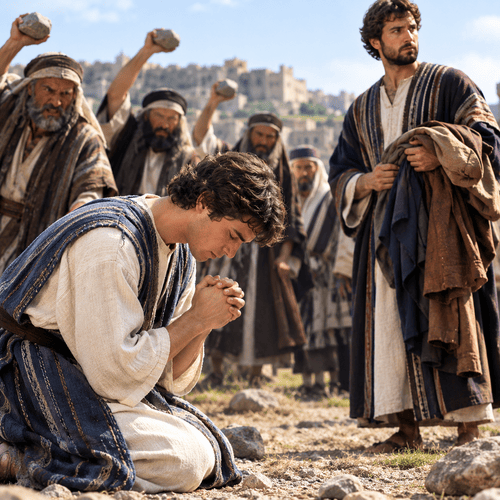
The council would hear no more. “They cried out with a loud voice and stopped their ears and rushed together at him” (Acts 7:57). They dragged him outside the city and began to throw stones. Then Stephen prayed twice.
“And as they were stoning Stephen, he called out, ‘Lord Jesus, receive my spirit.’ And falling to his knees he cried out with a loud voice, ‘Lord, do not hold this sin against them.’ And when he had said this, he fell asleep”
Acts 7:59–60
Luke wrote both the Gospel of Luke and Acts, and he clearly wants us to compare Stephen’s death with Jesus’ death.
| Aspect | JESUS ON THE CROSS | STEPHEN UNDER THE STONES |
|---|---|---|
| Handing over his spirit | “Father, into your hands I commit my spirit!” (Luke 23:46) | “Lord Jesus, receive my spirit.” (Acts 7:59) |
| Praying for his killers | “Father, forgive them, for they know not what they do.” (Luke 23:34) | “Lord, do not hold this sin against them.” (Acts 7:60) |
| A loud cry | “Jesus, calling out with a loud voice…” (Luke 23:46) | “He cried out with a loud voice…” (Acts 7:60) |
Stephen died the way his Master died. This is what it means to follow Jesus. The disciple learns not only how to live from his Lord, but also how to die.
A Dying Prayer That Proves Jesus Is God
Look again at the table above, and notice one important difference. Jesus prayed to the Father. Stephen prayed to Jesus.
This matters greatly. Stephen was a Jew who knew the Scriptures. He knew Psalm 31:5, where the dying believer says to the LORD, “Into your hand I commit my spirit.” He knew that at death “the spirit returns to God who gave it” (Ecclesiastes 12:7). Only God receives human spirits. Yet with his last breath, filled with the Holy Spirit, Stephen handed his spirit to Jesus.
- He prayed to Jesus. Jews prayed to God alone. Stephen called on Jesus by name.
- He called Him “Lord.” In the Greek Old Testament, Kyrios (“Lord”) is the word used for God’s own name.
- He trusted Jesus with his soul. No faithful Jew would commit his eternal spirit to a mere man, however great.
- He asked Jesus to forgive. “Who can forgive sins but God alone?” (Mark 2:7).
Stephen didn’t leave us a lecture on the Trinity. He did something more powerful. At the moment when no one pretends, he prayed to Jesus as God. This was the faith of the church from the very beginning—not a later invention.
“He Fell Asleep”
Luke doesn’t say Stephen died in agony. He says, “he fell asleep.” This is a common New Testament picture for the death of a believer (John 11:11; 1 Thessalonians 4:14).
It doesn’t mean the soul goes into some kind of sleep. Stephen had just asked Jesus to receive his spirit, and Jesus was standing ready to do so. The body sleeps in the grave. The person goes at once to be with Christ (Philippians 1:23). And sleep has a morning. One day the bodies of all who “have fallen asleep” in Jesus will be raised (1 Thessalonians 4:14–16). For the Christian, death isn’t a wall. It’s a bed with a sunrise after it.
The Young Man Holding the Coats
Luke slips in a detail that changes everything: “the witnesses laid down their garments at the feet of a young man named Saul” (Acts 7:58). And again: “And Saul approved of his execution” (Acts 8:1).
Saul went on to hunt Christians with fury. But only a short time later, the risen Jesus met him on the road to Damascus. Saul became Paul, the great apostle to the nations. Years later he still couldn’t forget that day: “when the blood of Stephen your witness was being shed, I myself was standing by and approving and watching over the garments of those who killed him” (Acts 22:20).
Stephen had prayed, “Lord, do not hold this sin against them.” Saul was one of “them.” God answered that prayer in a way Stephen never saw on earth. A saying often attributed to Augustine of Hippo puts it well: if Stephen had not prayed, the church would not have had Paul.
FROM BAD NEWS TO GOOD NEWS
Stephen’s death looked like a defeat for the church. A great persecution followed, and believers fled Jerusalem (Acts 8:1). But “those who were scattered went about preaching the word” (Acts 8:4).
The gospel reached Samaria, then Antioch, then the world—just as Jesus had promised in Acts 1:8. The blood of the first martyr became seed for the spread of the gospel.
Stephen and Zechariah: 2 Martyrs, 2 Prayers
Stephen wasn’t the first of God’s servants to be stoned for speaking the truth. In 2 Chronicles 24, the priest Zechariah son of Jehoiada rebuked Judah and was stoned in the temple court. As he died, he said, “May the LORD see and avenge!” (2 Chronicles 24:22). Jesus Himself mentioned Zechariah’s blood (Luke 11:51).
Zechariah’s prayer wasn’t wrong. He asked God to do justice, and God did. But notice the difference. Zechariah asked for vengeance. Stephen asked for forgiveness. What changed? Between the two martyrs stands the cross. Jesus had taken God’s judgement for sinners, and Stephen had learned from Him to say, “Love your enemies and pray for those who persecute you” (Matthew 5:44).
What Stephen’s Last Words Teach Us Today
- God uses ordinary servants. Stephen started by serving food to widows. No task done for Christ is too small.
- Know your Bible. Stephen’s whole defence came from Scripture. What we store up now, God can use later.
- Look up. When the world is raging, fix your eyes on Jesus, who is alive and reigning at God’s right hand.
- Death is not the end. For the believer, death is falling asleep in Jesus and waking up with Him.
- Forgive your enemies. This is the hardest lesson, and the most Christlike. Only grace can make a dying man pray for his killers.
- Pray for persecutors. Christians in many lands, including India, still suffer for their faith. Today’s Saul may become tomorrow’s Paul.
Conclusion: The First of Many
Stephen was the first Christian martyr, but he was not the last. In our main post we heard Patrick Hamilton, Thomas Cranmer and many others pray Stephen’s very words as the flames rose: “Lord Jesus, receive my spirit.” For two thousand years, believers have learned from Stephen how to die.
But the real hero of Acts 7 is not Stephen. It is the Son of Man standing at God’s right hand. Stephen could face the stones because he saw Jesus. And every believer who trusts that same Jesus can say, with Stephen, “Lord Jesus, receive my spirit”—and know He will.
FAMOUS LAST WORDS SERIES
Start here: Famous Last Words: What Believers Said Before They Died
Coming next: Paul (2 Timothy 4), David (2 Samuel 23), Jacob (Genesis 49), Joseph (Genesis 50), Simeon (Luke 2) and the seven sayings of Jesus from the cross.
Tough Questions, Honest Answers
Was Stephen the first Christian martyr?
Yes. John the Baptist and the baby boys of Bethlehem died earlier, but before the church began. Stephen was the first person killed for his testimony to the risen Jesus after Pentecost. That is why the church has long called him the “protomartyr,” which simply means “first martyr.” The word martyr itself comes from the Greek word for “witness.”
Why was Stephen stoned to death?
He was accused of blasphemy, and the Law said, “Whoever blasphemes the name of the LORD shall surely be put to death. All the congregation shall stone him” (Leviticus 24:16). The Law also required the witnesses to throw the first stones (Deuteronomy 17:7), which is why they took off their outer garments. Under Roman rule the council could not legally execute anyone (John 18:31), so Stephen’s death was most likely an angry mob action rather than a lawful sentence.
Who was Saul in the story of Stephen?
Saul was a young Pharisee from Tarsus who watched over the coats of those stoning Stephen and approved of his death (Acts 7:58; 8:1). He then led a violent persecution of the church. After the risen Jesus appeared to him on the road to Damascus (Acts 9), Saul became the apostle Paul. He later called himself “a blasphemer, persecutor, and insolent opponent” who “received mercy” (1 Timothy 1:13).
Was Stephen a deacon?
Acts 6 never uses the noun “deacon” for the seven men chosen. However, it does use the related verb for “serving” tables (Acts 6:2). Many Christians see these seven as the pattern for the later office of deacon (1 Timothy 3:8–13). Either way, Stephen’s life shows that a servant’s role and a bold witness for Christ go together.
Why did Stephen’s face look like an angel’s face?
Luke says the council saw that “his face was like the face of an angel” (Acts 6:15). This likely means it shone with a calm, heavenly glory. It recalls Moses, whose face shone after meeting God (Exodus 34:29). Ironically, Stephen was accused of speaking against Moses, while God made him look like Moses in front of his accusers.
Did Stephen make mistakes in his speech?
Critics point to two details. Acts 7:4 says Abraham left Haran after his father died, while Genesis 11:26 might suggest Terah was still alive. But if Abraham was not Terah’s firstborn, the numbers fit (Genesis 11:32; 12:4). Acts 7:16 links Abraham with a tomb at Shechem, while Genesis 33:19 says Jacob bought land there. Stephen may be summarising, or Abraham, who built an altar at Shechem (Genesis 12:6–7), may have bought land there first. Careful reading answers these charges.
When is St Stephen’s Day, and why is it celebrated?
Western churches remember Stephen on 26 December, the day after Christmas; many Eastern churches mark it on 27 December. Placing the first martyr next to Christmas makes a strong point: the Child born in Bethlehem is the Lord for whom His people are willing to die. In Britain and some Commonwealth countries the day is also known as Boxing Day.
Related Reads
- Famous Last Words: What Believers Said Before They Died
- Paul’s Last Words: “I Have Fought the Good Fight”
- David’s Last Words: The King Who Looked for a Better King
- Jacob’s Last Words: “I Wait for Your Salvation, O LORD”
- Joseph’s Last Words: “God Will Surely Visit You”
- Simeon’s Last Words: “Now You Are Letting Your Servant Depart in Peace”
- Father, Forgive Them: Who Was Jesus Praying For?
- Last Words on the Cross: Into Your Hands I Commit My Spirit
- Death Penalty For Blasphemy: Was God Too Harsh?
- When Courage Fails: Will I Be Forgiven If I Deny Christ in Persecution?
- Matthew 5:10: What Does ‘Blessed Are Those Who Are Persecuted’ Mean?
- What Happens to Our Souls When We Die?