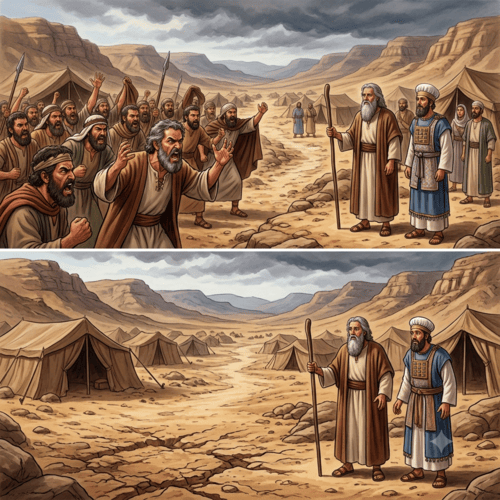
Picture this. 250 well-known leaders stand at the door of God’s tent of worship. Each holds a small pan of burning incense. They’ve come to worship God. By the end of the day, every one of them is dead—burned up by fire that came out from the LORD Himself.
Nearby, the ground splits open like a mouth. It swallows three rebel leaders, their tents and their families. Then it closes again, as if nothing had happened.
Many who read this story, often called Korah’s rebellion, feel shocked. Some feel angry. Was God being cruel? Was He overreacting to a small disagreement about leadership? Is this really the same God who loves sinners?
These are honest questions. As we walk through Numbers 16–17, we shall see Korah’s sin was far more serious than it first looks. We shall also see that, in the middle of this judgement, God shows amazing mercy—mercy that points straight to Jesus Christ.
KEY WORDS IN THIS POST
- Tabernacle: the tent where God lived among Israel in the wilderness.
- Levite: a man from the tribe of Levi. Levites served at the tabernacle, but most were not priests.
- Priest: a man from Aaron’s family. Only priests could offer sacrifices and burn incense before God.
- Incense: sweet-smelling spice burned as an offering, a picture of prayer rising to God.
- Censer: a small metal pan used to carry hot coals and incense.
- Mediator: someone who stands between a holy God and sinful people.
- Sheol: a Hebrew word for the grave, or the place of the dead.
Who Was Korah?
Korah was no outsider. He was Moses’ own cousin. Both men came from the family of Kohath, in the tribe of Levi (Exodus 6:18–21). The Kohathites carried the most holy objects of the tabernacle, such as the ark of the covenant.
So Korah lived close to holy things. But he wanted more.
He didn’t act alone. He joined with 3 men from the tribe of Reuben: Dathan, Abiram and On (Numbers 16:1).
Together they gathered 250 others. The Bible calls them “chiefs of the congregation, chosen from the assembly, well-known men” (Numbers 16:2). These were respected leaders, not foolish young men.
What Happened? A Timeline of Numbers 16–17
- Day 1—The challenge: Korah’s group confronts Moses and Aaron. Moses sets a test: tomorrow, the LORD will show whom He has chosen (16:4–7).
- Day 1—The refusal: Dathan and Abiram refuse Moses’ call (16:12–14).
- Day 2—The test: God’s glory appears at the tabernacle. God threatens to destroy everyone, but Moses and Aaron pray for the people (16:19–22).
- Day 2—The earth opens: The ground swallows Dathan, Abiram, their households and Korah’s people (16:31–33).
- Day 2—The fire falls: Fire from the LORD burns up the 250 men (16:35).
- Day 3—The grumbling and the plague: The nation blames Moses. A plague breaks out, and Aaron stops it with incense, but 14,700 die (16:41–49).
- Afterwards—The budding staff: Aaron’s dry staff grows buds, flowers and almonds overnight, settling who God’s priest is (17:1–11).
Korah’s Rebellion: What Was the Real Sin?
At first, Korah sounds almost reasonable. Listen to his words:
“You have gone too far! For all in the congregation are holy, every one of them, and the LORD is among them. Why then do you exalt yourselves above the assembly of the LORD?”
Numbers 16:3
It sounds like a fight for equality. After all, God did call all Israel holy (Exodus 19:6).
But Moses saw what was hiding underneath: “is it too small a thing for you that the God of Israel has separated you from the congregation of Israel, to bring you near to himself… And would you seek the priesthood also?” (Numbers 16:9–10).
Korah already had an honoured job as a Levite. He wanted Aaron’s job—the priesthood. This wasn’t equality. It was ambition.
Then Moses made the most important point of all: “it is against the LORD that you and all your company have gathered together. What is Aaron that you grumble against him?” (16:11). Aaron didn’t choose himself. God chose him. So to attack Aaron was to attack God.
John Calvin saw through Korah’s argument. God’s people really were holy, he agreed, but “holiness is neither destructive of subordination, nor does it introduce confusion.” Being holy doesn’t erase the roles God gives.
Matthew Henry, the Bible commentator, put his finger on the root problem:
“Those who aspire after and usurp the honours forbidden them put a great contempt upon the honours allowed them.”
Matthew Henry
3 Groups, 3 Sins, 3 Judgements
The rebels weren’t 1 group with 1 complaint. 3 different groups joined together, and each sinned in its own way. This table shows them side by side.
| GROUP | WHO THEY WERE | WHAT THEY DID WRONG | WHAT HAPPENED TO THEM |
|---|---|---|---|
| Korah and his followers | Levites from Moses’ own clan | Wanted the priesthood that God had given only to Aaron’s family | His people and goods were swallowed by the earth (16:32) |
| Dathan and Abiram | Leaders from the tribe of Reuben | Rejected Moses, called Egypt “a land flowing with milk and honey” and refused God’s call to come | Swallowed alive with their tents and households (16:31–33) |
| The 250 chiefs | Well-known leaders from across Israel | Burned incense before God, which only priests were allowed to do | Burned up by fire from the LORD (16:35) |
Why Did God Destroy the 250 Men?
The fire was not random. There were three clear reasons.
- They did what only priests could do. God had said clearly that Aaron and his sons alone would burn incense (Exodus 30:7–8). It meant coming very close to God on behalf of others.
- They knew exactly what they were doing. Moses explained the test the day before: “the man whom the LORD chooses shall be the holy one” (16:7). They had a whole night to think, and came anyway. This was a deliberate challenge to God.
- God had judged this sin before. Not long before, Aaron’s own sons Nadab and Abihu offered fire that God had not commanded. “And fire came out from before the LORD and consumed them” (Leviticus 10:2). The 250 men walked the same road.
Calvin found their stubbornness shocking:
“Surely if any spark of the fear of God had remained in them, their censers would straightway have fallen from their hands.”
John Calvin
In plain words: when God’s glory appeared (16:19), a God-fearing man would have dropped the pan and run.
After they died, God told the priests to hammer their bronze censers into a covering for the altar. Why? It was “to be a reminder to the people of Israel, so that no outsider, who is not of the descendants of Aaron, should draw near to burn incense before the LORD, lest he become like Korah and his company” (16:40). The lesson was clear: you come to God only in the way He provides.
Why Did the Earth Open Its Mouth?
Before the ground opened, Moses said something remarkable:
“If these men die as all men die… then the LORD has not sent me. But if the LORD creates something new, and the ground opens its mouth and swallows them up… then you shall know that these men have despised the LORD.”
Numbers 16:29–30
Moses put his whole reputation on the line. If the rebels died normally, he was a fraud. If something completely new happened, God had spoken. Calvin noted that their death would be so unusual, it would be as if God were adding something new to His creation.
The moment Moses finished speaking, the ground split apart (16:31). This was no unlucky earthquake. The timing was God’s signature.
Matthew Henry saw a sad fitness in it: “They made a rent in the congregation; justly therefore is the earth rent under them.” (A “rent” is a tear or split.) They tore God’s people apart, so the ground was torn apart under their feet.
Why Was God So Severe?
Wasn’t this too much? The Bible helps us see 3 things.
- God is holy. “Holy” means set apart—completely pure and different from us. Sinful people cannot simply walk into His presence. They need a go-between, and in Israel that was the priest. To reject God’s priest was to reject God’s only way of coming near.
- This was a founding moment. At such founding moments, God often judged sin openly so that later generations would learn. We see the same pattern with Nadab and Abihu (Leviticus 10), Achan (Joshua 7), and Ananias and Sapphira at the start of the church (Acts 5). Paul says they were “written down for our instruction” (1 Corinthians 10:11).
- Rebellion spreads. The day after the judgement, the whole nation began to grumble (16:41). Without a clear judgement, Korah’s spirit would have destroyed the whole people.
As Calvin warned, “there never was any more deadly or abominable plague in the Church of God, than ambition.”
But What About the Wives and Children?
This is the hardest part of the story. Numbers 16:27 says “Dathan and Abiram came out and stood at the door of their tents, together with their wives, their sons, and their little ones.” Then the earth swallowed them all. Here are 4 things to keep in mind.
- There was a clear warning. Moses told everyone, “Depart, please, from the tents of these wicked men… lest you be swept away with all their sins” (16:26). Thousands obeyed and lived.
- The families stood with the rebels. Calvin points out that Dathan and Abiram came out unafraid, with their wives and children beside them. Standing at the tent door was a public act of defiance.
- The judgement was not random. Korah’s own sons did not die (Numbers 26:11). They clearly separated from their father, and God saw the difference.
- God is the Lord of life. God says, “I kill and I make alive” (Deuteronomy 32:39). A human judge may not punish children for a father’s crime (Deuteronomy 24:16), but God sees every heart and never does wrong (Genesis 18:25).
Matthew Henry turned this into a gentle warning for parents: “Happy they who are taught betimes to bow before God, and not as those unhappy little ones to stand it out against him!” (“Betimes” means early.) What parents model, children often follow.
Is It Fair for God to Judge Like This?
We usually ask, “Why did God kill these people?” But the Bible teaches us to ask a different question: “Why does God let any sinner live?”
“For the wages of sin is death” (Romans 6:23). If God gave each of us what we deserve, no one would be left standing. The shocking thing in Numbers 16 is not that God judged. It is that He spared so many.
Mercy in the Middle of Judgement
Look closely, and Numbers 16–17 is full of grace.
5 SIGNS OF MERCY IN KORAH’S STORY
- Moses prayed for his enemies. He pleaded for the people insulting him (16:22).
- Everyone who separated lived. God gave the people a way of escape (16:24–27).
- Aaron stood between the dead and the living. Aaron ran into the crowd with his censer. “And he stood between the dead and the living, and the plague was stopped” (16:48).
- Korah’s sons were spared. “But the sons of Korah did not die” (26:11).
- A dead stick came to life. Aaron’s dry staff budded, blossomed and produced almonds (17:8). God ended the argument by giving life.
The same incense that killed the 250 men saved the people when the right priest offered it. Calvin saw the lesson: “The efficacy of the priesthood in propitiating God, is therefore both clearly and briefly set before us.” (To “propitiate” means to turn away God’s anger.) It is not the incense that saves. It is the priest God has chosen.
And what about Korah’s sons? Their family became temple singers. One of their songs says, “I would rather be a doorkeeper in the house of my God than dwell in the tents of wickedness” (Psalm 84:10). Remember: their ancestor’s neighbours had been told to “depart… from the tents of these wicked men” (Numbers 16:26). The sons of Korah learned the lesson.
Another of their songs says, “But God will ransom my soul from the power of Sheol” (Psalm 49:15). That song came from the family whose father went down into Sheol alive. That is grace.
Korah and Jesus: The Better High Priest
Why does all this matter to Christians today? Because Aaron’s priesthood was a picture pointing forward to Jesus.
The book of Hebrews says: “no one takes this honour for himself, but only when called by God, just as Aaron was” (Hebrews 5:4). Jesus, too, was appointed by the Father (Hebrews 5:5–6).
So Korah’s sin has a modern form. It is trying to come to God in any way other than through Jesus. “For there is one God, and there is one mediator between God and men, the man Christ Jesus” (1 Timothy 2:5). Anyone who says, “I can reach God my own way,” is carrying Korah’s censer.
But here is the good news. Aaron stood between the dead and the living for one afternoon. Jesus stands there forever. “Consequently, he is able to save to the uttermost those who draw near to God through him, since he always lives to make intercession for them” (Hebrews 7:25). Aaron offered incense. Jesus offered Himself.
Jude warns that false teachers share Korah’s fate (Jude 11), and Paul borrows Numbers 16:5 to comfort the church: “The Lord knows those who are his” (2 Timothy 2:19).
A WORD OF CAUTION: KORAH IS NOT A WEAPON FOR LEADERS
Some church leaders use this story to silence anyone who questions them. That misuses the text. Moses was “very meek, more than all people who were on the face of the earth” (Numbers 12:3). When challenged, he fell on his face (16:4) and prayed for his attackers (16:22).
No pastor today is Moses, and no pastor is a priest standing between God and people. Only Christ holds that place. Honest, humble questions are not rebellion.
What Does This Mean for Us Today?
- Be content with your calling. Korah had a wonderful job but wanted someone else’s. Ask God for joy in your own work.
- Come to God only through Christ. Good works, religious feelings or family background cannot open the way to God. Only Jesus can.
- Watch out for grumbling. It spread from 250 men to a whole nation in one day.
- There is hope for every family. Korah rebelled, but his descendants became worship leaders. A family’s past does not have to decide its future.
Conclusion
Why did God destroy Korah and the 250 men? Not because they disagreed with Moses, but because they rejected God’s chosen way of coming near to Him. They tried to grab the priesthood that God had given to Aaron alone. They did it knowingly and stubbornly, and pulled thousands along with them.
But the story does not end in fire and dust. It ends with a priest standing between the dead and the living, and a dead stick bursting into life. Both point to Jesus, the High Priest whom God Himself has chosen. The question for each of us is the same one Israel faced: will we come to God His way, or our own?
Tough Questions, Honest Answers
Was Korah swallowed by the earth or burned with the 250 men?
The Bible does not say clearly. Numbers 16:32 says the earth swallowed “all the people who belonged to Korah,” and Numbers 26:10 says it swallowed Dathan and Abiram “together with Korah.” But earlier, Korah stood at the tabernacle with the 250 men (16:19), so some Bible teachers think he died in the fire. Psalm 106:17–18 names only Dathan and Abiram as swallowed. This is not a contradiction—the text simply does not describe Korah’s exact moment of death. What matters is that he died under God’s judgement, just as Moses said.
How many people died because of Korah’s rebellion?
At least 250 men died in the fire (16:35). Dathan, Abiram and their households, together with Korah’s people, were swallowed by the earth, but the Bible does not give their number. The next day, 14,700 more died in the plague (16:49). So the total was about 15,000 people. The biggest loss came not from the rebellion itself, but from grumbling against God’s judgement afterwards.
What happened to On, the son of Peleth?
On is named with Dathan and Abiram in Numbers 16:1, but he never appears again. The Bible does not tell us whether he left the rebellion or died. An old Jewish tradition says his wife persuaded him to step away, but this is only a later story. We should not build teaching on the Bible’s silence. Still, his quiet disappearance reminds us that it is never too late to turn away from sin before judgement comes.
Did Korah and his followers go to hell?
Numbers 16:33 says they “went down alive into Sheol.” In the Old Testament, Sheol usually means the grave or the place of the dead, not hell as such. So the verse mainly tells us they were buried alive. The New Testament gives fuller light on final judgement, and Jude links false teachers to Korah’s rebellion and to a terrible end (Jude 11–13). Yet we cannot see into each person’s heart. We leave final judgement to God, who always judges rightly.
Which psalms did the sons of Korah write?
11 psalms carry the title “of the sons of Korah”: Psalms 42, 44–49, 84, 85, 87 and 88. Many Bible scholars think Psalm 43 also belongs with Psalm 42. These songs include some of the best-loved in the Bible: a deep thirst for God (42), “God is our refuge and strength” (46) and a royal wedding song that Hebrews 1:8–9 applies to Jesus (45). They also include Psalm 88, the darkest psalm of all. Together they show a family changed by grace.
Is the Korah of the Bible the same as Qarun in the Quran?
The Quran tells of Qarun, a man from Moses’ people whom God caused the earth to swallow along with his house (Surah 28:76–81). Muslim teachers generally see him as the same person as the biblical Korah. But the Quran’s account focuses on Qarun’s great wealth and pride, not on the priesthood. Later Jewish stories also spoke much about Korah’s riches, and many scholars note how similar the Quran’s account is to those traditions. The Bible’s account is far older, and it shows the real heart of the matter: Korah despised the priest God had chosen.
Is the story of Korah real history or just a legend?
The Bible presents it as real history. It gives names, family lines, places and numbers (Numbers 16:1; 26:9–11). Later writers treat it as fact: the Korahites appear as a real family of gatekeepers and singers (1 Chronicles 9:19; 2 Chronicles 20:19), and Psalm 106, Paul and Jude all look back to it. We should not expect archaeologists to find traces of a few tents swallowed in the desert more than 3,000 years ago. Jesus Himself treated the writings of Moses as true (John 5:46–47), and we gladly follow Him.
Related Reads
- Death Penalty For Blasphemy: Was God Too Harsh?
- Bridegroom of Blood: Why God Almost Killed Moses in Exodus 4
- Jesus in Numbers: The Serpent, the Rock and the Rising Star
- The Levitical Priesthood: How Does Jesus Fulfil It Perfectly?
- The Priesthood of All Believers: What the Bible Really Teaches
- Who Is Jeshua the High Priest—and How Does He Point Us to Christ?
- What Does Sheol Mean? Hell, Grave, Or Something Else?
- Can We Change God’s Mind? Didn’t Moses Show We Can?
- God’s Cup of Wrath: What It Is and Who Must Drink It
- Does Jude Belong in the Bible?