The swoon theory—the claim that Jesus did not actually die on the cross but merely fainted, was removed while still alive, and later revived in the coolness of the tomb—was not invented by ancient historians or Jewish critics of Christianity. It was conjured in the late eighteenth century by two German rationalist theologians, Karl Friedrich Bahrdt and Heinrich Paulus, who wanted to preserve Jesus as a moral teacher while excising the miraculous from the record. The theory was so implausible that David Strauss—one of the nineteenth century’s most ferocious critics of orthodox Christianity—dismissed it as impossible. A barely-alive Jesus stumbling out of the tomb, he argued, could never have convinced his disciples that he was the triumphant conqueror of death.
Yet the theory refuses to die. It resurfaces regularly in popular media, online forums, and certain strands of Islamic apologetics. It deserves a thorough answer, because what is at stake is not merely a historical footnote. The physical death of Jesus Christ is the foundation of the atonement. Penal substitutionary atonement—the doctrine that Christ bore the full penalty owed by his people—requires an actual death. A near-death experience, however dramatic, settles nothing legally or theologically. What follows examines the medical evidence before, during, and after the crucifixion, the historical record of Roman execution practice, and the theological stakes.
What the swoon theory actually claims
In its most coherent form, the swoon theory requires the following sequence: Jesus survived six hours of crucifixion despite having been severely scourged beforehand; the Roman soldiers—professional executioners whose lives depended on confirming death—were deceived; Jesus was wrapped in burial cloths and sealed in a cold, airless tomb; the tomb environment somehow revived him; he unwrapped himself from approximately 34 kilograms of linen and spices packed tightly around his body; he rolled away a stone estimated at one to two tonnes; he slipped past a Roman guard; he appeared to his disciples in a condition convincing enough that they took it for a resurrection; and then he vanished from history, presumably recovering quietly in obscurity.
Each of these steps would require something remarkable. Together they require something far more implausible than the resurrection itself. But the theory collapses long before it gets that far, because Jesus almost certainly could not have survived to enter the tomb alive.
Before the first nail: the state of Jesus at Golgotha
Roman crucifixion was not the starting point of Jesus’s ordeal. By the time he was nailed to the cross, his body had already endured hours of compounding trauma.
Luke, writing as a physician, records that Jesus experienced haematidrosis in Gethsemane—a rare but medically documented condition in which extreme psychological stress causes capillary haemorrhage into the sweat glands, producing bloody perspiration (Luke 22:44). Modern medical literature confirms haematidrosis exists under conditions of severe psychological duress and notes that it leaves the skin fragile and hypersensitive. It was poor preparation for what followed.
What followed was a Roman scourging. The flagrum was a multi-stranded leather whip with pieces of bone, metal, or glass embedded in the tips. Each stroke tore through skin and into the underlying muscle. Roman scourging was not a warm-up: some victims died before reaching the cross. Medical analysis of the injuries described suggests blood loss severe enough to produce hypovolaemic shock—a state in which the heart cannot pump sufficient blood to the vital organs. This was before a single nail was driven.
Beyond the scourging, Jesus endured a sleepless night of trials, a crown of thorns pressed into his scalp, repeated blows to the face, and mockery that was physical as well as verbal. John 19:17 records Jesus carrying his own cross beam before collapsing and requiring Simon of Cyrene to carry it for him. That collapse is medically significant. It confirms Jesus had reached the limit of his physical reserves before the crucifixion even began.
How Roman crucifixion kills
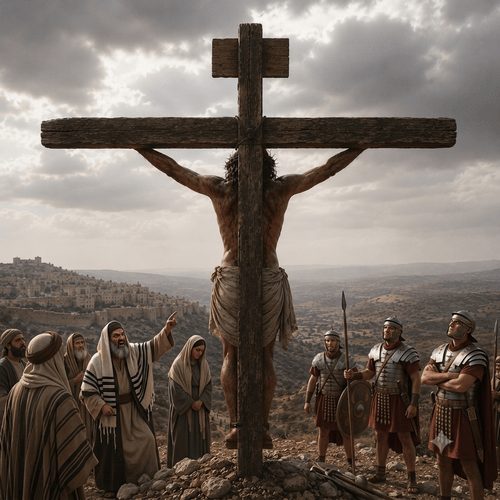
Rome had perfected crucifixion over centuries as a method of capital punishment that was simultaneously excruciating, prolonged, and public. Archaeological evidence confirms the brutal physical reality of the practice: in 1968, the remains of Yehohanan ben Hagkol were discovered in Jerusalem with a nail still through his heel bone, providing direct physical corroboration of the Gospel accounts’ description of the procedure.
The primary mechanism of death in crucifixion is asphyxiation. The position of the body—arms stretched wide, weight hanging from the wrists—forces the diaphragm into a state of inhalation. To exhale, the victim must push upward against the nails through the feet, temporarily relieving the pressure on the chest. As exhaustion sets in, this becomes impossible to sustain. The victim suffocates.
The nails through the wrists almost certainly impinged on the median nerve, sending agonising pain up both arms with every upward movement. Cardiovascular stress was extreme: the heart was forced to pump blood upward against gravity to reach the brain, already compromised by blood loss and traumatic shock. The cumulative effect of hypovolaemic shock, positional asphyxia, cardiac strain, and ongoing haemorrhage from the nail wounds created multiple, independent pathways to death—any one of which could have been fatal in the absence of immediate medical intervention.
Roman execution squads were not amateurs. They were professional soldiers who had performed these executions many times over, and who faced severe penalties—including death themselves—if a condemned prisoner was released alive. Their capacity to recognise death was born of brutal and constant experience.
Why Pilate’s surprise vindicates the Gospel record
When Joseph of Arimathea requested Jesus’s body, Pontius Pilate was surprised that Jesus was already dead (Mark 15:44). Sceptics have sometimes cited this as a reason to doubt the account: if even Pilate found the timing unusual, perhaps Jesus had not actually died.
This misreads both the text and the historical context. Crucifixion victims commonly lingered for twenty-four to forty-eight hours or longer, sometimes several days. Jesus had been on the cross for approximately six hours—from around the third hour (9 am) to the ninth hour (3 pm), as Mark 15:25 and 15:34–37 record. A six-hour crucifixion fell at the shorter end of the range, which explains Pilate’s reaction. But it was not without explanation: no other crucifixion victim in the historical record had endured what Jesus endured before reaching the cross.
Notice carefully what Pilate did with his surprise: he did not dismiss the report. He summoned the centurion responsible for the execution to verify the death before releasing the body (Mark 15:44–45). This is historically significant in two ways. First, it shows the Roman administration operated thorough confirmation procedures—a safeguard against precisely the kind of mistake the swoon theory alleges. Second, it is the kind of potentially awkward detail that a fabricator writing to defend the resurrection would have had every reason to omit. The Gospel writers included it because it happened.
Final confirmation came when a soldier drove a spear into Jesus’s side (John 19:34). The leg-breaking applied to the two criminals crucified alongside Jesus (John 19:31–32) was deliberately not applied to Jesus—because the soldiers had already confirmed he was dead. This fulfilled Psalm 34:20 (“not one of his bones will be broken”) and provided the additional professional verification that Pilate had requested. These were men who knew what death looked like. They were certain.
There is also a theological dimension the Reformed tradition has always recognised. Jesus himself declared: “No one takes my life from me, but I lay it down of my own accord” (John 10:18). His loud cry immediately before death (Mark 15:37) is medically unusual for someone dying of asphyxiation—such victims typically expire quietly as their strength finally fails. His declaration “It is finished” (John 19:30)—the Greek tetelestai, a commercial term meaning “paid in full”—carries the sense of a completed transaction, not a defeat. The precise timing, coinciding with the evening Passover sacrifice, was not incidental. Christ surrendered his spirit when the work of atonement was complete.
The blood and water: a detail that predates modern medicine
John 19:34 records that when the soldier drove a spear into Jesus’s side, “blood and water” flowed out. This detail is medically interpretable in two ways, both consistent with death.
The first interpretation involves pericardial and pleural effusion: severe trauma causes fluid to accumulate around the heart and in the pleural cavity around the lungs. When the spear punctured the chest cavity, this accumulated fluid—serous, watery in appearance—would have emerged separately from the darker blood. The second interpretation is that the “water” represents the separation of blood serum from clotted red blood cells, which occurs after death as the blood begins to settle. Either way, the detail is consistent with death, not survival.
Dr Frederick Zugibe, former Chief Medical Examiner of Rockland County, New York, and the authors of the landmark 1986 Journal of the American Medical Association analysis of the crucifixion both concluded that the blood and water description is medically accurate and confirms death. John recorded this observation centuries before anyone possessed the physiological framework to understand what it indicated. That he recorded it accurately is noteworthy.
Why the swoon theory fails on every front
The swoon theory does not merely face medical objections at one point in the sequence. It collapses at every stage.
Surviving the pre-crucifixion trauma alone—the scourging, the haematidrosis, the sleepless night, the beatings—would have required immediate fluid resuscitation, wound care, and likely surgical intervention. None of this was available in first-century Palestine. Modern trauma specialists consistently classify the injuries described in the Gospel accounts as multiple trauma requiring massive transfusion protocols and intensive care admission. Even with modern intervention, survival would be considered unlikely.
Surviving six hours of crucifixion after existing hypovolaemic shock would require the same level of intervention. The spear wound—had Jesus somehow still been alive when it was inflicted—would have been instantly fatal without emergency thoracic surgery. Penetration of the pericardial sac is a surgical emergency even today. The wound was designed to ensure death, and it did.
Even granting—against all the medical evidence—that Jesus survived to be placed in the tomb, recovery within thirty-six hours from that combined injury profile without treatment is physiologically impossible. The cool tomb environment that supposedly revived him would more plausibly have accelerated hypothermic shock in an already critically compromised patient.
And finally, Strauss’s argument bears repeating. A Jesus who had barely survived crucifixion, who emerged from the tomb broken, exhausted, and barely able to stand, would have produced—in Strauss’s own words—”the feeblest kind” of impression on the disciples. The resurrection appearances in the Gospel accounts are not the appearances of a man who needed urgent medical care. They are the appearances of one who had conquered death. Jesus eats fish with his disciples. He invites Thomas to examine his wounds. He walks seven miles to Emmaus. He commissions eleven frightened men to turn the world upside down. This is not consistent with a swoon. It requires either that the resurrection happened, or that the disciples fabricated appearances they later died rather than recant.
Why the death of Christ is non-negotiable theologically
The medical and historical case is strong enough to stand alone. But for believers, the stakes are higher than historical accuracy.
The Westminster Confession of Faith (VIII.IV) explicitly affirms that Christ “was crucified, and died, was buried, and remained under the power of death, yet saw no corruption.” This is not incidental language. The Confession connects the actual death of Christ directly to the satisfaction of divine justice and the reconciliation of his people to God. A Christ who merely fainted and recovered does not satisfy the penalty for sin. The wages of sin is death (Romans 6:23)—not near-death, not suffering, not a dramatic recovery.
Substitutionary atonement rests on the truth that the substitute actually bore the penalty in full. Tetelestai—”it is finished,” “paid in full”—announces the completion of a transaction. If Jesus did not die, the transaction was not completed. The debt was not paid. The resurrection has no saving power if there was no prior death to conquer.
This is why the physical death of Christ, confirmed by medical science, attested by hostile and disinterested witnesses, verified by professional Roman executioners, and recorded with precise clinical detail by an eyewitness, matters to every Christian. It is not a theological technicality. It is the foundation of everything.
Tough Questions, Honest Answers
Why did Jesus die faster than most crucifixion victims?
Because most crucifixion victims had not endured anything like Jesus’s pre-crucifixion ordeal. A full Roman scourging alone killed some men before they reached the cross. The combination of haematidrosis, the scourging, beatings through a sleepless night, and carrying the crossbeam until collapse meant Jesus arrived at Golgotha already in hypovolaemic shock. Six hours of crucifixion under those conditions was not medically unusual—it was the physiological consequence of what preceded it.
What does “blood and water” from the spear wound prove?
Modern medicine recognises two explanations, both indicating death: separation of blood serum from clotted cells (which occurs post-mortem), or the release of pericardial and pleural fluid that accumulates around the heart and lungs during severe trauma. Either way, the detail is consistent with death, not survival. John recorded it accurately centuries before the physiology was understood—which is itself a striking detail.
Why didn’t the soldiers break Jesus’s legs?
Leg-breaking was applied to the two criminals beside Jesus because the Sabbath was approaching and a quick death was needed. It was not applied to Jesus because the soldiers had already confirmed he was dead. This professional assessment, recorded in the text without editorial comment, simultaneously fulfils Psalm 34:20 and adds another layer of independent verification of the death.
Could the cool tomb have revived Jesus if he was still alive?
No. Hypovolaemic shock, cardiac trauma, and respiratory failure cannot be reversed by ambient temperature. Modern resuscitation has strict time limits measured in minutes, not hours. A patient in the condition Jesus would have been in—sealed in a cold tomb with no fluids, no wound care, and no oxygen support—would have died within the first hour of entombment even if somehow still alive when placed there.
Why was Christ’s actual death necessary for salvation?
Because the penalty for sin is death, not suffering. Genesis 2:17, Romans 6:23, and the entire sacrificial system of the Old Testament point to death as the required payment. Substitution requires that the substitute actually bears the penalty. A Jesus who merely suffered and recovered has not borne the penalty—he has endured pain and survived. The atonement rests on the reality that the death penalty was genuinely paid, in full, at Calvary.
What did David Strauss—a fierce opponent of orthodox Christianity—say about the swoon theory?
Strauss, whose 1835 Life of Jesus remains a foundational text of radical historical criticism, dismissed the swoon theory as impossible. He argued that a barely-surviving Jesus could never have produced the impression of triumphant resurrection. The appearances described in the Gospels require a figure of complete authority and power—not a wounded man in urgent need of medical care. That this critique came from the opposite end of the theological spectrum makes it particularly worth noting.
Related Reads
- Did Jesus Rise from the Dead? The Historical Case for the Resurrection
- Did the Disciples Die for a Lie? The Martyrdom Argument for the Resurrection
- Ten Evidences for the Resurrection in Luke 24: What One Chapter Proves
- The Resurrection of Jesus: Historical Evidence That Even Sceptics Accept
- Mass Hallucination: Does This Explain Resurrection Appearances?
- Penal Substitutionary Atonement: The Heart of the Gospel Explained
- Is the Shroud of Turin Real or Fake? The Evidence Weighed