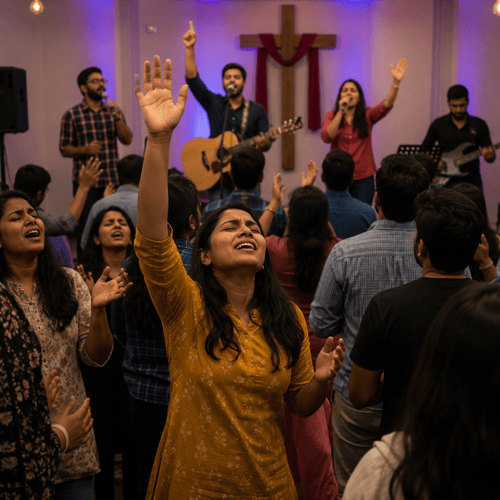
Walk into a church on a Sunday and you’ll likely see things our grandparents never saw. A group of dancers in matching robes moving down the aisle while the music swells. Or four members of the congregation stepping forward and acting out a short play about a man who lost his job, just before the sermon begins.
Ask why, and you’ll usually be told it helps bring the Bible to life. It reaches people who don’t read. It uses gifts God has given. Ask folks who dislike it, and they’ll tell you it just feels wrong. Or even grossly out-of-place.
The question behind the question
First, a word about what we’re discussing. This article is about public worship—what happens when the church gathers together on the Lord’s Day. That’s different from private devotion at home, and different again from a Christian concert, a wedding, or a school event.
The narrow question is this: what may the church do as an act of worship when it meets? Christians often answer the question using one of two rules.
| THE RULE | WHAT IT SAYS | HOW IT ANSWERS OUR QUESTION |
|---|---|---|
| The regulative principle (worship has to be only what God commands) | We’re to worship God only in ways He has commanded in Scripture. Silence means absence of warrant. | Dance and drama aren’t commanded for the gathered church. So the church mustn’t do them in worship. |
| The normative principle (worship can follow any pattern God hasn’t banned) | Worship God in any way Scripture doesn’t forbid, so long as it’s orderly and helpful. | Scripture doesn’t ban dance or drama, so a church is free to use both if they edify people. |
The first rule is the older one in the confessions among Protestant churches. The Westminster Confession of Faith puts it plainly in Chapter 21: God may not be worshipped according to the imaginations and devices of men, under any visible representation, or in any way not prescribed in Holy Scripture. The Belgic Confession says something similar in Article 32, warning church leaders not to depart from what Christ has ordained.
Notice what the confession isn’t saying. It does not say dance is dirty. It doesn’t say acting is a low profession. It says something much narrower and much more careful: God gets to decide how God is approached.
Do the famous verses actually prove it?
Anyone who defends dance in worship reaches for the same handful of passages. Let’s look at each.
Miriam took a tambourine after Israel crossed the Red Sea, and the women followed her with tambourines and dancing (Exodus 15:20). David “danced before the LORD with all his might” as the ark came home (2 Samuel 6:14). The Psalms say, “Let them praise his name with dancing” (Psalm 149:3) and “Praise him with tambourine and dance” (Psalm 150:4).
These are real verses and they mean what they say. Dancing does appear in the Bible, and God isn’t embarrassed by it. But look closely at the setting of each one.
| PASSAGE | WHAT HAPPENED | WHERE IT HAPPENED | WAS IT A SERVICE OF WORSHIP? |
|---|---|---|---|
| Exodus 15:20 | Women celebrate a military rescue | On the seashore, in the open | No—a spontaneous victory celebration |
| 2 Samuel 6:14 | A king leads a procession | In the street, moving the ark to Jerusalem | No—a one-off procession, not a scheduled service |
| Psalm 30:11 | God turns mourning into gladness | A poetic image of a changed life | No—it is a picture, not an instruction for a service |
| Psalm 149:3; 150:4 | Israel is called to praise God | The temple, alongside trumpet, harp and cymbal | Yes—but see the problem below |
The last row is where the argument quietly collapses. Psalm 150 doesn’t only mention dance. It also calls for trumpet, lute, harp, strings, pipe and loud clashing cymbals, in the sanctuary of the God of Israel. That sanctuary had a priesthood, an altar, burning incense and the blood of animals.
So if Psalm 150 authorises a dance team on Sunday morning, consistency demands a great deal more than a dance team. We cannot take one line out of the temple and leave the altar behind. As pastor HB Charles Jr bluntly puts it, Miriam at the Red Sea and David before the ark simply can’t be our primary guidelines for what we do on Sunday mornings.
THE SELECTIVE RETRIEVAL PROBLEM
When we pull one practice out of Old Testament worship and leave the rest, we’re not obeying Scripture—we’re shopping in it.
Take dance from the temple, and we must explain why we left the incense.
Take the tambourine, and we must explain why we left the animal sacrifices.
Take the procession, and we must explain why we left the ark, the priesthood and the veil.
The honest answer is that the whole temple system pointed forward to Christ and has been fulfilled in Him (Hebrews 9:11–14).
What God actually asked for in His house
Here’s a detail that is easy to miss. The Old Testament describes the staffing of God’s house in remarkable detail. There were priests and Levites. There were gatekeepers. There were appointed singers and trained musicians, listed by name and by family in 1 Chronicles 25. God cared enough to specify who played which instrument.
And yet no dancer is ever appointed. No play is ever scheduled. Theologian Derek Thomas draws out the point with dry precision: he observes “no office of ‘choreographer’ or ‘producer/director’ existed in the temple”.
That silence isn’t an accident of the record. In a system where God named the singers, the absence of a dance office and a drama office tells us something.
The silence of the New Testament
When we turn to the church, the picture becomes clearer still. The New Testament tells us what the first Christians did when they gathered, and it’s a short and sober list.
- Reading the Scriptures publicly—Paul tells Timothy to devote himself to it (1 Timothy 4:13).
- Preaching and teaching—the apostles’ teaching came first in Acts 2:42.
- Prayer—including prayer for kings and for all people (1 Timothy 2:1–2).
- Singing—psalms, hymns and spiritual songs, sung by everyone (Colossians 3:16).
- Baptism and the Lord’s Supper—instituted by Christ Himself (Matthew 28:19; 1 Corinthians 11:23–26).
- Giving—money set aside on the first day of the week (1 Corinthians 16:2).
That’s the pattern. No dance. No drama.
At this point a fair objection arrives: Isn’t this just an argument from silence? The Bible doesn’t mention church buildings, microphones or projectors either. Are those forbidden too?
No—and the difference matters. The claim isn’t that silence forbids. The claim is that worship needs a warrant.
Think of a servant sent to prepare a room for an honoured guest, with written instructions from the host. The servant is free to decide where to place the chairs, what time to open the doors and whether to use candles or electric light. He is not free to add a second course to the menu the host wrote out. Microphones and chairs are the arrangement of the room. Dance and drama are new courses on the menu.
Drama and the second commandment
Drama raises a second question that dance doesn’t, and this is where the discussion usually stops early.
The second commandment forbids making a carved image or any likeness for use in worship (Exodus 20:4–6). The Westminster Confession echoes it with that striking phrase quoted earlier: God isn’t to be worshipped “under any visible representation”. The Heidelberg Catechism, in questions 96 to 98, rejects the old defence that images are “books for the unlearned”. It answers God wants His people taught by the preaching of His Word, not by silent pictures.
Now put an actor on the platform, in costume, playing Christ before a congregation gathered to worship. Whatever you think about a picture in a children’s Bible, this is a moving, speaking, visible representation of the Son of God, presented to the church in the very hour of worship. That’s precisely the setting the commandment addresses.
TWO DIFFERENT OBJECTIONS—KEEP THEM APART
Against dance in worship: God hasn’t commanded it for the gathered church. There is no warrant.
Against drama in worship: the same warrant problem, plus a violation of the second commandment, whenever Christ or God is portrayed.
Preaching or performance?
There’s a third concern, and it’s pastoral rather than technical.
God has chosen a strange method for saving people. He didn’t choose spectacle. He chose speech. Faith comes from hearing, and hearing through the word of Christ (Romans 10:17). It pleased God to save believers through what Paul frankly calls the folly of preaching (1 Corinthians 1:21). Theologian Michael Horton has spent much of his career pressing this single point: the church lives by what it receives through the ear, not by what it stages for the eye.
Dance and drama are eye-based media. That isn’t a criticism of them as art. It’s simply what they are. And when an eye-based medium is placed next to an ear-based one in the same half hour, the eye tends to win. The sketch is remembered; the sermon is forgotten.
Three words that keep this sensible
Some people hear all this and imagine a joyless church where nobody may move a muscle. That’s a caricature, and it comes from missing three simple distinctions. Learn them and the whole subject becomes clear.
ELEMENTS, CIRCUMSTANCES AND FORMS
Element—a part of worship that God has commanded: reading Scripture, preaching, prayer, singing, the sacraments, giving. These are fixed. We may not add to the list or subtract from it.
Circumstance—a practical detail Scripture leaves free: what time the service starts, whether the room has chairs or benches, which language is used, whether there is a sound system or a car park. These vary from culture to culture, and rightly so.
Form—the way a commanded element is carried out: which psalm is sung, how long the prayer lasts, whether the sermon has three points or five. Here there is real freedom.
So a preacher who raises his voice, pauses for effect or uses his hands isn’t “doing drama”. A congregation that stands, kneels or lifts its hands isn’t “dancing”. Suggesting otherwise trivialises the discussion. The question is only ever whether a new element is being added to what Christ commanded.
The strongest case on the other side
An argument is only worth as much as the best objection it can answer. So here are the three strongest replies, stated as their defenders would state them.
1. The categories aren’t as neat as they look
Theologian John Frame has argued, in a long and serious exchange with other confessional writers, that the line between “element” and “form” is drawn by tradition rather than by Scripture, and that it moves whenever a tradition finds it convenient. If teaching is a commanded element, he asks, why could a dramatised teaching not be one legitimate form of it?
The reply. If “form” can stretch to absorb any new medium, the rule has no content left; a film, a dance and a mime all become “forms of teaching” and the confession means nothing. And preaching is not simply information transfer. It is a man, sent by Christ, standing in his own person and declaring God’s Word directly to the people as God’s own address to them. An actor pretending to be someone else is doing the opposite of that.
2. It’s culturally cold and quietly Western
Writers at The Gospel Coalition Africa have made this point with real force: many cultures move when they’re glad. To tell an African or Caribbean congregation that stillness is holier can look less like biblical faithfulness and more like a European temperament dressed up as doctrine.
The reply. The rule limits every culture equally. It stopped the Scots from bringing their organs and the Dutch from bringing their images long before it said anything to anyone else. And it protects the poor congregation as much as the rich one: a church with no dancers, no stage, no lighting and no budget lacks nothing, because God asked for a Bible, a table, some water, and voices.
3. The Psalms command it, and we sing the Psalms
If the inspired songbook says to praise God with dancing, why do we happily obey the singing part and quietly ignore the dancing part?
The reply. Because we obey the Psalms as the church of the new covenant, not as Israel at the temple. The same songbook calls for cymbals, ram’s horns and sacrifices in a sanctuary that no longer stands. We sing Psalm 150; we don’t stage it. And notice what the Psalms are for: they are given to be sung by the whole congregation.
Why this rule protects you
It’s easy to hear all this as a set of restrictions. It’s better understood as a protection, and the person it protects most is the ordinary church member with no platform. And no vote.
Derek WH Thomas makes the point sharply. Without an agreed rule, worshippers are simply at the mercy of whoever is running the service. If the leader decides God is honoured by a particular kind of movement, the quiet member who doesn’t join in can be told—from the front, in public—that he is resisting the Spirit. Nobody can appeal against that, because there’s nothing to appeal to.
Scripture takes this seriously. Paul warns against religious practices that have an appearance of wisdom but are self-made (Colossians 2:23). Nadab and Abihu offered fire that God hadn’t commanded, and the text underlines the words which He had not commanded them (Leviticus 10:1). Cain’s offering was sincere and it was rejected. Sincerity has never been the measure.
When worship is limited to what God commanded, no leader can bind our conscience with his own preferences. That’s not bondage. That’s freedom with a fence around it.
How dance and drama left worship. And came back
This isn’t a new argument, and knowing the history helps.
- Old Testament era—dance appears in victory songs and processions. It never becomes a temple office or a scheduled part of the sacrificial system.
- 1st to 3rd centuries—the descriptions we have of Christian gatherings centre on Scripture, prayer, singing and the Lord’s Supper.
- 10th to 15th centuries—mystery plays and passion plays grow up in and around church buildings, teaching a largely illiterate population by spectacle.
- 16th century—the Reformation strips worship back to Word and sacrament. Plays and dances leave the sanctuary across Protestant Europe.
- 1645—the Westminster Directory for Public Worship sets out, part by part, what a service contains. Dance and drama appear nowhere in it.
- Early 20th—Pentecostal renewal restores expressive movement to many congregations.
- From the 1970s—organised praise dance ministries spread rapidly, particularly in African American churches, and later worldwide.
- 1980s and 1990s—seeker-sensitive churches adopt short dramatic sketches as a warm-up to the sermon.
- Today—both are common in many traditions, and both are rarely defended from Scripture. They are usually defended from results.
What this doesn’t forbid
Now the necessary corrective, because this article can easily be misread.
- The body isn’t the problem. Scripture commands physical postures in worship: standing for the reading (Nehemiah 8:5), kneeling in prayer (Psalm 95:6), lifting hands (1 Timothy 2:8), clapping (Psalm 47:1). A church that sits frozen through everything isn’t more faithful.
- Joy isn’t the problem. The gathering of God’s people should be the gladdest hour of the week. Solemn doesn’t need to be sour.
- Dance is a good thing in its place. Ecclesiastes 3:4 tells us there’s a time to dance. There was music and dancing when the lost son came home (Luke 15:25). Weddings, festivals and family celebrations are the natural home of it.
- Acting is an honourable craft. A Christian may write, direct and perform. A school may stage a play. A family may act out a Bible story at home. None of that is the routine for gathered worship in church.
- People who disagree aren’t the enemy. Many of the most devoted believers you’ll ever meet are on the other side of this question. The issue is a matter of worship order, not of salvation.
A simple test we can actually use
If we’re members trying to think clearly, or an elder facing a proposal, five questions will do most of the work.
| ASK THIS | WHY IT MATTERS | WHAT A BAD ANSWER SOUNDS LIKE |
|---|---|---|
| Where does Scripture ask the church to do this when it gathers? | This is the whole question. Everything else is secondary. | “It is not forbidden anywhere.” |
| Is this a new part of worship, or a detail of how a commanded part is done? | Adding a part is the problem. Arranging a part is freedom. | “It is really just another way of teaching.” |
| Does anyone here become a spectator? | Worship is something the whole congregation does, not something a few do for the rest. | “People are worshipping as they watch.” |
| Is God or Christ being visibly portrayed? | The second commandment speaks directly to worship, and most directly here. | “It helps people picture him.” |
| If this were removed, would anything commanded be lost? | If nothing is lost, nothing essential was there. | “The service would feel flat.” |
The one question that settles it
This isn’t a contest between people who love God and people who love rules. On both sides there are believers who want God honoured on Sunday and are trying to work out how.
But the question that decides it isn’t whether dance is beautiful, or whether drama moves people, or whether a congregation enjoys either. All of that may be true and still be beside the point.
The question is the one a servant asks before adding anything to his master’s table: where were we told to?
Let’s ask it kindly. And ask it of everything in the service, including the parts we like. The God who told us exactly how He wished to be approached—right down to mentioning who the temple musicians should be—hasn’t been careless or silent about the hour we spend with Him.
Tough Questions, Honest Answers
Is dancing itself sinful for a Christian outside of church?
No. Scripture never treats bodily movement as evil in itself. Ecclesiastes 3:4 says there’s a time to dance, and in Jesus’ own parable the father’s house was full of music and dancing when the lost son came home (Luke 15:25). What Scripture warns against is dancing that stirs up lust or leads people into sin, as with the daughter of Herodias in Matthew 14:6. So the personal question is never “is movement allowed?” but “is this modest, wise and safe for me and for the people around me?” Public worship is a separate question altogether, because there God has told us what He wants done.
Why was Michal judged for despising David’s dance? Doesn’t that settle the argument?
Michal was judged for contempt, not for holding a view about worship services. Look at her actual words in 2 Samuel 6:20: she mocked the king for uncovering himself before the servant girls, and the passage presents her scorn as scorn for God’s anointed king and for the joy surrounding the ark. The judgement falls on a proud heart. It’s also worth noticing where this took place—in the open street, during a one-off procession, not in a scheduled service at the tabernacle. Using this passage to authorise a dance ministry asks it to answer a question it never raises.
Are nativity plays, Easter dramas and Passion plays the same issue?
They raise the same two concerns in different settings. When such a play is placed inside the worship service, it becomes a part of worship that God never asked for. When it also has an actor portraying Christ, it raises the even heavier question if a visible representation of the Son of God is permissible. Many careful believers therefore keep these things out of the service entirely. They’re however more relaxed about a school production or a community event—though the question of portraying Christ still deserves thought there. A useful test: would you be content for this to replace 10 minutes of the sermon? If not, why is it replacing them?
Can skits and puppets be used in children’s ministry or youth group?
A Sunday school class or a youth meeting is teaching rather than the gathered worship of the church, so it doesn’t fall under the same rule in the same way. Even so, 2 questions are worth asking. First, are the children learning to expect entertainment in the hour when their parents receive the Word? Second, is the puppet doing work a patient teacher with an open Bible should be doing? Children take in far more Scripture than adults usually credit them with. Plain, warm, direct teaching treats a child as a real hearer of God’s Word, which is a higher compliment than a show.
What about mime ministry, flag-waving and banner ministry?
These stand or fall with dance and drama, because they’re the same kind of thing: a wordless visual performance added to worship as though it were a part of it. None of them appears among the things Christ gave his church to do when it gathers. They also create the same difficulty—a small group performs while everyone else watches. This doesn’t mean the people involved are insincere; many may be deeply devoted and giving God their best. It means their devotion still needs a warrant, and on this point Scripture hasn’t given one.
Does this argument also rule out choirs, solos and musical instruments?
This is a fair question, and believers who hold the same rule have answered it differently for four centuries. Everyone agrees singing is commanded (Colossians 3:16; Ephesians 5:19), so the real debate is about what helps the congregation sing and what replaces it. Instruments are widely accepted as an aid to the singing rather than a separate act of worship. A choir or a soloist is harder to defend at the moment when it silences the congregation and turns them into listeners. The workable principle is simple: whatever helps everybody sing is an aid, and whatever makes the people watch instead of sing has quietly become a performance.
What should I do if my church introduces a dance ministry and I disagree?
Begin by assuming the best of those who introduced it, because almost always they want God honoured. Then go to your elders privately and ask the question kindly and directly: where does Scripture ask us to do this? Bring a question rather than an accusation, and be genuinely willing to hear the answer. If they will not engage with it, you may quietly refrain from taking part without judging the hearts of those who do. Leaving a church is a serious step and should follow a settled pattern of Scripture being set aside, not a single decision you happen to dislike.
Related Reads
- What’s the Regulative Principle? And Why Does It Still Matter?
- David Danced Before the Lord—Why Don’t Reformed Churches?
- The Second Commandment: Why Does God Forbid Idols?
- Is Being ‘Slain in the Spirit’ Biblical?
- Do Christians Need Holy Shrines? Why the Reformed Answer Is No
- What Does the Bible Say About Laying On of Hands?