On 16 October 1555, 2 old men were chained to a stake in Oxford. Nicholas Ridley had been Bishop of London. Hugh Latimer had preached before kings. As the wood was lit, Latimer turned to his friend and said, “Be of good comfort, Master Ridley, and play the man. We shall this day light such a candle, by God’s grace, in England, as I trust shall never be put out.”
What was their crime? They wouldn’t say bread becomes the body of Christ at the Catholic Mass. And they wouldn’t say the Mass is a sacrifice that takes away sins. 5 months later, Archbishop Thomas Cranmer died in the same place for the same reason.
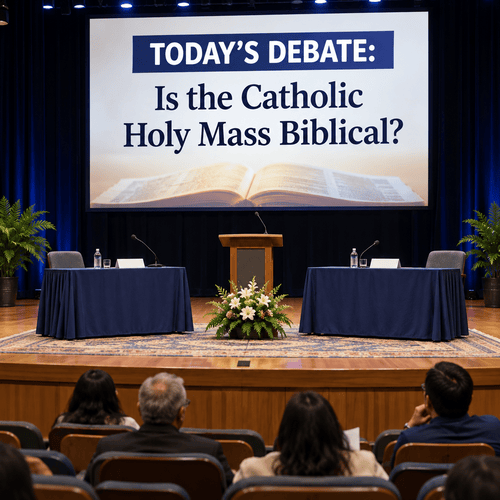
They didn’t die over a matter of taste. They believed the Mass touched the heart of the gospel: the cross of Christ. So the question is worth asking carefully: is the Catholic Holy Mass biblical?
What Happens at Holy Mass?
The Mass is the main worship service of the Roman Catholic Church. In India and much of Asia, it’s usually called “Holy Mass”. First come Bible readings, a short sermon, the creed and prayers. Then the priest stands at the altar, takes bread and wine, and speaks Jesus’ words: “This is my body… this is my blood.” He lifts up the bread and the cup, and the people kneel. Finally, the people receive the bread, which Catholics call the host.
Key Words You Will Meet at Mass—What They Mean
| WORD | WHAT IT MEANS IN SIMPLE ENGLISH |
|---|---|
| Eucharist | From the Greek for “thanksgiving”. Catholics use it for both the service and the bread and wine. |
| Host | The round wafer of bread. The word comes from the Latin hostia, which means “sacrificial victim”. |
| Consecration | The moment the priest speaks Jesus’ words over the bread and wine |
| Transubstantiation | The belief that the bread and wine truly become Christ’s body and blood, though they still look and taste the same |
| Propitiatory | Able to turn away God’s anger against sin |
| Latria | The highest worship, which belongs to God alone |
First, What Rome Gets Right
We want to be fair. Much of the Mass is good. It reads large portions of Scripture, recites the creed, prays the Lord’s Prayer and sings “Holy, holy, holy” from Isaiah 6. It treats Christ’s death with deep seriousness. Our concern is with what Rome says happens at the altar.
What Rome Teaches—In Its Own Words
Let’s hear Rome speak for itself, from the Council of Trent (1545–1563) and the Catechism of the Catholic Church (1992).
THE 4 PILLARS OF THE MASS—QUOTED FROM ROME’S OFFICIAL TEACHING
- A real sacrifice: “The victim is one and the same: the same now offers through the ministry of priests, who then offered himself on the cross; only the manner of offering is different… this sacrifice is truly propitiatory” (Catechism 1367).
- Offered for sins: The Eucharist is “offered in reparation for the sins of the living and the dead” (Catechism 1414).
- By priests: Trent curses anyone who says that Jesus’ words “Do this” did not make the apostles priests to offer his body and blood (Session 22, Canon 2).
- Bread that is no longer bread: “The whole substance of the bread” changes into Christ’s body, and the whole Christ—“body and blood, together with the soul and divinity”—is present (Catechism 1374, 1376).
- To be worshipped: Trent curses anyone who says Christ in the Eucharist should not be adored with latria, the worship due to God alone (Session 13, Canon 6).
Anyone who calls the Mass only a memorial is placed under a curse (Session 22, Canon 3). Now let’s test each pillar.
Pillar 1: Is the Mass a Real Sacrifice?
No book of the Bible speaks more about sacrifice than Hebrews. It was written to Jewish Christians tempted to go back to the temple and its daily offerings. Its answer, repeated again and again, is once for all.
- Christ’s offering happened once: “He did this once for all when he offered up himself” (Hebrews 7:27). “By a single offering He has perfected for all time those who are being sanctified” (Hebrews 10:14).
- To offer Christ again means he must suffer again: Christ did not “offer himself repeatedly… for then He would have had to suffer repeatedly since the foundation of the world” (Hebrews 9:25–26). In Hebrews, there’s no offering of Christ without His suffering.
- No blood, no forgiveness: “Without the shedding of blood there is no forgiveness of sins” (Hebrews 9:22). Yet Trent calls the Mass an “unbloody” sacrifice that is still “truly propitiatory”. Hebrews says those 2 things cannot go together.
- Forgiveness ends all offering: “Where there is forgiveness of these, there is no longer any offering for sin” (Hebrews 10:18). If our sins are forgiven, nothing is left to offer.
- The priest stands, but Christ sits: “Every priest stands daily at his service, offering repeatedly the same sacrifices… But when Christ had offered for all time a single sacrifice for sins, he sat down at the right hand of God” (Hebrews 10:11–12). A priest standing daily at an altar is the very picture Hebrews says is over.
Catholic teachers reply: “We do not repeat the cross. We re-present it—we make the one sacrifice present again.” But look at Rome’s own words: Christ “now offers through the ministry of priests”. That is an act of offering happening now, at every Mass. Hebrews 9:25 says that is exactly what Christ does not do.
What about Hebrews 8:3, “it is necessary for this priest also to have something to offer”? Hebrews has already said what he offered and when: “once for all when he offered up himself” (7:27). Today he does not offer; he “always lives to make intercession” for us (7:25).
The Heidelberg Catechism (1563) puts the contrast simply. The Lord’s Supper tells us our sins are forgiven “through the one sacrifice of Jesus Christ, which He himself finished on the cross once for all.” But the Mass teaches they’re not forgiven “unless Christ is still offered for them daily by the priests.” Thomas Cranmer wrote words that English churches still pray: on the cross Christ made “by his one oblation of himself once offered, a full, perfect, and sufficient sacrifice, oblation, and satisfaction, for the sins of the whole world.”
Full. Perfect. Sufficient. Nothing needs adding.
Pillar 2: Does the Church Need Priests?
In the Old Testament, a priest (Greek: hiereus) offered sacrifices for others. In the New Testament, church leaders are called elders, overseers and deacons—never priests. The word “priest” is used for only two kinds of people:
- Jesus Christ: “He holds his priesthood permanently, because he continues forever” (Hebrews 7:24). The Greek word for “permanently” means a priesthood that does not pass on to anyone else.
- All believers: “You are a chosen race, a royal priesthood” (1 Peter 2:9). Every Christian offers “spiritual sacrifices” (1 Peter 2:5)—praise, good works and our very lives (Hebrews 13:15–16; Romans 12:1).
Rome says “Do this in remembrance of me” (Luke 22:19) means “offer this”. But Paul explains: “as often as you eat this bread and drink the cup, you proclaim the Lord’s death until he comes” (1 Corinthians 11:26). The Supper proclaims a sacrifice to people. It does not offer a sacrifice to God.
Some point to Melchizedek, who “brought out bread and wine” to Abraham (Genesis 14:18). But he was feeding tired soldiers, and Hebrews 7, which explains Melchizedek in detail, never mentions the bread and wine.
Pillar 3: Does the Bread Become Christ’s Body?
When Jesus said, “This is my body,” did the bread turn into his flesh? Look at the text.
- “Is” often means “stands for”: Jesus spoke at the Passover meal, where Israel had always said of the lamb, “It is the LORD’s Passover” (Exodus 12:11). In the same breath he said, “This cup… is the new covenant” (Luke 22:20). The cup was not literally a covenant. Jesus also said, “I am the door” (John 10:9), and Paul said, “the Rock was Christ” (1 Corinthians 10:4).
- It’s still bread and wine: After the blessing, Jesus called the cup “this fruit of the vine” (Matthew 26:29). Paul calls the bread “bread” three times (1 Corinthians 11:26–28).
- God forbade drinking blood: “You shall not eat the blood of any creature” (Leviticus 17:14). The apostles repeated this rule after Pentecost (Acts 15:20). Yet not one disciple at the Last Supper objected.
- Christ’s body is in heaven: Heaven must receive him “until the time for restoring all the things” (Acts 3:21). We eat “until he comes” (1 Corinthians 11:26)—words that only make sense if his body is not yet here.
- Jesus trusted our senses: After rising, he said, “Touch me, and see” (Luke 24:39). Transubstantiation asks us to believe that what looks, feels and tastes like bread is not bread at all.
Catholics often turn to John 6: “Whoever feeds on my flesh and drinks my blood has eternal life” (6:54). But Jesus said this a year before the Last Supper. In the same chapter, eating means coming and believing (6:35), and verse 47 gives the same promise as verse 54: “whoever believes has eternal life.” And he adds, “the flesh is no help at all. The words that I have spoken to you are spirit and life” (6:63). If verse 54 were about the Mass, everyone who ever received Communion would be saved. Even Rome does not believe that. (We explain this chapter fully in our post on John 6.)
Augustine of Hippo, whom Catholics honour as a great teacher, read John 6 the same way. “Why do you prepare your teeth and your stomach?” he asked. “Believe, and you have eaten.”
The Westminster Confession of Faith (1646) concludes transubstantiation “is repugnant, not to Scripture alone, but even to common sense and reason.”
Pillar 4: Should We Worship the Host?
Here the stakes are very high. Rome does not ask Catholics merely to honour the host. It asks them to give it latria—full worship, the worship due to God alone. Catholics kneel before it, carry it in processions and pray before it in “adoration chapels”.
There’s no middle ground. If the bread truly is God, worshipping it is right. If it is still bread, this is worship of a created thing. Scripture shows it remains bread, so we cannot bow to it. (Our post on icon veneration looks at the separate question of bowing to holy pictures.)
But Doesn’t Malachi Predict the Mass?
Catholic teachers often say Malachi 1:11 predicts the Mass: “in every place incense will be offered to my name, and a pure offering.”
But the New Testament tells us what the offerings of God’s people now are: praise (Hebrews 13:15), generous giving (Philippians 4:18), our bodies (Romans 12:1) and our prayers, which rise like incense (Revelation 8:3–4). In the second century, Justin Martyr discussed this very verse. His conclusion? “Prayers and giving of thanks, when offered by worthy men, are the only perfect and well-pleasing sacrifices to God.”
How Did the Mass Grow?
Rome says the Mass is the faith of the apostles. History shows slow growth over centuries.
Timeline: From the Lord’s Supper to the Mass
- 100 AD: An early church manual, the Didache, calls the Lord’s Supper “your sacrifice”—meaning prayers and thanksgiving.
- 250 AD: Cyprian of Carthage begins to speak of the priest offering the Lord’s suffering at the table.
- 593 AD: Pope Gregory the Great encourages Masses for the souls of the dead.
- 831–844: A monk, Paschasius Radbertus, teaches that the bread becomes the very body born of Mary. Another monk from the same monastery, Ratramnus, replies that it is a figure.
- 1059: Berengar of Tours is forced to swear that Christ’s body is “crushed by the teeth of the faithful.”
- 1215: The Fourth Lateran Council makes transubstantiation official teaching.
- 1551 and 1562: The Council of Trent fixes the doctrine of the Mass and curses all who reject it.
- 1555–1556: Ridley, Latimer and Cranmer are burned at Oxford for denying it.
Even today many Catholics are unsure: a 2019 Pew Research survey found only about 1 in 3 US Catholics believe the bread and wine truly become Christ’s body and blood.
What’s the Lord’s Supper, Then?
Some think Protestants see the Lord’s Supper as “just a symbol”. That is not what the Bible teaches, nor what historic Protestant churches believe. The Supper is a true “participation in the body of Christ” (1 Corinthians 10:16). The Westminster Confession says believers “really and indeed, yet not carnally and corporally but spiritually, receive and feed upon Christ crucified.” Here’s how the 2 views compare.
The Catholic Mass and the Lord’s Supper—Side by Side
| QUESTION | THE CATHOLIC MASS | THE LORD’S SUPPER IN THE BIBLE |
|---|---|---|
| Where does it happen? | At an altar | At a table: “the table of the Lord” (1 Corinthians 10:21) |
| Who leads it? | A priest who offers Christ to God | A minister who serves God’s people |
| Which way does it go? | Up to God, as a sacrifice for sins | Down to us, as God’s gift of grace |
| How is Christ present? | Bodily, inside what looks like bread | Really but spiritually, by the Holy Spirit, received by faith |
| How often is Christ offered? | At every Mass, every day | Once for all, never again (Hebrews 10:10) |
| What should we do? | Kneel and adore the host | Lift up our hearts to Christ in heaven (Colossians 3:1) |
John Calvin loved the ancient call at the Supper: “Lift up your hearts!” We do not bring Christ down into the bread. By his Spirit, he lifts us up to himself.
Why This Matters
Is this only an argument about words? No. If Christ must be offered again and again, then forgiveness is never quite finished. Masses are said—often for a gift of money—for the living and for souls Rome believes are in purgatory. (We look at purgatory in our post on Catholic and Protestant salvation.)
Calvin warned that the Mass “buries and suppresses” the cross of Christ. The Church of England’s Thirty-Nine Articles answered with a beautiful truth: “The Offering of Christ once made is that perfect redemption, propitiation, and satisfaction, for all the sins of the whole world… and there is none other satisfaction for sin, but that alone.”
Conclusion: Christ Has Sat Down
On the cross, Jesus cried out, “It is finished” (John 19:30). Then he rose, ascended and sat down at the right hand of God. A seated priest is a priest whose work is done.
That is the good news the Mass hides. You do not need a priest to offer Christ for you today. Christ’s one sacrifice is enough for every sin of everyone who trusts him: “By a single offering he has perfected for all time those who are being sanctified” (Hebrews 10:14).
Ridley and Latimer believed that truth was worth dying for. The candle they lit is still burning. Come to the Lord’s table, not to offer Christ again, but to receive him by faith—and to give thanks that he has done it all.
Tough Questions, Honest Answers
Can Protestants take Communion at a Catholic Mass?
In most cases, the Catholic Church itself says no. Its own church law allows non-Catholics to receive only in rare cases, such as danger of death. We would add a second reason of our own. When a Catholic receives the host, the priest says, “The Body of Christ,” and the person answers, “Amen”—which means “It is true.” A Christian who believes Scripture cannot honestly say that. It is kinder and more truthful to stay seated and pray quietly.
Is it wrong for a Christian to attend Mass for a wedding or funeral?
No. Going to a family wedding or a friend’s funeral is an act of love, and Jesus himself spent time with people who did not share all his beliefs. You can sit respectfully, join in the Bible readings and pray for the people you love. But you should not kneel to adore the host or receive Communion, because that would be taking part in worship you believe is wrong. If someone asks why, explain gently and briefly. Many good conversations about the gospel begin this way.
Didn’t Ignatius and Justin Martyr believe the bread was Christ’s flesh?
Some early writers did use strong language. Ignatius of Antioch (c. 110) and Justin Martyr (c. 155) spoke of the bread and wine as Christ’s flesh and blood. But speaking warmly about the Supper is not the same as teaching transubstantiation, a word and idea that came more than a thousand years later. Other early writers spoke clearly of signs: Tertullian called the bread “the figure of my body.” The church fathers also disagreed with one another, which is why we must test them all by Scripture.
What about Eucharistic miracles like Lanciano?
Catholic tradition tells of hosts that turned into visible flesh or bled, such as the story from Lanciano in Italy, said to date from the eighth century. Such claims are very hard to test, and the Bible warns that signs and wonders can mislead (Deuteronomy 13:1–3; 2 Thessalonians 2:9). Strangely, these stories also go against Rome’s own teaching. Transubstantiation says the bread changes inside but keeps looking like bread, so visible flesh would be a different kind of miracle altogether. Jesus told those who demanded signs that the greatest sign was his own resurrection (Matthew 12:39–40).
Why do many Catholics receive only the bread, not the cup?
For centuries in the Middle Ages, ordinary worshippers were given only the bread, partly from fear of spilling Christ’s blood. The Council of Constance made this the rule in 1415. Rome teaches that the whole Christ is present in the bread alone, so nothing is lost. But Jesus said, “Drink of it, all of you” (Matthew 26:27), and Paul told the whole church to eat and drink (1 Corinthians 11:26–28). Since the 1960s, Catholic churches may offer the cup, but in many parishes people still receive only the host.
Do Lutherans and Anglicans believe the same as Catholics about Communion?
Not quite. Lutherans believe Christ’s body and blood are present “in, with and under” the bread and wine, but they reject transubstantiation and the sacrifice of the Mass (Augsburg Confession, Article 24). The Church of England’s Thirty-Nine Articles say transubstantiation “cannot be proved by Holy Writ” and is “repugnant to the plain words of Scripture.” Some Anglicans today, however, hold views very close to Rome’s. We believe Christ is truly present by his Spirit, while his human body remains in heaven. Our separate post on Lutheran views of Christ’s body explains why this difference matters.
What is the Latin Mass, and why is it called “Mass”?
The word “Mass” comes from the Latin words said at the end of the service: Ite, missa est, meaning “Go, you are sent.” The “Latin Mass” is the older form of the service, fixed in 1570 and said in Latin with the priest facing the altar. After the Second Vatican Council, most Catholic churches began using a new form of the Mass in local languages. Pope Francis limited the Latin Mass in 2021, and the debate between the two forms continues. But both forms teach the same sacrifice, so changing the language does not answer the biblical problem.
Related Reads
- Is Icon Veneration Biblical? What Scripture Really Says
- Catholic vs Protestant Salvation: What’s Wrong With Rome’s Gospel?
- Baptism and the Lord’s Supper: Why the Sacraments Truly Matter
- Fencing the Lord’s Table: Why Scripture Supports Careful Communion
- Does John’s Last Supper Chronology Differ From the Synoptics?
- ‘Sacrifice of Praise’: What Does Hebrews 13:15 Really Mean?
- The Priesthood of All Believers: What the Bible Really Teaches
- A Royal Priesthood: Why Does Peter Address Believers Thus?
- The Levitical Priesthood: How Does Jesus Fulfil It Perfectly?
- Mystery Man Melchizedek: How Does He Foreshadow Christ?
- The Reformation’s Five ‘Solas’: Cornerstones of Salvation
- Does the Bible Teach Purgatory? Scripture’s Clear Answer
- Penal Substitutionary Atonement: The Heart of the Gospel Explained