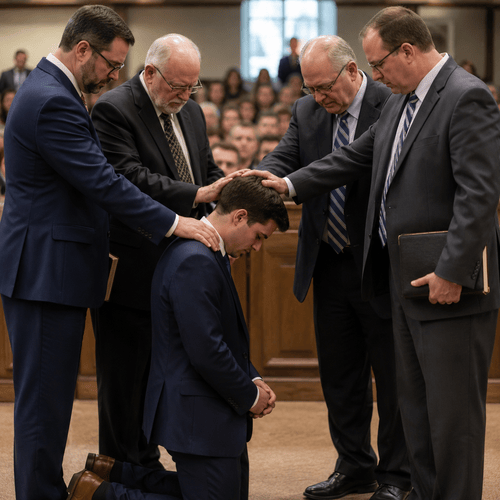
A man kneels in the front in church. Older men gather round him, place their hands on his head and shoulders, and pray. The Bible calls this the laying on of hands. Older books call it the imposition of hands.
But what actually happens in that moment? Some believe a power passes from one body to another—that gifts, healing or an “anointing” travels down the arm and into the other person. Others—prompted by verses such as 1 Timothy 5:22—are so uneasy about the idea they never lay hands on anybody at all.
THE SHORT ANSWER
The laying on of hands isn’t one thing in Scripture. The same gesture appears in sacrifice, blessing, healing, commissioning and the coming of the Spirit. But it doesn’t carry the same meaning in every case. Context decides.
What runs through all of them is personal identification expressed by touch. In the New Testament, it also means prayerful dependence on God to act.
What Scripture never shows is a power stored in a man’s hands and passed on by contact. The hands identify. The prayer asks. God acts.
That’s the claim. The rest of this post tests this answer, passage by passage.
A gesture with weight
Start with the Old Testament word for the laying on of hands: samakh in Hebrew. It doesn’t mean a light tap. It means to lean, to press down, to put your weight on something. The same verb describes a tired man resting his hand against a wall (Amos 5:19).
That detail changes the picture. When an Israelite brought an animal to the tabernacle, he didn’t stroke it kindly. He leaned on it.
“He shall lay his hand on the head of the burnt offering, and it shall be accepted for him to make atonement for him” (Leviticus 1:4).
Atonement is an old word for the covering and removing of sin, so a guilty person can be accepted by a holy God. Notice how tightly the verse links the leaning hand to that acceptance.
What did the leaning here actually mean?
This is a genuinely disputed question, and careful scholars propose a range of answers:
- Identification—this animal is mine, and it stands where I should stand.
- Ownership—this hand of mine marks the animal as belonging to me, so the sacrifice may be credited to me.
- Association or participation—I joins myself to what’s about to happen at the altar.
- Representation—this animal acts on behalf of me who leans on it.
- Transfer of guilt—my sin is handed over to the animal. This is the strongest claim, defensible in some contexts but not obviously in all.
Gordon Wenham reads the gesture chiefly as identification; Jewish scholar Jacob Milgrom argued for ownership rather than the passing over of guilt. These aren’t wild disagreements. They’re different perspectives on a gesture Scripture doesn’t quite stop to define.
One passage, however, does describe transfer of guilt in plain words.
| WHAT CHANGED ON THE DAY OF ATONEMENT | WHAT SCRIPTURE SAYS | WHAT WE CAN FAIRLY CONCLUDE |
|---|---|---|
| Two hands, not one | Aaron lays both hands on the live goat (Leviticus 16:21) | The doubled gesture marks this as an unusually deliberate form of the action |
| Words spoken aloud | He confesses over the goat all the sins of Israel (Leviticus 16:21) | Guilt is named out loud, so something specific is being handed over |
| The animal carries sin away | The goat bears their iniquities to a remote place (Leviticus 16:22) | Here transfer is stated outright. This is the clearest such case in the Old Testament |
The clearest example may be elsewhere
If you want an Old Testament picture that’s hard to misread, consider Numbers 8. The Levites are being set apart for service at the tabernacle, and God gives an unusual instruction.
“And you shall bring the Levites before the Lord, and the people of Israel shall lay their hands on the Levites” (Numbers 8:10).
Read what follows. The Levites are presented to the Lord as an offering from the people of Israel (Numbers 8:11), and God explains He has taken the Levites in place of the firstborn of every Israelite household (Numbers 8:16–18).
Nothing is poured into or over the Levites. No substance moves. The whole nation makes the public declaration: these men stand in our place before God. That’s representative identification, stated as plainly as Scripture ever states it. And it’s the idea that runs underneath almost every other use of the gesture.
It’s also the shape of the gospel itself, which the whole sacrificial system was pointing to:
“For our sake He made Him to be sin who knew no sin, so that in Him we might become the righteousness of God” (2 Corinthians 5:21).
One gesture, five different settings
Now to the heart of the confusion. Scripture uses this gesture in at least 5 distinct settings, and the meaning shifts in each.
| SETTING | KEY PASSAGES | WHAT THE GESTURE DOES HERE |
|---|---|---|
| Sacrifice and identification | Leviticus 1:4; 16:21; Leviticus 24:14; Numbers 8:10 | It declares a connection: this one stands for me, or for us |
| Blessing | Genesis 48:14; Matthew 19:13–15; Mark 10:16 | It marks out who is being blessed. The words carry the blessing, not the palms |
| Healing | Mark 6:5; Mark 8:23–25; Luke 4:40; Acts 9:17; Acts 28:8 | It accompanies healing with touch and compassion. Christ heals; the hand shows whom He is healing |
| Commissioning and setting apart | Numbers 27:18–23; Acts 6:6; Acts 13:3; 1 Timothy 4:14 | It publicly appoints someone to a task the church has already recognised |
| The coming of the Spirit | Acts 8:17; Acts 9:17; Acts 19:6 | It accompanies the Spirit’s arrival at moments when the gospel crossed a new frontier |
Same gesture. Different contexts. Different meanings.
When a worshipper laid hands on an animal, the gesture indicated sacrifice. When Jacob laid hands on Ephraim and Manasseh, it meant blessing. When Moses laid hands on Joshua, it pointed to commissioning. When Jesus laid hands on the sick, it accompanied healing. When the apostles laid hands on believers in Acts, it sometimes accompanied an extraordinary giving of the Spirit.
What holds these together isn’t the presence of any mystical substance in the fingers. What’s common is the personal identification expressed through physical touch—and, in several New Testament cases, a prayerful dependence on God to act.
What happened in Acts
Acts is where some of the modern confusion begins. Twice in that book, people receive the Holy Spirit when hands are laid on them (Acts 8:17; Acts 19:6). If we read only those two verses, we might conclude hands are the ordinary channel through which God gives His Spirit.
So we need to look at other instances in Acts that indicate the Holy Spirit’s presence.
| WHERE IN ACTS | WERE HANDS LAID ON ANY? | WHEN DID THE SPIRIT COME? |
|---|---|---|
| Pentecost, Jerusalem (Acts 2:1–4) | No | Directly, with wind and fire, before any hands were raised |
| The Ethiopian official (Acts 8:26–39) | No | Not mentioned at all; he simply goes on his way rejoicing |
| Samaria (Acts 8:14–17) | Yes, by Apostles Peter and John | After the apostles arrived from Jerusalem |
| Saul of Tarsus (Acts 9:17) | Yes, by Ananias, an ordinary disciple | Alongside the healing of his blindness |
| Cornelius’s household (Acts 10:44–48) | No | Before they were even baptised, while Peter was still speaking |
| Ephesus (Acts 19:1–7) | Yes, by Paul | After baptism, on men who had known only John’s baptism |
Look at the table again. Sometimes hands are laid, sometimes not. Sometimes the Holy Spirit comes before baptism, sometimes after. Sometimes an apostle lays hands, and in Saul’s case, hands were laid not by an apostle at all—Luke introduces Ananias simply as “a disciple at Damascus” (Acts 9:10).
Jesus told the apostles they’d be His witnesses “in Jerusalem and in all Judea and Samaria, and to the end of the earth” (Acts 1:8). The only two instances we see in Acts of the Holy Spirit coming with the laying on of hands is when the gospel has crossed the border. And on both occasions it’s apostles who lay hands.
WHY THE DIFFERENCE AT THE BORDER CROSSING?
Jews and Samaritans had despised each other for centuries. They had rival temples, rival scriptures and a long memory of insults. Had the Samaritans received the Spirit privately, with no apostle present, the result would likely have been two churches—one Jewish, one Samaritan—that never spoke to each other.
So the Spirit came when Peter and John came down from Jerusalem. The Samaritans were visibly joined to the same church under the same apostolic message. By the same Spirit.
The episode is remarkable precisely because it wasn’t normal. Nobody in Acts is instructed to reproduce it.
New Testament scholar David Peterson reads the Samaritan episode along these lines, as a boundary-crossing moment rather than a template. Richard Gaffin presses the wider point: the apostolic age was foundational in a way later ages are not. Paul says the church is “built on the foundation of the apostles and prophets” (Ephesians 2:20), and a foundation, by its nature, is laid once. Sinclair Ferguson likewise treats these episodes as signposts in the unfolding of God’s plan rather than instructions for every evening prayer meeting.
Acts itself supplies the warning against the opposite reading, and it comes with unusual sharpness.
REMEMBER SIMON THE MAGICIAN?
In Acts 8:18–24 a former sorcerer named Simon watches the apostles lay hands on the Samaritans. He even offers money in exchange for the ability to do the same.
Peter’s reply is among the harshest in the New Testament. He tells Simon his silver will perish with him, that he has no share in this matter, and that he must repent of his wickedness.
The church later named the sin after him: simony, the buying or selling of spiritual office and spiritual power.
The first person in Scripture to imagine the laying on of hands meant transferable power is condemned for it. That’s no small detail.
An honest note on a real disagreement
Whether the extraordinary events in Acts were tied to the apostolic era is disputed among Christians who equally love the Scriptures. BB Warfield argued in Counterfeit Miracles the miraculous gifts ceased with the apostles. O Palmer Robertson and Richard Gaffin have defended similar conclusions, too. Wayne Grudem and Sam Storms hold a high view of Scripture while expecting some gifts to continue.
This post doesn’t need to settle that debate, because both sides agree on the point that actually matters here. Neither camp teaches that favoured men carry portable anointing in their palms, which they pour into whoever they touch. On that question the disagreement isn’t between two Christian views. It’s between Scripture and Simon.
The puzzle of Hebrews 6:2
One verse keeps the topic alive in search engines.
“…not laying again a foundation of repentance from dead works and of faith towards God, and of instruction about washings, the laying on of hands, and the resurrection of the dead, and eternal judgement” (Hebrews 6:1–2).
Readers reasonably ask: if this is foundational Christian teaching, why do so few churches teach the laying on of hands? Notice first how much of the verse is uncertain.
- “Washings” here is a plural word (baptismoi), and it isn’t the usual New Testament word for Christian baptism. Careful readers, therefore, take it as Jewish ceremonial washings rather than baptism.
- “Laying on of hands” is unexplained. It could refer to blessing, to commissioning, to healing, to the receiving of the Spirit, or to some early Christian practice at initiation that Scripture nowhere details.
- Reference works acknowledge the range. The Reformation Study Bible, for instance, suggests both Old and New Testament possibilities, rather than settling on one.
The honest position, then, is this: we don’t precisely know which practice the writer had in mind. But we can say with confidence what he’s doing with the list. Hebrews 6:1–2 isn’t a syllabus to be reinstated. It’s a set of foundations readers are urged to build on and move past. He isn’t saying “organise your church programme around these six items.” He’s saying instead: you’ve laid this foundation already; stop digging it up; move on to maturity.
Any teaching that turns Hebrews 6:2 into a mandate for regular hand-laying ceremonies has read the verse in the opposite direction from the one the writer intended.
Can laying on of hands mean a sacrament?
A sacrament is a sign appointed by Jesus Christ Himself, in which a visible action is joined to a gospel promise. Not every good church practice qualifies. To count, a rite needs Christ’s own institution and a promise attached to the sign.
By that measure there are 2, and only 2: baptism and the Lord’s Supper. The Westminster Confession of Faith (27.4), the Heidelberg Catechism (Questions 65–68) and the Belgic Confession (Articles 33–35) all say so plainly.
Rome, however, counts 7, including confirmation—a rite in which a bishop lays hands on a baptised person, who’s said thereby to receive the Holy Spirit in a fuller way. The Council of Trent, in 1547, declared anyone who denies that confirmation is a true sacrament stands under the church’s condemnation.
This is when the disagreement begins to bite. Once the rite is called a sacrament, it stops being a sign: from a sign that identifies it becomes a channel that delivers. Hands are no longer showing whom the church is praying for; they’re said to be doing the work themselves.
JOHN CALVIN’S SURPRISING NUANCE
It would be easy to assume Calvin simply hated confirmation. He didn’t. In the Institutes of the Christian Religion (Book 4, Chapter 19), his attack falls on the sacramentalising of the rite, not on the rite in every form.
Calvin, in fact, speaks warmly of the ancient practice by which young people were carefully taught the faith, examined publicly, and then prayed over with the laying on of hands. He wished the older custom could be recovered.
His objection was precise: teaching and blessing are good; however, claiming a bishop’s hands confer the Holy Spirit isn’t.
Calvin is noticeably gentler about the laying on of hands in ordination than about other rites Rome had added. Ordination, he thought, has clear apostolic precedent.
The sharpest summary of the position, however, is older than Calvin. Writing against the Donatists, Augustine of Hippo asked what the laying on of hands could possibly be, if it isn’t prayer over a person.
Hands and the calling of ministers
Ordination is the act by which a church solemnly sets a man apart to a recognised office—minister, elder or deacon. It’s the one use of the gesture that almost every church retains.
The pattern begins with Moses and Joshua. God commands Moses to take Joshua, “a man in whom is the Spirit,” and lay his hand on him before the whole assembly (Numbers 27:18–23). Note the order carefully. The Spirit was already in Joshua before any hand touched him. The gesture recognised and publicised what God had already done.
A WORD ABOUT VOCABULARY
Luke never uses the word ordination. In Acts 6:6 the apostles pray and lay hands on 7 men the congregation had already chosen. In Acts 13:3 the church at Antioch fasts, prays and lays hands on Barnabas and Saul—two men who were already recognised teachers and whom the Holy Spirit had already called (Acts 13:2).
It’s therefore safer to speak of laying on of hands as commissioning or setting apart in these passages. Acts 13 in particular reads far more like a sending than a making: the church wasn’t creating ministers, it was releasing them to a task.
The 2 verses about Timothy
Paul refers to the laying on of hands on Timothy twice. At first glance, the 2 verses seem to pull in different directions.
| VERSE | WHOSE HANDS ARE NAMED | HOW THE GIFT IS DESCRIBED |
|---|---|---|
| 1 Timothy 4:14 | The council of elders, as a body | Given “by prophecy when the council of elders laid their hands on you” |
| 2 Timothy 1:6 | Paul’s own hands | The gift “which is in you through the laying on of my hands” |
In 1 Timothy 4:14 Paul emphasises it’s the presbytery who lay hands; in 2 Timothy 1:6 he emphasises it’s his hands. The most natural reconciliation is that Paul took part with the elders in one and the same commissioning. The precise relationship between the 2 passages is, however, debated and we mustn’t pretend otherwise.
Either way, the decisive point is what Paul then tells Timothy to do. He tells him to “fan into flame” the gift of God (2 Timothy 1:6)—language of stirring up something God has already given. He doesn’t tell Timothy spiritual power is acquired through laying on of hands, nor that it’s transmitted through his own.
TWO GREEK WORDS THAT ARE OFTEN CONFUSED
Epithesis ton cheiron—literally “the placing on of hands”: the gesture itself (1 Timothy 4:14; Hebrews 6:2).
Cheirotoneo—to appoint. The word originally described voting in a Greek assembly by raising of hand. It’s used of appointing elders in Acts 14:23 and of choosing a travelling companion in 2 Corinthians 8:19.
They’re different words with different meanings, but popular reference sites seem to regularly merge them. Arguments about church authority are sometimes built on that confusion.
An old argument worth knowing
How essential is the laying on of hands to a valid ordination? Scottish theologian George Gillespie, one of the Scottish commissioners at the Westminster Assembly, gave a carefully balanced answer that’s easy to misquote in either direction.
Gillespie held ordination itself is essential to a man’s lawful calling as a minister, and that laying on of hands is the ritual part of ordination. He didn’t regard the gesture as the substantial part of the act—the substance is the church’s calling and setting apart of the man. But he did regard it as an ordinance of the New Testament, and argued it ought to be retained.
Both extremes get him wrong. He isn’t dismissing the gesture as optional decoration. Neither does he make it the thing that validates an ordination. The church’s lawful calling constitutes the ordination; the hands are its appointed outward form. The confessional documents keep the practice on exactly that footing—the Westminster assembly’s Form of Presbyterial Church Government describes ordination with fasting, prayer and the imposition of hands by the presbytery, and the Second London Baptist Confession of 1689 (26.9) describes officers set apart with fasting, prayer and the laying on of hands of the eldership.
One live question remains: at a minister’s ordination, may ruling elders lay on hands, or only ministers of the Word? The Westminster language points one way; several presbyteries have long practised otherwise. It’s a genuine disagreement among brothers and should be held as one.
Was Charles Spurgeon ever ordained?
No—and the reason matters, because the story is often told carelessly. Charles Haddon Spurgeon declined ordination and disliked being called “Reverend”, but he wasn’t rejecting the church’s recognition of ministers. He was formally called, recognised and installed as pastor of his congregation, and held that office with great commitment for nearly 40 years.
His objection was to a particular idea of ordination: the notion that the ceremony confers ministerial authority or grace, setting a man into a separate priestly class. He preferred pastor to Reverend for the same reason.
Few would follow him in declining the ceremony. But his instinct guards something true: a man is a minister because God has gifted him and the church has lawfully called him—not because hands touched his head.
Don’t be in a hurry
“Do not be hasty in the laying on of hands, nor take part in the sins of others; keep yourself pure” (1 Timothy 5:22).
Paul’s warning is bracing. When a church appoints a man too quickly and he later falls, those who appointed him share in the damage. The gesture is public and it functions as a promise. It says to the congregation: we’ve examined this man, and we stand behind him. That isn’t a thing to do lightly because somebody seems enthusiastic.
What about praying for the sick?
Jesus healed by touch again and again (Mark 6:5; Mark 8:23–25; Luke 4:40). The apostles did the same too, and so did others: it was Ananias, an ordinary disciple, who laid hands on the blinded Saul (Acts 9:17), and Paul who prayed and laid hands on the father of Publius (Acts 28:8). Nobody should be embarrassed by that record, and healing deserves to be counted among the Bible’s major uses of the gesture rather than tucked away as a footnote.
But notice what the New Testament actually instructs the ongoing church to do when someone falls ill:
“Is anyone among you sick? Let him call for the elders of the church, and let them pray over him, anointing him with oil in the name of the Lord” (James 5:14).
Read it slowly. James doesn’t mention the laying on of hands at all. He mentions elders, prayer and oil. The sick person calls for the church’s recognised leaders; the leaders pray; the promise attached is the Lord’s own raising up and forgiving. The weight falls entirely on God answering prayer, not on a technique.
Mark 16:18 does speak of laying hands on the sick and is frequently quoted. Honesty requires a note: those closing verses of Mark are absent from our two oldest and most respected Greek manuscripts, and their authenticity is debated by careful scholars on all sides. Whatever conclusion you reach, it’s unwise to build a doctrine of healing on a contested text when clearer passages are available.
What the laying on of hands isn’t
Scripture never presents this gesture as any of the following.
- Not a transfer of “anointing”. No passage describes a spiritual coating that one Christian carries and can pour into another by touch.
- Not a mantle passed between men. Elijah’s cloak fell to Elisha (2 Kings 2:13), but nobody laid hands on anybody, and the event is a prophetic sign rather than a repeatable procedure.
- Not “spiritual covering”. The idea that a believer needs a stronger man’s hands over him for protection has no biblical basis. Christ covers his people.
- Not a power stored in the hands of the gifted. The moment power is located in a person rather than in the God who answers prayer, Simon’s error has arrived.
- Not a cause of collapse or physical manifestations. Nobody in Scripture falls backwards because an apostle touched them.
- Not an unbroken physical chain guaranteeing valid office. A church’s lawful calling of a man is what constitutes his ordination, not a traceable line of touches through history.
But this doesn’t mean nothing happens
Here we must be equally careful in the other direction, because Christians reacting against superstition often overcorrect into something just as unbiblical: the idea that the laying on of hands is empty theatre, a bit of harmless ceremony that changes nothing at all.
That’s clearly not the teaching of Scripture either.
SIGNS AREN’T EMPTY
God works through means. He has always chosen to act through ordinary things—preached words, water, bread, wine, the prayers of His people. To say the power is not in the hands isn’t to say God is absent when they are used.
Prayer is really answered. When elders pray over a sick believer, James attaches a promise to it (James 5:15). The prayer isn’t a performance. God hears it, and He acts.
Ordination genuinely confers office. A man who is lawfully set apart really does become an officer of the church, with real authority and real responsibility. Something changes, and the congregation is right to treat it as changed. That authority comes from Christ through the act of His church—but it truly comes.
The gift in Timothy was real. Paul doesn’t tell him to imagine a gift. He tells him to fan a real one into flame.
So the choice isn’t between magic and mime. The laying on of hands is a real part of a real act, performed in the presence of a God who really answers. What it isn’t is a mechanism that operates by itself, independently of God’s free response to the prayers of His people.
How a healthy church uses it today
- At ordination and installation. When a church sets apart a minister, elder or deacon, the hands make visible what the congregation has decided and what it’s praying for.
- When sending workers out. Acts 13:3 remains a model. A church that lays hands on those it sends is publicly binding itself to support them.
- When blessing children. Jesus took children in His arms and blessed them (Mark 10:16). A parent’s hand on a child’s head at bedtime prayer is closer to Scripture than most people realise.
- When praying for the sick, alongside the elders and the oil of James 5—as an expression of care and identification, and as a request, never as a technique expected to produce a result.
Hands that point to God
So what does the Bible say about the laying on of hands?
It says the gesture is old, honourable and genuinely meaningful. It ties a worshipper to his sacrifice, a nation to its representatives, a leader to his calling, a church to the workers it sends, and a sufferer to those praying over him. It also says the gesture is not one thing, and that we go wrong the moment we flatten it into one. Context decides the meaning.
And it says—consistently, from Leviticus to the Pastoral Epistles—the power was never in the hands. Joshua already had the Spirit. Timothy’s gift came from God. Cornelius received the Spirit while Peter was still talking.
Augustine asked the right question 16 centuries ago, and it’s still the right question: what is the laying on of hands, if not prayer over a person? So yes, the practice is a beautiful thing. Ten fingers resting on a head, pointing away from themselves, towards the God who alone acts.
Tough Questions, Honest Answers
Can an ordinary church member lay hands on someone while praying, or is this only for elders?
There’s no verse forbidding it, so we shouldn’t invent a rule Scripture doesn’t give. A mother praying with her hand on her child, or a friend resting a hand on a grieving friend’s shoulder, is doing something warm and natural. What Scripture does reserve for recognised leaders is the formal use: ordination, commissioning and the elders’ prayer for the sick in James 5. The difference isn’t that one touch is holier than another. It’s that ordination is an act of the church as a body, and a body acts through the officers it has appointed. So pray with your hands on your friend. Just don’t treat it as a ceremony that confers anything.
Why do people sometimes fall over when hands are laid on them? Is “being slain in the Spirit” in the Bible?
The phrase isn’t in the Bible, and neither is the practice. People in Scripture do sometimes fall down before God—but they fall forwards, on their faces, in fear and worship, and it happens in the presence of God himself rather than under a preacher’s hand. No apostle ever touches someone and watches them drop backwards into a waiting assistant’s arms. There are ordinary explanations for what happens at such meetings: strong expectation, crowd atmosphere, a firm push on the forehead, and the simple human wish not to disappoint. None of that means the people involved are insincere. It does mean we shouldn’t treat the experience as proof that God has done anything, because Scripture never offers it as such.
Should hands be laid on someone at baptism, or when they publicly profess faith?
Baptism itself is complete without it. Scripture attaches no promise to hands laid on a newly baptised person, and where Acts shows the 2 together, apostles are present and the church is crossing a new frontier. That said, a congregation that prays over young believers when they first profess faith and come to the Lord’s Table is doing something wise. John Calvin actually wished the ancient custom of careful teaching, public examination and prayer for young Christians could be recovered. The line to hold is simple: pray for them gladly, but never suggest they’re receiving the Spirit in that moment, or that they were somehow incomplete Christians before it.
Is anointing with oil the same thing as laying on of hands?
No, though they often happen together. Anointing with oil is the practice James 5:14 actually names, and oil in Scripture is a picture of being set apart for God—kings, priests and the tabernacle furniture were all anointed. Laying on of hands is a separate gesture of identification. Neither one is medicine and neither one is magic. Some churches use oil, some don’t, and Christians shouldn’t divide over it. What matters in James 5 is that the sick person calls the elders, that the elders pray, and that the outcome rests with the Lord.
Latter-day Saints say ordinances require hands laid on by proper priesthood authority. How’s that different from the biblical practice?
It differs at the deepest level, not merely in detail. That system treats the laying on of hands as a mechanism: the right man with the right authority performs the right action, and a spiritual result follows. Scripture presents the gesture as a sign accompanying prayer, with God free to act as he chooses—which is exactly why Cornelius received the Spirit before anyone touched him or baptised him. Behind the difference in practice lies a difference about priesthood itself. The letter to the Hebrews teaches that Christ holds a permanent priesthood because he lives for ever (Hebrews 7:24), so no earthly chain of hands is needed to reach God. Where a church claims that grace depends on its own hands, it has quietly moved the mediator.
Is it right to lay hands on objects, buildings or land while praying over them?
Scripture gives no example of it, and that silence is worth respecting. Believers in the Bible lay hands on people and on sacrificial animals—never on doorframes, boundary stones or city gates. Praying for your home, your workplace or your city is thoroughly biblical (Jeremiah 29:7), and there’s no harm in resting a hand on a wall while you do so, provided we understand the wall isn’t the point. The danger is drifting into the idea that touch makes prayer stronger, or that spiritual territory can be claimed by physical contact. God hears prayer offered from a kitchen chair just as readily.
If a minister moves to another denomination, should he be ordained again?
Practice varies, and this is a matter of church order rather than a clear command of Scripture. Churches that regard ordination as a physical channel of grace tend to insist on repeating it, because for them the chain of hands is the thing. If, as George Gillespie argued, the gesture designates rather than conveys, then a lawful ordination in one true church doesn’t evaporate when a man crosses a boundary. Most presbyterian and reformed bodies therefore examine the man thoroughly, receive him, and install him in his new charge without repeating the ordination itself. That approach honours both truths at once: the church must be careful about whom it recognises, and God’s earlier calling isn’t undone by paperwork.
Related Reads
- Faithful to the Pattern: Why Paul Reserves Ordination for Men
- Can Women Be Pastors and Deacons? What the Bible Says
- Is Apostolic Succession Biblical?
- Is Being ‘Slain in the Spirit’ Biblical?
- Baptism and the Lord’s Supper: Why the Sacraments Truly Matter
- Dancing and Drama in Worship: Is There a Biblical Warrant?