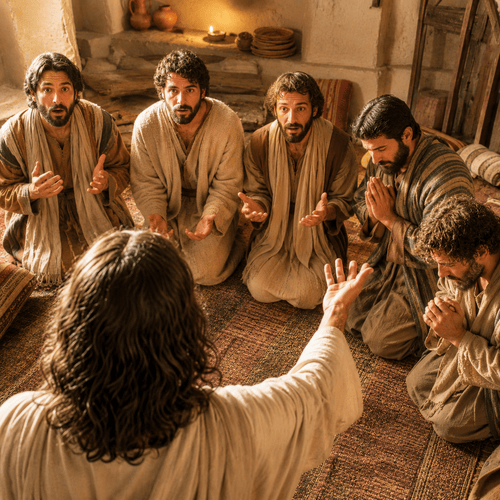
Everything hangs on this one question. If Jesus was only a wise teacher who happened not to be God, then His death on a cross was a sad waste. His grandest promises were empty, and His resurrection—if it ever truly happened—would change very little. But if Jesus is God come in human flesh, then His death actually pays for sin, His every word carries the authority of the One who flung the stars into place, and the only fitting response is to fall at His feet and call Him Lord.
There’s no comfortable middle ground to place Him in. A man who says the sort of things Jesus said about Himself is either telling the truth, or He’s badly deluded. Or He’s lying. What He cannot be is merely “a great moral teacher”, because great moral teachers don’t go around forgiving the sins of the world or accepting worship as their right. So which is it? Happily, the Bible doesn’t leave us to guess. Here are five clear lines of evidence, drawn straight from Scripture, that Jesus is exactly who He said He was.
1. The Prophets Foretold a Divine Messiah
Centuries before Jesus was born, the prophets described the coming Messiah in terms that fit no mere man. Isaiah named the promised child “Mighty God, Everlasting Father” (Isaiah 9:6), and called Him Immanuel, a name that means “God with us” (Isaiah 7:14). Micah said the ruler to come from Bethlehem had origins “from of old, from everlasting” (Micah 5:2)—language we’d never use of an ordinary king. Jeremiah even gave the promised Branch a startling name: “The LORD our Righteousness” (Jeremiah 23:6).
The pattern runs right through the Old Testament. Malachi promised the Lord Himself would suddenly come to His temple, with a messenger sent ahead to prepare His way (Malachi 3:1)—and John the Baptist became that messenger. Daniel saw “one like a son of man” given everlasting dominion, so that all peoples would serve Him (Daniel 7:13-14), an honour reserved for God. Jesus even turned this against His critics, asking how the Messiah could be merely David’s son when David himself called Him “my Lord” (Psalm 110:1; Matthew 22:41-45). The prophets did not simply foretell a great king. They foretold a divine one, and Jesus stepped into every line.
2. Jesus Claimed It Plainly Himself
Jesus took God’s own name on His lips. When God revealed Himself to Moses at the burning bush, He said, “I AM WHO I AM” (Exodus 3:14). So when Jesus told a hostile crowd, “Before Abraham was, I am” (John 8:58), nobody misheard Him—they instantly picked up stones to kill Him for blasphemy (John 8:59). He claimed equality with the Father so openly that His enemies tried to kill Him for “making Himself equal with God” (John 5:18), and He demanded to be honoured “just as they honour the Father” (John 5:23). “I and the Father are one”, he said (John 10:30), and again they reached for stones.
He also accepted worship. The disciples worship Him in the boat (Matthew 14:33); Thomas worships him in the locked room (John 20:28); and Jesus never once waves it away—even though an angel recoils from worship with the cry “Worship God!” (Revelation 19:10), and Peter pulls a kneeling man to his feet (Acts 10:26). No good and sane man speaks and acts like this unless it’s true. And His flawless character—even His enemies could not convict Him of a single sin (John 8:46)—rules out the theory He was either lying or He was mad. That leaves only one possibility: He is exactly who He said He was.
3. He Wielded the Power and Authority of God
Watch what Jesus does, and notice how He does it. The prophets prayed and pleaded for miracles; Jesus simply commanded them by His own authority. “Be clean”, He says, and leprosy vanishes (Mark 1:41). “Peace! Be still”, He says, and a raging storm falls silent (Mark 4:39). “Lazarus, come out”, He calls, and a man four days dead walks out of the tomb (John 11:43-44). Disease flees at His word, demons obey Him, and even death loosens its grip.
Most telling of all, He forgives sins. When he tells a paralysed man, “Your sins are forgiven”, the religious leaders react with the right instinct: “Who can forgive sins but God alone?” (Mark 2:7). Jesus answers not with an argument but with proof, healing the man on the spot so that all could see His authority was real. The prophets always said, “Thus says the LORD.” Jesus said, “I say to you.” The authority was His own, because the power was His own.
4. Heaven and Earth Testified to His Identity
From the very beginning, witness after witness declared who Jesus was—and they were not all His friends. At His baptism the Father’s own voice rang out, “This is my beloved Son”, while the Holy Spirit descended upon Him (Matthew 3:16-17). Angels announced His birth as “a Saviour, who is Christ the Lord” (Luke 2:11). Even the demons, who had every reason to keep silent, were forced to confess Him: “I know who you are—the Holy One of God” (Mark 1:24); “Son of the Most High God” (Mark 5:7).
The human witnesses were no less clear. John the Baptist pointed to Him as “the Lamb of God” and testified, “this is the Son of God” (John 1:29, 34). In the temple, old Simeon cradled the infant Jesus in his arms. He said his eyes had now seen God’s salvation (Luke 2:30), while the aged prophetess Anna spoke of Him to all who were waiting for redemption (Luke 2:38). And the men who walked with Him for three years—strict monotheists, every one—ended by calling Him God outright: Thomas cried, “My Lord and my God!” (John 20:28); John wrote, “the Word was God” (John 1:1); Paul called Him “our great God and Saviour” (Titus 2:13). When the Father above, the angels, the demons below and His closest friends all agree on a man’s identity, the verdict is surely in.
5. The Resurrection Sealed the Verdict
The first four lines are claims and witnesses; the fifth is God’s own answer to them. Claims can be disputed and witnesses cross-examined, but an empty tomb is harder to argue away. Paul writes Jesus “was declared to be the Son of God in power… by His resurrection from the dead” (Romans 1:4). The resurrection is heaven’s seal stamped upon everything Jesus had ever said about Himself.
Follow the logic through. If Jesus had taken the name of God, claimed God’s honour and wielded God’s authority, and then simply rotted in a borrowed grave, the case would be closed: He was a blasphemer and a fraud. But God raised Him on the third day. The resurrection is the Father’s public “Amen” to the Son. It’s also the most testable claim of all—a tomb that any sceptic in Jerusalem could walk over and inspect, and a band of frightened, scattered disciples so transformed by what they saw that they went on to die rather than take it back. People don’t give their lives for a story they know to be a lie. They’d met the risen Lord, and it had changed everything.
What Does This Mean for Us?
If Jesus is God, He isn’t one option on a shelf of spiritual ideas. He’s not a teacher to be admired from a safe distance. Nor is He a fine moral example to be praised and then quietly set aside. He’s the Lord who made us, who stepped down into His own world, who carried our sins to a cross, and who rose again to prove the debt was truly paid. That changes absolutely everything.
It means His words aren’t gentle suggestions but the commands of our Maker. It means His offer of forgiveness is rock-solid and real, because only God has the authority to forgive sins. And it means the response Thomas gave, when the evidence finally overwhelmed him, is the only response that honestly fits: “My Lord and my God.” That wasn’t cautious agreement, not respectful interest, but worship. The question then, is no longer whether Jesus is God; the evidence has settled that. The real question now is what we will do with him.
Tough Questions, Honest Answers
Is Jesus God, or the Son of God?
Both, and the two are not in competition. In the Bible, calling Jesus the “Son of God” is not a way of making Him less than God—it’s a claim to share God’s very nature. That’s exactly why, when Jesus called God His own Father, His listeners tried to stone Him for “making Himself equal with God” (John 5:18). A human son shares his father’s nature; the eternal Son shares the Father’s divine nature fully and completely. So “Son of God” and “God the Son” are pointing to the same glorious truth. But from two directions.
If Jesus is God, who was he praying to?
This is one of the best questions a thoughtful reader can ask, and the answer opens up the very heart of the Christian view of God. God is one in being, yet exists eternally as three persons: the Father, the Son and the Holy Spirit. So when Jesus prayed, God the Son was speaking to God the Father—not talking to himself, and not proving he was somehow less than God, but living out the loving relationship that has existed within God for all eternity. The Father and the Son are distinct persons who share one undivided divine nature. Prayer between them is not a problem for the claim that Jesus is God; it is a window into who God has always been.
How can Jesus be both God and man at the same time?
When the Son of God became man, He did not stop being God—He added a real human nature to His eternal divine one. So Jesus is one person with two natures, fully God and fully man, not a half-and-half mixture of the two. As God, He upholds the entire universe; as man, He grew tired, experienced hunger and thirst, wept at a graveside and finally died. This is a genuine mystery, but it’s not a contradiction, because we’re not claiming He was both God and not-God in the same way at the same time. The wonder at the centre of Christmas is precisely this: the One who made the world entered it as a helpless baby.
Doesn’t “the Father is greater than I” prove Jesus isn’t God?
Not when you notice what Jesus was actually talking about. In John 14:28 He is speaking as the One who has humbled Himself, taking the lowly form of a servant and submitting to the Father’s rescue plan. “Greater” here describes position and role, not nature—rather as a king may be “greater” than his own son in office, though the two are equally human. Remember the same Jesus who said the Father was greater also said, “I and the Father are one” (John 10:30). The verse points to His willing humility on our behalf, not to any lack of deity.
Why did Jesus say, “No one is good but God alone”?
At first glance Jesus seems to be denying He is good, or even that He is God (Mark 10:18). But look more closely at the moment. A rich young man has just breezily called Him “good teacher”, and Jesus is pressing him to weigh the word he has so casually used. In effect He is asking, “Do you grasp what you have just said? Goodness in its fullest sense belongs to God alone—so are you ready to follow that thought to its conclusion?” He’s not refusing the title; He’s inviting the man to see who is really standing in front of him. It’is a sharp challenge, not a denial.
If Jesus is God, why didn’t He simply say, “I am God, worship me”?
In fact He said and did things that meant exactly that—to the people who heard him. In a fiercely monotheistic culture, forgiving sins, taking God’s own name, accepting worship and calling Himself the Judge of all humanity were unmistakable divine claims. That’s precisely why His enemies kept reaching for stones to kill Him for blasphemy (John 10:33). A blunt modern slogan would actually have communicated less, not more, to a first-century Jewish audience. Jesus revealed His identity in the very language His hearers could not possibly misunderstand. And they understood it all too well.
Couldn’t the early church have invented Jesus’s divinity centuries later?
It’s a popular claim, but the evidence runs firmly against it. The belief that Jesus is God is woven into the earliest Christian writings we possess, some dating to within a couple of decades of His death—long before any great church council ever met. Paul quotes hymns that already worship Jesus as Lord, and the very first believers prayed to him directly. The Council of Nicaea in AD 325 did not invent the deity of Christ; it defended and clearly defined what Christians had believed, sung and prayed from the very beginning. His divinity is not a late addition to the faith—it’s the foundation the whole thing was built upon.


