You’ve probably seen the post. A photograph of a beautiful old manuscript, the gold paint still bright after 15 centuries. Above it, in bold letters, a claim that stops you scrolling: the Ethiopian Bible is the oldest and most complete Bible in the world, written in AD 330, containing 88 books while yours has only 66. And then the question that does the real work: what has been kept from you?
Posts like this are shared millions of times. They’re exciting. They hint at a secret. And they leave a great many ordinary Christians quietly anxious that someone, somewhere, took books out of their Bible and never told them.
So let’s look carefully at three things: what the Ethiopian Bible actually is, what the historical evidence actually shows, and what Scripture itself teaches about how we know which books belong.
What the claim actually says
Four Claims Bundled Into One
- Oldest. The Ethiopian Bible is the oldest Bible in the world.
- Dated. It goes back to about AD 330.
- Most complete. It has 81 or 88 books, more than anyone else.
- Suppressed. Other churches removed books that Ethiopia faithfully kept.
Notice the four separate claims. They’re almost always presented as a single package. That is precisely where the confusion starts, and untangling them is most of the work.
Four questions that sound like one
Before we go further, three simple words need explaining, because the whole argument turns on them.
- Manuscript. A copy of a book written out by hand. Before printing reached Europe in the 1450s, every Bible in the world was made this way—one scribe, one page at a time, often taking years. This is the key point for everything that follows: a manuscript is never the original. It’s always a copy of a copy. So when we ask which Bible is “oldest”, we’re only ever asking which copy has survived longest—not which book was the original.
- Codex. A book with pages bound along one edge, like the books on our shelves, rather than a rolled-up scroll. Christians adopted the codex very early, and it is what made it physically possible to bind many books together into one volume.
- Canon. The list of books a church accepts as Scripture. The word comes from a Greek term for a measuring rod, that is, a standard.
Now watch what happens when we separate the questions.
| THE QUESTION | WHAT IT IS REALLY ASKING | ETHIOPIA’S ANSWER |
|---|---|---|
| Which translation is oldest? | When was the Bible first put into this language? | The Ge’ez translation began somewhere between the 4th and 6th centuries. Old—but Syriac, Latin and Coptic versions are older. |
| Which surviving manuscript is oldest? | Which physical hand-written copy still exists today? | The Garima Gospels—genuinely ancient, and genuinely remarkable. But they contain only the four Gospels. |
| Which complete Bible in one volume is oldest? | Which single surviving book holds the whole Bible? | Complete Ge’ez Bibles are mostly from the 14th century onwards. |
| Which canon is largest? | Which church counts the most books as Scripture? | Ethiopia—and this one is true. But largest is not the same as oldest, and neither is the same as correct. |
The viral claim wins its argument by quietly sliding between these four questions. Answer them one at a time and it comes apart in our hands.
The Garima Gospels: a genuine treasure
Let’s begin with what’s true, because it is glorious.
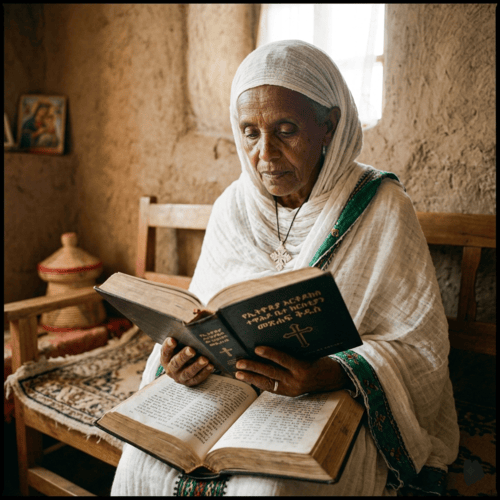
High in the Tigray region of northern Ethiopia, not far from the ancient city of Axum, stands the monastery of Abba Garima. It guards two thick books of goat-skin parchment written in Ge’ez, the ancient language of Ethiopian worship. They contain the four Gospels, decorated with painted arches, portraits of the four evangelists, and colours that have refused to fade.
For most of the 20th century, Western scholars insisted these books were medieval, perhaps from around AD 1100. The monks who’d guarded them for generations insisted they were far older. In that argument, the monks were right.
Radiocarbon testing carried out at Oxford, reported by the French scholar Jacques Mercier, produced a range of roughly AD 390–570 for the volume known as Garima 2, and roughly AD 530–660 for Garima 1. Mercier himself has argued, on artistic grounds, for a date nearer AD 600. Either way, these are the oldest surviving Ethiopian manuscripts of any kind, and quite possibly the oldest illustrated Christian books anywhere on earth.
What the Garima Gospels Are—and Aren’t
They are: the oldest surviving Ethiopian manuscripts; among the oldest illustrated Christian books in the world; a magnificent witness to African Christian craftsmanship at a time when Western scholars assumed it did not exist.
They’re not: a Bible. They contain four books. The Ethiopian canon claims eighty-one.
This matters more than it may seem. A meme that places a photograph of the Garima Gospels under the words “the oldest complete Bible” is showing you a Gospel book and calling it a Bible. It’s rather like photographing one volume of an encyclopaedia and announcing that you own the whole set.
So which manuscript is the oldest complete Bible?
| MANUSCRIPT | LANGUAGE | APPROXIMATE DATE | WHAT IT CONTAINS |
|---|---|---|---|
| Codex Vaticanus | Greek | AD 300–325 | Most of the Old and New Testaments; several sections now lost |
| Codex Sinaiticus | Greek | AD 330–360 | The complete New Testament and much of the Old |
| Codex Alexandrinus | Greek | 5th century | Almost the whole Bible, with some gaps |
| Garima Gospels | Ge’ez | AD 390–660 | The four Gospels only |
| Complete Ge’ez Bibles | Ge’ez | Mostly 14th century onwards | The full Ethiopian canon |
Codex Sinaiticus, most of which now sits in the British Library, holds the oldest complete New Testament that survives anywhere. Nothing in Ethiopia comes close on that particular measure. That’s not because Ethiopian Christians were careless. It’s because complete one-volume Bibles were rare and ruinously expensive everywhere in the ancient world. A single large codex could consume the skins of an entire flock. Most churches owned a Gospel book, a book of Psalms and a volume of Paul’s letters—not a Bible.
A copy cannot be older than what it copies
There’s a simpler point that settles the matter completely, and it’s usually overlooked.
The Ge’ez Old Testament wasn’t translated from Hebrew. It was translated from the Greek Septuagint—the Greek version of the Old Testament produced by Jewish scholars in Egypt from roughly the third century BC. Later Ethiopian scribes revised it further using Syriac, Arabic and Hebrew sources. The Ge’ez New Testament was translated from Greek.
A photocopy cannot be older than the page it copies. Ethiopian Scripture is a translation of Greek Scripture, which is itself—in the Old Testament—a translation of Hebrew Scripture. However beautiful the copy, it stands downstream of the original.
This is why textual scholars value the Ge’ez version highly as a secondary witness. It can show us what Greek text a translator was reading in the 6th century—which is useful evidence. But it’s never a primary witness, and it can’t be older than its own source.
Is it 81 books, or 88? Nobody can say for certain
Here the story becomes interesting. The Ethiopian Orthodox Tewahedo Church normally says its Bible contains 81 books: 46 in the Old Testament and 35 in the New. That’s the figure cited in its own teaching and catechism.
But the number 81 turns out to be a counting convention rather than a fixed list. Different manuscripts reach eighty-one by dividing or combining books in different ways. The medieval legal collection known as the Fetha Nagast names 73 books, and Ethiopian scholars traditionally supplied 8 more to reach the expected total. Scholars also distinguish a “narrower” canon from a “broader” canon which adds church-order documents. Count those in, and you arrive at the 88 that the internet memes mention.
The Ethiopian biblical scholar Bruk Ayele Asale published an academic study of this very question, and his title says everything that needs saying: the Ethiopian canon is neither open nor closed.
The Uncomfortable Fact
There’s no single, official, universally accepted, line-by-line list of the 81 books. Ask three sources and you may receive three slightly different rosters. The canon of the Ethiopian church has never been formally closed.
Christians attracted to the Ethiopian Bible because it appears to offer more should pause here and think slowly. A Bible whose contents can’t be listed with certainty can’t function as a final standard for anything at all. If we can’t say what our rule is, we don’t have a rule. We have a library.
So what actually makes a book part of the Bible?
This is the real question, and it isn’t a question about dates.
The historic Protestant confessions answer it in a very particular way. The Westminster Confession of Faith lists 66 books and says all of them are given by inspiration of God to be the rule of faith and life. It then adds, bluntly, that the books commonly called the Apocrypha aren’t of divine inspiration, form no part of the canon of Scripture, and therefore carry no authority in the church beyond that of any other human writing.
The Belgic Confession says the same, and then explains why the church accepts the 66 books—and its answer is striking. Not because the church has decided so, but because the Holy Spirit testifies in the hearts of believers that they are from God.
That order of events matters enormously. The church doesn’t make books canonical. The church recognises books which were already the Word of God from the moment they were written. A jeweller doesn’t create the diamond by valuing it.
New Testament scholar Michael Kruger describes the canon as self-authenticating. God’s books, he argues, carry divine qualities that God’s people learn to recognise, exactly as Jesus said his sheep hear His voice and follow Him. The church is not the judge who awards authority. The church is the flock that knows the shepherd.
On John 10:27 and the recognition of canon
RC Sproul summarises the Protestant position with a deliberately humble phrase: the canon is “a fallible collection of infallible books.” He meant the church’s act of recognition was a human act, and human acts can err—but the books themselves are breathed out by God and cannot. What the church can never do is add to them.
Herman Ridderbos pressed the point further still. The canon is closed, he argued, because the events to which it testifies are closed. Scripture is the permanent written witness to a finished work: the coming, death and resurrection of Christ, and the apostolic foundation laid once for all (Ephesians 2:20). There’s no continuing stream of new Scripture, because there’s no continuing stream of new redemption. The house has a foundation; you don’t keep pouring concrete after the walls are up.
The Old Testament test: who was entrusted with the books?
How, then, do we know which Old Testament books belong?
Paul answers directly. Speaking of the advantages given to the Jewish people, he says that to them were entrusted the oracles of God (Romans 3:2). God gave the Old Testament to Israel and made Israel its custodian. So the sensible question is: which books did Israel actually hold as Scripture in the days of Christ?
- Jesus’ own summary. He speaks of the Law of Moses and the Prophets and the Psalms (Luke 24:44)—the familiar threefold Hebrew collection, with no fourth category of extra books.
- Jesus’ own boundaries. He speaks of the blood of the prophets from the blood of Abel to the blood of Zechariah (Luke 11:51). Abel dies in Genesis. Zechariah dies in 2 Chronicles, the last book in the Hebrew arrangement. Jesus is naming the first and last martyrs of a defined collection—rather as we might say “from Genesis to Revelation.”
- Jewish testimony. The first-century historian Flavius Josephus wrote that his people possessed a fixed and limited number of trustworthy books, and said pointedly that writings produced after the reign of Artaxerxes were not regarded as carrying the same authority.
- Early Christian testimony. Around AD 170, Melito of Sardis travelled east specifically to establish the Old Testament list, and came back with a catalogue matching the Hebrew books.
- Jerome’s caution. The translator of the Latin Vulgate carefully distinguished books that establish doctrine from books the church may read for edification—and he placed the Apocrypha firmly in the second group.
One more observation is worth its weight. Jesus and the apostles rebuke the Jewish leaders for a great many things—hypocrisy, greed, misreading Moses, adding traditions of men. They never once accuse them of having lost books from the Scriptures. If the custodians had mislaid a third of the Old Testament, that silence would be very strange indeed.
But Jude quotes Enoch!
This is the strongest card in the Ethiopian argument, and it deserves a full and fair answer rather than a quick dismissal.
The Ethiopian church is the only church on earth to include 1 Enoch in its Bible. And Jude does appear to quote it:
It was also about these that Enoch, the seventh from Adam, prophesied, saying, “Behold, the Lord comes with ten thousands of his holy ones, to execute judgement on all…”
Jude 14–15
Those words correspond closely to 1 Enoch 1:9. So does that settle the matter? Two things need saying.
First: what 1 Enoch actually is
It’s not one book but five, stitched together over time—the Book of the Watchers, the Astronomical Book, the Book of Dreams, the Epistle of Enoch, and the Similitudes. Aramaic fragments of most of these turned up among the Dead Sea Scrolls at Qumran, which allowed scholars to date the earliest layers to around the 3rd century BC and the latest to the 1st century AD.
In other words, it was written thousands of years after the Enoch of Genesis 5 walked with God and was no more. It carries his name; it didn’t come from his pen. Books written under a borrowed famous name are called pseudepigrapha, and in the ancient world the practice was common and widely understood. Nobody was necessarily being dishonest. But nobody was writing Scripture either.
Second: what a quotation actually proves
| NEW TESTAMENT WRITER | SOURCE QUOTED | IS THAT SOURCE SCRIPTURE? |
|---|---|---|
| Paul, Acts 17:28 | The Greek poet Aratus | No |
| Paul, Titus 1:12 | The Cretan poet Epimenides | No |
| Paul, 1 Corinthians 15:33 | The playwright Menander | No |
| Jude, Jude 14–15 | 1 Enoch | The same reasoning applies |
Paul quotes pagan poets approvingly. In Titus he even calls Epimenides “a prophet of their own.” No one has ever concluded Greek drama belongs in the Bible. A true sentence can be quoted from a book that’s not inspired. The quotation makes the sentence true; it doesn’t make the book holy.
Three Things Jude’s Quotation Doesn’t Prove
- It doesn’t prove Jude regarded the whole of 1 Enoch as Scripture.
- It doesn’t prove Jude thought the historical Enoch wrote the book.
- It doesn’t prove the book is free from error—and by its own contents it plainly isn’t. Its astronomical section teaches a year of 364 days, which is simply wrong, and would leave any calendar built on it drifting badly within a decade.
What the quotation does show is that Jude expected his readers to know the book. That tells us something useful about Jewish reading habits in the first century, and nothing whatever about the canon. Jude is also the author who elsewhere refers to a dispute between Michael and the devil over the body of Moses (Jude 9), an episode found in no canonical book at all—and nobody proposes adding his source to the Bible either.
The books nobody else has
Beyond Enoch, the Ethiopian canon contains several works found in no other Bible on earth.
- Jubilees (Ge’ez Kufale), a retelling of Genesis and part of Exodus arranged around repeating cycles of 49 years, and pressing a distinctive solar calendar.
- 4 Baruch, also called the Rest of the Words of Baruch, a legendary account surrounding the fall of Jerusalem.
- 1, 2 and 3 Meqabyan. Almost every English-language article gets this wrong, so read slowly. These are not the books of Maccabees found in Catholic Bibles. They’re entirely separate Ethiopian compositions, about different people, telling different stories. The names look similar; the contents are unrelated.
- The broader canon adds church-order documents: the Sinodos, the Book of the Covenant, the Ethiopic Clement and the Didascalia.
That last group creates a structural problem which is easy to miss but impossible to unsee. These are books of church rules and church law. Placing them inside the Bible means the church’s own regulations become part of the standard by which the church is measured. The referee has written a chapter of the rulebook.
For the churches of the Reformation, this is the very heart of the matter. Scripture must stand over the church, never be partly produced by it. The moment a church can enlarge its own Bible, that Bible has stopped being a rule and become a mirror.
What we genuinely owe Ethiopian Christians
None of this should be said with a sneer, and confessional Protestants of all people ought to be careful here. We believe God has preserved His church in every century and on every continent, often in places Europe never bothered to look.
So consider this. Both 1 Enoch and Jubilees were lost to the rest of the world for well over a thousand years. Complete copies survive today in one language only: Ge’ez. When Scottish traveller James Bruce carried Ethiopian manuscripts of Enoch back to Europe in the 1770s, he restored to world scholarship a book that had vanished everywhere else. Every scholar who studies the Judaism of Jesus’ day—including every confessional Protestant scholar—is in debt to Ethiopian monks who simply kept copying while empires rose and fell around them.
They also produced, in the Garima Gospels, work of a quality that demolished a century of Western assumptions about African Christianity. That correction was long overdue, and it was thoroughly earned.
We can say all of that warmly and sincerely, and still say the canon is wrong. Gratitude and disagreement aren’t enemies.
Why “oldest” was never the right test
Step back and look at the shape of the argument we’ve been examining. It runs: this is older, therefore this is truer.
Scripture doesn’t reason that way. Paul wrote to the Galatians within roughly 20 years of the resurrection, and he was already astonished at how quickly they were deserting the gospel for a different one (Galatians 1:6). Error was early. It was early enough to be sitting in churches planted by an apostle while that apostle was still alive.
And then Paul says something breathtaking: even if we or an angel from heaven should preach to you a gospel contrary to the one we preached to you, let him be accursed (Galatians 1:8). Not even an angel’s authority outranks the message. Neither, then, does a date on a manuscript.
Tertullian, writing around AD 200, put it in one sentence that has never been improved upon: our Lord called himself the Truth, not the custom.
The question is never “who arrived first?” The question is always “what did God say?”
So is anything missing from our Bible?
No.
Our 66 books aren’t an abridged Bible. They’re the books God gave, kept by His providence across 3 continents and 2000 years, and recognised by His people. Nothing needed for salvation, faith or obedience has been withheld from you by anybody.
Paul told Timothy all Scripture is breathed out by God and profitable for teaching, for reproof, for correction, and for training in righteousness—and then gave the reason: that the man of God may be complete, equipped for every good work (2 Timothy 3:16–17). Complete. Equipped for every good work. That’s a total promise, and it’s made about the Scriptures we already own.
We don’t need a longer Bible. We need to read the one we have.
Tough Questions, Honest Answers
Can I read the Ethiopian Bible in English, and are those translations reliable?
Several English editions of the Ethiopian canon are now sold online, and some are excellent while others are very poor. The difficulty is that many popular editions don’t translate directly from Ge’ez manuscripts at all; they reprint old public-domain English versions of Enoch and Jubilees alongside a standard English Bible, and present the result as “the Ethiopian Bible.” Serious readers should look for editions that name their manuscript sources and their translators. If we want to study these texts, the scholarly editions of Enoch by George Nickelsburg and James VanderKam are far more trustworthy than anything sold with a gold cover and a dramatic subtitle. Read them as ancient Jewish literature, which is what they are, and not as Scripture.
Does the Ethiopian Bible contain a different version of the Gospels or the Ten Commandments?
No, and this is worth saying clearly because the memes imply otherwise. The four Gospels in the Garima manuscripts are the same four Gospels you read, telling the same story of the same Christ. The Ten Commandments are the commandments of Exodus 20. The differences between the Ethiopian Bible and yours lie almost entirely in which extra books are bound in alongside, not in rewritten versions of the books you already have. That’s actually a powerful argument for the reliability of the New Testament text: a church cut off from Europe for centuries by geography and by Islamic expansion was still copying the same Gospels.
Do Ethiopian Jews, the Beta Israel, use the same canon as the Ethiopian Orthodox Church?
Not exactly, and the difference is instructive. The Beta Israel community historically used Ge’ez religious texts and held to a body of Scripture that included some works outside the Hebrew Bible, but their tradition developed separately from the Orthodox Church and did not simply mirror it. What both communities share is a manuscript culture that preserved older material long after it disappeared elsewhere. The variation between them is a reminder that in Ethiopia, as everywhere, the boundaries of a book collection were shaped by local usage over time. Only a canon that God himself gave and preserved can escape that kind of drift.
If 1 Enoch isn’t Scripture, is it sinful for a Christian to read it?
Not at all. Reading a non-inspired ancient book is no more sinful than reading Josephus, Augustine or a modern commentary, and Paul evidently read Greek poets. The danger isn’t in reading but in the weight we give what we read. Treat 1 Enoch as a window into how some Jews in the centuries before Christ were thinking about angels, judgement and the age to come, and it will genuinely help us understand the world of the New Testament. Treat it as revelation and it will start reshaping our doctrine of angels, of the Flood and of the last days around material God never gave us.
Why does the Ethiopian New Testament have 35 books rather than 27?
Because the extra 8 are church-order books rather than apostolic writings—documents governing worship, discipline and the appointment of ministers, such as the Sinodos and the Book of the Covenant. They’re ancient and often interesting, and they tell us a great deal about how early churches organised themselves. But they belong to the category of church constitution, not divine revelation. Every one of the 27 books we already have is there; the additions are procedural manuals that have been given a promotion.
Did the Council of Nicaea, or any council, remove books from the Bible?
No. This claim is repeated constantly and it has no historical foundation whatever. The Council of Nicaea in AD 325 met to address the teaching of Arius about the person of Christ, and its records say nothing about deciding the canon. No council in the fourth century voted books out of an existing Bible. What the later councils and lists did was record which books the churches had already been reading in worship for generations—the church acknowledging a settlement, not imposing one. The popular image of bishops burning rival gospels comes from novels, not from sources.
Do modern Bible translators actually use Ge’ez manuscripts?
Yes, and this may surprise people who assume Western scholarship ignores Ethiopia. The Ge’ez version appears regularly in the footnotes of critical editions of the Greek New Testament, listed among the ancient versions alongside Latin, Syriac, Coptic and Armenian. When translators are weighing a difficult verse, the reading a sixth-century Ethiopian translator followed is real evidence about the Greek text he had in front of him. So Ethiopian manuscripts have quietly served the church far beyond Ethiopia. That service, however, is as a witness to Scripture, not as an addition to it.
Related Reads
- Is the Ethiopian Orthodox Church the First Church in the World?
- The Truth About Apocryphal Books: Why They’re Not in the Bible
- Shouldn’t the Book of Enoch Be In the Bible? Why Isn’t It?
- How Did Jews Know the Old Testament Canon Before Rome Did?
- Is the Biblical Canon Self-Authenticating?
- The Council of Nicaea: Uncovering Its History and Impact
- The Biblical Canon: The Journey from Scrolls to Scripture
- Why Didn't the Gnostic Gospels Make the Cut Into the Canon?
- Book of Jubilees: Why It Isn’t Scripture