Jesus once said something shocking. He pointed back to King Solomon—the richest, wisest and most famous king Israel ever had—and said, ‘something greater than Solomon is here’ (Matthew 12:42).
Solomon built God’s temple. Rulers travelled across the world just to hear him speak. And a travelling teacher, son of a carpenter from little Nazareth was telling us, in effect, ‘I am greater.’
Either that’s the most ridiculous claim ever made—or it’s true.
This post shows why it’s true. And why 1 Kings isn’t just a history of old kings and bloody battles. It teaches us to long for a better King. And it shows us what He will be like.
Jesus in the Old Testament — Book 11 of 39
This post is the eleventh instalment in our series tracing Christ through every book of the Old Testament. See the full series index.
Can We Really Find Jesus in 1 Kings?
Some mock Christians for ‘looking for Jesus even in the Old Testament’. So who taught us to read the Bible this way?
Jesus Himself. After He rose from the dead, ‘beginning with Moses and all the Prophets, He interpreted to them in all the Scriptures the things concerning himself’ (Luke 24:27). And the New Testament points back to 1 Kings again and again.
How the New Testament Uses 1 Kings
| NEW TESTAMENT PASSAGE | WHAT IT POINTS BACK TO IN 1 KINGS | WHAT IT TEACHES |
|---|---|---|
| Matthew 12:42 | The Queen of Sheba visits Solomon (1 Kings 10) | Jesus is greater than Solomon |
| Luke 4:25–26 | Elijah helps a foreign widow (1 Kings 17) | God’s grace reaches outsiders |
| Acts 7:47–49 | Solomon builds the temple (1 Kings 6–8) | No building can contain God |
| Romans 11:2–5 | God keeps 7,000 faithful people (1 Kings 19) | God keeps a people chosen by grace |
| James 5:17–18 | Elijah prays and the rain stops (1 Kings 17–18) | God hears ordinary believers |
John Calvin, the 16th century Bible teacher, put it simply: ‘We ought to read the Scriptures with the express design of finding Christ in them.’ The Westminster Confession of Faith (7.5) agrees. It says the Old Testament’s promises, sacrifices and types were ‘all fore-signifying Christ to come’.
TYPE OR ALLEGORY? 3 TESTS FOR FINDING JESUS HONESTLY
A type is a real person, event or object in the Old Testament that God used as a picture of something greater to come. An allegory, by contrast, ignores what a story really meant and invents hidden meanings. We call something a type of Christ only when it passes all three tests:
- Test 1—Bible support: the New Testament, or the Bible’s big story, makes the link.
- Test 2—Real history: the event truly happened and meant something in its own time.
- Test 3—Something greater: Jesus doesn’t just copy the picture. He goes far beyond it.
Edmund Clowney, a much-loved teacher of preachers, warned against 2 errors: turning Bible stories into simple moral lessons (‘be brave like Elijah’) and inventing strange hidden meanings. First ask what a story meant in its own day, he said, and then follow the line to Christ.
A Promise Under Pressure
1 Kings rests on a covenant, a binding promise God made to King David: ‘I will raise up your offspring after you… and I will establish the throne of his kingdom forever’ (2 Samuel 7:12–13).
At first, the promise does seem to come true. David’s son Solomon becomes king, builds God’s house and brings peace. But each king must ‘walk before me in faithfulness’ (1 Kings 2:4). Solomon fails. So do nearly all the kings after him.
How, then, can God keep His word? Even while judging Solomon, God keeps one tribe for David’s family, ‘that David my servant may always have a lamp before me in Jerusalem’ (1 Kings 11:36). The lamp flickers, but it never goes out. It finally shines bright when the angel tells Mary that God ‘will give to Him the throne of His father David… and of His kingdom there will be no end’ (Luke 1:32–33).
Solomon: A Great King Who Points to a Greater One
In his early years, Solomon is a living picture of the King God’s people were waiting for:
- An anointed son of David: Solomon rode David’s mule into Jerusalem as the people shouted, ‘Long live King Solomon!’ (1 Kings 1:33, 39). Jesus rode a donkey into Jerusalem as crowds shouted, ‘Hosanna to the Son of David!’ (Matthew 21:9). The Hebrew word for ‘anointed one’ gives us the word ‘Messiah’.
- A king of wisdom: Solomon asked God for ‘an understanding mind to govern your people’ (1 Kings 3:9). In Jesus ‘are hidden all the treasures of wisdom and knowledge’ (Colossians 2:3).
- A king of peace: Solomon’s name sounds like shalom, the Hebrew word for ‘peace’. In his days, people lived safely, ‘every man under his vine and under his fig tree’ (1 Kings 4:25). Jesus is the Prince of Peace (Isaiah 9:6).
- A king the nations seek: the Queen of Sheba travelled far to hear Solomon’s wisdom (1 Kings 10). Wise men from the East travelled far to worship Jesus (Matthew 2:11).
The Wise King Who Became a Fool
Long ago, God had warned Israel’s kings not to gather many horses from Egypt, many wives or great piles of gold (Deuteronomy 17:16–17). Solomon did all 3. In old age, ‘his wives turned away his heart after other gods’ (1 Kings 11:4).
Dale Ralph Davis titled his commentary on this book The Wisdom and the Folly. That sums Solomon up. Scholars such as Iain Provan notice warning signs even in the ‘golden’ chapters. The writer wants us to be uneasy even when all looks wonderful.
Where Solomon Failed, Jesus Succeeded
| AREA OF LIFE | KING SOLOMON | KING JESUS |
|---|---|---|
| Wealth | Gathered huge amounts of gold (1 Kings 10:14) | Became poor so that we could become rich (2 Corinthians 8:9) |
| Power | Bought horses and chariots from Egypt (1 Kings 10:28–29) | Rode into Jerusalem on a humble donkey (Matthew 21:5) |
| Love | Many wives turned his heart to idols (1 Kings 11:4) | Loved one bride, the church, and gave Himself for her (Ephesians 5:25) |
| The finish | His heart was ‘not wholly true to the LORD’ (1 Kings 11:4) | He was ‘obedient to the point of death’ (Philippians 2:8) |
The failure of Israel’s best king proves no ordinary king can save God’s people. We need a Son of David who is wise and never becomes a fool. As Tim Keller put it, Jesus is the ‘true and better’ version of every Old Testament hero.
The Temple: God’s House and God’s Son
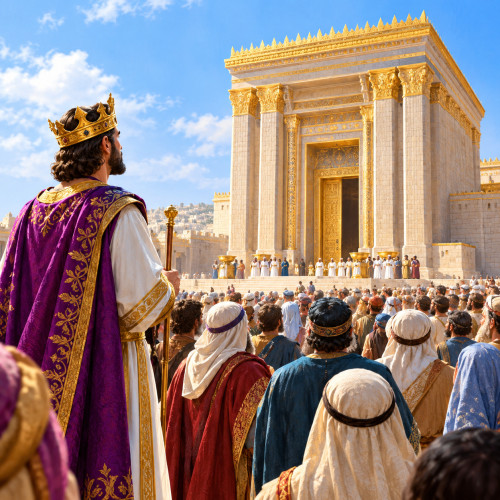
The centre of Solomon’s reign is the temple, where ‘the glory of the LORD filled the house of the LORD’ (1 Kings 8:11). Yet at his moment of triumph, Solomon asked an honest question:
‘But will God indeed dwell on the earth? Behold, heaven and the highest heaven cannot contain you; how much less this house that I have built!’ (1 Kings 8:27)
A thousand years later, John answers: ‘the Word became flesh and dwelt among us, and we have seen His glory’ (John 1:14). The Greek word for ‘dwelt’ means ‘pitched His tent’. God really did come to live on earth. Jesus even called His own body ‘this temple’ (John 2:19–21). Solomon’s temple pointed to Him in 2 clear ways:
- God’s glory lived there: a cloud of glory filled the temple. In Jesus, ‘the whole fullness of deity dwells bodily’ (Colossians 2:9).
- It looked like Eden: the walls were carved with cherubim (heavenly guardians), palm trees and flowers (1 Kings 6:29), like the garden where God walked with Adam. Jesus, the ‘last Adam’ (1 Corinthians 15:45), opens the way back to God.
Geerhardus Vos, a pioneer of biblical theology, taught God’s revelation grows like a seed into a tree. Solomon’s temple was part of that growth. The full tree is Christ, with His people built on Him ‘like living stones’ (1 Peter 2:5).
A Kingdom Torn in Two
After Solomon died, the people asked his son Rehoboam to lighten their ‘heavy yoke’ (a yoke is a wooden bar placed on working animals). Rehoboam’s wise advisers told him, ‘If you will be a servant to this people today and serve them… then they will be your servants forever’ (1 Kings 12:7). He refused and promised ‘scorpions’ instead of whips (12:14). 10 tribes broke away, and the kingdom split in 2.
Now listen to Jesus: ‘the Son of Man came not to be served but to serve’ (Mark 10:45), and ‘my yoke is easy, and my burden is light’ (Matthew 11:30). He’s the servant-King Rehoboam refused to be. He’s also the one Shepherd who gathers a divided people into ‘one flock’ (John 10:16).
A PROPHECY THAT NAMED A KING 300 YEARS EARLY
In 1 Kings 13:2, a man of God said, ‘a son shall be born to the house of David, Josiah by name’. About 300 years later, King Josiah did exactly what was predicted (2 Kings 23:15–16).
Why this matters: the God who named a king centuries early also named Bethlehem as the Saviour’s birthplace (Micah 5:2).
Elijah: The Prophet Who Points Past Himself
Midway through 1 Kings, King Ahab and Queen Jezebel lead Israel to worship Baal, a false god of rain and storms. So God sends the prophet Elijah. But Jesus Himself does what Elijah did—only much more.
Elijah’s Story: A Timeline
- 1 Kings 17—Drought and a widow: Elijah stops the rain, then raises a foreign widow’s son.
- 1 Kings 18—Mount Carmel: Elijah faces 450 prophets of Baal, and God answers with fire.
- 1 Kings 19—Horeb and Elisha: Elijah flees, God meets him, and Elisha is called to follow.
A Dead Son Given Back to His Mother
In the town of Nain, Jesus raised a widow’s only son and ‘gave him to his mother’ (Luke 7:15). In the Greek Old Testament the early church read, those are the exact words used of Elijah in 1 Kings 17:23. The crowd made the link: ‘A great prophet has arisen among us!’ (Luke 7:16).
But notice the difference. Elijah cried out to God and stretched himself over the boy three times (1 Kings 17:21). Jesus simply said, ‘Young man, I say to you, arise’ (Luke 7:14). Elijah asked for God’s power. Jesus has that power in Himself.
Fire on the Sacrifice
On Mount Carmel, Elijah asked, ‘How long will you go limping between two different opinions? If the LORD is God, follow Him’ (1 Kings 18:21). Baal’s prophets shouted all day, and nothing happened. Then Elijah rebuilt God’s altar with 12 stones, soaked the sacrifice with water and prayed. ‘Then the fire of the LORD fell and consumed the burnt offering’ (18:38).
Look at where the fire fell. Israel deserved God’s judgement, but the fire fell on the sacrifice in their place. This is the gospel in picture form.
Mount Carmel and the Cross: The Same Pattern
| AT MOUNT CARMEL | AT THE CROSS |
|---|---|
| Fire fell on the sacrifice, not on the guilty people | Christ suffered ‘the righteous for the unrighteous’ (1 Peter 3:18) |
| Elijah prayed at the time of the evening offering (18:36) | Jesus died at ‘the ninth hour’ (Mark 15:34), the hour of evening sacrifice and prayer (Acts 3:1) |
| One prophet stood alone for God before the people | One ‘mediator between God and men’ stood alone for us (1 Timothy 2:5) |
| The people cried, ‘The LORD, he is God’ (18:39) | A Roman soldier said, ‘Truly this man was the Son of God!’ (Mark 15:39) |
Alone in the Wilderness
Jezebel threatened Elijah, and he fled, asking God to let him die. Then ‘the angel of the LORD came again a second time and touched him’ and fed him (1 Kings 19:7), and Elijah walked 40 days to Horeb. Jesus also spent 40 days in the wilderness, ‘and the angels were ministering to him’ (Mark 1:13). But where Elijah ran from danger, Jesus walked towards it—for us.
Many Bible teachers since the early church have believed this ‘angel of the LORD’ was God the Son, appearing before His birth. 1 Kings doesn’t say so directly, so we hold this view humbly (compare John 1:18).
The 7,000 God Kept
Elijah complained, ‘I, even I only, am left’ (19:10). God replied, ‘Yet I will leave 7,000 in Israel’ who had not bowed to Baal (19:18). Paul applies this to salvation: ‘there is a remnant, chosen by grace’ (Romans 11:5). A remnant is a small group that remains. The 7,000 did not keep themselves; God said, ‘I will leave’ them. Calvin drew great comfort here. Even when the church seems almost gone, God is quietly keeping His people.
Leave Everything and Follow
Elijah called Elisha while he was ploughing. Elisha asked, ‘Let me kiss my father and my mother, and then I will follow you’ (19:20), and Elijah agreed. When a man said something similar to Jesus, He replied, ‘No one who puts his hand to the plough and looks back is fit for the kingdom of God’ (Luke 9:62). The plough points straight back to Elisha. But Jesus claims more than Elijah ever did: the right to ask for everything, because following Him is following God.
Naboth and Micaiah: Innocent Men Who Suffered
King Ahab wanted Naboth’s vineyard, but Naboth wouldn’t sell his family land. So Jezebel arranged a fake trial with ‘two worthless men’ who claimed, ‘You have cursed God and the king’ (1 Kings 21:10). Naboth was taken outside the city and stoned.
Naboth and Jesus: The Same Kind of Injustice
| WHAT HAPPENED TO NABOTH | WHAT HAPPENED TO JESUS |
|---|---|
| False witnesses spoke against him (21:13) | False witnesses spoke against Him (Mark 14:56) |
| He was accused of cursing God (21:13) | He was accused of blasphemy, or insulting God (Mark 14:64) |
| He was killed outside the city (21:13) | He ‘suffered outside the gate’ (Hebrews 13:12) |
| He died because rulers wanted his vineyard | He told a parable of a vineyard owner’s son killed by greedy tenants (Mark 12:1–8) |
One great difference remains. Naboth’s blood called for justice on Ahab (21:19). Jesus’ blood ‘speaks a better word’ (Hebrews 12:24). It calls for mercy for all who trust Him.
Then there is Micaiah. When Ahab’s 400 prophets promised victory, Micaiah told the truth: ‘I saw all Israel scattered on the mountains, as sheep that have no shepherd’ (1 Kings 22:17). For this, he was struck on the cheek and thrown into prison (22:24–27). Jesus, too, was struck for telling the truth (John 18:22). But He is also the answer to Micaiah’s vision: ‘I am the good shepherd. The good shepherd lays down his life for the sheep’ (John 10:11).
What Does 1 Kings Ask of You?
Elijah’s question still stands: how long will you limp between two opinions? Like Solomon, we can slowly divide our hearts between God and money, comfort or success.
The good news is that we’re saved not by being better than Solomon, but by trusting the One who is greater. He is the wise King who never failed, the true temple where we meet God, the sacrifice who took the fire in our place and the Shepherd who gathers His scattered sheep.
So come to Him. He still says, ‘Take my yoke upon you, and learn from me, for I am gentle and lowly in heart, and you will find rest for your souls’ (Matthew 11:29).
Tough Questions, Honest Answers
Why did God send a lying spirit to Ahab’s prophets?
In 1 Kings 22:19–23, Micaiah describes a vision in which God allows a lying spirit to speak through Ahab’s prophets. This can sound as if God lies, but the Bible says God ‘never lies’ (Titus 1:2). The vision shows that God rules even over evil and can use it as judgement on a king who had rejected the truth again and again. Notice that God did not hide what He was doing. Through Micaiah, He told Ahab plainly that his prophets were lying (22:23). Ahab chose to believe the lie anyway. Paul describes the same pattern: when people refuse to love the truth, God gives them over to the lies they prefer (2 Thessalonians 2:10–11).
Did Solomon have 40,000 or 4,000 horse stalls?
1 Kings 4:26 says 40,000 stalls, while 2 Chronicles 9:25 says 4,000. Most Bible scholars believe a scribe made a copying mistake with the number at some point. Numbers were easy to miscopy when every Bible was written out by hand. The 4,000 figure also fits better with the 1,400 chariots mentioned in 1 Kings 10:26. Christians have long taught that the Bible is without error in its original writings, while accepting that small copying slips crept into later copies. Importantly, no teaching of the Christian faith depends on this number.
Was King Solomon saved?
The Bible does not tell us directly, so we should be careful. On one side, God loved Solomon from birth and gave him the name Jedidiah, which means ‘loved by the LORD’ (2 Samuel 12:25). God also promised David that His ‘steadfast love will not depart’ from his son (2 Samuel 7:15). On the other side, Solomon built altars to false gods in old age (1 Kings 11:7–8), and the Bible never records that he repented. Nehemiah remembered him as a king ‘beloved by his God’ who was still led into sin (Nehemiah 13:26). The clear lesson for us is that a great start is no substitute for a faithful finish, and that salvation always rests on God’s grace, not our record.
Is there archaeological evidence for the kings in 1 Kings?
Yes, and it keeps growing. A stone inscription found at Tel Dan in 1993 mentions the ‘House of David’, the royal family of Judah. An Egyptian wall carving at Karnak records the military campaign of Pharaoh Shishak, which 1 Kings 14:25–26 describes. The Kurkh Monolith, an Assyrian stone, names ‘Ahab the Israelite’ as a leader at the Battle of Qarqar in 853 BC. The Mesha Stele from Moab mentions Omri, king of Israel and father of Ahab (1 Kings 16). Archaeology cannot prove that God spoke, but it does show that 1 Kings describes real kings in real places.
Who was the Queen of Sheba?
The Bible does not give her name, but it says she came to test Solomon ‘with hard questions’ (1 Kings 10:1). Most scholars place Sheba in south-west Arabia, around modern Yemen, a land made rich by the spice and incense trade. Ethiopian tradition claims her as an Ethiopian queen, but that story comes from much later writings. Jesus spoke of her as a real person who will stand at the final judgement (Matthew 12:42). She is a picture of every outsider who hears of God’s wisdom and travels far to find it. If a foreign queen crossed deserts to hear Solomon, how much more should we listen to Jesus?
Was John the Baptist really Elijah come back to life?
Malachi promised that God would send ‘Elijah the prophet’ before the great day of the LORD (Malachi 4:5). Jesus said of John the Baptist, ‘he is Elijah who is to come’ (Matthew 11:14). Yet when John was asked if he was Elijah, he answered, ‘I am not’ (John 1:21). Both are true, because the angel explained that John would come ‘in the spirit and power of Elijah’ (Luke 1:17). John was not Elijah reborn but a new prophet with Elijah’s mission and boldness. The Bible rules out reincarnation, because ‘it is appointed for man to die once, and after that comes judgment’ (Hebrews 9:27).
What was the ‘still small voice’ Elijah heard?
The phrase comes from the King James Version of 1 Kings 19:12, which the ESV translates as ‘the sound of a low whisper’. God sent a great wind, an earthquake and a fire, but the LORD was not in them. Then came the quiet whisper, and God spoke to Elijah. Elijah had just seen fire fall from heaven, and he needed to learn that God also works in quiet, hidden ways. This verse is not teaching us to search for inner voices or feelings. God’s clear voice for us today is His written Word, the Bible (2 Timothy 3:16–17).
Related Reads
- Jesus in the Old Testament: Where He Appears In All 39 Books
- Jesus in 2 Samuel: The King Whose Throne Lasts Forever
- The Divine Romance: Finding Jesus in the Song of Solomon
- Solomon’s Many Wives: Is God Really Okay With Polygamy?
- Malachi’s Closing Prophecy: Who Is the Promised Elijah?
- Jesus in 2 Kings: 7 Ways the Book Points to Christ