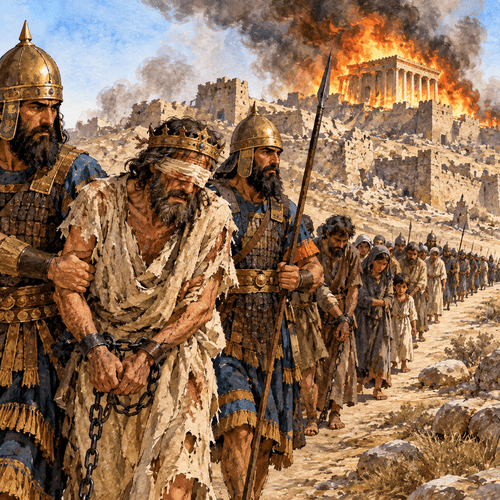
Picture the heartrending closing scene in 2 Kings. The temple is burning. The city walls are broken open. The last king of Judah watches his own sons killed in front of him. Then his eyes are gouged out, and he’s dragged to Babylon. In chains.
Now here’s the question this post asks: where’s Jesus in all of this?
Many readers skip 2 Kings. It’s a book of bad kings, burnt cities, dead children. There’s even a starving mother in a besieged city who eats her own son. It reads like the opposite of good news. Yet Jesus Himself said books like this one are written about Him. On the road to Emmaus, after His resurrection, we read this: “And beginning with Moses and all the Prophets, He interpreted to them in all the Scriptures the things concerning himself” (Luke 24:27).
In the Hebrew Bible, 1 and 2 Kings aren’t filed under history. They sit among the Prophets. So when Jesus said “all the Prophets”, He was including this book. That means the burning temple and the blinded king aren’t a detour from the gospel. They’re part of the road that leads to it.
This post walks through 7 places where 2 Kings points to Christ. But first, a fair question needs an honest answer.
Jesus in the Old Testament — Book 12 of 39
This post is the twelfth instalment in our series tracing Christ through every book of the Old Testament. See the full series index.
Are we force-fitting Jesus into a book that never mentions Him?
It’s a fair challenge. The name Jesus never appears in 2 Kings. So are Christians simply being desperate in wanting to see Him here?
No, and here’s why. The claim isn’t that the writer of 2 Kings was secretly writing about Nazareth. The claim is that God, who rules all of history, arranged real events so they’d prepare His people for His Son. Jesus said the Scriptures “bear witness about me” (John 5:39). John Calvin, writing on that verse, said we should read the Scriptures “with the express design of finding Christ in them”.
KEY TERM: A ‘TYPE’ OF CHRIST
A type is a real person, event, or object in the Old Testament that God designed to look like something greater that was coming. The greater thing is called the fulfilment.
A type isn’t a code or a secret message. The events really happened. Think of it as a small sketch made by an artist before the finished painting. The sketch is real, but it was always pointing forward.
Dutch scholar Geerhardus Vos wrote God didn’t reveal truth in one lump, but unfolded it slowly through the story of His saving acts. That’s why the Old Testament looks like a picture coming slowly into focus.
To keep this honest rather than imaginative, we use four tests. A link only counts as a genuine type if it passes all four.
4 TESTS FOR A GENUINE ‘TYPE’
- It’s real history. The event actually happened. A type isn’t a fable.
- There’s a real match. The pattern is clear in the text itself, not forced onto it.
- Christ is greater. The fulfilment always rises above the picture. It’s never a flat repeat.
- Scripture supports it. The New Testament, or the shape of the Bible story itself, points the same way.
Sure, not every link is equally strong. That’s why it makes sense to grade our claims.
| STRENGTH | WHAT IT MEANS | EXAMPLE IN 2 KINGS |
|---|---|---|
| Strong | The New Testament directly connects the passage to Jesus. | Naaman the Syrian (2 Kings 5), named by Jesus in Luke 4:27 |
| Solid | The wording or the shape of the story matches closely, and the Bible story moves in that direction. | Elijah taken up, then the Spirit given to Elisha (2 Kings 2) |
| Suggestive | A true and helpful comparison, offered as a comparison and not as proof. | Life returning through Elisha’s bones (2 Kings 13:21) |
WHERE WE SAY NO
In 2 Kings 6 an iron axe head falls into the river and floats when Elisha throws a stick into the water. Some early writers, including Irenaeus in the 2nd century, treated the wood as a picture of the cross. Nothing in the passage or in the New Testament points that way.
1. Elijah and Elisha: the messenger and the one who follows
2 Kings opens with Elijah, the fierce prophet of fire, and closes his story in Chapter 2 when he’s carried to heaven in a whirlwind. His helper Elisha takes his place. That handover is the first signpost.
- The clothing matches. Elijah is identified by a simple description: “He wore a garment of hair, with a belt of leather about his waist” (2 Kings 1:8). Centuries later, John the Baptist appears in exactly that outfit (Matthew 3:4). The match is deliberate.
- Jesus made the link Himself. Speaking of John the Baptist, He said, “he is Elijah who is to come” (Matthew 11:14). John wasn’t Elijah come back from the dead. He came in Elijah’s role: the messenger who goes ahead, heralding the arrival of someone greater.
- Both stories turn at the Jordan. Elijah’s ministry ends at the Jordan river, and there Elisha receives the Spirit and begins his own work. John the Baptist’s ministry ends as Jesus is baptised in that same river and the Spirit comes upon Him.
- The names carry the message. Elijah means “my God is the LORD”. Elisha means “my God saves”. The names match the ministries: warning first, then healing and rescue. Jesus noticed the same pattern with John and Himself—John came fasting, the Son of Man came eating and drinking (Matthew 11:18–19).
There’s one more echo, and it’s striking. Elisha is promised the Spirit on one condition: “if you see me as I am being taken from you, it shall be so for you” (2 Kings 2:10). He watches his master go up, and then the power comes. In Acts, the disciples watch Jesus go up “as they were looking on” (Acts 1:9), and then the Spirit comes at Pentecost. Luke even describes Jesus setting out for Jerusalem using the same word the Greek Old Testament uses for Elijah being “taken up” (Luke 9:51).
Notice, too, how Jesus refuses the harsher side of the pattern. When James and John want to call down fire on a village, exactly as Elijah did in 2 Kings 1, Jesus turns and rebukes them (Luke 9:54–55).
2. Elisha’s miracles: a preview of the ministry of Jesus
Elisha’s miracles are strange and homely: a debt paid, a stew made safe, bread that stretches. Then you read the Gospels and the same shapes appear, bigger and brighter.
| WHAT ELISHA DID | WHAT JESUS DID | WHAT THE PATTERN SHOWS |
|---|---|---|
| Fed 100 men with 20 barley loaves, “and they ate and had some left” (2 Kings 4:42–44) | Fed 5,000 with 5 barley loaves, with 12 baskets left over (John 6:9–13) | The same God provides, and in Jesus the supply is far larger |
| Raised the son of a woman at Shunem (2 Kings 4:32–37) | Raised the son of a widow at Nain, a village a few miles from Shunem (Luke 7:11–17) | Death obeys the prophet’s prayer; in Jesus it obeys His word alone |
| Cleansed one foreign soldier of leprosy (2 Kings 5:14) | Cleansed lepers freely, and touched them (Luke 5:12–13) | The outsider and the untouchable are welcomed |
| Paid a widow’s debt with jars of oil (2 Kings 4:1–7) | Cancelled the record of debt that stood against us (Colossians 2:14) | God settles debts His people cannot pay |
| Made poisoned food safe to eat (2 Kings 4:38–41) | Reversed sickness, hunger, and death wherever He went | The curse on creation begins to be undone |
| Fed a blinded enemy army instead of killing them (2 Kings 6:18–23) | Told His followers to love their enemies and feed them (Luke 6:27–35) | Mercy shown to enemies is God’s own character |
2 details deserve a closer look.
- The prophet must come down himself. When the boy at Shunem dies, Elisha first sends his servant Gehazi with a staff. Nothing happens. Only when Elisha comes in person, and stretches himself out on the dead child, does life return (2 Kings 4:31–35). A message sent from a distance couldn’t do it. Neither could we be saved at a distance: the Son had to come and lay His own body on our death.
- Life flows from a dead prophet’s grave. Elisha dies, and later a corpse is thrown into his tomb in a hurry. “As soon as the man touched the bones of Elisha, he revived and stood on his feet” (2 Kings 13:21). It’s the only moment in the Bible like it. We offer it as a comparison rather than a proof, but it’s a startling one: life coming out of a dead man’s grave.
3. Naaman: grace for people who aren’t “insiders”
This is the strongest link in the book, because Jesus made it Himself.
Naaman was a foreign general, an enemy commander, and a leper—leprosy being a skin disease that made people unclean and excluded them from temple worship and normal life. He’s told to wash 7 times in the muddy Jordan. He’s furious. He expected a grand ceremony. His servants persuade him, he obeys, “and his flesh was restored like the flesh of a little child, and he was clean” (2 Kings 5:14). A grown soldier is given the skin of a baby. It’s a picture of being born again.
When Jesus preached in His home town of Nazareth, He chose this story to explain His mission: “there were many lepers in Israel in the time of the prophet Elisha, and none of them was cleansed, but only Naaman the Syrian” (Luke 4:27). The crowd tried to throw Him off a cliff for it. They understood the point perfectly. God gives His mercy where He pleases, including to outsiders. No one claims mercy by birth.
- Grace can’t be bought. Elisha refuses every gift (2 Kings 5:16). When his servant Gehazi runs after the money, he catches Naaman’s disease. The warning is plain: whoever tries to trade for God’s mercy ends up with nothing.
- The witness was a nobody. The whole rescue begins with a captured Israelite slave girl who mentions the prophet to her mistress. God uses the powerless to save the powerful.
4. The lamp that wouldn’t go out: God protects David’s line
Running underneath the whole book is a promise. God had sworn to David one of his descendants would reign for ever. Again and again in 2 Kings, Judah deserves destruction but is spared it. The reason is never Judah’s goodness.
“Yet the LORD was not willing to destroy Judah, for the sake of David his servant, since he promised to give a lamp to him and to his sons forever” (2 Kings 8:19). When Jerusalem is saved from the Assyrian army, the reason is the same: “for my own sake and for the sake of my servant David” (2 Kings 19:34).
The lamp almost goes out in Chapter 11. Queen Athaliah tries to kill every member of the royal family. One baby, Joash, is stolen away by his aunt and hidden for 6 years inside the temple. The entire promise of a coming King hangs, for 6 years, on one hidden child.
If that sounds familiar, it should. In Matthew 2, another ruler tries to kill the royal child, and God hides Him in Egypt. The pattern reaches all the way back to God’s first promise that a child of the woman would crush the serpent (Genesis 3:15). Someone is always trying to end that line. It never ends, because God keeps it.
Edmund Clowney put the point simply: the Bible is one story, and it’s the story of Christ. 2 Kings is the stretch of that story where the flame is nearly blown out, but isn’t.
5. Even the best kings can’t fix it
2 Kings gives us two genuinely good kings. Both show us what we need. Both also show us they’re not it.
| KING | WHAT HE GOT RIGHT | WHERE IT FELL SHORT | WHAT IS STILL NEEDED |
|---|---|---|---|
| Hezekiah (2 Kings 18–20) | Trusted God in a hopeless siege; no king before or after trusted like him (18:5) | Later showed off his treasure to Babylon, and was told exile would follow (20:17) | A King whose faith never slips, even in private |
| Josiah (2 Kings 22–23) | Found the lost book of the law and obeyed it with his whole heart (23:25) | “Still the LORD did not turn from the burning of his great wrath” (23:26) | A King who can carry away the wrath, not only delay it |
Read that line from 2 Kings 23:26 again slowly, because it’s the hinge of the whole book. Here’s the most obedient king in the story, who does everything right—yet the judgement still comes. Reform isn’t enough. Sincerity isn’t enough. Obedience by a good man on our behalf cannot remove God’s anger against sin.
That’s exactly why the cross had to happen. Jesus didn’t merely keep the law better than Josiah. He absorbed the wrath that Josiah’s goodness couldn’t turn aside. If 2 Kings only left us saying “be more like Josiah”, we’d miss the book’s own verdict on Josiah.
6. Exile: the punishment Jesus took
Chapter 17 explains why the northern kingdom fell, and Chapter 25 finishes the story for the south. The temple, where God had promised to meet His people, is burnt. The people are marched out of the land. King Zedekiah sees his sons killed, is blinded, and is led away in chains (2 Kings 25:7).
Exile is the Bible’s picture of the deepest punishment: being sent away from God’s presence. It began in Eden, when Adam and Eve were put out of the garden. Here it happens to a whole nation.
- Jesus is the true temple. When the temple is destroyed, God’s meeting place with His people seems gone. Jesus pointed to His own body and said He’d raise this temple in 3 days (John 2:19–21). The meeting place is now a person.
- Jesus went outside. He “suffered outside the gate” (Hebrews 13:12), put out of the city like an exile, so those who deserve exile could be brought home.
- Jesus was forsaken. On the cross He cried, “My God, my God, why have you forsaken me?” He took the sentence of being sent away, and He took it for us.
So the darkest chapter in 2 Kings isn’t a dead end. It shows us the size of the debt the cross would later pay.
7. The last 4 verses: a door left open
2 Kings could have ended with ashes. It doesn’t. The final scene jumps forward around 25 years, to a prison cell in Babylon.
A new Babylonian king “graciously freed Jehoiachin king of Judah from prison”. He speaks kindly to him, gives him a seat above the other kings, and lets him eat at the royal table every day for the rest of his life (2 Kings 25:27–30).
Scholars have argued about this ending for decades. German scholar Martin Noth read it as a flicker with no future in it. Gerhard von Rad read it as deliberate hope: David’s heir is alive, out of prison, eating at a king’s table. We agree with von Rad, for a simple reason. The book has spent its whole length telling us God will keep a lamp burning for David. It ends by showing us the lamp’s still lit.
And the New Testament finishes the sentence. Jehoiachin, also called Jeconiah, appears by name in the family tree of Jesus (Matthew 1:11–12). The prisoner at the table in Babylon is an ancestor of the King who will never lose His throne.
Read Our Post: Jehoiachin’s Ration Tablets: Vindicating Bible Accounts
Timeline: where these events sit in history
- 850 BC—Elijah is taken up, and Elisha begins his ministry (2 Kings 2).
- 841 BC—Jehu destroys Baal worship in the north; Athaliah tries to wipe out David’s family in the south.
- 722 BC—Samaria falls, and the northern kingdom of Israel goes into exile (2 Kings 17).
- 701 BC—Sennacherib of Assyria besieges Jerusalem in the days of Hezekiah (2 Kings 18–19).
- 622 BC—The book of the law is found, and Josiah’s reforms begin (2 Kings 22–23).
- 586 BC—Jerusalem and the temple are destroyed (2 Kings 25).
- 561 BC—Jehoiachin is released from prison in Babylon (2 Kings 25:27–30).
DID IT REALLY HAPPEN? WHY THAT MATTERS HERE
Everything in this post depends on 2 Kings being real history, because a pattern arranged by God must be made of real events. Outside the Bible, several archaeological finds line up with the book:
- The Mesha Stele—a stone monument from Moab that names the conflict behind 2 Kings 3.
- The Black Obelisk—an Assyrian monument showing tribute from Jehu, king of Israel.
- The Siloam Inscription—carved inside the water tunnel that 2 Kings 20:20 credits to Hezekiah.
- Sennacherib’s Prism—the Assyrian king’s own account of shutting Hezekiah in Jerusalem, which never claims the city was taken.
- The Babylonian ration tablets—palace records listing food allowances for Jehoiachin of Judah and his sons, matching the final scene of the book.
3 objections, answered
- “You’re inventing links.” Some links are invented, and we have said so about the floating axe head. But the strongest links in this post aren’t ours. Jesus chose Naaman. Jesus identified John the Baptist as the promised Elijah. The New Testament, not our imagination, set the pattern we’re following.
- “Jewish readers read Kings as a book about keeping the law and losing the land.” And they are right that this is a large part of the book. Our point is not that the surface message is wrong, but that it is unfinished. The book itself keeps pointing past its own ending, to a promise made to David that no king in the book manages to fulfil.
- “This kind of reading kills practical application.” The opposite is true. If 2 Kings is only a supply of moral examples, the book’s own conclusion about Josiah destroys the method. Seeing Christ first doesn’t remove the call to obey. It removes the illusion that our obedience is what saves us.
What this means for us
- If we feel far away from God: exile was answered by a Saviour who was sent away in the place of His people. Distance isn’t the last word any more.
- If we feel like outsiders: the first man in this book to be cleansed and to confess the true God is a foreign general. Jesus preached that story on purpose.
- If we’re tired of trying harder: Josiah tried hardest of all. The book is honest it wasn’t enough. That’s why the King who came later had to do more than set a good example.
- If the world looks out of control: the lamp for David flickered for years in a hidden prison cell, and God kept it burning. He’s still keeping His promises in circumstances that look like defeat.
2 Kings ends with a prisoner eating at a king’s table. The Bible ends with a wedding feast, and the guests are people who were once prisoners too.
Tough Questions, Honest Answers
Why did bears attack the boys who mocked Elisha (2 Kings 2:23–24)?
This is not a story about a grumpy old man and some cheeky children. The Hebrew phrase covers young men, not toddlers, and they came out of Bethel, the centre of Israel’s false worship, in a jeering crowd. Their taunt, “Go up, you baldhead”, mocked Elijah’s being taken up to heaven, which means they were mocking God’s act, not just Elisha’s appearance. Rejecting God’s prophet was treated in the old covenant as rejecting God Himself. The passage is meant to shock us, and it’s placed at the very start of Elisha’s ministry as a warning that the God of mercy is also holy. Read Our Post: Elisha’s Curse on 42 Youth: Divine Justice or Overreaction?
Was John the Baptist actually Elijah come back to life?
No. John himself said plainly he wasn’t Elijah (John 1:21), and Jesus said he was (Matthew 11:14). Both statements are true because they answer different questions. John wasn’t Elijah in person, which is what his questioners meant, and the Bible doesn’t teach reincarnation. But John came “in the spirit and power of Elijah” (Luke 1:17), doing the job Elijah’s ministry pictured: calling a straying nation back to God just before the great day arrives.
Elijah went to heaven without dying. Does that contradict John 3:13?
John 3:13 says no one has ascended into heaven except the Son of Man who came down from heaven. Elijah didn’t go up by his own power or his own right; God took him, as God took Enoch in Genesis 5. The verse in John is about authority, not travel: only Jesus comes from heaven and can therefore speak about it with first-hand knowledge. Elijah was a passenger. Jesus is the one who belongs there, and He went up to take His throne.
Did Elisha really perform twice as many miracles as Elijah?
This is a popular claim, usually built on counting 8 miracles for Elijah and 16 for Elisha, sometimes with the raising of the dead man at Elisha’s tomb counted as the final one. The counting isn’t wrong in itself, but it misunderstands the request. When Elisha asked for “a double portion of your spirit” (2 Kings 2:9), he was using the language of inheritance: under the law, the firstborn son received a double share of the family estate (Deuteronomy 21:17). Elisha wasn’t asking to out-perform his master. He was asking to be treated as the true heir and successor of Elijah’s prophetic office. The Spirit is God’s gift, not a quantity to be measured out in miracle totals.
Why did Elisha allow Naaman to bow in the temple of Rimmon (2 Kings 5:18–19)?
Naaman asks pardon in advance for one thing: as the king’s attendant, he must physically support his master when the old man bows in the temple of the god Rimmon. Elisha answers, “Go in peace.” He doesn’t bless idolatry, and Naaman has already declared he will worship no god but the LORD. Elisha is dealing gently with a brand new believer who is going home to an impossible situation, and who himself knows it’s a problem, which is why he raises it. God is patient with beginners, and He is well able to teach Naaman the rest in time. Gentleness with a weak conscience isn’t the same as approval of sin.
Does the curse on Jeconiah rule Jesus out of David’s throne?
Jeremiah 22:30 says of Jeconiah, also called Jehoiachin, that none of his offspring will succeed in sitting on David’s throne. Matthew’s family tree includes him (Matthew 1:11–12), which some argue disqualifies Jesus. The answer lies in how Jesus was born. Joseph was His legal father but not His biological father, so Jesus inherits the legal right to the throne through Joseph’s line without inheriting Jeconiah’s blood. Luke’s family tree traces a different descent through David’s son Nathan, avoiding the cursed branch. God had already signalled the reversal when He told Jeconiah’s grandson Zerubbabel that He would make him like a signet ring (Haggai 2:23)—the very image Jeremiah used when describing the curse.
Was the angel who struck the Assyrian army the pre-incarnate Christ (2 Kings 19:35)?
Many careful readers think so, and it’s a serious view rather than a fringe one. Throughout the Old Testament, the angel of the LORD speaks as God, receives worship, and forgives sin, which no created angel may do, and some have concluded that these are appearances of the Son before His birth in Bethlehem. Others hold this is simply a messenger sent by God, and the passage doesn’t say enough to decide. The text in 2 Kings 19 doesn’t name him or give him a speech, so certainty isn’t available here. What’s certain, and is the point of the chapter, is that Jerusalem was saved by God alone and not by weapons, and that God did it for the sake of His promise to David—the promise that Christ would later fulfil.