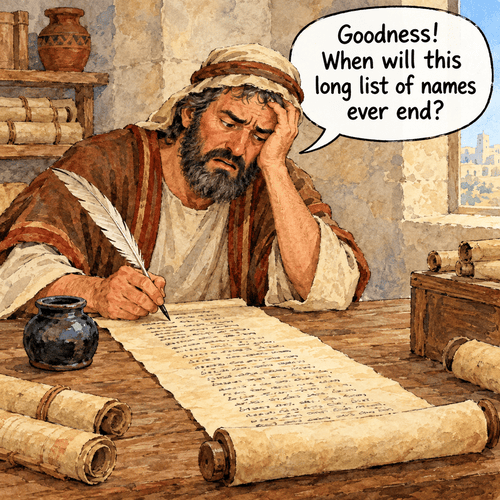
Think of a book with a long list of names.
1 Chronicles opens with 9 chapters of them. Adam. Seth. Enosh. Hundreds more. No miracles. No battles. Just names. This is where most Bible reading plans quietly lose people.
But those lists aren’t filler. They’re a search party. The book is hunting for somebody—a King who never dies and a Priest who never fails—and it never finds Him. It’s still looking when it ends.
That’s not a weakness in the book. That’s the message. 1 Chronicles is a question mark. Jesus is where that long list is pointing to.
Jesus in the Old Testament — Book 13 of 39
This post is the thirteenth instalment in our series tracing Christ through every book of the Old Testament. See the full series index.
A book written by people who had no king
To read this book well, we need to know who read it first.
The word exile describes what happened in 586 BC. The army of Babylon burned Jerusalem, destroyed the temple and carried the people away. The kingdom of David stopped. 50 years later Persia let the people go home. They rebuilt the temple. They didn’t crown a king. They were a small, poor community living under a foreign empire.
Chronicles was written for those people, around 450 to 400 BC. The author never gives his name, so writers call him the Chronicler. He covers much of the same history as Samuel and Kings, but he chooses his material with great care.
Now think about what that means. A man living in a land with no throne keeps insisting David’s throne will last for ever. He isn’t being sentimental about the past. He’s pointing his readers towards the future.
ONE WORD YOU WILL NEED: “TYPE”
A type is a real person, place or event in the Old Testament that God designed in advance as a preview of Christ. A type isn’t a secret code for clever readers to crack. It’s a shadow, and a shadow is always cast by something solid.
David was a real king with a real throne, a real army and a real grave. He was also a preview. The preview was always smaller than the person it advertised.
The promise that had its warning removed
The heart of the book is Chapter 17. David wants to build a house for God. God replies He will build a house—a family, a dynasty—for David instead.
That promise first appears in 2 Samuel 7. Chronicles repeats it, but with two changes. In a writer this careful, small changes are never small.
Table 1: Two changes the Chronicler makes when he retells God’s promise to David
| GOD’S PROMISE IN 2 SAMUEL 7 | THE SAME PROMISE IN 1 CHRONICLES 17 | WHY THE CHANGE MATTERS |
|---|---|---|
| “When he commits iniquity, I will discipline him with the rod of men” (2 Samuel 7:14) | The sentence about sin is gone. The promise now reads: “I will be to him a father, and he shall be to me a son” (1 Chronicles 17:13) | The promised son is no longer described as a sinner who will need correction |
| “your house and your kingdom” (2 Samuel 7:16) | “I will confirm him in my house and in my kingdom for ever” (1 Chronicles 17:14) | The son doesn’t merely rule Israel. He rules inside God’s own house and God’s own kingdom |
Then turn to Hebrews 1:5. When the New Testament sets out to prove Jesus is greater than the angels, it reaches for this very promise—a father and a son—and applies it to Christ. The apostles didn’t invent that link. They read the promise the way the Chronicler had already shaped it.
Why the promised son can’t be Solomon
The obvious candidate is Solomon. He was David’s son, and he built the temple. But he can’t be the final answer, and the first readers knew it better than we do.
- His kingdom split. Within one generation of his death, the nation tore in two.
- His line lost the throne. By the time Chronicles was written, no descendant of David had ruled for more than a century.
- He sinned—and everybody knew it. Nehemiah, writing in the same period, asks his people a blunt question: “Didn’t Solomon king of Israel sin on account of such women?” (Nehemiah 13:26).
So the first readers were holding a book that promised a son who’d never need correcting, in a country where every king had failed and every king had died. The promise had outlived every man who might have fulfilled it. It was waiting for somebody else.
A throne that belongs to God
Chronicles then says something we won’t find stated quite so plainly anywhere else in the Old Testament. It calls David’s throne God’s throne.
“the throne of the kingdom of the LORD over Israel” (1 Chronicles 28:5)
“Then Solomon sat on the throne of the LORD as king in place of David his father” (1 Chronicles 29:23)
The king of Israel is a caretaker. The chair was never his.
Now listen to Peter preaching in Jerusalem 7 weeks after the crucifixion. He says David knew God had sworn to seat one of his descendants on that throne, and that David was speaking about the resurrection of Christ (Acts 2:30–31). The caretaker’s chair is filled at last by its owner, because the Son of David turns out to be the Son of God (Revelation 3:21).
Timeline: how the promise travelled
- About 1000 BC—God promises David a son whose throne will never end.
- 586 BC—Jerusalem falls. The last king of David’s line is taken away in chains.
- 538 BC—Cyrus of Persia lets the people go home. The temple is rebuilt. No king is crowned.
- About 450–400 BC—Chronicles is written. David’s family line is still being traced, name by name.
- About 5 BC—An angel tells a young woman in Nazareth that God will give her son the throne of his father David (Luke 1:32–33).
The family tree that refuses to stop
Chapter 3 lists David’s descendants. And it doesn’t stop at the exile. It runs on past Jehoiachin, the king dragged to Babylon, past Zerubbabel who led the rebuilding, and on for several more generations (1 Chronicles 3:17–24).
Ask why anybody would bother. Nobody keeps careful records of a royal family with no future. The Chronicler tracks that line because he believes the promise is still alive and the next name still matters.
Matthew agrees. When he opens his Gospel he walks the same line—David, Jehoiachin, Zerubbabel—down to Joseph, the husband of Mary (Matthew 1:12–16).
From Adam to the Messiah
The genealogies aren’t a random pile of names. Watch 4 deliberate choices.
- They begin at Adam. The first word of the book is a name, and the name is Adam (1:1). Chronicles doesn’t start with Israel; it starts with the human race. Luke ends his family tree of Jesus in the same place (Luke 3:38), and Paul calls Jesus the last Adam (1 Corinthians 15:45). The problem Jesus came to solve is as old as the first man.
- They include the nations. Chapter 1 sweeps in the peoples of the whole world, not only the chosen family. The book hunting for Israel’s king keeps one eye on everybody else.
- They put Judah first and give him the most room. Judah wasn’t the eldest son, and Chronicles explains why he leads anyway: “Judah became strong among his brothers and a chief came from him” (5:2). That echoes the ancient promise that the ruler’s staff would stay with Judah (Genesis 49:10).
- They keep the awkward names. Tamar (2:4) and Bath-shua (3:5) stand in the royal line, and so does Boaz (2:11–12), whose wife Ruth was a foreigner. Matthew keeps those names too. This family runs on grace, not on respectability.
The last book in the Hebrew Bible
In the Hebrew order of the Old Testament, Chronicles comes last. That detail has teeth.
Jesus once summed up every murdered messenger of the Old Testament as running “from the blood of righteous Abel to the blood of Zechariah” (Matthew 23:35). Abel dies in Genesis, the first book. Zechariah dies in 2 Chronicles 24, the last one. Jesus was saying: from the first page to the last. His Bible ended here.
And how does it end? With a Persian king giving permission to go up and build God’s house (2 Chronicles 36:23). No son of David on a throne. No finished temple. The Old Testament stops in the middle of a sentence, waiting for a page Chronicles could not write. Jerome, who translated the Bible into Latin, called Chronicles a summary of the whole Old Testament; it is a summary that ends by pointing forward.
The threshing floor where the sword went back in
Chapter 21 is the hinge of the book. David counts his fighting men, an act of pride and unbelief. A plague follows. Then David looks up and sees the angel of the LORD standing between earth and heaven with a drawn sword stretched out over Jerusalem.
Watch what happens next, step by step. Every step is a door into the gospel.
- A shepherd offers to take the blow. David cries out, “let your hand, O LORD my God, be against me and against my father’s house. But do not let the plague be on your people” (21:17). He asks for the punishment to land on him instead of on the flock. Jesus said the good shepherd lays down his life for the sheep (John 10:11). David offered. Jesus paid.
- A sacrifice that costs. Ornan offers his threshing floor free of charge. David refuses: he will not “offer burnt offerings that cost me nothing” (21:24). Forgiveness is never cheap. Peter says we were bought with the precious blood of Christ, not with silver or gold (1 Peter 1:18–19).
- Fire from heaven. God answers David by sending fire on the altar (21:26). The fire is God’s public receipt. The sacrifice has been accepted.
- The sword is put away. “Then the LORD commanded the angel, and he put his sword back into its sheath” (21:27). Judgement does not stop because God changed his mind. It stops on the far side of a sacrifice.
- And the place becomes the temple. David announces that this spot is where the house of God will stand (22:1). Later we are told exactly where that was: Mount Moriah (2 Chronicles 3:1).
WHY MOUNT MORIAH KEEPS APPEARING
Genesis 22—On a mountain in the land of Moriah, Abraham raises a knife over Isaac. A ram dies instead of the boy.
1 Chronicles 21—On the threshing floor that will become that mountain’s temple, an angel holds a sword over the city. A sacrifice is offered, and the sword goes away.
The temple years—On the same hill, priests kill animals every morning and evening for centuries. The sword stays sheathed.
Outside the same city—Jesus is crucified outside the gate (Hebrews 13:12), and the sacrifices stop, because the substitute has come.
The pattern never changes: a substitute dies, and the one who deserved to die walks home alive.
A king dressed in priest’s clothing
1 Chronicles gives more space to worship than to war. David brings the ark—the gold chest that marked God’s presence—into Jerusalem, and something odd happens to his clothes: “David also wore a linen ephod” (15:27). An ephod was priest’s clothing. Then David blesses the people in the name of the LORD and hands bread and meat to every person there (16:2–3).
Israel’s law kept king and priest firmly apart, and Chronicles later records what happened to a king who pushed his way into the priest’s work (2 Chronicles 26:16–21). So David is not stealing the priesthood. He is casting a shadow. In his own psalm he sings of a king who is also “a priest for ever after the order of Melchizedek” (Psalm 110:4). Hebrews names that man: Jesus, who holds both offices by right and holds them permanently because he never dies (Hebrews 7:23–25).
David also hands Israel a song (16:8–36), stitched together from what we now number as Psalms 105, 96 and 106, and it calls the nations to come and worship. Centuries later, Hebrews pictures Jesus singing God’s praise at the head of the congregation (Hebrews 2:12). David organised the choir. Jesus stands at the front of it.
Table 2: 4 offices David fills in 1 Chronicles—and how Jesus fills each one permanently
| WHAT DAVID DOES | WHERE IN 1 CHRONICLES | HOW JESUS COMPLETES IT |
|---|---|---|
| Rules as king over God’s people | Chapters 11–12; 17:14 | Seated on the throne of God, ruling for ever (Acts 2:30–36) |
| Wears the ephod, blesses the people, gives out bread | 15:27; 16:2–3 | Our priest for ever, who blesses and feeds his people (Hebrews 7:23–25) |
| Offers a sacrifice that stops the plague | 21:24–27 | Offers himself once for all and ends the judgement (Hebrews 9:26) |
| Leads the singing and prepares the temple | 16:8–36; 22:5 | Leads his people’s praise and is himself the true temple (Hebrews 2:12; John 2:19–21) |
Three quieter echoes
Some links in Chronicles are loud. Others are quieter, but still worth hearing as long as we hold them loosely.
- “We are your bone and flesh” (11:1). The tribes crown David by claiming him as family. Hebrews says Jesus shared our flesh and blood so that he could call us brothers and rescue us (Hebrews 2:14–17).
- The water from Bethlehem (11:15–19). 3 soldiers break through enemy lines to fetch David a drink from the well at Bethlehem. He will not touch it: “Shall I drink the lifeblood of these men?” The greater King born in Bethlehem spends nobody’s blood but his own.
- “Yours is the kingdom” (29:11). David’s last recorded prayer of praise gives God the kingdom, the power and the glory. Many readers meet those words for the first time at the close of the Lord’s Prayer.
TWO KINDS OF LINK, AND WHY THE DIFFERENCE MATTERS
A type is a connection the New Testament itself makes, or one the Old Testament sets up on purpose. Hebrews 1:5 quoting God’s promise to David is a type. You can build your faith on it.
An echo is a family resemblance—the same God working in the same way, so the stories rhyme. Echoes are worth noticing and worth preaching warmly. They’re not a place to build doctrine.
Keeping the two apart is what stops Bible reading from becoming guesswork.
Is this a fair way to read the book?
Some scholars say it’s not. Sara Japhet, a writer on Chronicles, argues the book is concerned with Israel as God’s kingdom in its own present, and not with a coming messiah at all.
That deserves a straight answer, and here it is in four parts.
- The text itself was edited in that direction. The sin clause is removed and the kingdom becomes God’s own (17:13–14). Those are the writer’s choices, not ours.
- The timing makes any other reading strange. A promise of an everlasting throne, written down and circulated when no son of David ruled anything, is a promise about the future by definition.
- The family tree keeps running. You don’t track a royal line for generations after the crown is gone unless you expect the line to matter again (3:17–24).
- The earliest readers agreed. Matthew, Luke, Peter and the writer to the Hebrews all treat this promise as unfinished business that Jesus finishes. HGM Williamson and Martin J Selman both find a living royal hope inside Chronicles, and Richard L Pratt Jr reads the whole book as shaping the returned community’s hope around God’s word to David.
One rule keeps this kind of reading honest. We let the New Testament show us which links are real instead of inventing our own; Jesus Himself walked 2 disciples through Moses and all the Prophets and showed them the things concerning Himself (Luke 24:27).
That’s why the Westminster Confession reminds us the old covenant was administered through promises, prophecies, sacrifices and types, all pointing forward to Christ. Types were God’s idea long before they were ours.
Why this matters on a weekday
If you’ve ever wondered whether God forgets, look again at those 9 chapters of names. Most of those people are remembered by nobody on earth, and God’s promise travelled safely through every one of them—through bad kings, civil war, invasion and exile—and arrived on time in Bethlehem.
Your hope doesn’t rest on your record either. David’s household needed a substitute at the threshing floor, and so do you. The sword goes back into its sheath for one reason only: a sacrifice has been accepted.
So the lists deserve our patience. They’re the road Jesus travelled to reach us.
Tough Questions, Honest Answers
Did God or Satan push David into counting the army?
2 Samuel 24:1 says the LORD incited David; 1 Chronicles 21:1 says Satan did. Both statements are true, because they describe different levels of the same event. Satan acted out of malice, aiming to ruin David and his people. God permitted and governed that act for his own holy purposes, exactly as he did with Job (Job 1–2) and, supremely, at the cross, where wicked men did what God’s hand had planned beforehand (Acts 2:23; 4:27–28). God never does evil and never needs to; he rules over it. And David is still fully responsible, which is why he confesses, “I have sinned greatly” (1 Chronicles 21:8).
Why does 1 Chronicles leave out David’s failures with Bathsheba?
It is not a cover-up. The full account sits in 2 Samuel 11–12, in the same Bible, and the Chronicler assumes his readers know Samuel and Kings well. Every biblical writer selects; John says plainly that the world could not hold the books if everything were written down (John 21:25). The Chronicler is writing to a discouraged community that needs to know God kept his covenant and how worship should be ordered, so he follows the covenant line rather than the scandal. He is not painting David as faultless either, since he records the census disaster in chapter 21 and the death of Uzzah in chapter 13. Silence with a purpose isn’t the same as dishonesty.
Is the prayer of Jabez a formula for blessing?
Jabez prayed for blessing and for enlarged borders, and God granted his request (1 Chronicles 4:9–10). That is a genuine answered prayer, and it is a lovely encouragement: a man named for pain was not defined by it. But the verse is a report, not a promise. Nowhere does Scripture attach a guarantee to repeating his words, and treating them as a formula turns prayer into a technique and God into a machine. Pray boldly for God’s blessing on your life and work, and then say what Jesus taught us to say: your will be done.
Does the curse on Jeconiah disqualify Jesus from David’s throne?
Jeremiah 22:30 says none of Jeconiah’s offspring would succeed in sitting on David’s throne, and Matthew traces Joseph’s line straight through him (Matthew 1:11–12; 1 Chronicles 3:17). Two answers are usually given, and they fit together. First, God later lifted that judgement: through Haggai he tells Zerubbabel, Jeconiah’s grandson, that he will make him like a signet ring, reversing the very image Jeremiah had used (Haggai 2:23; Jeremiah 22:24). Second, Jesus receives the legal right to the throne through Joseph, his adoptive father, while Luke’s genealogy is widely understood to follow Mary’s descent. Either way, his title is finally settled not by paperwork but by resurrection (Acts 2:30–36).
Why do some numbers in Chronicles differ from Samuel and Kings?
The census totals differ (1 Chronicles 21:5; 2 Samuel 24:9), and so does the price paid for the threshing floor: six hundred shekels of gold for the site in Chronicles, fifty shekels of silver in Samuel (1 Chronicles 21:25; 2 Samuel 24:24). Some differences are about scope, since Chronicles speaks of buying the whole site while Samuel speaks of the floor and the oxen. Others involve different units or rounded totals. And some are almost certainly copying slips, because numbers are the easiest thing in any manuscript to miscopy, which is why ancient copies sometimes disagree at exactly these points. Christians confess that God’s Word was without error as it was originally given; copying is a human task that God has still overseen remarkably well. No disputed figure touches any doctrine.
Who wrote 1 Chronicles, and when?
The book never names its author, so honesty requires us to say we do not know. Jewish tradition preserved in the Talmud links it with Ezra, and the book’s interests—temple, priests, Levites, genealogies—fit a scribe of that kind. Most place it between about 450 and 400 BC, after the return from exile, since the family list in chapter 3 runs several generations past Zerubbabel. In Hebrew, 1 and 2 Chronicles were a single book; they were divided when the Old Testament was translated into Greek. Its authority never rested on a famous name but on the God who breathed it out.
Why does Matthew’s family tree skip names that 1 Chronicles includes?
Matthew omits 3 kings between Joram and Uzziah—Ahaziah, Joash and Amaziah—who all appear in 1 Chronicles 3:11–12. This isn’t an error but an ancient convention: genealogies traced descent rather than listing every generation, and the phrase “father of” could mean ancestor. Matthew tells us openly what he’s doing, arranging the list into 3 groups of 14 (Matthew 1:17). 1 Chronicles gives us the full record; Matthew gives us the shape of it. They’re doing different jobs, and neither is being careless.
Related Reads
- Jesus in the Old Testament: Where He Appears In All 39 Books
- Jesus in 2 Kings: 7 Ways the Book Points to Christ
- Jesus in 2 Samuel: The King Whose Throne Lasts Forever
- Shepherd-King: How David Is a Type of Christ
- Mystery Man Melchizedek: How Does He Foreshadow Christ?
- Where Is Jesus in 2 Chronicles? 10 Clear Signposts
- Who Incited David’s Census: God or Satan?
- Kings vs Chronicles: Why Does the Bible Tell Israel’s Story Twice?